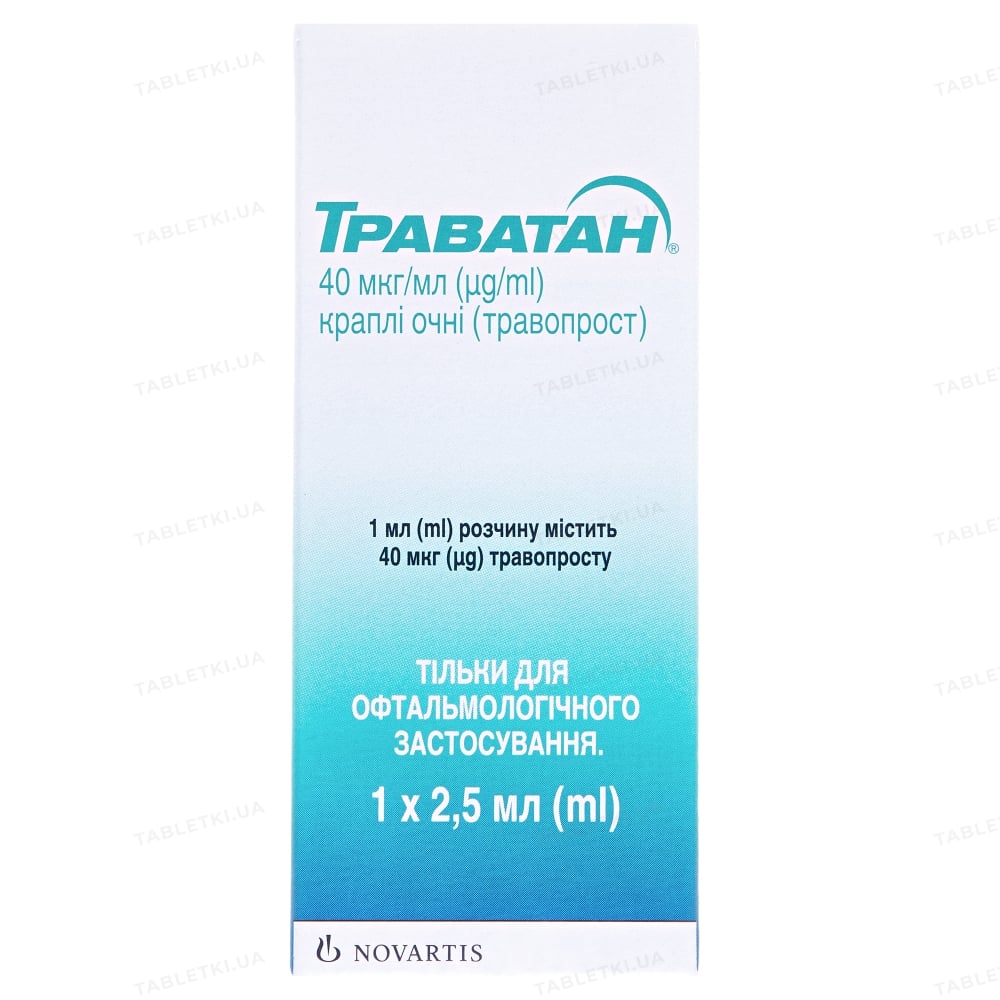
Travatan Eye Drops, 40 mcg/mL, 2.5 mL per bottle.
Composition
Active ingredient: travoprost; 1 mL of solution contains 40 μg of travoprost;
excipients: polyquat, polyethoxylated hydrogenated castor oil, boric acid, mannitol (E 421), sodium chloride, propylene glycol, sodium hydroxide and/or concentrated hydrochloric acid (for pH adjustment), purified water.
Dosage form
Eye drops.
Main physical and chemical properties: a clear solution ranging from colorless to pale yellow.
Pharmacotherapeutic group
Ophthalmic preparations. Antiglaucoma agents and miotics. Prostaglandin analogs. ATC code S01E E04.
Pharmacological properties
Pharmacodynamics.
Mechanism of action
Travoprost, a prostaglandin F2α analog, is a full selective agonist that exhibits a high degree of affinity for prostaglandin FP receptors; It reduces intraocular pressure by increasing the outflow of aqueous humor through the trabecular meshwork and the uveoscleral pathway. The reduction in intraocular pressure in humans begins approximately 2 hours after administration, and the maximum effect is achieved after 12 hours. A significant reduction in intraocular pressure following a single dose may persist for more than 24 hours.
Clinical Efficacy and Safety
Clinical studies of Travatan® (containing polyquad as a preservative) in patients with open-angle glaucoma or ocular hypertension, who used the medication once daily in the evening, demonstrated a reduction in intraocular pressure of 8–9 mm Hg (approximately 33%) from a baseline of 24–26 mm Hg. Data on the use of Travatan® in combination with 0.5% timolol and limited data on its use in combination with brimonidine 0.2% were obtained from clinical studies, which demonstrated an additive effect of Travatan® when used with these antiglaucoma medications. There are no clinical data regarding its concomitant use with other ophthalmic hypotensive medications.
Secondary Pharmacology
Travoprost significantly increased blood flow to the optic disc in rabbits after 7 days of topical application to the eye (1.4 micrograms once daily).
Travatan® with the preservative polyquad caused minimal toxic effects on the ocular surface in human corneal cell cultures and following topical ocular administration in rabbits compared to eye drops containing benzalkonium chloride as a preservative.
Children
The efficacy of Travatan® in children aged 2 months to 18 years was demonstrated in a 12-week double-blind clinical trial of travoprost compared with timolol in 152 patients diagnosed with ocular hypertension or pediatric glaucoma. Patients received either travoprost 0.004% once daily or timolol 0.5% (or 0.25% for patients under 3 years of age) twice daily. The primary efficacy endpoint was the change in intraocular pressure (IOP) at 12 weeks relative to baseline. The mean reductions in IOP in the travoprost and timolol groups were similar (see Table 1).
In the age groups 3 to 12 years (n=36) and 12 to 18 years (n=26), the mean IOP reduction in the travoprost group after 12 weeks was similar to that in the timolol group. After 12 weeks, the mean IOP reduction in the 2-month-to-3-year-old age group treated with travoprost was 1.8 mmHg, compared with 7.3 mmHg in the group treated with timolol. In the timolol group, the IOP reduction was based on data from only 6 patients, compared with 9 patients in the travoprost group. In 4 patients in the travoprost group, compared with 0 patients in the timolol group, there was no relevant reduction in the mean IOP after 12 weeks. Data for children under 2 months of age are not available.
The IOP-lowering effect was observed after the second week of treatment and was consistently maintained throughout the 12-week study in all age groups.
Table 1
Comparison of the change in mean IOP from baseline (mm Hg) at 12 weeks
|
N |
Travoprost, mean
(SD) |
N |
Timolol,
mean value (SP) |
Mean difference a |
(95% CI) |
| 53 |
(1.05) |
60 |
(0.96) |
|
(-2.1, 1.0) |
| SE – standard error; CI – confidence interval.
a Mean difference when using travoprost/timolol. The estimate is based on least-squares means (standardized means) obtained using a statistical model that includes correlated IOP measurements from a single patient (initial diagnosis and baseline IOP were taken into account). |
|||||
Preclinical Safety Data
In ophthalmic toxicity studies in monkeys, administration of travoprost at a dose of 0.45 μg twice daily caused an increase in the palpebral fissure width. Topical application of travoprost to the right eye of monkeys at concentrations up to 0.012% twice daily for 1 year did not result in systemic toxicity.
Studies of reproductive toxicity were conducted in rats, mice, and rabbits following systemic administration. The results pertain to the activity of the FP receptor agonist in the uterus, associated with early embryonic mortality, post-implantation loss, and fetal toxicity. In pregnant rats, systemic administration of travoprost at doses 200 times higher than the therapeutic dose during the organogenesis period resulted in an increase in the number of developmental defects. Low levels of radioactivity were measured in the amniotic fluid and fetal tissues of pregnant female rats administered 3H-travoprost. Studies of reproductive function and fetal development revealed an increased risk of fetal loss, with a high percentage of cases in female rats and mice (180 pg/mL and 30 pg/mL in blood plasma, respectively) at doses 1.2–6 times higher than the therapeutic dose (up to 25 pg/mL).
Pharmacokinetics.
Absorption
Travoprost belongs to the class of ester prodrugs. It is absorbed through the cornea, where the isopropyl ester is hydrolyzed to the active free acid. Studies in rabbits have shown that peak concentrations of 20 ng/mL of free acid in the aqueous humor are reached 1–2 hours after topical administration of Travatan®. Concentrations of the active ingredient in the intraocular fluid decline with a half-life of approximately 1.5 hours.
Distribution
After instillation of Travatan® into the eyes of healthy volunteers, minimal systemic exposure to the active free acid was observed. Peak concentrations of free active acid in plasma were observed 10–30 minutes after administration, at levels of 25 pg/mL or less. Thus, plasma levels of the substance rapidly decline within 1 hour after administration to a level below the limit of quantification of 10 pg/mL. Due to low plasma concentrations and rapid elimination following topical application, the half-life of free active acid in humans has not been determined.
Metabolism
Metabolism is the primary route of elimination for both travoprost and the active free acid. The systemic metabolic pathways are parallel to those of endogenous prostaglandin F2α, characterized by the reduction of the 13,14 double bond, oxidation of the 15-hydroxyl group, and β-oxidative cleavage of the upper side chain.
Excretion
The free acid form of travoprost and its metabolites are primarily excreted by the kidneys. The effects of Travatan® have been studied in patients with hepatic impairment (ranging from mild to severe), as well as in patients with renal impairment (ranging from mild to severe) (creatinine clearance less than 14 mL/min). No dose adjustment is necessary for these patients.
Children
A pharmacokinetic study in children aged 2 months to 18 years following administration of travoprost demonstrated very low concentrations of free acid in plasma, ranging from less than 10 pg/mL to 54.5 pg/mL, i.e., below the limit of quantification. In 4 previous systemic pharmacokinetic studies in adults, the concentration of free acid in plasma following administration of travoprost ranged from below the limit of quantification to 52.0 pg/mL. While most of the data showed plasma concentrations below the limit of quantification throughout all studies, thereby making statistical comparisons of systemic exposure across all age groups impossible, the overall trend indicates that following topical administration of Travatan®, the concentration of free acid in plasma is very low in all age groups evaluated.
Indications
For the reduction of elevated intraocular pressure in patients with ocular hypertension or open-angle glaucoma.
To reduce elevated intraocular pressure in children aged 2 months to 18 years with ocular hypertension or pediatric glaucoma.
Contraindications
Hypersensitivity to the active ingredient or to any other components of the drug.
Interactions with Other Medications and Other Types of Interactions
No studies on interactions with other medications have been conducted.
Specific in vitro interaction studies were conducted using Travatan® and medications containing thiomersal. No evidence of precipitation was observed.
Special Considerations for Use
Eye Color Change
Travatan® may gradually change eye color by increasing the number of melanosomes (pigment granules) in melanocytes. Before starting treatment, patients should be informed of the possibility of irreversible eye color change. Treatment of one eye may lead to irreversible heterochromia. The long-term effects and consequences of prolonged exposure to melanocytes are currently unknown. The change in iris color occurs slowly and may be imperceptible for months or even years. Eye color changes have primarily been observed in patients with mixed iris colors, such as blue-brown, gray-brown, yellow-brown, and green-brown; however, this phenomenon has also been observed in patients with brown eyes. Typically, brown pigmentation around the pupil spreads concentrically toward the periphery of the iris of the affected eye; however, the entire iris or parts of it may take on a more intense brown color. After discontinuation of treatment, no further increase in brown pigmentation in the iris was observed.
Changes in the Skin of the Eyelids and Periorbital Area
In controlled clinical trials, 0.4% of patients reported darkening of the eyelid skin and/or the periorbital area associated with the use of Travatan®.
Changes in the periorbital area and eyelid skin, including deepening of the eyelid crease, have been observed with the use of prostaglandin analogs.
Travatan® may gradually alter the structure of the eyelashes in the eye(s) to which it is applied; in clinical studies, such changes were observed in approximately half of the patients and included an increase in the length, thickness, pigmentation, and/or number of eyelashes. The mechanism underlying these changes in eyelash structure and the long-term consequences of this effect are currently unknown.
As demonstrated in studies conducted on monkeys, Travatan® causes a slight widening of the palpebral fissure. However, this effect was not observed in clinical trials and is considered species-specific.
There is no experience with the use of Travatan® in inflammatory eye diseases, neovascular glaucoma, angle-closure glaucoma, narrow-angle glaucoma, or congenital glaucoma, and there is only limited experience with its use in eye diseases caused by thyroid dysfunction, in open-angle glaucoma in patients with pseudophakia, or in pigmentary or pseudoexfoliative glaucoma. Therefore, Travatan® should be prescribed with caution to patients with active signs of eye infection.
Patients with aphakia
Cases of macular edema have been reported during treatment with prostaglandin F2α analogs.
It is recommended to use Travatan® with caution in patients with aphakia, pseudophakia, and a torn posterior lens capsule or anterior chamber lenses, or for the treatment of patients with known risk factors for cystoid macular edema.
Iritis/Uveitis
Travatan® should be prescribed with caution to patients with known risk factors for iritis/uveitis.
Skin Contact
Contact of Travatan® with the skin should be avoided, as transdermal absorption of travoprost has been demonstrated in studies on rabbits.
Prostaglandins and their analogs are biologically active substances that can be absorbed through the skin. Therefore, pregnant women or women planning to become pregnant should take appropriate precautions to prevent direct contact with the contents of the bottle. If a significant amount of the vial’s contents comes into contact with the skin accidentally, the affected area must be thoroughly cleaned immediately.
Contact Lenses
Patients should be informed that they must remove their contact lenses before instilling Travatan® and that they must wait 15 minutes after instillation before reinserting their contact lenses.
Excipients
Travatan® contains propylene glycol, which may cause skin irritation.
Travatan® contains polyethoxylated hydrogenated castor oil 40, which may cause skin reactions.
Children
Data on the efficacy and safety of the drug in patients aged 2 months to 3 years (9 patients) are limited (see the “Pharmacological Properties” section). No data are available for children under 2 months of age.
For children under 3 years of age with primary congenital glaucoma, surgical procedures (e.g., trabeculectomy/goniotomy) remain the first-line treatment.
There are no data from long-term studies on the safety of use in children.
Use during pregnancy or breastfeeding.
Women of Reproductive Age/Contraception
Travatan® should not be used by women of reproductive age who are not using contraception (see the “Pharmacological Properties” section).
Pregnancy
Travoprost has adverse pharmacological effects on pregnant women and/or the fetus/newborn. Travatan® should not be used during pregnancy unless clearly necessary.
Breastfeeding
It is unknown whether travoprost from eye drops passes into breast milk. Animal studies have shown that travoprost and its metabolites can pass into breast milk; therefore, the use of Travatan® during breastfeeding is not recommended.
Reproductive function
There are no data on the effect of Travatan® on human reproductive function. Animal studies have demonstrated that travoprost, at a dose 250 times higher than the maximum recommended dose for ophthalmic use, does not have a harmful effect on reproductive function.
Effect on the ability to drive or operate machinery
Travatan® has no or negligible effect on the ability to drive or operate machinery; however, as with any eye drops, temporary blurred vision or other visual disturbances may affect the ability to drive or operate machinery. If blurred vision occurs during instillation, the patient should wait until vision clears before driving or operating machinery.
Directions for Use and Dosage
For ophthalmic use.
Use for the treatment of adults, including elderly patients
Administer 1 drop of Travatan® into the conjunctival sac(s) of the affected eye(s) once daily. Optimal effect is achieved when the dose is administered in the evening.
After instillation, it is recommended to pinch the nasolacrimal duct or gently close the eyelids. This reduces systemic absorption of the medication administered to the eye, which may lower the likelihood of systemic side effects.
If more than one topical ophthalmic medication is used, the interval between applications should be at least 5 minutes (see the section “Interactions with Other Medications and Other Types of Interactions”).
If a dose is missed, treatment should continue with the next scheduled dose. The dose should not exceed one drop in the affected eye(s) once daily.
If switching from another ophthalmic antiglaucoma medication to Travatan®, discontinue the other medication and begin using Travatan® the following day.
Use in Patients with Impaired Liver or Kidney Function
The use of Travatan® has been studied in patients with hepatic impairment (ranging from mild to severe) as well as in patients with renal impairment (ranging from mild to severe) (creatinine clearance below 14 mL/min). No dose adjustment is necessary for these patients (see the “Pharmacological Properties” section).
For patients who wear contact lenses, see the “Special Instructions for Use” section.
Patients should be advised to tear open the outer protective packaging of the dropper bottle immediately before the first use. To prevent contamination of the dropper tip and the contents of the bottle, take care not to touch the eyelids, surrounding areas, or other surfaces with the tip of the dropper bottle.
Children. Travatan® may be used in children aged 2 months to 18 years according to the same dosing regimen as for adults. However, data for the age group from 2 months to 3 years (9 patients) are limited (see the “Pharmacological Properties” section).
The safety and efficacy of Travatan® in children under 2 months of age have not been established. No data are available.
Children
Travatan® may be used in children aged 2 months to 18 years according to the same dosing regimen as for adults. However, data for the age group from 2 months to 3 years (9 patients) are limited (see the “Pharmacological Properties” section).
The safety and efficacy of Travatan® in children under 2 months of age have not been established. No data are available.
Overdose
No cases of overdose have been reported. Topical overdose is unlikely to cause or be associated with toxic effects. In the event of a topical overdose with Travatan®, rinse the eye(s) with warm water. In case of accidental ingestion, symptomatic and supportive therapy should be provided.
Side Effects
Brief overview of safety data.
The most common adverse reactions observed during clinical trials of Travatan® were ocular hyperemia and iris hyperpigmentation, which occurred in approximately 20% and 6% of patients, respectively.
The list of adverse reactions is presented in Table 2.
The adverse reactions listed below were classified as follows: very common (≥ 1/10), common (≥ 1/100 to < 1/10), uncommon (≥ 1/1,000 to < 1/100), very rare (≥ 1/10,000 to < 1/1,000), rare (< 1/10,000), or frequency unknown (the frequency cannot be estimated from the available data). Within each group, adverse reactions are listed in order of decreasing severity. Data on adverse reactions were obtained during clinical trials and during the postmarketing period of Travatan® use.
Table 2
| Organ System | Frequency | Adverse Reactions |
| Immune system | Uncommon | Hypersensitivity, seasonal allergies |
| Psychiatric disorders | Frequency unknown | depression, anxiety, insomnia |
| Nervous system | Uncommon
Rare |
Headache
dizziness, visual field disturbances, dysgeusia |
| Ophthalmological disorders
|
Very common
Common
Uncommon
Rare
Frequency unknown
|
Eye redness
Iris hyperpigmentation, eye pain, eye discomfort, dry eyes, itchy eyes, eye irritation
corneal erosion, uveitis, iritis, inflammation of the anterior chamber, keratitis, punctate keratitis, photophobia, eye discharge, blepharitis, eyelid erythema, periorbital edema, itchy eyelids, decreased visual acuity, blurred vision, increased tearing, conjunctivitis, ectropion, cataract, scaling along the eyelid margins, eyelash growth
iridocyclitis, herpes simplex, eye inflammation, photopsia, eyelid eczema, conjunctival edema, halos around light sources, conjunctival follicles, ocular hypoesthesia, trichiasis, meibomian gland inflammation, anterior chamber pigmentation, mydriasis, asthenopia, eyelash hyperpigmentation, thickening of the eyelashes
macular edema, periorbital pathology/deepening of the furrows around the eyelids |
| Ear and balance disorders | Frequency unknown | vertigo, tinnitus |
| Cardiac disorders | Uncommon
Rare
Frequency unknown |
rapid heartbeat
irregular heartbeat. decreased heart rate
chest pain, bradycardia, tachycardia, arrhythmia |
| Vascular system | Rare | decreased diastolic blood pressure, increased systolic blood pressure, hypotension, hypertension |
| Respiratory system, thoracic, and mediastinal disorders | Uncommon
Rare
Frequency unknown |
cough, nasal congestion, throat irritation
dyspnea, asthma, respiratory disorders, sore throat, dysphonia, allergic rhinitis, nasal dryness asthma exacerbation, nosebleeds |
| Gastrointestinal | Rare
Frequency unknown |
exacerbation of peptic ulcer, gastrointestinal disorders, constipation, dry mouth
diarrhea, stomach pain, nausea, vomiting |
| Skin and subcutaneous tissue disorders | Uncommon
Rare
Frequency unknown |
skin hyperpigmentation (around the eyes), skin depigmentation, hair structure abnormalities, hypertrichosis
allergic dermatitis, contact dermatitis, erythema, rash, hair discoloration, madarosis
Itching, abnormal hair growth |
| Musculoskeletal
Musculoskeletal system, connective tissue, and bones |
Rare
|
musculoskeletal pain, arthralgia
|
| Renal and urinary tract | Frequency unknown | dysuria, urinary incontinence |
| General disorders and administration site conditions | Rare | Asthenia |
| Laboratory tests | Frequency unknown | Elevated PSA (prostate-specific antigen) levels |
Children
Based on the results of a 3-month Phase 3 study and a 7-day pharmacokinetic study involving 102 children who received Travatan®, the type and characteristics of the adverse reactions reported were similar to those observed in adult patients. Short-term safety profiles in various subgroups of children were also similar to those in adults (see the “Pharmacological Properties” section). The most common adverse reactions reported in children were: ocular hyperemia (16.9%) and eyelash growth (6.5%). In a similar 3-month study in adult patients, these adverse reactions occurred at a frequency of 11.4% and 0.0%, respectively.
Additional adverse reactions reported in children participating in the 3-month study (n=77) included eyelid erythema, keratitis, increased lacrimation, and photophobia, and were recorded as isolated cases with an incidence of 1.3% compared with 0.0% observed in adult patients in a similar study (n=185).
Reporting of Suspected Adverse Reactions
It is important to report suspected adverse reactions after a drug has received marketing authorization. This allows for ongoing monitoring of the drug’s benefit-risk profile. Healthcare professionals are asked to report such adverse reactions in accordance with the law.
Shelf Life
2 years.
Shelf life after first opening the vial: 4 weeks.
Storage Conditions
No special storage conditions are required for this medication.
Packaging
2.5 mL in an oval dropper vial made of polypropylene or low-density polyethylene with a polypropylene cap. Each vial is packaged in a secondary container and placed in a cardboard box containing 1 or 3 vials. Not all package types may be available on the market.
Manufacturer
Alcon Couvreur
Address
Rijksweg 14, Puurs-Sint-Amands, 2870, Belgium.