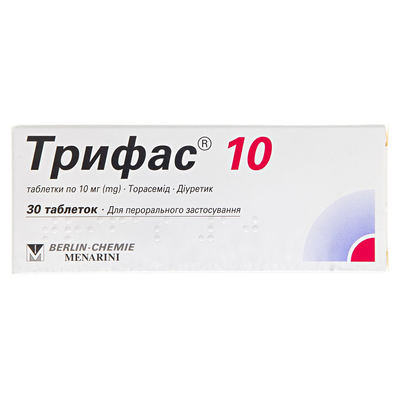

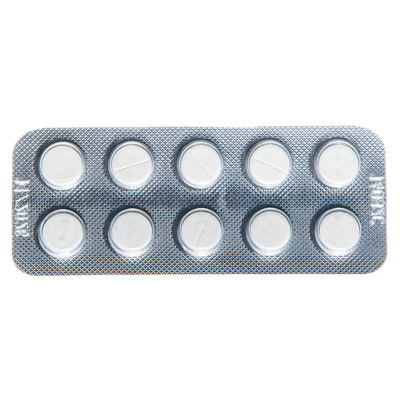
Trifas 10 tablets, 10 mg each, No. 30 (10×3)
Ingredients
Active ingredient: torasemide
Each tablet contains 10 mg of torasemide;
Inactive ingredients: lactose monohydrate, corn starch, colloidal anhydrous silicon dioxide, magnesium stearate.
Dosage Form
Tablets.
Main physical and chemical properties: white, round, flat tablets with beveled edges and a score line on one side. The tablet can be divided into two equal parts.
Pharmacotherapeutic group
Diuretics. Potent diuretics.
ATC code C03C A04.
Pharmacological properties
Pharmacodynamics.
Mechanism of action
Torasemide acts as a saluretic; its action is associated with the inhibition of renal reabsorption of sodium and chloride ions in the ascending limb of the loop of Henle.
Pharmacodynamic Effects
In humans, the diuretic effect rapidly reaches its peak within the first 2–3 hours after intravenous and oral administration, respectively, and remains constant for nearly 12 hours. In healthy volunteers, a dose-logarithm-proportional increase in diuresis (loop diuretic activity) was observed in the dose range of 5–100 mg. An increase in diuresis was observed in cases where other diuretics, such as thiazide-type distal-acting diuretics, no longer produced the desired effect, for example, in renal insufficiency. Through this mechanism of action, torasemide reduces edema. In cases of heart failure, torasemide alleviates symptoms and improves myocardial function by reducing preload and afterload.
Following oral administration, the antihypertensive effect of torasemide develops gradually, beginning in the first week after the start of treatment. The maximum antihypertensive effect is achieved no later than 12 weeks. Torasemide lowers blood pressure by reducing total peripheral vascular resistance. This effect is explained by the normalization of an impaired electrolyte balance, primarily by reducing the elevated activity of free calcium ions in the muscle cells of arterial blood vessels, as observed in patients with hypertension.
Presumably, this effect reduces increased contractility and/or vascular responses to endogenous vasopressors, such as catecholamines.
Pharmacokinetics.
Absorption and Distribution
Following oral administration, torasemide is rapidly and almost completely absorbed. Peak serum concentrations are reached within 1–2 hours. Bioavailability is approximately 80–90%. Assuming complete absorption, the maximum first-pass effect in the liver does not exceed 10–20%. According to data from two studies, food reduces the rate (kinetic component) of torasemide absorption (Cmax decreases and tmax increases), but does not affect total absorption. The plasma protein binding of torasemide is over 99%, while that of its metabolites M1, M3, and M5 is 86%, 95%, and 97%, respectively. The apparent volume of distribution (Vz) is 16 L.
Metabolism
In the human body, torasemide is metabolized to form three metabolites: M1, M3, and M5. There is no evidence of other metabolites. Metabolites M1 and M5 are formed as a result of the stepwise oxidation of the methyl group of the phenolic ring to a carboxylic acid. Metabolite M3 is formed as a result of the hydroxylation of the phenolic ring. Metabolites M2 and M4, which have been identified in animal studies, have not been detected in humans.
Elimination
The terminal half-life (t1/2) of torasemide and its metabolites in healthy volunteers is 3–4 hours. The total clearance of torasemide is 40 mL/min; renal clearance is approximately 10 mL/min. In healthy volunteers, approximately 80% of the administered dose is excreted as torasemide and its metabolites in the urine in the following proportions:
torasemide—approximately 24%, metabolite M1—approximately 12%, metabolite M3—approximately 3%, metabolite M5—approximately 41%. The major metabolite M5 has no diuretic effect. The active metabolites M1 and M3 together account for approximately 10% of the total pharmacokinetic effect. In renal insufficiency, the total clearance and half-life of torasemide remain unchanged, while the half-lives of M3 and M5 are prolonged. However, the pharmacodynamic profile remains unchanged. The severity of renal insufficiency does not affect the duration of action. Torasemide and its metabolites are practically not removed by hemodialysis or hemofiltration. In patients with impaired liver function or heart failure, the half-lives of torasemide and metabolite M5 are slightly prolonged. The ratio of unchanged torasemide to its metabolites excreted in the urine is virtually the same as in healthy volunteers. Therefore, no accumulation of torasemide or its metabolites occurs.
Linearity
Torasemide and its metabolites exhibit dose-dependent, linear kinetics. This means that its maximum plasma concentration and the area under the pharmacokinetic curve increase proportionally with the dose.
Indications
Treatment and prevention of recurrent edema and/or effusions caused by heart failure.
Contraindications
Hypersensitivity to the active ingredient, sulfonylurea drugs, or any of the drug’s excipients.
Renal failure with anuria.
Hepatic coma or precoma.
Hypotension.
Hypovolemia.
Hyponatremia.
Hypokalemia.
Significant urinary retention, for example, due to prostatic hypertrophy. Breastfeeding.
Interactions with other medications and other types of interactions
Combinations are not recommended
Torasemide, especially at high doses, may enhance the ototoxic and nephrotoxic effects of aminoglycoside antibiotics, such as kanamycin, gentamicin, tobramycin, and cytostatic agents—active platinum derivatives—as well as the nephrotoxic effects of cephalosporins. When torasemide is used concomitantly with lithium preparations, an increase in plasma lithium concentrations is possible, which may lead to an enhanced effect of lithium and the occurrence of adverse reactions.
Drug combinations requiring caution
Torasemide potentiates the effects of other antihypertensive agents, particularly angiotensin-converting enzyme (ACE) inhibitors, which may result in an excessive decrease in blood pressure when used concomitantly. When torasemide is used concomitantly with digitalis preparations, potassium deficiency caused by diuretics may lead to an increase in the side effects of both drugs. Torasemide may reduce the effectiveness of antidiabetic agents. Probenecid and nonsteroidal anti-inflammatory drugs (e.g., indomethacin, acetylsalicylic acid) may inhibit the diuretic and antihypertensive effects of torasemide. When used in combination with high-dose salicylates, torasemide may increase their toxic effects on the central nervous system. Torasemide may potentiate the effects of theophylline, as well as the muscle-relaxing effects of curare-like drugs. Laxatives, as well as mineralocorticoids and glucocorticoids, may increase the potassium loss caused by torasemide. Torasemide may reduce the vasoconstrictive effects of catecholamines, such as epinephrine and norepinephrine. When used concomitantly with cholestyramine, the absorption of torasemide may be reduced and, consequently, its expected efficacy may be diminished.
Special Considerations for Use
Torasemide should not be prescribed in the following cases:
- gout;
- cardiac arrhythmias (e.g., sinoatrial block, second- and third-degree atrioventricular block);
- abnormalities in acid-base metabolism;
- concomitant therapy with lithium, aminoglycosides, or cephalosporins;
- abnormal blood counts, such as thrombocytopenia or anemia in patients without renal insufficiency;
- impaired renal function caused by nephrotoxic substances;
- children and adolescents under 18 years of age.
Since treatment with torasemide may lead to an increase in blood glucose levels, patients with latent or overt diabetes mellitus should undergo regular monitoring of carbohydrate metabolism. Particular attention should be paid to the onset of symptoms of hemoconcentration and electrolyte depletion, especially at the start of treatment and when treating elderly patients. During long-term use of torasemide, regular monitoring of electrolyte balance—particularly serum potassium—is required. Blood glucose, uric acid, creatinine, and lipid levels should also be monitored regularly. In addition, a complete blood count (red blood cells, white blood cells, platelets) should be monitored regularly.
Consequences of Improper Use as a Doping Agent
Use of the drug Trifas® 10 may result in a positive doping test. It is impossible to predict the impact on health if Trifas® 10 is used improperly—that is, for doping purposes—and in such cases, harm to health cannot be ruled out.
Excipients
Trifas® 10 contains lactose; therefore, patients with rare hereditary disorders such as galactose intolerance, lactase deficiency, or glucose-galactose malabsorption should not take this medication.
Use During Pregnancy or Breastfeeding
Pregnancy. There are no reliable data on the effects of torasemide on pregnant women. Information is available regarding the reproductive toxicity of torasemide. Torasemide crosses the placental barrier. Trifas® 10 is not recommended for use during pregnancy or in women of childbearing age who are not using contraception. Therefore, torasemide should be used during pregnancy only when absolutely necessary and at the lowest effective dose. Diuretics are not suitable for the standard treatment of hypertension or edema in pregnant women, as they can reduce placental perfusion and have a toxic effect on fetal development. If torasemide is used to treat pregnant women with heart failure or renal insufficiency, careful monitoring of electrolyte levels and hematocrit, as well as fetal development, is necessary.
Lactation. It has not yet been established whether torasemide or its metabolites are excreted into breast milk in animals or humans. The risk associated with the use of this medication in newborns and infants cannot be ruled out. Therefore, the use of torasemide during lactation is contraindicated (see the “Contraindications” section). The decision to discontinue breastfeeding or to discontinue or suspend the use of Trifas® 10 should be made by weighing the benefits of breastfeeding for the infant against the benefits of treatment with the drug for the woman.
Fertility. No studies have been conducted on the effect of torasemide on fertility in humans. Animal studies have not revealed any such effect of torasemide.
Effect on Reaction Time When Driving or Operating Machinery
Even when used as directed, torasemide may adversely affect reaction time while driving or operating machinery. This applies particularly at the start of treatment, during dose escalation, when switching medications, when concomitant therapy is initiated, and when consuming alcohol. Therefore, special caution should be exercised when driving or operating machinery while taking torasemide.
Dosage and Administration
Edema and/or effusions caused by heart failure.
Adults.
Treatment should begin with a daily dose of 5 mg of torasemide, equivalent to ½ tablet of Trifas® 10. This dose is generally considered the maintenance dose.
The tablet can be divided into two parts as follows:
Hold the tablet between the index fingers and thumbs of both hands with the score line facing up, and, pressing down with your thumbs along the score line, break the tablet in half.
If the 5 mg daily dose is insufficient, a daily dose of 10 mg of torasemide is prescribed. Depending on the severity of the patient’s condition, the daily dose may be increased to 20 mg per day.
Special Patient Groups
Elderly patients. No special dose adjustment is required. However, no studies have been conducted comparing the drug’s effects in young and elderly patients.
Patients with hepatic insufficiency. Torasemide is contraindicated in patients with hepatic coma or precoma (see the “Contraindications” section). Treatment of this patient group should be conducted with caution, as plasma concentrations of torasemide may increase (see the “Pharmacokinetics” section).
Directions for Use
Take the tablets on an empty stomach with a small amount of liquid. The bioavailability of torasemide is not affected by food intake.
Trifas® 10 is usually administered over a prolonged period or until the severity of edema subsides.
Children
The safety and efficacy of Trifas® 10 in children and adolescents under 18 years of age have not been established. Therefore, torasemide should not be used in children and adolescents (under 18 years of age) (see the “Special Considerations” section).
Overdose
Symptoms of intoxication. Typical symptoms are unknown. Overdose may cause severe diuresis, including the risk of excessive water and electrolyte loss, drowsiness, impaired consciousness, symptomatic arterial hypotension, circulatory collapse, and gastrointestinal disturbances.
Treatment of Overdose. No specific antidote is known. Symptoms of intoxication usually resolve upon dose reduction or discontinuation of the drug and with appropriate fluid and electrolyte replacement (blood electrolyte levels should be monitored). Torasemide is not removed from the blood by hemodialysis.
Treatment for hypovolemia: fluid volume replacement.
Treatment for hypokalemia: administration of potassium supplements.
Treatment for circulatory collapse: place the patient in a supine position and, if necessary, administer symptomatic therapy.
Anaphylactic shock (immediate measures). At the first sign of skin reactions (such as hives or skin redness), agitation, headache, sweating, nausea, or cyanosis, perform venous catheterization; place the patient in a horizontal position with the legs elevated, ensure a clear airway, and administer oxygen. If necessary, subsequently apply intensive care measures (including the administration of epinephrine, glucocorticoids, and replacement of circulating blood volume).
Side Effects
The following adverse reactions may occur during treatment with Trifas® 10.
The following frequency categories were used to assess adverse reactions:
very common: ≥1/10;
common: ³1/100 to <1/10;
occasionally: from ³1/1,000 to <1/100;
rare: from ³1/10,000 to < 1/1,000;
very rare: <1/10,000.
Unknown: cannot be estimated from the available data.
Blood and hematopoietic system disorders. Very rare: hemoconcentration, thrombocytopenia, erythropenia, and/or leukopenia (see the “Special Precautions for Use” section).
Immune system disorders. Very rare: allergic reactions. Following intravenous administration, acute, potentially life-threatening hypersensitivity reactions (anaphylactic shock) may occur, requiring immediate medical attention.
Metabolism/Electrolytes. Common: worsening of metabolic alkalosis, hyperkalemia, hypokalemia when accompanied by a low-potassium diet, vomiting, diarrhea, following excessive use of laxatives, as well as in patients with chronic liver dysfunction. Depending on the dosage and duration of treatment, disturbances in water and electrolyte balance may occur, such as hypovolemia, hypokalemia, and/or hyponatremia (see the “Special Considerations for Use” section).
Nervous system disorders. Common: headache, dizziness (especially at the start of treatment). Uncommon: paresthesia. Very rare: syncope, cerebral ischemia, confusion.
Ocular disorders. Very rare: visual disturbances.
Ear and labyrinth disorders. Very rare: tinnitus, hearing loss.
Cardiovascular system. Very rare: myocardial ischemia, arrhythmia, angina pectoris, acute myocardial infarction.
Vascular system. Very rare: thromboembolic complications, arterial hypotension, as well as circulatory disorders in the heart and central circulatory disorders.
Gastrointestinal system. Common: gastrointestinal disturbances (e.g., loss of appetite, stomach pain, nausea, vomiting, diarrhea, persistent constipation), especially at the start of treatment. Sometimes: xerostomia. Very rarely: pancreatitis.
Hepatic and biliary tract disorders. Common: elevated levels of certain liver enzymes (gamma-glutamyl transpeptidase) in the blood.
Skin and subcutaneous tissue disorders. Very rare: allergic reactions (e.g., itching, rash, photosensitivity), severe skin reactions.
Musculoskeletal and connective tissue disorders. Common: muscle spasms (especially at the start of treatment).
Renal and urinary tract disorders. Occasionally: in cases of urinary dysfunction (e.g., benign prostatic hyperplasia), increased urine production may be accompanied by urinary retention and bladder distension.
General disorders and administration site conditions. Common: increased fatigue, general weakness (especially at the start of treatment).
Laboratory test results. Common: increased levels of uric acid and lipids (triglycerides, cholesterol) in the blood (see the “Special Considerations for Use” section).
Occasionally: increased blood levels of urea and creatinine (see the “Special Considerations for Use” section).
Reporting of Suspected Adverse Reactions.
Reporting suspected adverse reactions after a drug’s approval plays an important role. This allows for continued monitoring of the drug’s benefit-risk profile. Healthcare professionals should report any suspected adverse reactions.
Shelf life
5 years.
Storage conditions
No special storage conditions are required. Keep out of reach of children.
Packaging
10 tablets per blister pack; 3, 5, or 10 blister packs per cardboard box.
Dispensing Category
By prescription only.
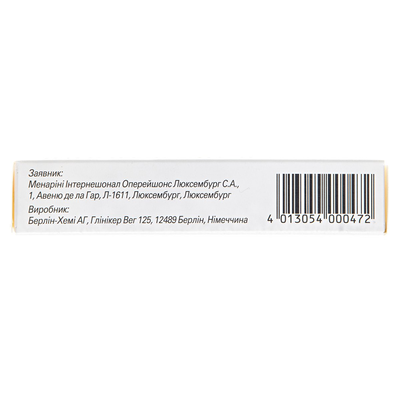
Manufacturer
BERLIN-CHEMIE AG.