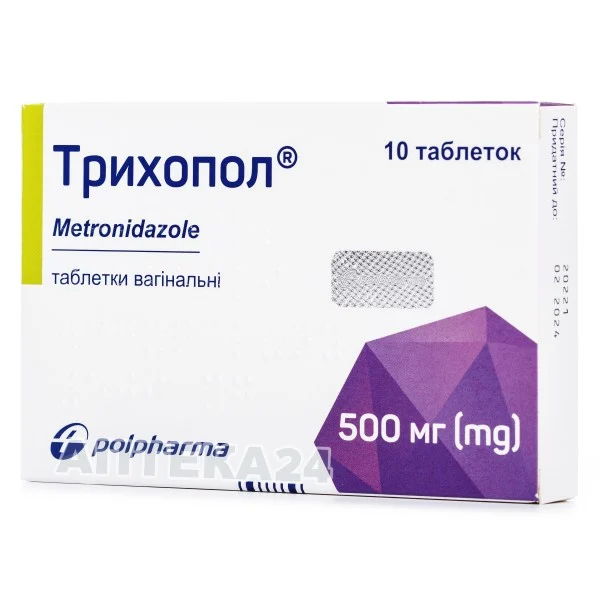

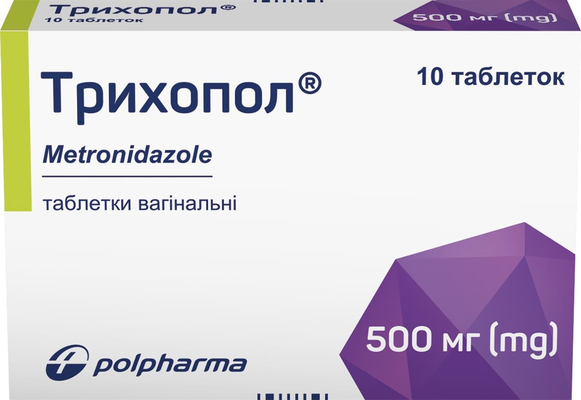
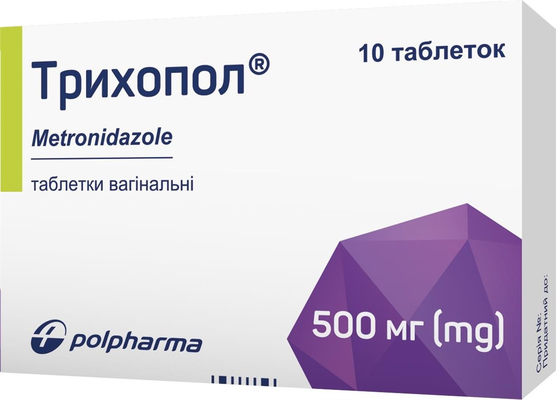
Trichopol vaginal tablets, 500 mg each, No. 10
Ingredients
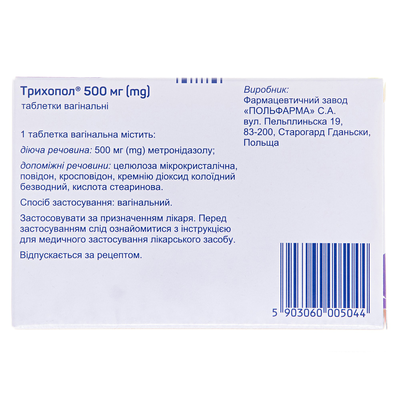
Active ingredient: metronidazole;
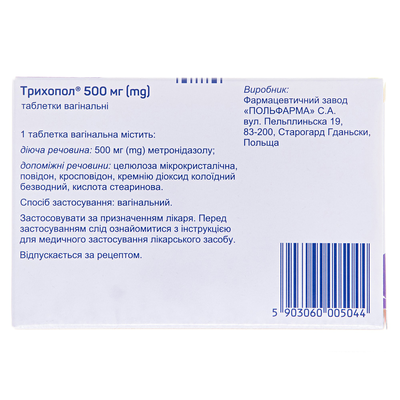
1 vaginal tablet contains 500 mg of metronidazole;
excipients: microcrystalline cellulose, povidone, crospovidone, colloidal anhydrous silicon dioxide, stearic acid.
Dosage Form
Vaginal tablets.
Main physical and chemical properties: oblong, biconvex tablets that are white or light yellowish in color.
Pharmacotherapeutic group
Antimicrobial and antiseptic agents used in gynecology. Imidazole derivatives.
ATC code G01A F01.
Pharmacological properties
Pharmacodynamics.
Metronidazole belongs to the nitro-5-imidazole class and has a broad spectrum of activity. The following microorganisms are susceptible to the drug: Peptostreptococcus spp., Clostridium spp., Bacteroides spp., Fusobacterium spp., Prevotella spp., and Veilonella. Metronidazole inhibits the growth of protozoa—Trichomonas vaginalis, Giardia intestinalis (Lamblia intestinalis), and Entamoeba histolytica.
The following are inconsistently susceptible to the drug: Bifidobacterium spp., Eubacterium spp. Insensitive strains of microorganisms include: Propionibacterium, Actinomyces, Mobiluncus.
Pharmacokinetics.
Following vaginal administration, systemic absorption is minimal.
The plasma half-life is 8–10 hours. Plasma protein binding is negligible (less than 20%). Rapid and pronounced diffusion into the lungs, kidneys, liver, bile, cerebrospinal fluid, skin, saliva, and vaginal secretions. Crosses the placental barrier and passes into breast milk.
Metabolism occurs primarily in the liver, resulting in two unconjugated, oxidized, active metabolites (5–30% of activity).
Excretion occurs primarily via the kidneys: 35–65% of the administered dose is excreted in the urine as metronidazole and its oxidized metabolites.
Indications
Topical treatment of trichomoniasis vaginitis and nonspecific vaginitis.
Contraindications
Hypersensitivity to metronidazole or to any other component of the drug.
Hypersensitivity to imidazole derivatives.
This medication is not recommended for use in combination with disulfiram or alcohol (see the section “Interactions with Other Medications and Other Types of Interactions”).
Interactions with Other Medications and Other Types of Interactions
Antabuse-like effect. There are many medications that trigger an Antabuse-like reaction to alcohol, and their concurrent use with alcohol is not recommended.
Combinations Not Recommended.
Alcohol: Antabuse effect (flushing, erythema, vomiting, tachycardia). Avoid consuming alcoholic beverages and taking medications that contain alcohol.
Disulfiram: There is a risk of developing psychotic episodes or confusion, which are reversible after discontinuation of the drug.
Busulfan: When busulfan is used in high doses, busulfan concentrations may double in patients receiving metronidazole.
Combinations requiring precautions during use.
Oral anticoagulant therapy (warfarin-like): enhanced effects of oral anticoagulants and an increased risk of hemorrhagic complications due to slowed hepatic metabolism. Prothrombin levels should be monitored more frequently, and INR (International Normalized Ratio) levels should be monitored. It is recommended to adjust the dose of the oral anticoagulant while taking metronidazole and for 8 days after discontinuation.
Anticonvulsants that are enzyme inducers (carbamazepine, fosphenytoin, phenobarbital, phenytoin, primidone). Decreased plasma concentrations of metronidazole due to stimulation of its hepatic metabolism by the inducer.
Clinical monitoring should be performed during and after treatment with the inducer. Adjustment of the metronidazole dosage may be necessary.
Rifampicin. Decreased plasma concentrations of metronidazole due to stimulation of its metabolism in the liver by rifampicin.
Clinical monitoring should be performed during and after treatment with rifampicin. Adjustment of the metronidazole dosage may be necessary.
Lithium: Plasma lithium levels may increase while taking metronidazole and may reach toxic levels. Close monitoring of plasma lithium concentrations, creatinine, and electrolytes is required in patients taking lithium and metronidazole concomitantly; if necessary, the lithium dosage should be adjusted.
Cyclosporine: There is a risk of increased cyclosporine levels in the blood plasma. If the drugs must be taken concurrently, cyclosporine and creatinine levels should be carefully monitored.
Combinations Requiring Special Attention.
Fluorouracil (as well as tegafur and capecitabine): A decrease in fluorouracil clearance leads to increased 5-fluorouracil toxicity.
Disturbance of the INR (International Normalized Ratio).
Numerous cases of increased activity of oral anticoagulants have been reported in patients receiving antibacterial therapy. Risk factors contributing to susceptibility to this complication include the presence of an infection or severe inflammation, the patient’s age, and their overall health status. Under these circumstances, it is difficult to determine to what extent the infection itself or its treatment affects the INR imbalance. However, certain classes of antibiotics play a greater role in this regard, specifically: fluoroquinolones, macrolides, cyclines, co-trimoxazole, and some cephalosporins.
Laboratory test results. Metronidazole can immobilize treponemes, leading to a false-positive Nelson test.
Special Considerations for Use
In patients with severe, chronic, or progressive diseases of the peripheral or central nervous system, the risk of worsening neurological status should be taken into account.
In patients with a history of hematologic disorders or who are receiving the drug in high doses and/or for an extended period, blood tests should be performed regularly, particularly to monitor white blood cell counts.
During long-term treatment with this drug, patients should be monitored for signs of adverse reactions, such as central or peripheral neuropathy (paresthesia, ataxia, dizziness, seizures).
Patients should be informed that metronidazole may cause the urine to turn dark (due to an active metabolite).
The use of vaginal suppositories while using condoms or diaphragms increases the risk of latex rupture.
Hypersensitivity/skin and skin appendage disorders. Allergic reactions, including anaphylactic shock, may occur and can be life-threatening (see the “Adverse Reactions” section). In such cases, metronidazole treatment must be discontinued and appropriate therapy initiated.
If, at the start of treatment, a patient develops generalized erythema and pustular rash accompanied by a fever, acute generalized exanthematous pustulosis should be suspected (see the “Adverse Reactions” section); if such a reaction develops, treatment with the drug must be discontinued, and further use of metronidazole—whether as monotherapy or in combination with other drugs—is contraindicated.
Central nervous system disorders. If symptoms characteristic of encephalopathy or cerebellar syndrome appear, the patient’s treatment should be immediately reviewed, and treatment with metronidazole should be discontinued.
Cases of encephalopathy have been reported during postmarketing surveillance of the drug. In addition, cases of MRI changes associated with encephalopathy have been observed (see the “Adverse Reactions” section). The affected areas are most commonly located in the cerebellum (particularly in the dentate nucleus) and in the corpus callosum. In most cases, encephalopathy and MRI changes resolved after discontinuation of treatment with the drug. Fatal cases have been reported very rarely.
Patients should be monitored for possible signs of encephalopathy or for worsening symptoms if they have central nervous system disorders.
If aseptic meningitis develops during treatment with this drug, re-administration of metronidazole is not recommended; however, in patients with a serious infectious disease, the benefit-risk ratio should be re-evaluated.
Peripheral nervous system disorders. Patients should be monitored for possible signs of peripheral neuropathy, especially during long-term treatment with the drug or in the presence of severe, chronic, or progressive peripheral neuropathy.
Psychiatric disorders. Psychotic reactions, including self-harming behavior, may occur in patients after the first dose of the drug, especially in those with a history of psychiatric disorders (see the “Adverse Reactions” section). In such cases, metronidazole treatment should be discontinued, the physician should be notified, and appropriate therapeutic measures should be taken immediately.
Hematologic effects. In patients with a history of blood disorders and in patients receiving high doses of the drug and/or over a prolonged period, blood tests should be performed regularly, with particular attention to monitoring white blood cell counts.
Whether to continue treatment with this drug in patients with leukopenia depends on the severity of the infectious disease.
Drug Interactions. Concomitant use of metronidazole and alcohol is not recommended (see the “Drug Interactions and Other Interactions” section).
Concomitant use of metronidazole and busulfan is not recommended (see the section “Interactions with Other Medications and Other Types of Interactions”).
Concomitant use of metronidazole and disulfiram is not recommended (see the section “Interactions with Other Medications and Other Types of Interactions”).
Metronidazole has no direct effect on aerobic or facultative anaerobic bacteria.
In patients undergoing hemodialysis, metronidazole and its metabolites are eliminated during the 8-hour hemodialysis session; therefore, metronidazole should be taken immediately after hemodialysis.
No dose adjustment is necessary for patients with renal insufficiency undergoing peritoneal dialysis.
Metronidazole is primarily metabolized by oxidation in the liver. A significant impairment in metronidazole clearance may occur in the presence of hepatic insufficiency. Significant accumulation may occur in patients with hepatic encephalopathy, and as a result, high plasma concentrations of metronidazole may exacerbate symptoms of encephalopathy. Therefore, metronidazole should be used with caution in patients with hepatic encephalopathy. The daily dose should be reduced by one-third and may be administered once daily.
With systemic use of metronidazole, cases of severe hepatotoxicity/acute liver failure have been reported, including fatal cases and cases with rapid onset following the initiation of therapy in patients with Cockayne syndrome. Therefore, metronidazole should be used in such patients only after a careful risk-benefit assessment and in the absence of alternative treatment. Liver function tests should be performed immediately before starting therapy and after completing treatment until test results return to normal or to baseline levels. If a significant elevation in liver function tests is detected during treatment, the drug should be discontinued. Patients with Cockayne syndrome should be advised to report any symptoms suggestive of possible liver damage to their doctor and to discontinue use of the drug.
Patients with Cockayne syndrome should be advised to immediately inform their doctor of any symptoms of potential liver damage and to stop taking metronidazole.
There is a possibility that a gonococcal infection may persist after the elimination of a trichomoniasis infection.
The half-life of metronidazole is not altered in patients with renal insufficiency. Therefore, no dose adjustment is necessary. However, metronidazole metabolites are present in such patients. The clinical significance of this is currently unknown.
Use during pregnancy or breastfeeding.
Pregnancy. Animal studies have not demonstrated any teratogenic effects. Since no teratogenic effects have been observed in animals, malformations are not expected to occur in humans. According to available data, substances that cause birth defects in humans have teratogenic effects in animals in appropriately conducted studies in two species. Numerous clinical data have not demonstrated any specific teratogenic or fetotoxic effects associated with the use of metronidazole during pregnancy. However, the absence of such a risk can only be confirmed by epidemiological studies. Therefore, metronidazole should be prescribed during pregnancy only when necessary.
Breastfeeding. Metronidazole is excreted into breast milk. Therefore, use of this medication should be avoided during breastfeeding.
Effect on reaction time when driving or operating machinery.
Patients should be warned about the risk of dizziness, confusion, hallucinations, seizures, and visual disturbances. If such symptoms occur, patients should not drive or operate machinery.
Dosage and Administration
This medication is approved for use only in adult patients.
Trichomonal vaginitis: Administer 1 vaginal tablet once daily for 10 days. Before insertion into the vagina, the tablet should be lightly moistened with cooled boiled water. Treatment should be conducted concurrently with oral administration of Trichopol® tablets. Do not discontinue treatment during menstruation.
Nonspecific vaginitis. Insert 1 vaginal tablet deeply into the vagina once daily for 7 days. If necessary, Trichopol® tablets may be prescribed orally.
Simultaneous treatment of the patient’s sexual partner is recommended, even if he has no symptoms of infection.
The maximum duration of treatment should not exceed 10 days; the number of treatment courses should be 2–3 per year.
Children.
This medication is contraindicated for use in children.
Overdose
Cases have been reported of a single dose of up to 12 g being ingested during suicide attempts and accidental overdoses. Ataxia, vomiting, and mild disorientation may occur. Since there is no known specific antidote for metronidazole, symptomatic treatment is recommended.
Side Effects
Blood and lymphatic system disorders:
- agranulocytosis, neutropenia, thrombocytopenia, pancytopenia;
- leukopenia.
Metabolism and nutrition:
- anorexia.
Psychiatric disorders:
- hallucinations;
- psychotic reactions with paranoia and/or delirium, which in rare cases may be accompanied by suicidal thoughts or suicide attempts (see the “Special Considerations for Use” section);
- depressed mood.
Nervous system disorders:
- peripheral sensory neuropathy;
- headache, dizziness, confusion, seizures;
- aseptic meningitis (see the “Special Precautions for Use” section);
- encephalopathy, which may be accompanied by changes on MRI, usually of a reversible nature. Fatal cases have been reported very rarely (see the “Special Precautions for Use” section);
- subacute cerebellar syndrome (ataxia, dysarthria, gait disturbance, nystagmus, tremor) (see the “Special Considerations for Use” section).
Ocular disorders:
- temporary visual disturbances, such as blurred vision, diplopia, myopia, decreased visual acuity, and changes in color perception;
- optic neuropathy/neuritis.
Ear and balance disorders:
- hearing impairment/hearing loss (including sensorineural), tinnitus.
Gastrointestinal disorders:
- mild gastrointestinal disturbances (epigastric pain, nausea, vomiting, diarrhea);
- glossitis with dry mouth, stomatitis, taste disturbances;
- cases of reversible pancreatitis;
- discoloration or changes in the appearance of the tongue (mycosis).
Hepatobiliary disorders:
- elevated liver enzyme levels (AST, ALT, alkaline phosphatase); very rare cases of acute cholestatic or mixed hepatitis and hepatocellular liver damage have been reported, sometimes accompanied by jaundice. Isolated cases of hepatocellular failure have been reported, which may require a liver transplant.
Skin and appendages:
- flushing with hyperemia, pruritus, and rashes, which may be accompanied by fever;
- urticaria, angioedema, anaphylactic shock (see the “Special Considerations for Use” section);
- very rare cases of acute generalized exanthematous pustulosis (see the “Special Considerations for Use” section);
- toxic epidermal necrolysis;
- fixed drug eruption;
- Stevens–Johnson syndrome.
Musculoskeletal and connective tissue disorders:
- myalgia, arthralgia.
Genitourinary system:
- urine may take on a reddish-brown color due to the presence of water-soluble pigments, which are metabolites of metronidazole.
Shelf life
3 years.
Storage conditions
Store in the original packaging at a temperature not exceeding 25 °C.
Keep out of reach of children.
Packaging
10 tablets per blister pack; 1 blister pack per cardboard box.
Dispensing Category
Prescription only.
Manufacturer
“POLPHARMA” S.A. Pharmaceutical Plant /
Pharmaceutical Works “POLPHARMA” S.A.