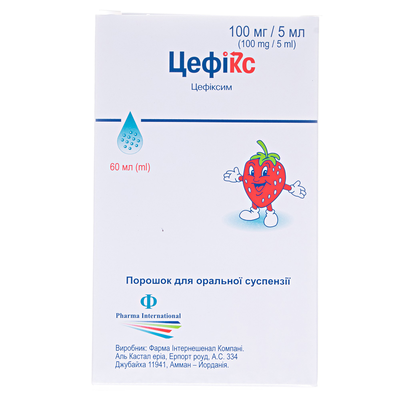

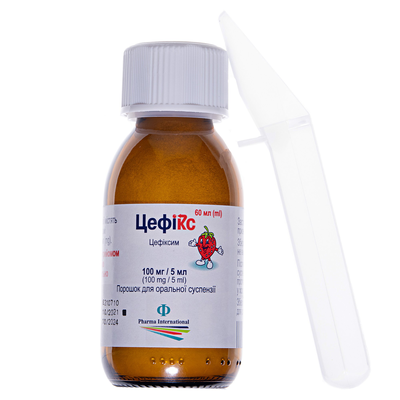
Cefix Powder for Oral Suspension, 100 mg/5 mL, 60 mL per bottle.
Ingredients
Active ingredient: cefixime;
5 mL of suspension contains 100 mg of cefixime (as trihydrate);
excipients: sodium benzoate (E 211); xanthan gum; croscarmellose sodium; sodium carboxymethylcellulose; microcrystalline cellulose; citric acid, monohydrate; anhydrous colloidal silicon dioxide; sucrose; strawberry flavoring (powder).
Dosage Form
Powder for oral suspension.
Main physical and chemical properties: an almost white to light yellow powder with a strawberry odor.
Pharmacotherapeutic group
Antibacterial agents for systemic use. Other beta-lactam antibiotics. Third-generation cephalosporins. ATC code J01D D08.
Pharmacological properties
Pharmacodynamics.
Cefixime is a third-generation cephalosporin antibiotic for oral administration. In vitro, it exhibits significant bactericidal activity against a broad spectrum of Gram-positive and Gram-negative microorganisms. It is clinically effective in treating infections caused by the most common pathogenic microorganisms, including Streptococcus pneumoniae, Streptococcus pyogenes, E. coli, Proteus mirabilis, Klebsiella species, Haemophilus influenzae (beta-lactamase-positive and -negative), Moraxella (Branhamella) catarrhalis (beta-lactamase-positive and -negative), and Enterobacter species. It exhibits a high degree of stability in the presence of beta-lactamases.
Most strains of enterococci (Streptococcus faecalis, Group D streptococci) and staphylococci (including coagulase-positive, coagulase-negative, and methicillin-resistant strains) are resistant to cefixime. In addition, most strains of Pseudomonas, Bacteroides fragilis, Listeria monocytogenes, and Clostridia are resistant to cefixime.
Pharmacokinetics.
Absorption. The absolute bioavailability of cefixime following oral administration is 22–54%. Since food intake does not significantly affect absorption, cefixime may be administered regardless of meals. Maximum serum concentrations following administration of the recommended doses for adults or children range from 1.5 to 3 μg/mL. With repeated dosing, accumulation of cefixime is negligible or absent. The pharmacokinetics of cefixime were compared in healthy elderly patients (aged > 64 years) and young volunteers (aged 11–35 years) following administration of 400 mg of cefixime once daily for 5 days. The mean Cmax and AUC values were slightly higher in elderly patients. Elderly patients may be prescribed the drug at the same doses as adults.
Distribution. Cefixime is almost completely bound to albumin; the mean free fraction is approximately 30%.
Metabolism. Metabolites of cefixime have not been detected in human serum or urine.
Excretion. Cefixime is excreted primarily unchanged in the urine. The predominant mechanism is glomerular filtration.
There are no data on the transfer of cefixime into breast milk.
Indications
Infectious and inflammatory diseases caused by microorganisms susceptible to the drug:
- upper respiratory tract infections (including otitis media) and other upper respiratory tract infections (sinusitis, pharyngitis, tonsillitis of bacterial etiology) in cases of known or suspected resistance of the pathogen to other commonly used antibiotics, or in cases where treatment is likely to be ineffective;
- lower respiratory tract infections (including acute bronchitis and exacerbations of chronic bronchitis);
- urinary tract infections (including cystitis, cystourethritis, and uncomplicated pyelonephritis).
Clinically effective in the treatment of infections caused by the most common pathogenic microorganisms, including Streptococcus pneumoniae, Streptococcus pyogenes, E. coli, Proteus mirabilis, Klebsiella species, Haemophilus influenzae (beta-lactamase-positive and -negative), Moraxella (Branhamella) catarrhalis (beta-lactamase-positive and -negative), and Enterobacter species. It exhibits a high degree of stability in the presence of beta-lactamases.
Most strains of enterococci (Streptococcus faecalis, Group D streptococci) and staphylococci (including coagulase-positive, coagulase-negative, and methicillin-resistant strains) are resistant to cefixime. In addition, most strains of Pseudomonas, Bacteroides fragilis, Listeria monocytogenes, and Clostridia are resistant to cefixime.
Contraindications
Confirmed hypersensitivity to cephalosporin antibiotics or to other components of the drug; hypersensitivity to penicillins; porphyria.
Drug Interactions and Other Interactions
As with other cephalosporins, an increase in prothrombin time has been reported in some patients; therefore, caution should be exercised in patients receiving anticoagulant therapy.
Cefixime should be used with caution in patients receiving coumarin-type anticoagulants, such as potassium warfarin. Since cefixime may potentiate the effects of anticoagulants, an increase in prothrombin time may occur, with or without clinical signs of bleeding.
Tubular secretion inhibitors (allopurinol, probenecid, diuretics) increase the maximum serum concentration of cefixime by slowing its renal excretion, which may lead to symptoms of overdose.
When cefixime is used in combination with potentially nephrotoxic agents (aminoglycosides, colistin, polymyxin, viomycin) or potent diuretics (ethacrynic acid, furosemide), there is an increased risk of developing renal failure.
Salicylic acid increases the level of free cefixime by 50% due to the displacement of cefixime from its protein-binding sites. This effect is concentration-dependent.
When used concomitantly with carbamazepine, an increase in its plasma concentration is possible; therefore, it is advisable to monitor carbamazepine levels in the blood plasma.
Nifedipine increases the bioavailability of cefixime, but no clinical interaction has been established.
Use of this medication may reduce the reabsorption of estrogens and decrease the effectiveness of combined oral contraceptives.
During treatment with cefixime, a false-positive reaction for glucose in urine may occur when using copper sulfate tablets, Benedict’s solution, or Fehling’s solution. The glucose oxidase test is recommended for determining glucose in urine.
Cephalosporin antibiotics may cause a false-positive result in the direct Coombs test. Therefore, it should be noted that a positive Coombs test result may be due to the use of this medication.
Special Considerations for Use
Beta-lactams, including cefixime, increase the risk of encephalopathy in patients (which may include convulsions, confusion, impaired consciousness, and motor disorders), especially in cases of overdose and renal insufficiency.
Severe skin adverse reactions, such as toxic epidermal necrolysis, Stevens-Johnson syndrome, and drug rash with eosinophilia and systemic symptoms (DRESS syndrome) have been reported in some patients receiving cefixime. If severe skin reactions occur, cefixime should be discontinued and appropriate treatment initiated.
Cases of drug-induced hemolytic anemia, including severe and fatal cases, have been reported during treatment with cephalosporins. There have also been reports of hemolytic anemia following repeated use of cephalosporins (including cefixime).
Effect on Renal Function.
Cefixime should be used with caution in patients with severe renal impairment (see “Dosage and Administration. Dosage in Renal Impairment”).
As with other cephalosporins, cefixime may cause acute renal failure, including tubulointerstitial nephritis as the primary pathological condition. If acute renal failure occurs, cefixime administration should be discontinued, and appropriate therapy and/or measures should be initiated.
When cefixime is administered in high doses concomitantly with aminoglycosides, polymyxin B, colistin, or loop diuretics (furosemide, ethacrynic acid), renal function must be closely monitored. After prolonged use of cefixime, hematopoietic function should be monitored.
Hypersensitivity reactions.
Before starting treatment with cefixime, it is necessary to determine whether the patient has a history of hypersensitivity reactions to cephalosporins, penicillins, or other medications.
Antibiotics, including cefixime, should be used with caution in patients with any form of allergic reaction, particularly to medications.
If an allergic reaction occurs, the drug should be discontinued and appropriate treatment initiated. Allergic reactions (particularly anaphylaxis) associated with the use of beta-lactam antibiotics can be severe and, in rare cases, fatal (see “Adverse Reactions”).
Colitis/overgrowth of non-susceptible microorganisms.
Gastrointestinal adverse reactions may occur with the use of this drug; therefore cefixime should be prescribed with caution to patients with a history of bleeding, gastrointestinal disorders—particularly ulcerative colitis, regional colitis, or enteritis—as well as in cases of impaired liver function.
Prolonged use of cefixime may lead to overgrowth of non-susceptible microorganisms, including disruption of the normal intestinal microflora, which may lead to overgrowth of Candida albicans and the development of oral candidiasis (see “Adverse Reactions”).
Pseudomembranous colitis.
Broad-spectrum antibiotics, especially with prolonged use, may cause pseudomembranous colitis. Symptoms of pseudomembranous colitis may develop during or after discontinuation of antibiotic therapy.
The onset of severe diarrhea during treatment with this drug may be a result of pseudomembranous colitis. In such cases, cefixime should be discontinued and appropriate investigations conducted.
Effects on the Blood System.
The use of beta-lactam antibiotics may lead to the development of neutropenia and agranulocytosis, especially during prolonged treatment. If neutropenia develops, treatment with cefixime must be discontinued.
Blood tests should be monitored during long-term use of the drug (more than 10 days).
Effects on Serological Test Results.
When cefixime is used, the Coombs test may yield false-positive results. Cefixime may also cause a false-positive result in urine glucose tests (see “Adverse Reactions”).
Spectrum of Antibacterial Activity.
For infections caused by group A beta-hemolytic streptococci, the course of treatment should be at least 10 days to prevent acute rheumatic fever.
Interaction with alcohol.
Cephalosporins increase the toxicity of alcohol; therefore, consuming alcoholic beverages is not recommended during treatment with cefixime.
Important information about certain excipients.
Cefix, powder for oral suspension, contains sucrose as an excipient; therefore, if a patient has been diagnosed with an intolerance to certain sugars, they should consult a doctor before taking this medication. Patients with rare hereditary disorders such as fructose intolerance or sucrase-isomaltase deficiency should not use this medication.
Use During Pregnancy or Breastfeeding.
There are no data on the use of this medication during pregnancy. Cefixime may be used during pregnancy only if the expected benefit to the mother outweighs the potential risk to the fetus. Cefixime crosses the placenta. If use of the medication is necessary, breastfeeding should be discontinued.
Effect on reaction time when driving or operating machinery.
Generally, it has no effect; however, adverse reactions affecting the central nervous system (e.g., dizziness) should be taken into account, as they may cause a decrease in psychomotor reaction time—in such cases, one should refrain from driving or operating machinery.
Dosage and Administration
Food intake does not affect the absorption of cefixime. The usual course of treatment is 7 days; if necessary, treatment may be extended to 14 days. For the treatment of uncomplicated cystitis, the course of treatment is 3 days.
For children aged 6 months to 10 years weighing up to 50 kg:
The recommended dose is 8 mg/kg per day as a single dose or 4 mg/kg every 12 hours, depending on the severity of the condition.
For adults and children 10 years of age and older (or weighing more than 50 kg):
the recommended dose is 400 mg per day as a single dose or 200 mg every 12 hours, depending on the severity of the condition.
For elderly patients:
administer the drug at the dose recommended for adults. Renal function should be monitored, and the dose adjusted in cases of severe renal impairment (see “Dosage in Renal Impairment”).
Dosage in Renal Impairment:
Cefixime may be used in patients with impaired renal function. For patients with a creatinine clearance of 20 mL/min or higher, administer the usual dose and dosing schedule. For patients with a creatinine clearance below 20 mL/min, it is recommended to reduce the daily dose by 50%. This also applies to patients undergoing chronic ambulatory peritoneal dialysis or hemodialysis.
Instructions for preparing the suspension.
Before preparation, invert and shake the vial to loosen the powder. Add boiled cold water in two steps up to the line (mark) on the vial, shaking the vial each time until a homogeneous suspension forms.
The suspension may be taken no earlier than 5 minutes after preparation.
Shake the prepared suspension thoroughly before each dose.
Children.
This medication is indicated for children 6 months of age and older. The safety and efficacy of cefixime in children under 6 months of age have not been established; therefore, cefixime is not recommended for this patient population.
Overdose
Symptoms: increased severity of adverse reactions, dizziness, nausea, vomiting, diarrhea.
Treatment: gastric lavage, administration of antihistamines and glucocorticoids; oxygen therapy. Hemodialysis or peritoneal dialysis only marginally contribute to the elimination of cefixime from the body. Treatment is symptomatic.
There are no specific antidotes for treating overdose.
Side Effects
Side effects caused by cefixime are mild and occur rarely. The following disorders are possible:
Nervous system: headache, dizziness, dysphoria; cases of convulsions have been reported with the use of cephalosporins, including cefixime (frequency unknown).
Beta-lactams, including cefixime, increase the risk of encephalopathy in patients (which may include convulsions, confusion, impaired consciousness, and movement disorders), especially in cases of overdose and renal insufficiency (frequency unknown).
Ear and vestibular system disorders: hearing loss.
Respiratory system: dyspnea.
Blood and lymphatic system disorders: eosinophilia, granulocytopenia, leukopenia, thrombocytopenia, thrombocytosis, neutropenia, hemolytic anemia, hypoprothrombinemia (bleeding and bruising without apparent cause), thrombophlebitis, prolonged thrombin and prothrombin times, agranulocytosis.
Gastrointestinal: stomach and intestinal cramps, abdominal pain, diarrhea*, nausea, vomiting, oral candidiasis, pseudomembranous colitis, dry mouth, dyspepsia, flatulence, dysbiosis; in rare cases—stomatitis, glossitis.
Metabolism and nutrition: anorexia.
Hepatobiliary system: hepatitis, cholestasis, transient elevation of liver transaminases and alkaline phosphatase, hyperbilirubinemia, cholestatic jaundice, scleral icterus, and cutaneous icterus.
Renal and urinary system: acute renal failure, including interstitial nephritis as the primary pathological condition; hematuria.
Immune system, skin, and subcutaneous tissue disorders: hypersensitivity reactions, including: rash, pruritus, angioedema, anaphylactic shock, anaphylactic reactions; reactions similar to serum sickness; drug rash with eosinophilia and systemic symptoms (DRESS); facial edema, skin erythema, urticaria, erythema multiforme or Stevens-Johnson syndrome, serum sickness, purpura, arthralgia, fever.
Skin: maculopapular and vesiculobullous rashes, fungal dermatitis, desquamation, dry skin, hair loss, sunburn, toxic epidermal necrolysis.
Reproductive system and mammary glands: genital itching, Candida-induced vaginitis.
Infections and infestations: vaginal candidiasis (vaginal itching or discharge).
Cases of diarrhea following cefixime administration may be associated with Clostridium difficile.
Laboratory findings: Most laboratory changes are transient and have no clinical significance. Possible increases in blood urea nitrogen, elevated serum creatinine levels, and false-positive Coombs test results may occur; a positive reaction for ketones in urine may also occur in tests using nitroprusside, but not nitroferricyanide. Taking cefixime may cause false-positive results in urine glucose tests (therefore, enzymatic tests should be used) and changes in liver and kidney function test results.
General disorders: increased sweating, increased fatigue, weakness, inflammation of the mucous membranes.
* Diarrhea is usually associated with higher doses of the drug. Cases of diarrhea (ranging from mild to severe) have been reported—in such cases, discontinuation of therapy is warranted. If severe diarrhea occurs, cefixime should be discontinued.
Shelf life
3 years (unopened vial).
Once prepared, store the suspension in the refrigerator for up to 14 days.
Storage Conditions
Store at a temperature not exceeding 25 °C.
Keep out of reach of children.
Packaging
1 vial of powder (for 30 mL or 60 mL of suspension) with a measuring spoon in a cardboard box.
Dispensing Category
By prescription.