
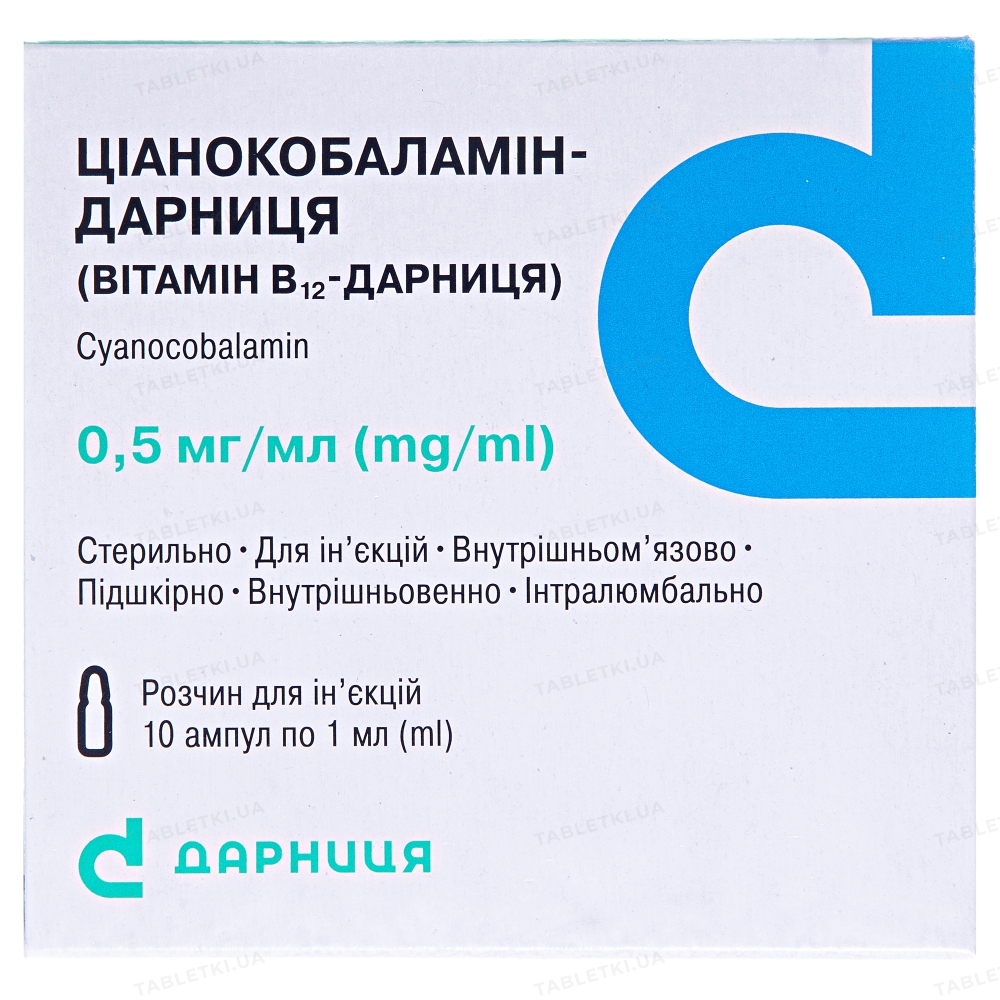
Cyanocobalamin-Darnitsa Solution for Injection, 0.5 mg/mL, 1 mL, No. 10 in ampoules
Ingredients
Active ingredient: cyanocobalamin;
1 mL of solution contains 0.2 mg or 0.5 mg of cyanocobalamin;
excipients: sodium chloride, sodium acetate trihydrate, acetic acid, water for injection.
Dosage Form
Solution for injection.
Main physical and chemical properties: a clear, red-colored liquid.
Pharmacotherapeutic group
Vitamin B12 (cyanocobalamin and its analogs). Cyanocobalamin. ATC code B0ZV A01.
Pharmacological properties
Pharmacodynamics.
Vitamin B12 (cyanocobalamin) has metabolic and hematopoietic effects. In the body (primarily in the liver), it is converted into a coenzyme form—adenosylcobalamin, or cobamamide—which is the active form of vitamin B12. Cobamamide is a component of numerous enzymes, including the reductase that reduces folic acid to tetrahydrofolate. It has high biological activity. Cobalamide participates in the transfer of methyl and other one-carbon units; therefore, it is essential for the formation of deoxyribose and DNA, creatine, and methionine—a methyl group donor— in the synthesis of the lipotropic factor choline, for the conversion of methylmalonic acid to succinic acid (a component of myelin), and for the utilization of propionic acid. Cobamamide is essential for normal hematopoiesis, as it promotes the maturation of red blood cells. It participates in the synthesis and accumulation of compounds containing sulfhydryl groups in red blood cells, which increases their tolerance to hemolysis. It activates the blood coagulation system; at high doses, it causes an increase in thromboplastic activity and prothrombin activity. It lowers blood cholesterol levels. Has a positive effect on liver and nervous system function. Enhances the regenerative capacity of tissues.
Pharmacokinetics.
When administered parenterally, vitamin B12 rapidly enters the systemic circulation. In the blood, it binds to transcobalamins I and II, which transport it to the tissues. It is stored primarily in the liver. Plasma protein binding is 90%. The time to reach maximum concentration (Tcmax) after subcutaneous or intramuscular administration is approximately 1 hour. It is excreted from the liver into the intestines via bile and reabsorbed into the bloodstream. The half-life (T1/2) from the liver is 500 days. With normal renal function, 7–10% is excreted by the kidneys, and approximately 50% is excreted in the feces; with impaired renal function—0–7% via the kidneys, 70–100% via feces. It crosses the placental barrier.
Indications
Treatment of malignant, posthemorrhagic, and iron-deficiency anemias; aplastic anemias in children; and nutritional anemias caused by toxic substances and medications, as well asrelated to vitamin B12 deficiency, regardless of the cause of the deficiency (gastrectomy, helminthic infestations, impaired intestinal absorption, pregnancy). Polyneuropathies, trigeminal neuralgia, radiculitis, causalgia, migraine, diabetic neuropathies, amyotrophic lateral sclerosis, cerebral palsy, Down syndrome, and alcohol-induced delirium. Use in children with dystrophy, following infectious diseases, and for sprue (in combination with folic acid), in liver diseases (hepatitis, cirrhosis, Botkin’s disease), radiation sickness, psoriasis, herpetiform dermatitis, neurodermatitis, and photodermatoses.
Contraindications
Hypersensitivity to the components of the drug. Erythremia, erythrocytosis. Neoplasms, except in cases accompanied by megaloblastic anemia and vitamin B12 deficiency. Acute thromboembolic diseases. High-functional-class exertional angina.
Interactions with Other Medications and Other Types of Interactions
Aminoglycosides, salicylates, antiepileptic drugs, colchicine, and potassium-containing drugs reduce the absorption of this medication and affect its pharmacokinetics.
When used concomitantly with kanamycin, neomycin, polymyxins, or tetracyclines, the absorption of cyanocobalamin is reduced.
It is pharmacologically incompatible with ascorbic acid and heavy metal salts (inactivation of cyanocobalamin); thiamine bromide, pyridoxine, and riboflavin (the cobalt ion contained in the cyanocobalamin molecule destroys other vitamins).
Thiamine—increases the risk of allergic reactions caused by thiamine.
Chloramphenicol – reduces the hematopoietic response to the drug.
Oral contraceptives—reduce the concentration of cyanocobalamin in the blood.
Special Considerations for Use
During therapy, peripheral blood parameters must be monitored: on days 5–8 after the start of treatment, determine the reticulocyte count and iron concentration. Red blood cell count, hemoglobin level, and hematocrit should be monitored 1–2 times per week for the first month, and then 2–4 times per month thereafter. Remission is achieved when the red blood cell count rises to 4.0–4.5 × 10¹²/L, when red blood cell size returns to normal, anisocytosis and poikilocytosis disappear, and the reticulocyte count normalizes following a reticulocytic crisis. After achieving hematologic remission, monitor peripheral blood at least once every 4–6 months.
If there is a tendency toward leukocytosis or erythrocytosis, the dose of the drug should be reduced or treatment temporarily suspended.
Cyanocobalamin must not be used with medications that increase blood clotting.
During treatment, caution should be exercised and blood clotting monitored in individuals prone to thrombosis and in patients with angina.
Important information about excipients.
This medication contains less than 1 mmol (23 mg) of sodium per dose, meaning it is essentially sodium-free.
Use during pregnancy or breastfeeding.
Use with caution and under medical supervision during pregnancy (there are isolated reports of teratogenic effects of vitamin B12 at high doses) or while breastfeeding, taking into account the benefit-risk ratio.
Effect on reaction time when operating motor vehicles or other machinery.
During treatment, patients should refrain from driving and engaging in potentially hazardous activities that require increased attention and rapid psychomotor reactions.
Dosage and Administration
Administer the drug subcutaneously, intramuscularly, or intravenously; in cases of lateral funicular myelopathy and amyotrophic sclerosis, it may also be administered intralumbally.
Adults
For B12-deficient anemias, administer the medication at doses of 100–200 mcg (0.1–0.2 mg) every other day until remission is achieved.
When symptoms of funicular myelopathy appear and in cases of macrocytic anemias with nervous system damage, administer cyanocobalamin in a single dose of 400–500 μg (0.4–0.5 mg) or more. Administer daily during the first week, and then at intervals of 5–7 days (prescribe folic acid concurrently). In severe cases, administer into the spinal canal, starting with a single dose of 15–30 mcg; increase the dose with each subsequent injection (50, 100, 150, 200 mcg). Administer intralumbar injections every 3 days; a total of 8–10 injections are required per course. During remission, in the absence of signs of funicular myelopathy, administer 100 mcg twice a month for maintenance therapy; and if neurological symptoms are present, 200–400 mcg 2–4 times per month.
For amyotrophic lateral sclerosis, encephalomyelitis, and neurological disorders accompanied by pain, administer the medication in gradually increasing doses ranging from 200 to 500 mcg per injection (upon improvement—100 μg per day). The course of treatment is 14 days.
For peripheral nerve injuries, administer 200–400 μg once every 2 days for 40–45 days.
For hepatitis and liver cirrhosis, administer 15–30 mcg daily or 100 mcg every other day for 25–40 days.
For diabetic neuropathy, sprue, and radiation sickness, administer 60–100 μg daily for 20–30 days.
For vitamin B12 deficiency: for treatment—1 mg intramuscularly or intravenously daily for 1–2 weeks; the maintenance dose is 1–2 mg intramuscularly or intravenously, ranging from once a week to once a month. The duration of treatment with cyanocobalamin and the need for repeat courses depend on the course of the disease and the effectiveness of treatment.
Children
Administer subcutaneously only.
For posthemorrhagic and iron-deficiency anemias, administer 30–100 μg 2–3 times a week.
For aplastic anemia in children, administer 100 mcg until clinical and hematological improvement is observed.
For nutritional anemias in children, administer 30 mcg for 15 days.
For dystrophies in young children, Down syndrome, and cerebral palsy, administer 15–30 mcg every other day.
For hepatitis and liver cirrhosis in children, administer 15–30 mcg daily or 100 mcg every other day for 25–40 days.
Children.
Do not use the 0.5 mg/mL formulation in children under 3 years of age.
Administer subcutaneously only.
Overdose
Symptoms: pulmonary edema, congestive heart failure, peripheral vascular thrombosis.
Treatment: symptomatic.
Side Effects
Gastrointestinal: loose stools.
Metabolic: acne, bullous rashes, nausea, sweating, disturbances in purine metabolism, hypokalemia.
Nervous system: headache, dizziness, nervous agitation, drowsiness, muscle paralysis, loss of consciousness.
Cardiovascular system: tachycardia, chest pain, congestive heart failure, peripheral vascular thrombosis, low blood pressure, cardiac arrest.
Blood disorders: hypercoagulation.
Immune system disorders: allergic reactions, including skin manifestations such as erythema, hives, rash, itching, dermatitis, and edema, including angioedema; respiratory disorders, including an attack of suffocation, anaphylactic shock, and anaphylactoid reactions.
General disorders and administration site conditions: malaise, fever; at the injection site: erythema, itching, pain, swelling, induration, and necrosis.
Reporting of Suspected Adverse Reactions.
Reporting suspected adverse reactions after a drug’s approval is an important procedure. It allows for continued monitoring of the benefit-risk profile of the drug in question. Healthcare professionals must report any suspected adverse reactions through the national reporting system.
Shelf life
2 years.
Storage Conditions
Store in the original packaging at a temperature not exceeding 25 °C. Do not freeze.
Keep out of reach of children.
Incompatibility
When cyanocobalamin is used in the same solution as ascorbic acid or pyridoxine, the vitamins are mutually degraded; when used with nicotinic acid — cyanocobalamin is degraded; when combined with riboflavin, cobalt ions accumulate.
Packaging
1 mL per ampoule; 5 ampoules per blister pack; 2 blister packs per carton.
Manufacturer
PJSC “Darnitsa Pharmaceutical Company.”
Address
Ukraine, 02093, Kyiv, 13 Boryspilskaya St.







