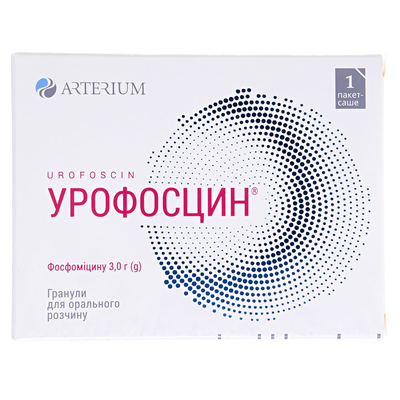
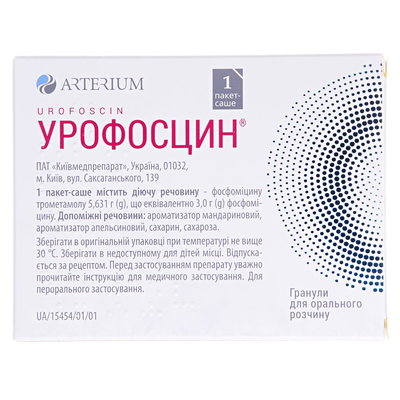
Urofoscin granules for oral solution, 3 g and 8 g, No. 1, in a sachet
Ingredients
Active ingredient: fosfomycin;
1 sachet contains 5.631 g of fosfomycin trometamol, equivalent to 3 g of fosfomycin;
excipients: orange flavoring, tangerine flavoring, saccharin, sucrose.
Dosage Form
Granules for oral solution.
Main physical and chemical properties: a white or nearly white granular powder with a characteristic mandarin flavor.
Pharmacotherapeutic group
Antimicrobial agents for systemic use. Other antimicrobial agents.
ATC code J01X X01.
Pharmacological properties
Urofoscin® contains the active ingredient fosfomycin in the form of fosfomycin trometamol. Fosfomycin is a bactericidal antibiotic (a phosphonic acid derivative). It inhibits bacterial cell wall synthesis by blocking one of the early stages of peptidoglycan synthesis.
Pharmacodynamics.
Urofoscin® contains fosfomycin [mono-(2-amino-2-hydroxymethyl-1,3-propanediol) (2R-cis)-(3-methyloxiranil) phosphonate]—an antibiotic derived from phosphonic acid and used to treat urinary tract infections.
Fosfomycin affects the first stage of bacterial cell wall synthesis.
The structure of fosfomycin is similar to that of phosphoenolpyruvate. This is why it inactivates the enzyme enolpyruvyl transferase, thereby irreversibly blocking the condensation of uridine diphosphate-N-acetylglucosamine with phosphoenolpyruvate, one of the first stages in bacterial cell wall synthesis. Fosfomycin may also reduce bacterial adhesion to the epithelial cells of the bladder mucosa, which can be a contributing factor in the development of recurrent infections.
The table below presents data on the in vitro activity of fosfomycin trometamol against clinically isolated microorganisms. The minimum inhibitory concentration (MIC) was determined by the disk diffusion method using 200 μg phosphomycin trometamol disks. Microorganisms with a complete inhibition zone diameter >16 mm (on Mueller–Hinton medium) were classified as susceptible (corresponding to 200 μg/mL).
| MIC90 (μg/mL) | Range | |
| Susceptible microorganisms | ||
| E. coli | 8 | 0.25–128 |
| Klebsiella | 32 | 2–128 |
| Citrobacter spp. | 2 | 0.25–2 |
| Enterobacter spp. | 16 | 0.5–64 |
| Proteus mirabilis | 128 | 0.12–256 |
| S. faecalis | 60 | 8–256 |
| Resistant microorganisms (diameter of the zone of
of complete inhibition >16 mm) |
||
| Serratia spp. | 32 | |
| Enterobacter cloacae | 256 | |
| Pseudomonas aeruginosa | 256 | |
| Morganella morganii | >256 | |
| Providencia rettgeri | >256 | |
| Providencia stuartii | >256 | |
| Pseudomonas ssp. | >256 |
Resistance/Cross-Resistance
Fosfomycin remains effective against the most common bacteria found in urinary tract infections.
Only a few bacteria may develop resistance. The resistance rate for E. coli, which causes uncomplicated urinary tract infections, is very low.
Most multidrug-resistant E. coli and other enterobacteria that produce extended-spectrum beta-lactamases (ESBLs) are susceptible to fosfomycin. Similarly, most strains of methicillin-resistant Staphylococcus aureus (MRSA) are susceptible to fosfomycin.
To date, no cases of cross-resistance with other antibacterial agents have been reported. Cross-resistance is unlikely because fosfomycin differs from any other antibiotic in its chemical structure and has a unique mechanism of action.
Clinical Efficacy
Fosfomycin has a broad spectrum of antibacterial activity, including against most Gram-positive and Gram-negative microorganisms that cause urinary tract infections, as well as penicillinase-producing strains.
In vivo, resistance has been observed in Enterobacter spp., Klebsiella spp., Enterococci, Proteus mirabilis, Staphylococcus aureus, and Staphylococcus saprophyticus.
In addition, Urofoscin® reduces bacterial adhesion to the bladder mucosal epithelium, which may be a contributing factor in the development of recurrent infections.
Pharmacokinetics.
Absorption
After oral administration, approximately 50% of fosfomycin trometamol is rapidly absorbed. After administration of 50 mg/kg body weight, the time to reach maximum concentration (tmax) is 2–2.5 hours, and the maximum concentration (Crnax) is 20–30 μg/mL.
Distribution
The plasma protein binding of fosfomycin is very low (less than 5%). The volume of distribution is 1.5–2.4 L/kg body weight.
Fosfomycin crosses the placental barrier and is excreted into breast milk.
Metabolism
Fosfomycin is not metabolized.
Excretion
The plasma half-life is approximately 4 hours. After a single dose of 3 g of fosfomycin trometamol, a urinary concentration of 1,800–3,000 μg/mL is reached within 2–4 hours. Therapeutically effective concentrations (200–300 μg/mL) persist for up to 48 hours after administration. 40–50% of the dose is excreted unchanged in the urine within the first 48 hours.
Pharmacokinetics in Specific Patient Populations
In patients with renal insufficiency, drug elimination is slowed in proportion to the degree of functional impairment, while the plasma half-life (t₁/₂) increases (up to 50 hours at a creatinine clearance of 10 mL/min).
Indications
Treatment of acute, uncomplicated lower urinary tract infections caused by microorganisms susceptible to fosfomycin in men, girls aged 12 years and older, and women. Prophylaxis during diagnostic procedures and surgical interventions in adult patients.
Contraindications
Hypersensitivity to any component of the drug, severe renal insufficiency (creatinine clearance <10 mL/min), children under 12 years of age, and patients undergoing hemodialysis.
Drug Interactions and Other Interactions
Concomitant use with metoclopramide and other drugs that increase gastrointestinal motility reduces the absorption of Urofoscin®, leading to a decrease in Urofoscin® concentrations in serum and urine.
Specific issues related to fluctuations in the INR (International Normalized Ratio). Numerous cases of increased antagonistic activity of vitamin K antagonists have been reported in patients taking antibiotics. Risk factors include serious infections or inflammation, advanced age, and poor overall health. In these cases, it is difficult to determine whether a change in INR is related to an infectious disease or is caused by the medication. However, there are certain classes of antibiotics whose use is more frequently associated with fluctuations in INR, including fluoroquinolones, macrolides, cyclines, co-trimoxazole, and some cephalosporins.
Interaction studies were conducted only in adults.
Special Considerations for Use
There is insufficient evidence of the efficacy of Urofoscin® in children. Since the 3-g dose is not intended for children under 12 years of age, the drug should not be used in this age group.
The use of fosfomycin may lead to the development of hypersensitivity reactions, including anaphylaxis and anaphylactic shock, which may be life-threatening (see the “Adverse Reactions” section).
If these reactions occur, fosfomycin should be discontinued; resuming fosfomycin in these patients is not permitted. Appropriate therapeutic measures should be taken.
Concomitant food intake slows the absorption of fosfomycin. Therefore, it is recommended to take the medication on an empty stomach or 2–3 hours after a meal.
The use of antibiotics, including fosfomycin trometamol, may lead to antibiotic-associated diarrhea. The severity may range from mild diarrhea to fatal colitis. The onset of severe, persistent, and/or bloody diarrhea during or after (including several weeks after) the completion of antibiotic treatment may be a symptom of Clostridium difficile-associated diarrhea (CDAD). Therefore, the possibility of this diagnosis should be considered in patients who develop severe diarrhea during or after treatment with fosfomycin trometamol. If the diagnosis is suspected or confirmed, appropriate treatment should be initiated immediately. In this case, medications that inhibit peristalsis are contraindicated.
Renal insufficiency: The concentration of fosfomycin in urine remains therapeutically effective for 48 hours if creatinine clearance is above 10 mL/min.
Urofoscin® contains sucrose. Patients with diabetes mellitus and those who must follow a special diet should be aware that 1 packet of Urofoscin® contains 2.213 g of sucrose. Urofoscin® should not be used in patients with fructose intolerance, glucose-galactose malabsorption, or sucrase-isomaltase deficiency.
Use during pregnancy or breastfeeding.
Pregnancy
The use of single doses for the treatment of urinary tract infections in pregnant women is not considered appropriate.
Animal studies have not revealed any direct or indirect toxicity affecting pregnancy, embryonic development, fetal development, and/or postnatal development.
There are only limited data on the safety of fosfomycin use in pregnant women. These data do not indicate the development of congenital malformations or fetal/neonatal toxicity associated with fosfomycin.
During pregnancy, the drug may be used if necessary, when the expected benefit of therapy for the pregnant woman outweighs the potential risk to the fetus.
Breastfeeding
Urofoscin® is excreted into breast milk even after a single dose. Use of the drug should be discontinued during breastfeeding.
Effect on reaction time when driving or operating machinery.
Urofoscin® may cause dizziness, which may impair the ability to drive or operate machinery.
Dosage and Administration
Urofoscin® is taken orally on an empty stomach, preferably before bedtime, after emptying the bladder. Dissolve the contents of the packet in 1 glass of water and drink the prepared solution immediately.
Taking the medication with food slows the absorption of fosfomycin. Therefore, it is recommended to take the medication on an empty stomach or 2–3 hours after a meal.
This dosage (3 g) is indicated for patients weighing 50 kg or more.
Treatment Adults and adolescents weighing 50 kg or more: 1 packet of Urofoscin® 3 g once daily. Prevention
Adults weighing 50 kg or more: 1 packet of Urofoscin® 3 g 3 hours before and 24 hours after the procedure.
Children.
May be used to treat acute, uncomplicated lower urinary tract infections in girls aged 12 years and older.
There are insufficient data on the therapeutic use of the drug in boys aged 12 years and older, as well as insufficient data on its prophylactic use in both boys and girls.
Overdose
Data on phosphomycin overdose following oral administration are limited.
Symptoms: vestibular disturbances, hearing impairment, a metallic taste in the mouth, and a general decrease in taste perception.
Cases of hypotension, severe drowsiness, electrolyte imbalances, thrombocytopenia, and hypoprothrombinemia have been reported with parenteral administration of fosfomycin.
Treatment: symptomatic and supportive therapy. It is recommended to consume plenty of fluids to increase diuresis.
Side Effects
The most common adverse reactions following a single dose of fosfomycin trometamol include gastrointestinal disturbances, primarily diarrhea. These symptoms are usually transient and resolve spontaneously.
The frequency of adverse reactions is defined as follows: very common (≥1/10); common (≥1/100 – <1/10); uncommon (≥1/1,000 – <1/100); rare (≥1/10,000 – <1/1,000); very rare (<1/10,000); frequency unknown (cannot be estimated from the available data). Within each frequency group, adverse reactions are listed in order of decreasing severity.
| Organ system classes | Adverse reactions and their frequency | |||
| Common | Uncommon | Rare | Frequency unknown | |
| Infections and infestations | Vulvovaginitis | |||
| Immune system disorders | Anaphylactic reactions, including anaphylactic shock, hypersensitivity | |||
| Nervous system disorders | Headache, dizziness | Paresthesia | ||
| Cardiovascular system | Tachycardia | Arterial
hypotension |
||
| Respiratory system, thoracic organs, and mediastinum | Asthma | |||
| Gastrointestinal | Diarrhea, nausea, indigestion | Abdominal pain, vomiting | Antibiotic-associated
colitis |
|
| Skin and subcutaneous tissue | Rash, hives, itching | Angioedema | ||
| Systemic disorders | Fatigue | |||
Reporting of Adverse Reactions
Reporting suspected adverse reactions after a drug’s approval is important. It allows for continuous monitoring of the drug’s benefit-risk profile. Healthcare professionals should report any suspected adverse reactions through the national reporting system.
Shelf life
1.5 years.
Storage Conditions
Store in the original packaging at a temperature not exceeding 30°C. Keep out of the reach of children.
Packaging
8 g per sachet. One sachet per cardboard pack.
Dispensing Category
By prescription only.
Manufacturer
Kyivmedpreparat PJSC.