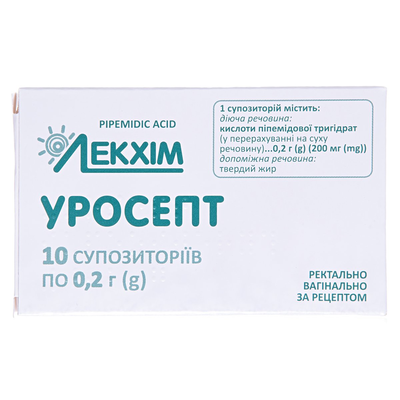
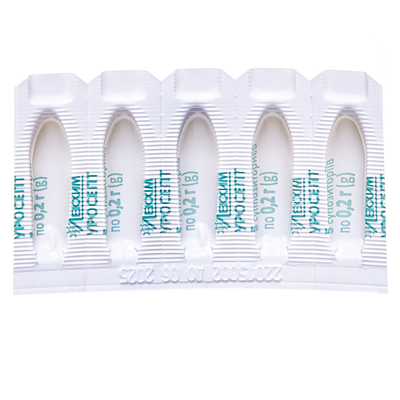
UrosEPT Suppositories, 0.2 g each, No. 10 (5 x 2)
Composition
Active ingredient: ripemidic acid;
1 suppository contains 0.2 g (200 mg) of pipemidic acid trihydrate, calculated on a dry weight basis;
Excipient: hard fat.
Dosage Form
Suppositories.
Main physical and chemical properties: The suppositories are white or white with a yellowish tint and spherical in shape. A slight coating on the surface of the suppository is permissible.
Pharmacotherapeutic group
Antibacterial agents of the quinolone group.
ATC code J01M B04.
Pharmacological properties
Pharmacodynamics.
A quinolone urinary tract antiseptic. It has bactericidal activity and is active against most Gram-negative microorganisms, as well as against some Gram-positive microorganisms, particularly Staphylococcus aureus.
Pharmacokinetics.
The maximum concentration of the drug in blood plasma is reached 2–3 hours after administration and coincides with the maximum concentration of the drug in urine. It is excreted by the kidneys unchanged.
Indications
Infectious and inflammatory diseases caused by microorganisms sensitive to pipemidic acid, including pyelonephritis, urethritis, cystitis, prostatitis, and nonspecific colpitis.
Contraindications
Hypersensitivity to pipemidic acid, quinolones, or any other component of the drug. Severe renal insufficiency (creatinine clearance less than 10 mL/min), severe hepatic dysfunction. Liver cirrhosis, porphyria. Central nervous system disorders (epilepsy, neurological conditions with a low seizure threshold).
Drug Interactions and Other Interactions
With long-term use of pipemidic acid, the half-life of theophylline is prolonged, resulting in a 40–80% increase in its serum concentration. Therefore, patients taking theophylline should have their serum theophylline levels monitored more frequently.
Quinolones increase serum caffeine concentrations; pipemidic acid may result in a 2- to 4-fold increase in caffeine levels.
This medication may enhance the effects of warfarin, rifampicin, and cimetidine when used concomitantly.
Concomitant use of quinolones and nonsteroidal anti-inflammatory drugs increases the risk of seizures.
Antacids (aluminum, magnesium, and calcium-containing drugs) and sucralfate significantly reduce the absorption of pipemidic acid; therefore, they should not be administered simultaneously. The interval between doses of these medications should be 2–3 hours. However, this effect was not observed when used in combination with cimetidine and ranitidine.
A synergistic bactericidal effect occurs when used with aminoglycosides.
Special Considerations
Patients should drink plenty of fluids during treatment.
In rare cases, Uroscept may cause seizures; therefore, treatment is contraindicated in patients with epilepsy and other neurological disorders characterized by a lowered seizure threshold.
Due to the risk of an acute porphyria attack, treatment is contraindicated in patients with porphyria.
Caution should be exercised when prescribing the drug to patients over 70 years of age, as side effects are more common in the elderly.
Patients should be advised to avoid direct sunlight and artificial ultraviolet radiation during treatment with pipemidic acid due to the potential for photosensitization.
Superinfections caused by resistant bacteria and fungi may develop.
The drug should be used with caution in patients with glucose-6-phosphate dehydrogenase deficiency, as quinolones may cause an acute hemolytic crisis.
Pseudomembranous colitis may develop with long-term treatment with pipemidic acid; therefore, appropriate measures should be taken if the patient develops diarrhea.
Treatment with pipemidic acid may alter the intestinal flora, resulting in an increase in the number of Clostridium difficile bacteria and, consequently, the development of pseudomembranous colitis.
In adolescents, the drug may affect temporary cartilage tissue; therefore, pipemidic acid is contraindicated in children under 18 years of age.
Allergic reactions most commonly occur in individuals with hypersensitivity to acetylsalicylic acid.
Laboratory tests. A false-positive reaction for glucose in the urine may occur.
Pregnancy and lactation.
The drug is contraindicated during pregnancy or lactation.
Affects the ability to operate vehicles and machinery.
While taking this medication, you should refrain from driving or operating machinery, as dizziness and visual disturbances may occur (see the “Side Effects” section).
Directions for Use and Dosage
Before using a suppository, you must:
- tear off 1 suppository from the primary packaging along the perforation line of the blister pack;
- Next, pull on the edges of the film, tearing it apart in opposite directions, and remove the suppository from the primary packaging.
Administer 1 suppository vaginally or rectally twice daily for 10 days. If necessary, the daily dose may be increased to 3 suppositories, i.e., 1 suppository 3 times daily.
Children.
This medication should not be used to treat children.
Overdose
Symptoms: nausea, vomiting, dizziness, headache, confusion, tremors, and seizures.
Treatment: If the patient remains conscious after ingesting a large amount of the drug, it is recommended to induce vomiting, perform gastric lavage, and administer activated charcoal.
Pipemidic acid is removed by hemodialysis (90% within 6 hours).
If CNS side effects occur (including epileptiform seizures), symptomatic treatment (diazepam) should be administered.
Side Effects
Local reactions: irritation, pain, itching at the injection site.
Systemic reactions:
Blood and lymphatic system: Eosinophilia is rare, and reversible thrombocytopenia has been observed in elderly patients and patients with renal impairment. Hemolytic anemia may occur in individuals with glucose-6-phosphate dehydrogenase deficiency;
Psychiatric disorders: agitation, depression, confusion, hallucinations;
nervous system disorders: tremor, sleep disturbances, sensory disturbances, dizziness; very rarely—seizures, dizziness, headache;
Eye disorders: visual disturbances;
skin and subcutaneous tissue disorders: hypersensitivity reactions, including skin rash, itching, photosensitivity, Stevens-Johnson syndrome; rarely—angioedema. Skin reactions are reversible. There have been reports of anaphylactic reactions. Due to the possibility of cross-sensitivity to other quinolones, caution is required when treating patients who have had an anaphylactic reaction to any quinolone;
Musculoskeletal disorders: acute arthropathy, tendinitis;
gastrointestinal disorders: anorexia, epigastric pain, heartburn, nausea, vomiting, flatulence, abdominal pain, diarrhea, or constipation; rarely—pseudomembranous colitis;
Other: rarely—weakness, development of resistance, superinfection.
If signs of hypersensitivity reactions, anaphylactic shock, toxic epidermal necrolysis, or seizures appear, treatment should be discontinued immediately.
Shelf life
3 years.
Storage conditions
Keep out of reach of children. Store in the original packaging at a temperature not exceeding 25 °C.
Packaging
5 suppositories per blister; 2 blisters per package.
Conditions of Sale
By prescription only.