
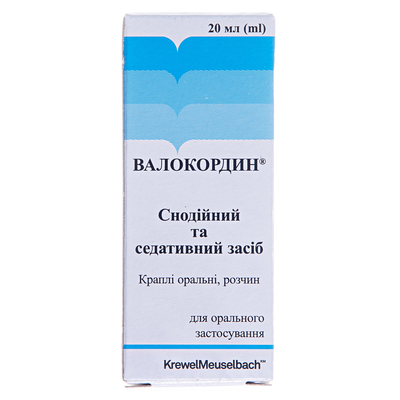
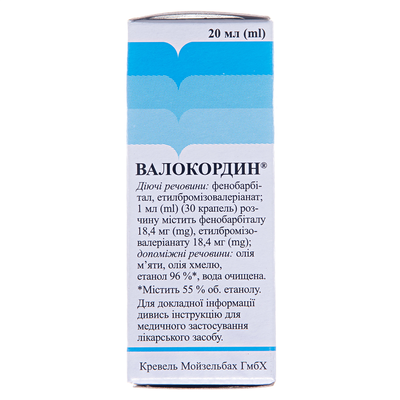
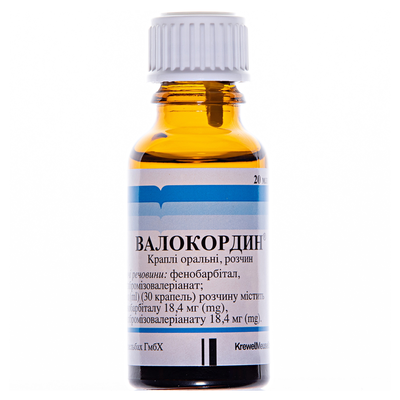
Valocordin Drops, oral solution, 20 ml per dropper bottle.
Ingredients
Active ingredients: phenobarbital, ethylbromizovalerate;
1 mL (30 drops) of solution contains 18.4 mg of phenobarbital and 18.4 mg of ethylbromovalerate;
Excipients: peppermint oil, hop oil, 96%* ethanol, purified water.
*The finished product contains 55% v/v ethanol.
Dosage Form
Oral drops, solution.
Main physical and chemical properties: a colorless solution with a fragrant odor and a bitter taste.
Pharmacotherapeutic group
Hypnotics and sedatives. Barbiturates in combination with drugs from other groups. ATC code N05C B02.
Pharmacological properties
Pharmacodynamics.
Valocordin® is a combination drug containing phenobarbital and ethylbromizovalerate (ethyl ester of α-bromizovaleric acid). Depending on the dose, both of these substances have sedative and hypnotic effects, and at high doses, they produce a narcotic effect. Like other barbituric acid derivatives, phenobarbital inhibits the reticular formation’s inhibitory system. Ethylbromizovalerate exhibits both antispasmodic and sedative properties. At the concentration found in Valocordin®, ethylbromovalerianate acts as a synergist for phenobarbital (rapid onset of action).
Pharmacokinetics.
Phenobarbital is rapidly absorbed (directly in the stomach). Approximately 35% of it binds to plasma proteins; the unbound portion is filtered by the kidneys. Reabsorption occurs at low pH levels. Reversible diffusion does not occur due to the alkalinity of urine. Approximately 30% of phenobarbital is excreted unchanged in the urine, and only a small portion is oxidized in the liver. With prolonged use, the active ingredient accumulates in the blood plasma, and liver enzymes are induced. As a result of this induction, the oxidation of phenobarbital and other drugs is accelerated.
The bromine in ethylbromizovalerate is excreted from the body very slowly. If the drug is used for a prolonged period, it accumulates in the central nervous system, leading to chronic bromine intoxication.
Indications
- Functional disorders of the cardiovascular system;
- neuroses accompanied by increased irritability and feelings of fear;
- psychosomatically induced anxiety;
- states of agitation with pronounced autonomic symptoms;
- difficulty falling asleep.
Contraindications
Hypersensitivity to the active ingredients or to any other component of the drug, acute hepatic porphyria, severe liver and kidney dysfunction, diabetes mellitus, depression, myasthenia gravis. Medications containing phenobarbital are contraindicated in cases of alcoholism, drug dependence, and substance abuse (including a history thereof); in cases of respiratory diseases with shortness of breath, obstructive syndrome, severe arterial hypotension, or acute myocardial infarction; in depressive disorders where the patient is prone to suicidal behavior.
Interactions with Other Medications and Other Types of Interactions
When this medication is used with other drugs that depress the central nervous system (CNS), there may be a synergistic increase in effect (sedative-hypnotic effect), which may be accompanied by respiratory depression. Alcohol potentiates the drug’s effects and may increase its toxicity.
Medications containing valproic acid enhance the effects of barbiturates.
Phenobarbital induces liver enzymes and, consequently, may accelerate the metabolism of certain drugs metabolized by liver enzymes (e.g., coumarin derivatives, antibiotics, and sulfonamides). Phenobarbital potentiates the effects of analgesics, anesthetics, anesthetic agents, neuroleptics, and tranquilizers; it reduces the effects of acetaminophen, indirect anticoagulants, metronidazole, tricyclic antidepressants, salicylates, and digitoxin.
It may affect the blood concentration of phenytoin, as well as carbamazepine and clonazepam. MAO inhibitors prolong the effect of phenobarbital. Rifampin may reduce the effect of phenobarbital. When used with gold-containing drugs, the risk of kidney damage increases. With prolonged concomitant use with nonsteroidal anti-inflammatory drugs, there is a risk of gastric ulcers and bleeding. Concomitant use of phenobarbital-containing medications with zidovudine increases the toxicity of both drugs. Undesirable interactions of Valocordin® (contains phenobarbital) with lamotrigine, thyroid hormones, doxycycline, chloramphenicol, antifungal agents (azole group), griseofulvin, glucocorticoids, and oral contraceptives due to the potential for reduced efficacy of the aforementioned drugs.
This medication increases the toxicity of methotrexate.
Special Considerations for Use
Life-threatening skin reactions, including Stevens-Johnson syndrome and toxic epidermal necrolysis, have been reported with the use of phenobarbital.
Patients should be warned about the signs and symptoms and closely monitored for skin reactions. The highest risk of Stevens-Johnson syndrome or toxic epidermal necrolysis occurs during the first weeks of treatment.
If symptoms of Stevens-Johnson syndrome or toxic epidermal necrolysis are observed (e.g., progressive skin rashes, often with blisters, and mucosal lesions), treatment should be discontinued.
The best outcomes in the treatment of Stevens-Johnson syndrome or toxic epidermal necrolysis have been observed with early diagnosis and immediate discontinuation of any drug suspected of causing these symptoms. The best prognosis for treatment is associated with early discontinuation of the suspected medication.
If a patient develops Stevens-Johnson syndrome or toxic epidermal necrolysis while taking Valocordin®, the drug must not be administered to these patients under any circumstances.
If chest pain persists after taking the medication, consult a doctor to rule out acute coronary syndrome. Use with caution in patients with hyperkinesis, hyperthyroidism, adrenal insufficiency, decompensated heart failure, severe hypotension, persistent pain, or acute drug intoxication.
Valocordin® contains 55% v/v ethanol.
Long-term use of Valocordin® is not recommended due to the risk of drug dependence, possible accumulation of bromine in the body, and the development of bromine poisoning.
Use during pregnancy or breastfeeding.
Contraindicated during pregnancy and breastfeeding.
Effect on reaction time when operating motor vehicles or other machinery.
Valocordin® impairs reaction time. Patients taking this medication should refrain from potentially hazardous activities that require increased attention and rapid mental and motor reactions.
Dosage and Administration
Prescribed for adults.
Take orally with meals, dissolving a single dose in a small amount of liquid.
The usual dosage is 22–30 drops 3 times daily; if the patient has insomnia, the dose may be increased to 45 drops.
The duration of treatment is determined by the physician.
Children.
There is no experience with the use of this medication in children.
Overdose
Symptoms.
Acute (mild to moderate) barbiturate poisoning:
dizziness, fatigue, and even deep sleep from which the patient cannot be awakened.
Hypersensitivity reactions may occur: angioedema, hives, itching, rash.
Acute severe poisoning:
deep coma accompanied by tissue hypoxia, shallow breathing—initially rapid, then slowed breathing, rapid heartbeat, cardiac arrhythmia, low blood pressure, bradycardia, vascular collapse, weakening or loss of reflexes, nystagmus, headache, nausea, weakness, cardiac dysfunction, decreased body temperature, slowed pulse, and reduced urine output.
If poisoning is left untreated, it may be fatal as a result of circulatory failure, respiratory paralysis, or pulmonary edema.
Long-term use of bromine-containing medications can lead to bromine poisoning, which is characterized by the following symptoms: confusion, ataxia, apathy, depressed mood, conjunctivitis, a cold, acne, or purpura.
Treatment.
Cases of acute Valocordin® poisoning should be treated in the same manner as poisoning with other sedatives and barbiturates, depending on the severity of the symptoms. The patient should be transferred to the intensive care unit. Respiration and circulation must be stabilized and normalized. Respiratory failure is treated with artificial respiration, and shock is managed with infusions of plasma and plasma substitutes. If a significant amount of time has elapsed since ingestion, gastric lavage is necessary (10 g of activated charcoal powder and sodium sulfate are administered into the stomach). To rapidly eliminate the barbiturate from the body, forced diuresis with alkalis, as well as hemodialysis and/or hemoperfusion, may be performed.
Treatment of bromine poisoning: The elimination of bromine ions from the body can be accelerated by administering a significant amount of a table salt solution along with saluretic agents.
If hypersensitivity reactions occur, prescribe desensitizing medications.
Side Effects
Neurological: asthenia, weakness, impaired coordination, nystagmus, ataxia, hallucinations, paradoxical excitement, insomnia (in elderly patients), decreased concentration, fatigue, slowed reactions, headache, cognitive impairment. In isolated cases, drowsiness, mild dizziness, and confusion may occur.
Musculoskeletal system: With long-term use of phenobarbital-containing medications, there is a risk of impaired osteogenesis and the development of rickets. There have been reports of reduced bone mineral density, osteopenia, osteoporosis, and fractures in patients receiving long-term phenobarbital therapy. The mechanism by which phenobarbital affects bone metabolism has not been identified.
Gastrointestinal system: nausea, vomiting, constipation, epigastric discomfort; with long-term use—liver dysfunction.
Hematopoietic system: agranulocytosis, megaloblastic anemia, thrombocytopenia, anemia.
Cardiovascular system: decreased blood pressure, bradycardia.
Very rare: allergic reactions, including angioedema, difficulty breathing, facial swelling, rash, and itching.
Serious skin adverse reactions reported with phenobarbital use: Stevens-Johnson syndrome and toxic epidermal necrolysis, urticaria, Lyell’s syndrome, rhinitis, conjunctivitis, acne, purpura, and epiphora.
Shelf life
3 years.
Storage conditions
Store in the original packaging at a temperature not exceeding 25 °C.
Keep out of reach of children.
Incompatibility
None known.
Packaging
20-mL or 50-mL dropper bottle, 1 dropper bottle per cardboard box.
Dispensing Category
Over-the-counter – 20 mL; by prescription – 50 mL.







