
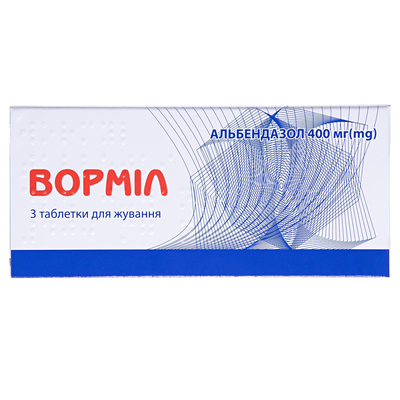

Wormil Chewable Tablets, 400 mg, No. 3
Ingredients
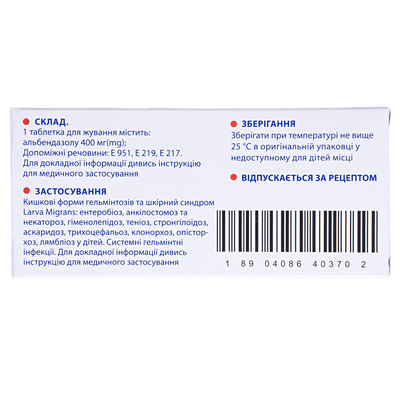
Active ingredient: albendazole;
1 chewable tablet contains 400 mg of albendazole;
Excipients: corn starch, microcrystalline cellulose, sodium methylparaben (E 219), sodium propylparaben (E 217), sodium starch glycolate (type A), colloidal anhydrous silicon dioxide, talc, magnesium stearate, dried mixed fruit essence, aspartame (E 951), sodium lauryl sulfate.
Dosage Form
Chewable tablets.
Main physical and chemical properties: white or cream-white, oblong, biconvex, uncoated tablets with a score line and the imprint “VORMIL.”
Pharmacotherapeutic group
Anthelmintics. Agents used against nematodes. Benzimidazole derivatives. ATX code R02C A03.
Pharmacological Properties
Pharmacodynamics.
Albendazole is a broad-spectrum antiprotozoal and anthelmintic drug from the benzimidazole carbamate group. The drug acts on both intestinal and tissue parasites in the form of eggs, larvae, and adult helminths. The anthelmintic action of albendazole is due to the inhibition of tubulin polymerization, which leads to metabolic disruption and the death of helminths.
Albendazole is active against the following intestinal parasites: nematodes—Ascaris lumbricoides, Trichuris trichiura, Enterobius vermicularis, Ancylostoma duodenale, Necator americanus, Strongyloides stercoralis, Cutaneus Larva Migrans; cestodes—Hymenolepsis nana, Taenia solium, Taenia saginata; trematodes—Opisthorchis viverrini, Clonorchis sinensis; Protozoa – Giardia lamblia (intestinal or duodenal).
Albendazole is active against tissue parasites, including cysts and alveolar echinococcosis caused by infection with Echinococcus granulosus and Echinococcus multilocularis, respectively. Albendazole is an effective treatment for neurocysticercosis caused by infection with Taenia solium larvae, capillariasis caused by Capillaria philippinensis, and gnathostomiasis caused by Gnathostoma spinigerum.
Albendazole destroys cysts or significantly reduces their size (by up to 80%) in patients with granulocystic echinococcosis. After treatment with albendazole, the proportion of nonviable cysts increases to 90%, compared with 10% in untreated patients. Following the use of albendazole to treat cysts caused by Echinococcus multilocularis, complete recovery was observed in a minority of patients, while the majority experienced improvement or stabilization of their condition.
Pharmacokinetics.
After oral administration, the drug is poorly absorbed (up to 5%) from the gastrointestinal tract. Concomitant intake of fatty foods increases absorption of the drug approximately fivefold.
Albendazole is rapidly metabolized in the liver during first-pass metabolism. The major metabolite, albendazole sulfate, retains half the pharmacological activity of the parent compound.
The plasma half-life of albendazole sulfate is approximately 8.5 hours. Albendazole sulfate and other metabolites are excreted primarily in bile, with only a small portion excreted in urine. After prolonged use of the drug in high doses, its elimination from the cysts takes several weeks.
Indications
Intestinal helminthiases and cutaneous larva migrans syndrome (short-term treatment with low doses): enterobiasis, ankylostomiasis and necatoriasis, hymenolepiasis, taeniasis, strongyloidosis, ascariasis, trichocephalosis, clonorchiasis, opisthorchiasis, and giardiasis in children.
Systemic helminthiasis (long-term treatment with high doses):
Cystic echinococcosis (caused by Echinococcus granulosus):
- if surgical intervention is not possible;
- before surgery;
- after surgery, if preoperative treatment was brief, if helminths predominate, or if live forms were detected during surgery;
- after percutaneous drainage of cysts for diagnostic or therapeutic purposes;
Alveolar echinococcosis (caused by Echinococcus multiocularis):
- in cases of inoperable disease, particularly with local or distant metastases;
- after palliative surgery;
- after radical surgery or liver transplantation;
neurocysticercosis (caused by Taenia solium larvae):
- in the presence of single or multiple cysts or granulomatous lesions of the brain;
- in cases of arachnoid or intraventricular cysts;
- in cases of rastemosis cysts;
capillariasis (caused by Capillaria philippinensis), gnathostomiasis (caused by Gnathostoma spinigerum and related species), trichinosis (caused by Trichinella spiralis and T. pseudospiralis), toxocariasis (caused by Toxocara canis and related species).
Contraindications
Hypersensitivity to albendazole, other benzylidazole derivatives, or other components of the medication. Retinal disorders. Women planning to become pregnant. Women of childbearing age should use effective nonhormonal contraceptives during treatment and for 1 month afterward. Phenylketonuria.
Drug Interactions and Other Interactions
Albendazole induces cytochrome P450 enzymes.
Concomitant use with cimetidine, praziquantel, and dexamethasone may increase the plasma levels of albendazole metabolites, which are responsible for the drug’s systemic activity; this, in turn, may lead to an overdose.
Medications that may slightly reduce the efficacy of albendazole include anticonvulsants (e.g., phenytoin, fosphenytoin, carbamazepine, phenobarbital, primidone), levamisole, and ritonavir.
The drug’s effectiveness in patients should be monitored, and alternative dosing regimens or therapies may be required.
Gray fruit juice also increases the plasma levels of albendazole sulfoxide.
Due to the potential for cytochrome P450 inhibition, there is a theoretical risk of interactions with the following medications: oral contraceptives, anticoagulants, oral hypoglycemic agents, and theophylline.
When albendazole is used concomitantly with theophylline, theophylline levels in the blood should be monitored.
The systemic effect is enhanced when the drug is taken with food.
Special Considerations
Short-term treatment of intestinal infections and the skin condition Larva Migrans.
For the prophylactic use of Vormil during early pregnancy, women of childbearing age should undergo treatment during the first week after menstruation or after a negative pregnancy test. Reliable contraception is required during therapy.
Treatment with albendazole may reveal the presence of pre-existing neurocysticercosis, especially in areas with high rates of infection with Taenia solium strains. Patients may experience neurological symptoms such as seizures, increased intracranial pressure, and focal symptoms due to an inflammatory reaction caused by the death of parasites in the brain. Symptoms may appear rapidly after treatment, so appropriate therapy with corticosteroids and anticonvulsants should be initiated immediately.
Long-term treatment of systemic helminthiasis.
Treatment with albendazole is associated with a mild or moderate elevation in liver enzymes, which usually returns to normal after treatment is discontinued. Cases of hepatitis have been reported. Therefore, liver enzyme levels should be checked before starting each course of treatment and at least once every 2 weeks during treatment. If liver enzymes rise significantly (more than twice the upper limit of normal), treatment with albendazole should be discontinued. Treatment may be resumed once enzyme levels return to normal, but the patient’s condition should be closely monitored.
Albendazole may cause bone marrow suppression; therefore, the patient’s blood tests should be performed both at the start of treatment and every 2 weeks during the 28-day treatment cycle. Patients with liver disease, including hepatic echinococcosis, are more prone to bone marrow suppression, which can lead to pancytopenia, aplastic anemia, agranulocytosis, and leukemia, requiring careful monitoring of blood counts. If blood counts decrease significantly, treatment should be discontinued (see the “Dosage and Administration” and “Side Effects” sections).
It can be used during deworming prior to vaccination, as well as for prophylactic treatment twice a year.
Patients with neurocysticercosis receiving albendazole treatment may experience symptoms (e.g., seizures, increased intracranial pressure, and focal symptoms) associated with an inflammatory reaction caused by the death of the parasite. This should be treated with corticosteroids and anticonvulsants. Oral or intravenous corticosteroids are recommended to prevent increased intracranial pressure during the first week of treatment.
To prevent the use of Vormil in women in early pregnancy, as well as in women of reproductive age, the following should be observed:
- begin treatment only after a negative pregnancy test;
- advise them on the need to use effective contraception during treatment and for one month after discontinuation.
Treatment with albendazole may reveal the presence of pre-existing neurocysticercosis, especially in areas with high rates of infection with Taenia solium strains. Patients may experience neurological symptoms such as seizures, increased intracranial pressure, and focal symptoms due to an inflammatory reaction caused by the death of parasites in the brain. Symptoms may appear rapidly after treatment; therefore, appropriate therapy with corticosteroids and anticonvulsants should be initiated immediately.
The presence of sodium propylparaben and sodium methylparaben in the medication may cause allergic reactions (possibly delayed).
Pregnancy and Lactation
This medication is contraindicated during pregnancy or lactation, or for the treatment of women planning to become pregnant.
Effect on the ability to drive and operate machinery
Given the possibility of side effects such as dizziness, it is recommended to refrain from driving or operating machinery while taking albendazole.
Dosage and Administration
Intestinal infections and Larva Migrans skin syndrome.
The medication should be taken with food. It is preferable to take it at the same time each day. If recovery does not occur within three weeks, a repeat course of treatment is prescribed.
The tablet may be chewed or crushed and taken with a small amount of water.
| Infection | Age | Duration of Treatment |
| Enterobiasis, ankylostomiasis, necatoriasis, ascariasis, trichocephalosis | Adults and children over 2 years of age.
For children aged 1 to 2 years, appropriate doses should be administered as an oral suspension. |
400 mg once daily (1 tablet) as a single dose.
|
| Strongyloidosis, taeniasis, hymenolepiasis | Adults and children over 2 years of age. | 400 mg once daily (1 tablet) for 3 days. For hymenolepiasis, it is recommended to repeat the course of treatment between
the 10th to the 21st day after the previous course. |
| Clonorchiasis, opisthorchiasis | Adults and children over 2 years of age. | 400 mg (1 tablet) twice daily for 3 days. |
| Cutaneous larval migration syndrome | Adults and children over 2 years of age. | 400 mg (1 tablet) once daily for 1–3 days. |
| Giardiasis | Only children aged 2 to 12 years. | 400 mg (1 tablet) once daily for 5 days. |
Systemic helminthiasis (long-term treatment with high doses).
The medication should be taken with food.
High doses of this medication are not recommended for children under 6 years of age. The dosing regimen is determined by the doctor on an individual basis, depending on age, body weight, and the severity of the infection.
The dose for patients weighing more than 60 kg is 400 mg (1 tablet) twice daily. If body weight is less than 60 kg, the medication should be prescribed at a rate of 15 mg/kg/day. This dose should be divided into 2 doses. The maximum daily dose is 800 mg.
| Infection | Duration of Treatment |
| Cystic echinococcosis | 28 days. The 28-day cycle may be repeated (up to 3 times) after a 14-day break. |
| Inoperable and multiple cysts | Up to 3 cycles of 28 days each for the treatment of hepatic, pulmonary, and peritoneal cysts. For cysts in other locations (such as in the bones or brain), longer treatment may be required. |
| Before surgery | Two 28-day cycles are recommended before surgery. If surgery must be performed before these cycles are completed, treatment should be continued for as long as possible until the start of surgery. |
| After surgery
After percutaneous cyst drainage |
If a short course of treatment (less than 14 days) was received before surgery or in the case of emergency surgery, two 28-day treatment cycles, separated by a 14-day break in medication use, should be administered after surgery.
Similarly, if viable cysts are detected or the helminths have spread, two full treatment cycles should be administered. |
| Alveolar
Echinococcosis |
28 days. The second 28-day course should be repeated after a two-week break in taking the medication. Treatment may be extended over several months or years. |
| Neurocysticercosis** | The duration of treatment ranges from 7 to 30 days. A second course may be repeated after a two-week break from taking the medication. |
| Parenchymal cysts and granulomas | The usual duration of treatment ranges from 7 days (minimum) to 28 days. |
| Arachnoid and intraventricular cysts | The usual course of treatment is 28 days. |
| Racemose cyst | The usual course of treatment is 28 days and may last longer. The duration of treatment is determined by the clinical and radiographic response to treatment. |
| Capillariosis | 400 mg once daily for 10 days.
One course of treatment is usually required, but further courses may be necessary if the results of parasitological testing remain positive. |
| Gnathostomiasis | 400 mg once daily for 10–20 days (see above). |
| Trichinosis, toxocariasis | 400 mg twice daily for 5–10 days (see above). |
** When treating patients with neurocysticercosis, appropriate corticosteroid and anticonvulsant therapy should be prescribed. Oral and intravenous corticosteroids are recommended for the prevention of cerebral hypertension during the first week of treatment.
Elderly Patients
Experience with the use of this drug in the treatment of elderly patients is limited. No dose adjustment is required; however, albendazole should be used with caution in elderly patients with hepatic insufficiency.
Renal insufficiency
Since albendazole is excreted by the kidneys in very small amounts, no dose adjustment is required for this patient population; however, if signs of renal insufficiency are present, such patients should be closely monitored.
Hepatic impairment Since albendazole is extensively metabolized in the liver to a pharmacologically active metabolite, hepatic impairment may significantly affect its pharmacokinetics. Therefore, patients with abnormal liver function tests (elevated transaminases) should be closely monitored at the start of albendazole treatment, and treatment should be discontinued if transaminases rise significantly or blood counts decrease to clinically significant levels.
Children.
This medication is contraindicated for the treatment of children under 2 years of age in this dosage form.
For children aged 1 to 2 years, Vormil is administered as an oral suspension if necessary.
Overdose
Symptoms: nausea, vomiting, diarrhea, tachycardia, drowsiness, visual disturbances, visual hallucinations, speech disturbances, dizziness, loss of consciousness, hepatomegaly, elevated transaminase levels, jaundice; respiratory failure, brownish-red or orange discoloration of the skin, urine, sweat, saliva, tears, and feces proportional to the dose administered.
Treatment: gastric lavage and symptomatic and supportive therapy.
Side Effects
Gastrointestinal: stomatitis, dry mouth, heartburn, nausea, vomiting, abdominal pain, flatulence, diarrhea, constipation, epigastric pain.
Hepatobiliary disorders: transient elevation of liver enzymes, jaundice, hepatitis, hepatocellular disorders.
Cardiovascular disorders: increased blood pressure, tachycardia.
Central and peripheral nervous system disorders: insomnia or drowsiness, headache, dizziness, confusion, disorientation, hallucinations, seizures, decreased visual acuity.
Blood and lymphatic system disorders: leukopenia, neutropenia, thrombocytopenia, anemia, including aplastic anemia; agranulocytosis, pancytopenia. Patients with liver disease, including hepatic echinococcosis, are more prone to bone marrow suppression.
Skin and subcutaneous tissue disorders: skin rashes, erythema, erythema multiforme, Stevens-Johnson syndrome, alopecia (thinning of the hair and moderate hair loss), pruritus, urticaria, pemphigus, dermatitis, edema.
Renal and urinary system disorders: impaired renal function, acute renal failure, proteinuria.
General disorders: bone pain, sore throat, fever, weakness.
Hypersensitivity reactions, including anaphylactic/anaphylactoid reactions, may occur.
Shelf life
3 years.
Storage conditions
Store at a temperature not exceeding 25 °C in the original packaging, out of the reach of children.
Packaging
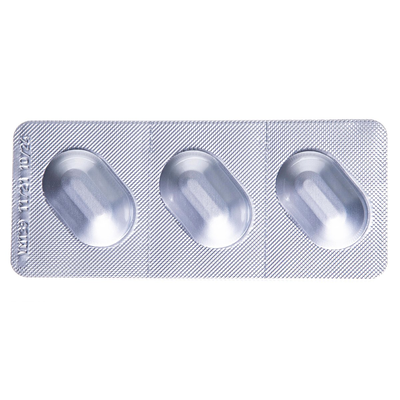
1 or 3 tablets per blister pack; 1 blister pack per package, along with the package insert.
Manufacturer
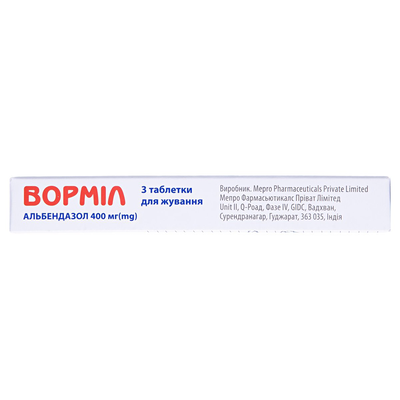
MePro Pharmaceuticals Private Limited.
Manufacturer’s location and business address.
Block II, Q-Road, Phase IV, GIDC, Vadhwan, Surendranagar, Gujarat, 363 035, India.
or
XEl Laboratories Pvt. Ltd., India.
Location of the manufacturer and its address of business operations.
E-1223, Phase I, Ext. (Ghatal) RIICO Industrial Estate, Bhivadi, Alwar District (Rajasthan), India.
Applicant
Mili Healthcares Limited.







