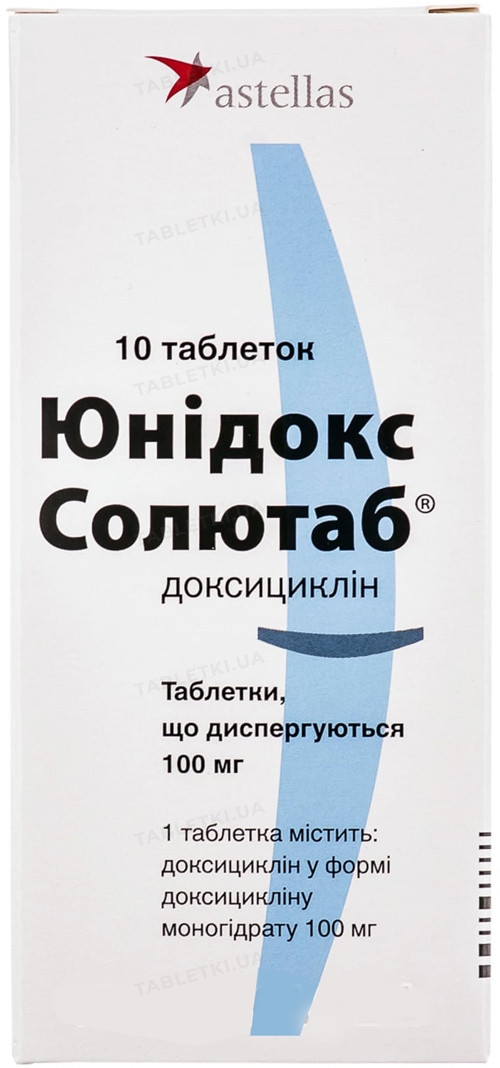
Unidox Solutab Dispersible Tablets, 100 mg, No. 10
Active ingredient: doxycycline;
1 tablet contains 100 mg of doxycycline in the form of doxycycline monohydrate;
Inactive ingredients: microcrystalline cellulose, saccharin, low-substituted hydroxypropyl cellulose, hypromellose, anhydrous colloidal silicon dioxide, magnesium stearate, lactose monohydrate.
Dosage Form
Dispersible tablets.
Main physical and chemical properties: Round, biconvex tablets ranging in color from light yellow to grayish-yellow and brown with speckles, embossed with “173” on one side and a line on the other side.
Pharmacotherapeutic group
Antibacterial agents for systemic use. Tetracycline. Doxycycline. ATC code J01A A02.
Pharmacological Properties
Pharmacodynamics.
Doxycycline has a bacteriostatic effect; its antimicrobial action is achieved by inhibiting protein synthesis. The drug is effective against a broad spectrum of Gram-positive and Gram-negative bacteria and certain other microorganisms.
Pharmacokinetics.
Tetracyclines are readily absorbed and bound to plasma proteins. They are accumulated by the liver in bile and excreted in biologically active form at high concentrations in urine and feces.
Doxycycline is almost completely absorbed after oral administration. Studies show that the absorption of doxycycline differs from that of some other tetracyclines and is not affected by concomitant food intake (including milk).
After administration of a 200-mg dose, the maximum serum concentration of doxycycline in healthy adult volunteers averaged 2.6 μg/mL after 2 hours and decreased to 1.45 μg/mL after 24 hours.
Doxycycline is a highly lipophilic substance and has a low affinity for calcium. It exhibits high stability in blood plasma. Doxycycline is not metabolized to the epi-anhydrous form.
Indications
Unidox Solutab® is used to treat infections caused by susceptible strains of Gram-positive and Gram-negative microorganisms, as well as certain other microorganisms, namely:
- Respiratory tract infections: pneumonia and other lower respiratory tract diseases caused by susceptible strains of Streptococcus pneumoniae, Haemophilus influenzae, Klebsiella pneumoniae, and others. Pneumonia caused by Mycoplasma pneumoniae. Treatment of chronic bronchitis and sinusitis.
- Urinary tract infections: infections caused by susceptible strains of Klebsiella species, Enterobacter species, as well as Escherichia coli, Streptococcus faecalis, and others.
- Sexually transmitted diseases: infections caused by Chlamydia trachomatis, including uncomplicated infections of the urethra and endocervix, as well as rectal infections. Nongonococcal urethritis caused by Ureaplasma urealyticum (T-mycoplasma). Chancroid, inguinal granuloma, and venereal granuloma. Unidox Solutab® is an alternative medication for the treatment of gonorrhea and syphilis.
- Skin infections: acne, when antibiotic therapy is necessary.
Since the active ingredient in Unidox Solutab®, doxycycline, belongs to the tetracycline class of antibiotics, it can be used to treat infections caused by microorganisms susceptible to tetracyclines, namely:
- Ophthalmic infections: infections caused by susceptible bacteria such as Neisseria gonorrhoeae, Staphylococcus species, and Haemophilus influenzae. The infection causing trachoma is not always eradicated, as confirmed by immunofluorescence testing. For the treatment of paratrachoma, Unidox Solutab® may be used as monotherapy or in combination with other medications.
- Rickettsial infections: Rocky Mountain spotted fever, typhus, Q fever, coxiella endocarditis, tick-borne fever.
- Other infections: ornithosis, brucellosis (when used in combination with streptomycin), cholera, bubonic plague, epidemic relapsing typhus; tick-borne relapsing fever; tularemia; melioidosis; chloroquine-resistant tropical malaria; and acute intestinal amebiasis (when used in combination with amebicide).
Unidox Solutab® is an alternative medication for the treatment of leptospirosis, gas gangrene, and tetanus.
Unidox Solutab® is indicated for the prevention of the following conditions: Japanese river fever, traveler’s diarrhea (caused by enterotoxigenic Escherichia coli), leptospirosis, and malaria. Malaria prophylaxis should be administered in accordance with current practice due to the potential for resistance to develop.
Contraindications
Hypersensitivity to doxycycline and tetracyclines or to any excipient in the medication.
Concomitant severe renal and/or hepatic insufficiency. Severe hepatic dysfunction. Pregnancy or breastfeeding. Children under 12 years of age.
Drug Interactions and Other Interactions
The absorption of doxycycline may be reduced when taken concomitantly with antacids containing aluminum, calcium, or magnesium, or with other medications containing these cations, as well as when taken orally with zinc, iron, or bismuth salts. The administration of doxycycline and such medications should be spaced as far apart as possible.
Activated charcoal and ion-exchange resins (cholestyramine) may reduce the absorption of doxycycline. Therefore, these medications should be taken 2–3 hours before taking doxycycline.
Quinapril may reduce the rate of doxycycline absorption due to the high magnesium content in quinapril tablets.
Medications that increase gastric acidity may negatively affect the absorption of tetracyclines, which dissolve better in an acidic environment than in an alkaline one.
Bacteriostatic drugs may affect the bactericidal effect of penicillin; therefore, it is recommended to avoid the concurrent use of doxycycline and penicillin.
There have been reports of prolonged prothrombin time in patients taking warfarin and doxycycline. Tetracyclines reduce plasma prothrombin activity; therefore, a reduction in the dose of anticoagulants may be necessary.
Concomitant use of barbiturates, carbamazepine, diphenylhydantoin, primidone, and phenytoin may reduce the half-life of doxycycline. Therefore, consideration should be given to increasing the daily dose of Unidox Solutab®.
Alcohol may shorten the half-life of doxycycline.
Several cases of pregnancy and breakthrough bleeding have been reported with the concurrent use of doxycycline and oral contraceptives.
Doxycycline may increase plasma concentrations of cyclosporine. Concomitant use of these drugs should be accompanied by careful monitoring.
Doxycycline potentiates the hypoglycemic effect of sulfonylurea derivatives. Blood glucose levels should be carefully monitored when these drugs are used concomitantly, and the dose of sulfonylurea should be reduced if necessary. If doxycycline is prescribed shortly before, during, or after a course of retinoids (e.g., acitretin, isotretinoin), there is a risk that the potentiation between the drugs may cause reversible intracranial hypertension. Therefore, concomitant use of these drugs should be avoided.
Concomitant use with methotrexate may increase the toxicity of the latter.
Concomitant treatment with digoxin or digoxin derivatives may increase digoxin concentrations in plasma, which may lead to digoxin toxicity (nausea, vomiting, dizziness, fatigue, and cardiac arrhythmias).
Concomitant use of theophylline and doxycycline increases the risk of gastrointestinal side effects.
Tetracycline may inhibit the breakdown of ergot alkaloids in the liver (isolated cases of ergotism are possible).
Fatal renal toxicity has been reported with the concurrent use of tetracyclines and methoxyflurane (see the “Special Instructions and Precautions for Use” section).
Concomitant use of isotretinoin or other systemic retinoids with doxycycline should be avoided. Each of these drugs, when used alone, may in some cases cause a reversible increase in intracranial pressure (pseudotumor cerebri) (see the “Special Instructions and Precautions for Use” section).
Laboratory Parameters.
A false increase in urinary catecholamines may be observed due to an interaction with the fluorescent test. Tetracyclines interfere with reactions involving glucose in urine.
Urine glucose tests may yield false-positive results when using the copper sulfate (Benedict’s) method. Urine glucose tests using glucose oxidase reagents may yield false-negative results.
Special Considerations
Cross-resistance and cross-sensitivity to other tetracycline antibiotics may occur.
Patients with impaired liver function.Tetracyclines may be hepatotoxic, especially when taken in high doses or concomitantly with other hepatotoxic drugs, or in the presence of pre-existing hepatic or renal insufficiency. Unidox Solutab® should be used with caution in patients with impaired liver function (see the “Contraindications” section), as well as in those who are concurrently taking potentially hepatotoxic medications. Abnormal liver function tests have been rarely reported during both oral and parenteral administration of tetracyclines, including doxycycline.
Patients with renal impairment. In patients with normal renal function, renal excretion of doxycycline is approximately 40% over 72 hours. This rate may decrease to 1–5% after 72 hours in patients with severe renal insufficiency (creatinine clearance below 10 mL/min). Studies have shown that there is no significant difference in the serum half-life of doxycycline between patients with normal renal function and those with severe renal insufficiency. Hemodialysis does not affect the serum half-life of doxycycline.
The antianabolic effects of tetracyclines may increase blood urea levels. Studies have shown that this antianabolic effect does not occur when the drug is used in patients with renal insufficiency. However, worsening azotemia may occur in patients with impaired renal function. Tetracyclines should be used with caution in patients with moderate to severe renal insufficiency under medical supervision.
Serious skin reactions. Serious skin reactions, such as exfoliative dermatitis, erythema multiforme, Stevens-Johnson syndrome, toxic epidermal necrolysis, and DRESS syndrome (drug rash with eosinophilia and systemic symptoms) (see the “Side Effects” section). If serious skin reactions occur, doxycycline should be discontinued immediately and appropriate therapy initiated.
Photosensitivity. This effect manifests as an increased reaction to sun exposure and has been observed in some patients taking tetracyclines, including doxycycline. Patients who will be exposed to sunlight or ultraviolet radiation should be informed of the possibility of this reaction and that treatment should be discontinued at the first sign of erythema.
Cases of photoonycholysis have been reported in patients taking doxycycline (see the “Side Effects” section). During treatment with doxycycline, exposure to sunlight and tanning beds should be avoided.
Overgrowth of microorganisms. Treatment with doxycycline may lead to overgrowth of non-susceptible pathogens (e.g., Candida) on the skin or mucous membranes (genital tract, oral cavity, and intestines) as a result of selection (see the “Side Effects” section). Any resulting infections require treatment.
Cases of pseudomembranous colitis have been reported in patients receiving antibacterial agents, including doxycycline. The severity of the condition ranged from mild to life-threatening. It is important to consider pseudomembranous colitis and staphylococcal enteritis in patients with diarrhea resulting from antibiotic therapy. Depending on the diagnosis, vancomycin and teicoplanin should be used to treat pseudomembranous colitis, and cloxacillin should be used to treat staphylococcal enteritis. In such situations, intestinal motility inhibitors should not be used.
When using antibacterial drugs, including doxycycline, cases of Clostridium difficile-associated diarrhea (CDAD) have been reported, ranging in severity from mild to fatal. The use of antibacterial drugs affects the normal intestinal microflora and leads to increased growth of C. difficile.
- C. difficile produces toxins A and B, which, in turn, contribute to the development of CDAD.
Toxin-producing strains of C. difficile can increase morbidity and mortality, as such infections are resistant to antibiotic therapy and may require colectomy. It is important to consider this diagnosis in patients with diarrhea resulting from antibiotic therapy. A thorough medical history is necessary, as CDAD has been reported to occur as late as 2 months after the completion of antibiotic therapy.
Esophagitis. Cases of esophagitis and esophageal ulcers have been reported with the use of tetracyclines, including doxycycline, in tablet and capsule form. Most patients with these complaints take the medication immediately before bedtime or without sufficient fluid intake. This medication should be taken with plenty of fluid (water) to prevent irritation of the esophagus and the formation of ulcers (see the “Dosage and Administration” section). Tablets should be swallowed while sitting or standing.
Cases of fontanelle protrusion in newborns and benign intracranial hypertension in young children and adults have been reported with the use of full therapeutic doses of tetracyclines. These conditions resolve rapidly upon discontinuation of the drug.
Benign intracranial hypertension. Cases of fontanelle bulging have been reported in infants receiving tetracyclines. Benign intracranial hypertension (pseudotumor cerebri) has been associated with the use of tetracyclines, including doxycycline. Benign intracranial hypertension is usually transient, but cases of irreversible vision loss due to benign intracranial hypertension have been reported with the use of tetracyclines, including doxycycline. If visual disturbances occur during treatment, an urgent ophthalmologic examination is required. Since intracranial pressure may remain elevated for several weeks after discontinuation of the drug, patients should remain under observation until their condition stabilizes. Concomitant use of isotretinoin or other systemic retinoids with doxycycline should be avoided, as isotretinoin is also known to cause benign intracranial hypertension (see the “Drug Interactions and Other Interactions” section).
Porphyria. Porphyria has rarely been reported in patients receiving tetracyclines.
Sexually Transmitted Diseases. During treatment for sexually transmitted diseases, if syphilis is suspected as a concomitant condition, appropriate diagnostic testing, including dark-field microscopy, should be performed. In such cases, serological testing should be performed monthly for at least 4 months.
Infections caused by β-hemolytic streptococci. For infections caused by Group A β-hemolytic streptococci, treatment should be continued for at least 10 days.
Myasthenia gravis. Due to the possibility of mild neuromuscular blockade, the drug should be used with caution in patients with myasthenia gravis.
Systemic lupus erythematosus. The use of tetracyclines may lead to an exacerbation of systemic lupus erythematosus.
Methoxyflurane. Methoxyflurane should be used with caution in combination with tetracyclines.
Jarisch-Herxheimer reaction. In some patients with spirochetal infections, a Jarisch-Herxheimer reaction may occur immediately after the start of treatment with doxycycline. Patients should be informed that this reaction is a consequence of antibiotic treatment for spirochetal infections.
The use of tetracyclines may affect blood clotting (prolongation of prothrombin time). Therefore, tetracyclines should be used with particular caution in patients with coagulation disorders (see the section “Interactions with Other Medications and Other Forms of Interaction”).
During long-term treatment, periodic laboratory monitoring of organ and system function is necessary, including assessment of hematopoietic system function, as well as renal and hepatic function. If abnormalities are detected, treatment should be discontinued.
It has been reported that long-term use of tetracyclines causes the thyroid gland to turn a brownish-black color, as observed under a microscope. No cases of thyroid dysfunction have been reported.
Long-term use of tetracyclines may cause vitamin B deficiency due to the elimination of bacteria that produce vitamin B.
Increased excretion of ascorbic and folic acids has been observed during tetracycline therapy, but this is generally not clinically significant.
This medication contains lactose; therefore, patients with rare hereditary forms of galactose intolerance, lactase deficiency, or glucose-galactose malabsorption should not take this medication.
Pregnancy and lactation.
Pregnancy
This medication is contraindicated during pregnancy. The risks associated with the use of tetracyclines during pregnancy are primarily due to their effects on the development of teeth, bones, and the skeleton (see the “Children” section for use during tooth development).
During pregnancy, there is an increased risk of liver damage when taking tetracyclines.
Breastfeeding.
Tetracyclines pass into breast milk; therefore, use of this medication is contraindicated during breastfeeding (see the “Children” section for use during tooth development).
Effects on the ability to drive and operate machinery.
The effect of doxycycline on the ability to drive or operate machinery has not been studied. If side effects such as hypotension, dizziness, ringing in the ears, blurred vision, scotoma, diplopia, or prolonged loss of vision, you should refrain from driving or operating machinery (see the “Side Effects” section).
Dosage and Administration
Unidox Solutab® is intended for oral use only.
Place the tablet in a glass of water and stir well until a homogeneous mixture forms. Drink the mixture immediately. The medication should be taken while sitting or standing, well before bedtime, to reduce the risk of esophagitis or esophageal ulcers. It is recommended to take the mixture with food.
The score line is not intended to divide the tablet into equal doses; it is for aesthetic purposes only.
Adults. The usual dose of Unidox Solutab® for adults for the treatment of acute infections is 200 mg on the first day of treatment (1 dose or 100 mg every 12 hours) and 100 mg per day on subsequent days. For the treatment of severe infections, the drug should be administered at a dose of 200 mg per day throughout the entire treatment period.
Exceeding the recommended dose may increase the frequency of adverse reactions. Treatment should be continued for 24–48 hours after the disappearance of symptoms and fever.
For streptococcal infections, treatment should be continued for 10 days to prevent the development of rheumatic fever or glomerulonephritis.
Children. For children over 12 years of age weighing up to 45 kg, the recommended dose is 4.4 mg/kg of body weight (on the first day of treatment, the recommended dose should be administered in 1 or 2 doses); on subsequent days, the dose is 2.2 mg/kg of body weight (in 1 or 2 doses); for more severe infectious diseases, a dose of up to 4.4 mg/kg of body weight may be prescribed.
Children weighing more than 45 kg should be given the standard adult dose.
Use of the drug for the treatment of certain infections.
- Acne: The recommended dose is 50 mg daily with food (including liquids) for 6–12 weeks.
- Sexually transmitted diseases: For the treatment of conditions such as uncomplicated gonococcal infections (excluding anorectal infections in men), uncomplicated infections of the urethra and endocervix, rectal infections caused by Chlamydia trachomatis, and nongonococcal urethritis caused by Ureaplasma urealyticum, the recommended dose is 100 mg twice daily for 7 days.
For the treatment of acute epididymitis caused by Chlamydia trachomatis or Neisseria gonorrhoeae, the drug should be administered at a dose of 100 mg twice daily for 10 days.
For the treatment of primary and secondary syphilis, the recommended dose for female patients without confirmed pregnancy or penicillin allergy is 200 mg orally twice daily for 2 weeks (as an alternative to penicillin therapy).
- Epidemic typhoid fever, tick-borne relapsing fever: The recommended dose is 100–200 mg as a single dose, depending on the severity of the disease.
- Chloroquine-resistant tropical malaria: The recommended dose is 200 mg daily for at least 7 days due to the potential for severe infectious disease.
Fast-acting schizonticides (e.g., quinine) should always be used as adjunctive therapy with Unidox Solutab®, the dose of which varies on a case-by-case basis due to the potential for severe infectious disease.
- Malaria prophylaxis: The recommended dose for adults is 100 mg per day. For children over 12 years of age, the recommended dose ranges from 2 mg/kg per day up to a total daily dose of 100 mg. Prophylaxis may be started 1–2 days before traveling to a malaria-endemic region. Prophylactic use should be continued daily while in the malaria-endemic region and for 4 weeks after leaving the region. Current standards for the treatment of malaria should also be taken into account.
- Prevention of Japanese river fever: The recommended dose is 200 mg as a single dose.
- Prevention of traveler’s diarrhea in adults: The recommended dose is 200 mg on the first day of travel (administered as a single 200 mg dose or 100 mg every 12 hours) and 100 mg daily for the remainder of the trip. There is no information on the use of the drug for more than 21 days for prevention.
- Prevention of leptospirosis: The recommended dose is 200 mg once a week for the duration of the stay in a region where leptospirosis is present and 200 mg at the end of the trip. There is no information on the use of this medication for more than 21 days for prevention.
- Use in elderly patients: The drug may be used at the usual doses without special precautions. No dose adjustment is necessary in patients with impaired renal function. Unidox Solutab® may be the drug of choice for elderly patients, as its use is less likely to cause esophageal irritation and ulcers.
- Use in patients with hepatic impairment—see “Use in patients with hepatic impairment” in the “Special Instructions and Precautions for Use” section.
- Use in patients with renal impairment—studies have shown that use of the drug at recommended doses does not lead to accumulation of the antibiotic in this patient population (see the “Special Instructions and Precautions for Use” section).
Children. Unidox Solutab® is contraindicated in children under 12 years of age. Like other tetracyclines, Unidox Solutab® forms stable calcium complexes in any bone-forming tissue. A reduction in the growth rate of the tibia has been observed in premature newborns who received tetracyclines orally at a dose of 25 mg/kg every 6 hours. This adverse reaction is reversible upon discontinuation of the drug. The use of tetracyclines during tooth development (the second half of pregnancy; infants and children under 12 years of age) may cause permanent discoloration of the teeth (yellow-brown-gray). This side effect is more common with long-term use but may also occur with repeated short courses of treatment. Enamel hypoplasia has also been reported.
Overdose
Acute antibiotic overdose is rare. In the event of an overdose, the medication should be discontinued. Symptoms of toxicity may include liver damage, accompanied by symptoms such as vomiting, fever, jaundice, bruising, melena, azotemia, elevated transaminases, prolonged prothrombin time, and the development of pancreatitis.
Treatment of Toxicity
An overdose may cause irritation and ulceration of the esophagus, accompanied by retrosternal pain, dysphagia, and esophagitis. This is because the tablets may become lodged in the esophagus. In this case, drink up to 200 mL of water (125 mL for children). Inducing vomiting is not recommended to prevent further irritation of the esophagus. The use of activated charcoal and a laxative may be sufficient to reduce absorption. Hemodialysis does not affect the elimination of doxycycline. Treatment should be symptomatic while monitoring fluid and electrolyte balance.
Side Effects
Adverse reactions are listed below by organ system and frequency in accordance with MedDRA. Frequency is defined as follows: very common (≥1/10), common (≥1/100, <1/10), uncommon (≥1/1,000, <1/100), rare (≥1/10,000, <1/1,000), very rare (<1/10,000), unknown (cannot be estimated from the available data).
The following adverse reactions have been observed in patients receiving tetracyclines, including doxycycline.
Infections and infestations
Common: vaginitis.
Rare: candidiasis.
Disorders of the blood and lymphatic system
Rare: hemolytic anemia, thrombocytopenia, neutropenia, decreased prothrombin, eosinophilia, leukocytosis, lymphocytopenia, lymphadenopathy, presence of atypical lymphocytes, toxic granulocytopenia.
Frequency unknown: prolonged prothrombin time (see sections “Special Warnings and Precautions for Use” and “Interactions with Other Medications and Other Forms of Interaction”).
Immune system disorders
Common: hypersensitivity reactions, including anaphylactic shock, anaphylaxis, anaphylactoid reactions, Henoch-Schönlein purpura, angioedema; Hypotension; pericarditis; exacerbation of systemic lupus erythematosus; dyspnea; serum sickness; peripheral edema; tachycardia; urticaria.
Rare: drug-induced rash with eosinophilia and systemic symptoms (DRESS syndrome); Jarisch-Herxheimer reaction (when testing for spirochetal infection during treatment with doxycycline).
Endocrine disorders:
Rare: brownish-black microscopic staining of thyroid tissue (with long-term use of tetracyclines; see the “Special Instructions and Precautions for Use” section)—no thyroid dysfunction has been reported.
Metabolic and Nutritional Disorders
Rare: porphyria, anorexia, decreased appetite.
Nervous system disorders
Common: headache.
Rare: anxiety, paresthesias, restlessness, benign intracranial hypertension (pseudotumor cerebri)*, bulging fontanelle, abnormalities or loss of sense of smell and taste, in some cases partially irreversible.
Very rare: seizures, depression, hallucinations.
* Fontanelle protrusion in newborns and benign intracranial hypertension in children and adults have been reported with the use of full therapeutic doses of tetracyclines. In adults and older children, benign intracranial hypertension associated with the use of tetracyclines, including doxycycline, has been observed, accompanied by meningeal irritation and papilledema. Symptoms of benign intracranial hypertension may include headache, nausea, tinnitus, dizziness, blurred vision, hallucinations, scotoma, and diplopia. These symptoms resolve within a few days or weeks after discontinuation of therapy. Irreversible vision loss has been reported.
Ear and Vestibular Disorders
Rare: tinnitus, dizziness.
Vascular disorders
Rare: hot flashes.
Gastrointestinal disorders
Adverse reactions involving the gastrointestinal tract are generally mild and do not require discontinuation of treatment.
Common: nausea, vomiting, blackening of the tongue.
Uncommon: dyspepsia (heartburn/gastritis).
Rare: abdominal pain, dysphagia, enterocolitis (including staphylococcal enteritis), inflammatory lesions (with Candida overgrowth) in the anogenital region, itching in this region, pancreatitis, pseudomembranous colitis (with Clostridioides difficile overgrowth; see “Special Instructions and Precautions for Use”), diarrhea, glossitis, stomatitis, inhibition of the growth of vitamin B-synthesizing bacteria, esophagitis, and esophageal ulcers (see the “Special Instructions and Precautions for Use” section).
Unknown: discoloration of teeth (reversible superficial discoloration of permanent teeth has been reported with doxycycline use, but the frequency cannot be estimated based on available data), dental enamel hypoplasia (mainly following long-term use).
Hepatobiliary disorders
Rare: hepatotoxicity with transient elevations in liver enzyme levels, hepatitis, jaundice, hepatic insufficiency, and liver failure.
Skin and subcutaneous tissue disorders
Common: rashes, including maculopapular and erythematous rashes, and photosensitivity reactions (see “Rash.” “Special Warnings and Precautions for Use”).
Rare: exfoliative dermatitis, erythema multiforme, Stevens-Johnson syndrome, toxic epidermal necrolysis, photoonycholysis, skin hyperpigmentation (with chronic use of doxycycline).
Musculoskeletal disorders
Common: abnormalities in bone and tooth development (brittle bones and irreversible discoloration of teeth).
Rare: arthralgia, myalgia.
Urinary system disorders
Uncommon: hematuria
Rare: elevated blood urea levels.
Very rare: kidney disorders, such as interstitial nephritis, acute renal failure, anuria.
Frequency unknown: worsening of azotemia in patients with renal insufficiency. Fanconi-like syndrome, including albuminuria, glucosuria, aminoaciduria, hypophosphatemia, hypokalemia, and renal tubular acidosis.
Shelf life
5 years.
Storage conditions
Keep out of reach of children. Store at a temperature not exceeding 25 °C.
Packaging
10 tablets per blister pack, 1 blister pack per cardboard box.
Manufacturer
Astellas Pharma Europe B.V., Netherlands.
Address
Hogemaat 2, 7942 JG Meppel, Netherlands.
Applicant
Astellas Pharma Europe B.V., Netherlands.
Applicant’s location.
Sylviusweg 62, 2333 BE Leiden, Netherlands.
Astellas Pharma Europe B.V. Representative Office in Ukraine: 04050, Kyiv, 13 Pimonenko St., Bldg. 7-B, Office 41.
If side effects occur, please report them to the Astellas Pharma Europe B.V. representative office at the following address: 04050, Kyiv, 13 Pimonenko St., Bldg. 7-B, Office 41, Tel.: 044-490-68-25, Fax: 044-490-68-26.