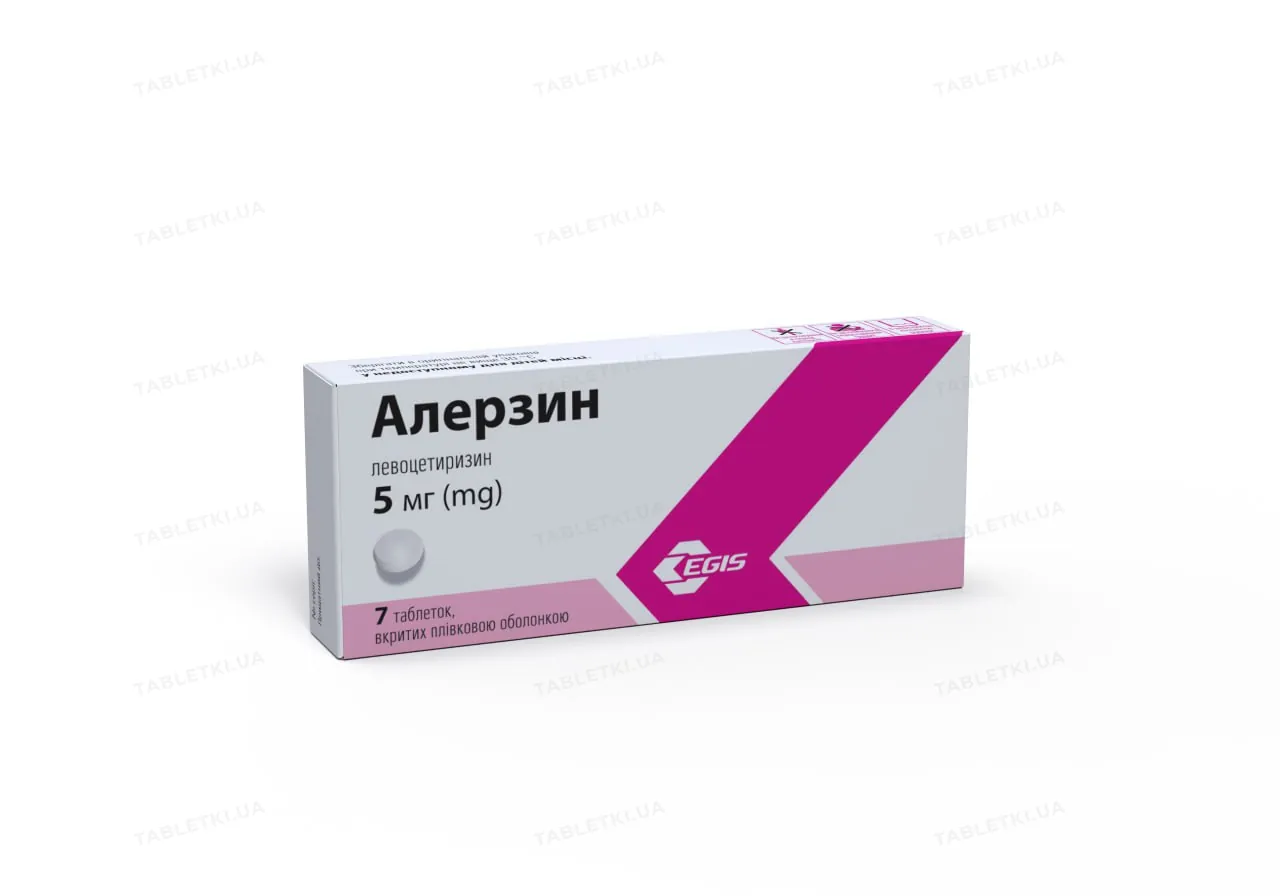
Alerzin tablets, film-coated, 5 mg, No. 7
Ingredients
Active ingredient: levocetirizine dihydrochloride;
1 tablet contains 5 mg of levocetirizine dihydrochloride (equivalent to 4.21 mg of levocetirizine);
excipients: microcrystalline silicon dioxide cellulose, low-substituted hydroxypropyl cellulose, lactose monohydrate, magnesium stearate;
Coating composition: Opadry II 33G28523 white (hypromellose, titanium dioxide (E 171), polyethylene glycol 3350, triacetylglycerol, lactose monohydrate).
Dosage Form
Film-coated tablets.
Main physical and chemical properties: white or almost white, round, moderately biconvex film-coated tablets, odorless or almost odorless, with a stylized letter “E” engraved on one side and the number “281” on the other.
Pharmacotherapeutic group
Antihistamines for systemic use. Piperazine derivatives. ATC code R06A E09.
Pharmacological properties
Pharmacodynamics.
Mechanism of action
Levocetirizine, the R-enantiomer of cetirizine, is a potent and selective antagonist of peripheral H1 receptors.
Binding studies have shown that levocetirizine has a high affinity for human H1 receptors (Ki = 3.2 nmol/L). The affinity of levocetirizine is twice that of cetirizine (Ki = 6.3 nmol/L). Levocetirizine dissociates from H1 receptors with a half-life of 115 ± 38 min. After a single dose, levocetirizine receptor binding was 90% at 4 hours and 57% at 24 hours.
Pharmacodynamic studies in healthy volunteers showed that, at half the dose, levocetirizine has activity comparable to that of cetirizine both when applied to the skin and when administered intranasally.
Pharmacodynamic Properties
The pharmacodynamic activity of levocetirizine was studied in randomized controlled trials.
In a comparative study of the effects of 5 mg of levocetirizine, desloratadine 5 mg, and placebo on a histamine-induced skin reaction characterized by the appearance of blisters and redness, treatment with levocetirizine resulted in a significant reduction in blister formation and redness, with the effect peaking within the first 12 hours and lasting for 24 hours (p < 0.001) compared with placebo and desloratadine.
In placebo-controlled studies using an allergic reaction stimulation chamber model, levocetirizine at a dose of 5 mg began to suppress pollen allergy symptoms 1 hour after administration.
In vitro studies (Boyden chamber and “cell layer” methods) showed that levocetirizine inhibits eosinophil transendothelial migration induced by eotaxin in skin and lung cells. An in vivo pharmacodynamic study (using the “skin chamber” method) demonstrated three main inhibitory effects of levocetirizine at a dose of 5 mg during the first 6 hours after pollen exposure compared with placebo in 14 adult patients: inhibition of VCAM-1 release, changes in vascular permeability, and reduced eosinophil activity.
Clinical Efficacy and Safety
The safety and efficacy of levocetirizine have been demonstrated in several double-blind, placebo-controlled clinical trials involving adult patients with seasonal allergic rhinitis, chronic allergic rhinitis, or perennial allergic rhinitis. Some studies have shown that levocetirizine significantly alleviates the symptoms of allergic rhinitis, including nasal congestion.
A six-month clinical trial involving 551 adult patients (including 276 patients who received levocetirizine) with perennial allergic rhinitis (symptoms present 4 days per week for at least 4 consecutive weeks) and who were sensitized to house dust mites and grass pollen, demonstrated that levocetirizine at a dose of 5 mg was clinically and statistically significantly more effective than placebo in improving the overall assessment of allergic rhinitis symptoms throughout the study period, without any tachyphylaxis. Throughout the study, levocetirizine significantly improved patients’ quality of life.
In a placebo-controlled clinical trial involving 166 patients with chronic idiopathic urticaria, 85 patients received placebo, while 81 patients received levocetirizine at a dose of 5 mg once daily for 6 weeks. Treatment with levocetirizine resulted in a significant reduction in itching intensity during the first week and throughout the entire treatment period compared with placebo.
Levocetirizine also resulted in a significant improvement in health-related quality of life, as assessed by the Dermatology Quality of Life Index, compared with placebo.
Chronic idiopathic urticaria was studied as a model of urticaria. Since histamine release is a causative factor in urticaria, levocetirizine is expected to be effective in providing symptomatic relief in urticaria conditions other than chronic idiopathic urticaria.
No significant effect of levocetirizine on the QT interval was observed on the ECG.
Pediatric Population
The safety and efficacy of levocetirizine in children were studied in two placebo-controlled clinical trials, including patients aged 6 to 12 years with seasonal and perennial allergic rhinitis, respectively. In both studies, levocetirizine significantly improved symptoms and enhanced health-related quality of life.
In children under 6 years of age, clinical safety was established in several short-term and long-term therapeutic studies:
- one clinical study in which 29 children aged 2 to 6 years with allergic rhinitis received 1.25 mg of levocetirizine twice daily for 4 weeks;
- one clinical study in which 114 children aged 1 to 5 years with allergic rhinitis or chronic idiopathic urticaria received 1.25 mg of levocetirizine twice daily for 2 weeks;
- one clinical study in which 45 children aged 6 to 11 months with allergic rhinitis or chronic idiopathic urticaria received 1.25 mg of levocetirizine once daily for 2 weeks;
- one long-term (18-month) clinical study of levocetirizine involving 255 patients with atopy aged 12 to 24 months.
The safety profile was similar to that observed in short-term studies conducted in children aged 1 to 5 years.
Pharmacokinetics.
The pharmacokinetic parameters of levocetirizine exhibit a linear relationship, are independent of dose and time, and show low inter-patient variability. The pharmacokinetic profile following administration of a single enantiomer is the same as that observed with cetirizine. No chiral inversion is observed during absorption or elimination.
Absorption. Levocetirizine is rapidly and extensively absorbed following oral administration. In adults, the maximum plasma concentration (Cmax) is reached 0.9 hours after administration. Steady state is reached after 2 days. Cmax is typically 270 ng/mL and 308 ng/mL following single and multiple doses of the drug at 5 mg once daily, respectively. The extent of absorption is dose-independent and is not affected by food intake; however, Cmax is reduced and is reached later.
Distribution. There is no information regarding the distribution of the drug in human tissues or regarding the penetration of levocetirizine across the blood-brain barrier. In animal studies, the highest concentrations were observed in the liver and kidneys, and the lowest in central nervous system tissues. The drug’s binding to human plasma proteins is 90%. The distribution of levocetirizine is limited; the volume of distribution is 0.4 L/kg.
Biotransformation. The extent of levocetirizine metabolism in the human body is less than 14% of the administered dose; therefore, differences due to genetic polymorphism or concomitant use of enzyme inhibitors are expected to be negligible.
The metabolic process involves aromatic oxidation, N- and O-dealkylation, and conjugation with taurine. Dealkylation occurs primarily via cytochrome CYP 3A4, whereas numerous and/or unidentified CYP isoforms are involved in the process of aromatic oxidation. Levocetirizine does not affect the activity of cytochrome isoenzymes 1A2, 2C9, 2C19, 2D6, 2E1, CYP4 at concentrations significantly exceeding the maximum levels observed following oral administration of a 5 mg dose. Given the low degree of metabolism and the lack of ability to inhibit metabolism, interactions between levocetirizine and other substances (and vice versa) are unlikely.
Elimination. The half-life of levocetirizine from plasma in adults (T1/2) is 7.9 ± 1.9 hours. T1/2 is shorter in young children. Total clearance in adults is 0.63 mL/min/kg. Levocetirizine and its metabolites are primarily excreted from the body in the urine (an average of 85.4% of the administered dose is excreted). Only 12.9% of the administered dose is excreted in the feces. Excretion of the drug occurs primarily via glomerular filtration and active tubular secretion.
Special Populations
Renal impairment. The apparent clearance of levocetirizine correlates with creatinine clearance. Therefore, for patients with moderate to severe renal impairment, it is recommended to adjust the dosing intervals for levocetirizine based on creatinine clearance. In patients with anuria and end-stage renal disease, total clearance is reduced by approximately 80% compared to total clearance in individuals without such impairment. The amount of levocetirizine removed during a standard 4-hour hemodialysis session was < 10%.
Children. Data from a pharmacokinetic study in 14 children aged 6 to 11 years with body weights ranging from 20 to 40 kg following oral administration of a single 5-mg dose of levocetirizine demonstrate that the Cmax and the area under the concentration-time curve (AUC) are approximately twice as high as in healthy adult patients in a crossover study. The mean body-weight-normalized Cmax, which was reached on average in 1.2 hours, was 450 ng/mL; total clearance was 30% higher, and the half-life was 24% shorter in the pediatric population than in adults.
No specific pharmacokinetic studies have been conducted in children under 6 years of age. A retrospective population pharmacokinetic analysis was conducted involving 323 patients (181 children aged 1 to 5 years, 18 children aged 6 to 11 years, and 124 adults aged 18 to 55 years) who received single or multiple doses of levocetirizine ranging from 1.25 to 30 mg. The data obtained from this analysis showed that administration of levocetirizine at a dose of 1.25 mg once daily in children aged 6 months to 5 years is expected to result in plasma concentrations similar to those in adults receiving 5 mg of levocetirizine once daily.
Elderly patients. Pharmacokinetic data in the elderly are limited. After a single daily oral dose of 30 mg of levocetirizine for 6 days in 9 elderly patients (ages 65–74), total clearance was approximately 33% lower than in younger individuals. It has been shown that the distribution of racemic cetirizine depends on renal function rather than age. This also applies to levocetirizine, since both levocetirizine and cetirizine are excreted primarily in the urine. Therefore, the dose of levocetirizine should be adjusted according to renal function in elderly patients.
Gender. Pharmacokinetic results for 77 patients (40 men and 37 women) were evaluated for potential gender effects. The half-life was slightly shorter in women (7.08 ± 1.72 hours) than in men (8.62 ± 1.84 hours); however, oral clearance adjusted for body weight in women (0.67 ± 0.16 mL/min/kg) is comparable to that in men (0.59 ± 0.12 mL/min/kg). For men and women with normal renal function, the same daily doses and dosing intervals may be used.
Race. The effect of race on levocetirizine has not been studied. Since levocetirizine is primarily excreted by the kidneys and there are no significant racial differences in creatinine clearance, the pharmacokinetic characteristics of levocetirizine are not expected to differ based on race. No racial differences in the kinetics of racemic cetirizine have been observed.
Hepatic impairment. The pharmacokinetics of levocetirizine in patients with hepatic impairment have not been studied. In patients with chronic liver disease (hepatocellular, cholestatic, and biliary cirrhosis) who received a single dose of 10 mg or 20 mg of racemic cetirizine, a 50% increase in the half-life was observed, along with a 40% decrease in clearance compared to healthy volunteers.
Pharmacokinetic/pharmacodynamic interactions. The effect on histamine-induced skin reactions does not correlate with plasma concentration.
Preclinical safety data
Preclinical data did not reveal any particular risk to humans based on standard studies of pharmacological safety, repeated-dose toxicity, genotoxicity, carcinogenicity, and reproductive and developmental toxicity.
Indications
Symptomatic treatment of allergic rhinitis (including perennial allergic rhinitis) and urticaria in adults and children aged 6 years and older.
Contraindications
Hypersensitivity to levocetirizine, cetirizine, hydroxyzine, any other piperazine derivatives, or any other excipient in the medication.
End-stage renal failure with an estimated glomerular filtration rate (eGFR) below 15 mL/min (requiring dialysis).
Drug Interactions and Other Interactions
No interaction studies (including studies with CYP3A4 inducers) have been conducted with levocetirizine. Studies with cetirizine racemate have shown that concomitant use with antipyrine, azithromycin, cimetidine, diazepam, erythromycin, glipizide, ketoconazole, or pseudoephedrine does not result in clinically significant adverse interactions.
When coadministered with theophylline (400 mg daily), a slight decrease (16%) in cetirizine clearance was observed (theophylline distribution was unchanged).
In a study of repeated administration of ritonavir (600 mg twice daily) and cetirizine (10 mg daily), cetirizine exposure increased by approximately 40%, whereas ritonavir distribution was slightly altered (–11%) when co-administered with cetirizine.
Food intake does not affect the extent of drug absorption but reduces the rate of absorption.
Concomitant use of cetirizine or levocetirizine with alcohol or other drugs that depress the central nervous system may cause an additional decrease in alertness and performance in susceptible patients.
Special Considerations for Use
Alcohol should be avoided while taking this medication (see the section “Interactions with Other Medications and Other Types of Interactions”).
When prescribing this medication to a patient, attention should be paid to the presence of certain factors that may cause urinary retention (e.g., spinal cord injury, benign prostatic hyperplasia), as levocetirizine increases the risk of urinary retention.
Levocetirizine should be used with caution in patients with epilepsy and a risk of seizures, as its use may exacerbate seizures.
Antihistamines suppress the response to skin allergy tests; the medication must be discontinued 3 days prior to the test (elimination period).
Itching may occur after discontinuing levocetirizine, even if such symptoms were not present before treatment began. It may resolve on its own. In some cases, symptoms may be severe, and it may be necessary to resume taking the medication. Once treatment is resumed, these symptoms should subside.
The medication Alerzin contains lactose monohydrate. Patients with rare hereditary forms of galactose intolerance, lactase deficiency, or glucose-galactose malabsorption should not take this medication.
Use During Pregnancy or Breastfeeding.
Pregnancy
There are no or limited data (fewer than 300 pregnancy outcomes) on the use of levocetirizine in pregnant women. However, for cetirizine and the levocetirizine racemate, a large body of data (more than 1,000 pregnancy outcomes) in pregnant women indicates the absence of birth defects or fetal/neonatal toxicity. Animal studies do not indicate any direct or indirect harmful effects on the course of pregnancy, embryonic/fetal development, the delivery process, or postnatal development.
If necessary, the use of levocetirizine during pregnancy may be considered.
Breastfeeding
Cetirizine, a racemic mixture of levocetirizine, passes into breast milk. Therefore, levocetirizine may also pass into breast milk. Adverse reactions associated with levocetirizine may occur in breastfed infants. Therefore, levocetirizine should be prescribed with caution to women who are breastfeeding.
Fertility
There are no clinical data on the effect of levocetirizine on fertility.
Effect on the ability to drive or operate machinery
Comparative clinical studies have found no evidence that levocetirizine, at recommended doses, impairs concentration, reaction time, or the ability to drive or operate machinery. However, some patients may experience drowsiness, fatigue, and asthenia while taking levocetirizine. Therefore, patients who intend to drive, engage in potentially hazardous activities, or operate machinery should consider their response to the medication.
Dosage and Administration
Recommended doses:
Adults and children 12 years of age and older: the recommended daily dose is 5 mg (1 film-coated tablet).
Elderly patients
Dose adjustment is recommended for elderly patients with moderate to severe renal impairment (see the “Renal Impairment” section).
Renal Insufficiency
Dosage intervals should be determined individually, depending on the patient’s renal function (eGFR—estimated glomerular filtration rate); see Table 1 for dosage adjustments.
Table 1
Dose Adjustment for Patients with Renal Impairment
| Group | eGFR, mL/min | Dose and Number of Doses |
| Normal renal function | ≥ 90 | 1 tablet once daily |
| Mild impairment | 60 – < 90 | 1 tablet once daily |
| Moderate impairment | 30 – < 60 | 1 tablet once every 2 days |
| Severe impairment | 15 – < 30
(do not require dialysis) |
1 tablet once every 3 days |
| End-stage renal failure | < 15
(requiring dialysis) |
Contraindicated |
For children with impaired renal function, the dose of the drug should be adjusted individually, taking into account renal clearance and body weight.
There are no specific data on use in children with impaired renal function.
Hepatic impairment
No dosage adjustment is required for patients with hepatic insufficiency. For patients with both hepatic and renal insufficiency, the dosage regimen should be adjusted according to Table 1.
Pediatric Population
Children aged 6 to 12 years: the recommended daily dose is 5 mg (1 film-coated tablet).
Children aged 2 to 6 years: It is not possible to adjust the dose of this dosage form (film-coated tablet). It is recommended to prescribe levocetirizine in a dosage form suitable for pediatric use.
Directions for Use
Take the film-coated tablet orally, regardless of meals, swallow it whole with a small amount of water. It is recommended to take the daily dose in a single administration.
Duration of Use
Patients with intermittent allergic rhinitis (symptoms lasting less than 4 days per week or less than 4 weeks per year) should be treated based on the nature of the condition and medical history. Treatment may be discontinued if symptoms resolve and may be resumed if symptoms recur. In cases of persistent allergic rhinitis (symptoms lasting more than 4 days per week or more than 4 weeks per year) during periods of exposure to allergens, the patient may be offered continuous therapy. There is clinical experience with the use of levocetirizine for a treatment period of at least 6 months.
For chronic allergic rhinitis and chronic urticaria, there is clinical experience with the use of cetirizine (racemate) for up to 1 year.
Children.
The drug Alerzin in the form of film-coated tablets should not be used in children under 6 years of age, as this dosage form does not allow for the necessary adjustment of the dosing regimen. For this patient population, it is recommended to prescribe levocetirizine in a dosage form suitable for pediatric use.
Overdose
Symptoms: may include drowsiness in adults; in children, agitation and restlessness may initially occur, followed by drowsiness.
Treatment: There is no specific antidote for levocetirizine. If symptoms of overdose occur, symptomatic and supportive therapy is recommended. Gastric lavage should be considered shortly after administration of the drug. Hemodialysis is ineffective for removing levocetirizine from the body.
Side Effects
Clinical Studies
Adults and children aged 12 years and older
In therapeutic studies involving women and men aged 12 to 71 years, 15.1% of patients in the 5-mg levocetirizine group experienced at least one adverse reaction, compared with 11.3% in the placebo group. 91.6% of these adverse reactions were mild to moderate in severity.
In clinical trials, the discontinuation rate due to adverse reactions was 1.0% (9/935) with levocetirizine 5 mg and 1.8% (14/771) with placebo.
Clinical therapeutic studies of levocetirizine included 935 patients who received the drug at the recommended dose of 5 mg per day. In these studies, the following adverse reactions were reported with a frequency of 1% or greater (common: ≥ 1/100 to < 1/10) with the use of 5 mg of levocetirizine or placebo (see Table 2).
Table 2
| Adverse Reactions | Placebo (n = 771) | Levocetirizine, 5 mg (n = 935) |
| Headache | 25 (3.2%) | 24 (2.6%) |
| Drowsiness | 11 (1.4%) | 49 (5.2%) |
| Dry mouth | 12 (1.6%) | 24 (2.6%) |
| Increased fatigue | 9 (1.2%) | 23 (2.5%) |
Asthenia and abdominal pain have also been reported infrequently (≥ 1/1,000 to < 1/100).
The incidence of sedative adverse reactions, such as drowsiness, fatigue, and asthenia, was generally higher (8.1%) with 5 mg of levocetirizine than with placebo (3.1%).
Pediatric Population
In two placebo--controlled studies involving children aged 6 to 11 months and 1 to 6 years, 159 patients received levocetirizine at a dose of 1.25 mg once daily for 2 weeks and 1.25 mg twice daily, respectively. The following adverse reactions were reported with a frequency of 1% or higher with either levocetirizine or placebo (see Table 3).
Table 3
| Organ Systems and Adverse Reactions | Placebo (n = 83) | Levocetirizine (n = 159) |
| Gastrointestinal | ||
| diarrhea | 0 | 3 (1.9%) |
| vomiting | 1 (1.2%) | 1 (0.6%) |
| constipation | 0 | 2 (1.3%) |
| Nervous system | ||
| drowsiness | 2 (2.4%) | 3 (1.9%) |
| Psychiatric | ||
| Sleep disturbances | 0 | 2 (1.3%) |
In double-blind, placebo-controlled studies involving children aged 6–12 years, 243 children received 5 mg of levocetirizine daily for varying periods ranging from less than 1 week to 13 weeks. The following adverse reactions were reported with a frequency of 1% or more with either levocetirizine or placebo (see Table 4).
Table 4
| Adverse Reactions | Placebo (n = 240) | Levocetirizine, 5 mg (n = 243) |
| Headache | 5 (2.1%) | 2 (0.8%) |
| Drowsiness | 1 (0.4%) | 7 (2.9%) |
Postmarketing experience
Adverse reactions observed during the postmarketing period are categorized by organ system and frequency of occurrence.
The frequency of adverse reactions is classified as follows: very common (≥ 1/10), common (≥ 1/100 and < 1/10), uncommon (≥ 1/1,000 and < 1/100), rare (≥ 1/10,000 and < 1/1,000), very rare (< 1/10,000), frequency unknown (cannot be estimated from the available data).
Immune system disorders: frequency unknown: hypersensitivity, including anaphylaxis.
Nutrition and metabolism disorders: frequency unknown: increased appetite.
Nervous system disorders: frequency unknown: seizures, paresthesia, dizziness, syncope, tremor, dysgeusia.
Psychiatric disorders: frequency unknown: aggression, agitation, hallucinations, depression, insomnia, suicidal thoughts, nightmares.
Eye disorders: frequency unknown: visual disturbances, blurred vision, nystagmus.
Ear and balance disorders: frequency unknown: vertigo.
Cardiac disorders: frequency unknown: palpitations, tachycardia.
Respiratory, thoracic, and mediastinal disorders: frequency unknown: shortness of breath.
Gastrointestinal system: frequency unknown: diarrhea, vomiting, nausea.
Hepatic and biliary tract disorders: frequency unknown: hepatitis.
Skin and subcutaneous tissue disorders: frequency unknown: angioedema, persistent drug rash, pruritus, rash, urticaria.
Musculoskeletal, connective tissue, and bone disorders: frequency unknown: myalgia, arthralgia.
Renal and urinary system disorders: frequency unknown: dysuria, urinary retention.
General disorders and administration site conditions: frequency unknown: edema.
Laboratory findings: frequency unknown: weight gain, abnormal liver function tests.
Description of Individual Adverse Reactions
Itching has been reported following discontinuation of levocetirizine.
Reporting of suspected adverse reactions
Reporting adverse reactions after the drug’s approval is important. This allows for monitoring the benefit-risk ratio of this drug. Healthcare and pharmaceutical professionals, as well as patients or their legal representatives, should report all cases of suspected adverse reactions and lack of efficacy of the drug through the Automated Pharmacovigilance Information System at the following link: https://aisf.dec.gov.ua.
Shelf life
5 years.
Do not use after the expiration date printed on the package.
Storage Conditions
Store in the original packaging at a temperature not exceeding 30 °C, out of reach of children.
Packaging
7 tablets per blister; 1 or 2 blisters per cardboard box;
10 tablets per blister; 1, 2, or 3 blisters per cardboard box.
Dispensing Category
Available without a prescription.
Manufacturer
EGIS Pharmaceutical Plant, Ltd., Hungary.
Manufacturer’s location and address of its place of business.
1165 Budapest, Bekényfeldi Street 118–120, Hungary.