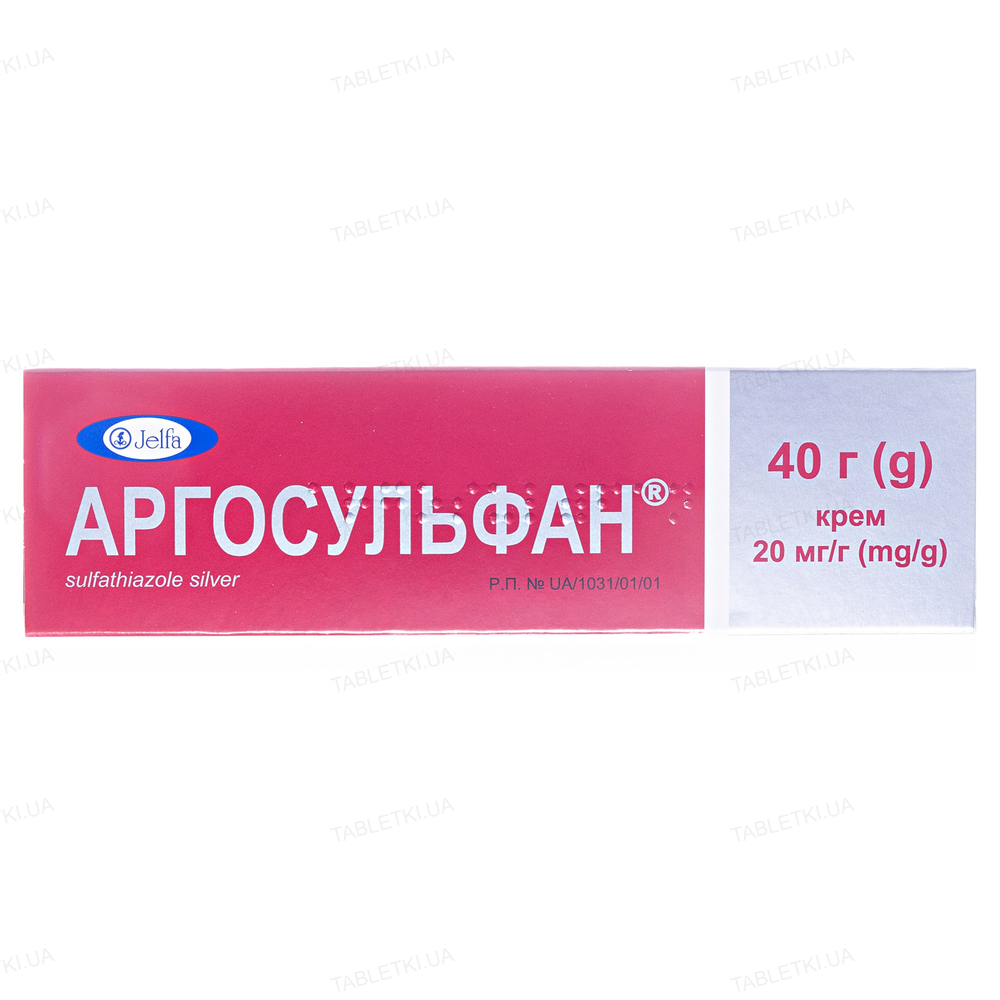
Argosulfan Cream 20 mg/g, 40 g in tubes
Ingredients
Active ingredient: silver sulfathiazole;
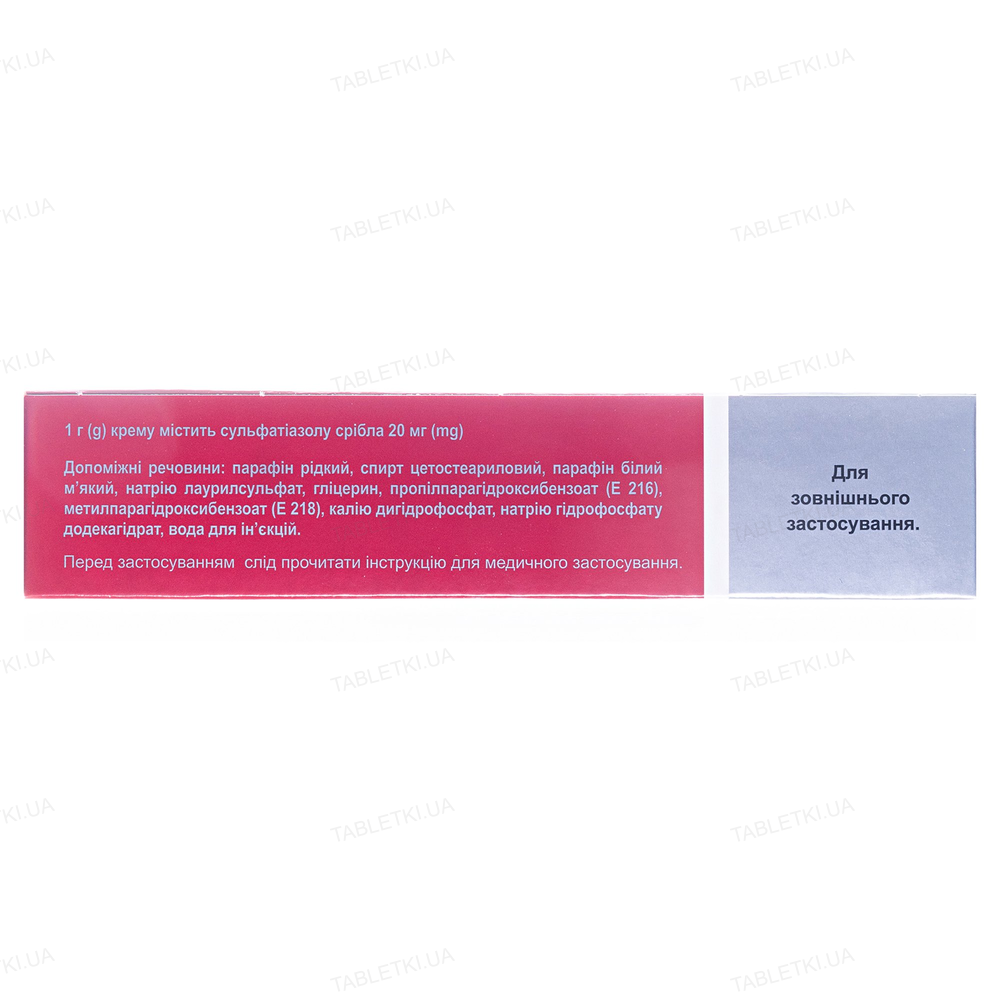
1 g of the product contains 20 mg of silver sulfathiazole;
excipients: liquid paraffin, cetostearyl alcohol, white soft paraffin, sodium lauryl sulfate, glycerin, propyl parahydroxybenzoate (E 216), methyl parahydroxybenzoate (E 218), potassium dihydrogen phosphate, sodium hydrogen phosphate dodecahydrate, water for injection.
Dosage Form
Cream.
Main physicochemical properties: a homogeneous emulsion mass that is white or white with a tint ranging from pink to light gray.
Pharmacotherapeutic group
Chemotherapeutic agents for topical use. Sulfonamides. ATC code D06B A02.
Pharmacological properties
Pharmacodynamics.
The mechanism of sulfathiazole’s antimicrobial action involves inhibition of the growth and reproduction of microorganisms; which is associated with competitive antagonism with para-aminobenzoic acid and inhibition of dihydropteroate synthase, leading to disruption of the synthesis of dihydrofolic acid and, ultimately, its active metabolite—tetrahydrofolic acid—which is essential for the synthesis of purines and pyrimidines in microbial cells.
Silver sulfathiazole has a broad spectrum of antibacterial activity against mixed flora (Gram-positive and Gram-negative microorganisms), including Pseudomonas aeruginosa.
It inactivates and significantly reduces the infectivity of herpes viruses outside the cell and the varicella-zoster virus.
The drug effectively protects the wound from infection, forms a protective layer on the wound surface, maintains adequate moisture, and promotes wound healing.
Pharmacokinetics.
Silver sulfathiazole has the lowest solubility among other silver salts in the sulfanilamide group, as well as high stability. The low solubility and high stability of silver sulfathiazole allow it to remain on the surface of the affected skin area and reduce absorption into the bloodstream. Absorbed sulfathiazole is acetylated in the liver and then excreted in the urine as inactive metabolites and, in part, unchanged. Absorption of sulfatiazol increases when the medication is applied to large areas of affected skin.
Indications
Argosulfan® is used topically to treat infections in the following cases:
- skin burns of all degrees (including radiation burns);
- bedsores;
- trophic leg ulcers.
Contraindications
Hypersensitivity to sulfasalazine, other sulfonamides, or excipients.
Argosulfan® should not be used:
- in breastfeeding women;
- premature newborns and infants under two months of age due to the risk of kernicterus;
- in patients with congenital glucose-6-phosphate dehydrogenase deficiency due to the risk of hemolytic anemia.
Special Safety Precautions
Cross-hypersensitivity to sulfonylurea derivatives, benzothiazine, and p-aminosalicylic acid is possible. In each case, a thorough allergy history should be obtained, particularly regarding sulfonamides. Avoid contact of the drug with the eyes and mucous membranes. In case of accidental contact, rinse with plenty of water. The development of adverse and systemic side effects characteristic of sulfonamides is also possible.
Use the drug with caution in patients in shock following severe burns and in burn patients who are difficult to communicate with. Accumulation of the drug and the occurrence of adverse reactions are possible in patients with impaired liver or kidney function. During prolonged use on large areas of skin, serum sulfathiazole levels should be monitored, especially in cases of kidney or liver disease, as well as white blood cell counts, since agranulocytosis or anemia may develop.
Do not use other topical medications.
Prolonged use should be avoided.
Argosulfan® contains excipients, including cetostearyl alcohol, propyl parahydroxybenzoate, methyl parahydroxybenzoate, and sodium lauryl sulfate. Due to its cetostearyl alcohol content, this medication may cause a local skin reaction (e.g., contact dermatitis). Due to the presence of propyl parahydroxybenzoate and methyl parahydroxybenzoate, the medication may cause allergic reactions (including delayed-type reactions). Sodium lauryl sulfate may cause local skin reactions at the application sites, such as skin irritation, a burning or stinging sensation, or worsening of a skin reaction caused by other medications applied to the same area of skin.
Patients with skin conditions, such as atopic dermatitis, are more sensitive to the irritating properties of sodium lauryl sulfate.
Interactions with Other Medications and Other Types of Interactions
This medication is not recommended for concurrent use with other topical medications to prevent interactions.
When used systemically, folic acid or p-aminosalicylic acid derivatives (e.g., procaine) may weaken the antibacterial effect of silver sulfathiazole.
The development of the above interactions is possible but unlikely, since silver salts of sulfonamides act primarily on the cell membrane rather than on metabolic processes (however, such an effect cannot be ruled out).
Leukopenia may develop during concomitant treatment with cimetidine (leukopenia is observed 20 times more frequently when used with sulfadiazine).
Special Considerations for Use
Use during pregnancy or breastfeeding.
The safety of Argosulfan® during pregnancy has not been studied.
No animal studies have been conducted on the effects of silver sulfathiazole on fetal development. No controlled studies have been conducted on the effects of topical application of the drug on fetal development. Use of the drug during pregnancy is not recommended, except in cases where the expected benefit to the woman outweighs the potential risk to the fetus.
Lactation (breastfeeding).
It is unknown whether silver sulfathiazole or its metabolites are excreted into breast milk. It is known that sulfonamides for oral use can pass into breast milk and cause jaundice in infants.
Use of this medication is not recommended during breastfeeding.
Fertility.
No data are available.
Effect on reaction time when driving or operating machinery.
Argosulfan® does not affect the ability to drive or operate machinery.
Dosage and Administration
Use for burns.
The product is intended for topical application, either as an open dressing or under occlusive dressings. Argosulfan® does not cause discoloration of the skin or clothing.
After cleaning and surgical debridement of the wound, apply a 2–3 mm layer of the cream under sterile conditions. All affected areas of the skin must be covered with the cream throughout the entire treatment period. If, for any reason, part of the wound is not covered with the cream, always apply an additional thin layer of the product. There is no need to apply an occlusive dressing to the wound, unless there are specific indications for its use. Apply the cream until the wound has completely healed or until the wound surface is prepared for a skin graft (surgical intervention).
Treatment of pressure ulcers and trophic ulcers of the lower leg.
Apply a thin layer of the product to the affected skin areas 2–3 times daily.
If the product is applied to infected wounds, exudate may appear. In such cases, before applying the cream, the wound must be rinsed with a 0.1% aqueous solution of chlorhexidine, a 3% aqueous solution of boric acid, or another antiseptic. For adults, dosage adjustment is not required.
Patients with renal insufficiency
Due to the lack of clinical trials, caution should be exercised when using Argosulfan® in patients with renal insufficiency. In patients with severe renal impairment, serum sulfonamide concentrations should be monitored.
Patients with hepatic impairment
Due to the lack of clinical trials, this medication should be used with caution in patients with hepatic impairment.
Method of Application
The drug is intended for topical use, either as an open application or under occlusive dressings.
Children
This medication may be used in children 3 months of age and older.
Overdose
The product may be absorbed through damaged skin. There are no reports of overdose.
Side Effects
The very low solubility and poor absorption of silver sulfathiazole through damaged skin reduce the potential for side effects when using this medication.
With long-term use, there is a risk of systemic side effects associated with sulfonamides, including kidney or liver damage, agranulocytosis, hemorrhagic diathesis, aplastic and hemolytic anemia, leukopenia, dermatological reactions, and hypersensitivity, such as Stevens-Johnson syndrome and exfoliative dermatitis.
Shelf Life
Shelf life: 2 years.
Shelf life after first opening: 6 months.
Storage Conditions
Store at a temperature not exceeding 25 °C. Do not freeze.
Packaging
Cream in 15 g or 40 g tubes.
Dispensing category
Over-the-counter.
Manufacturer
Yelpa Pharmaceutical Plant A.T.
Manufacturer’s location and business address.
58-500 Jelenia Góra, 21 Wincenty Pola St., Poland.