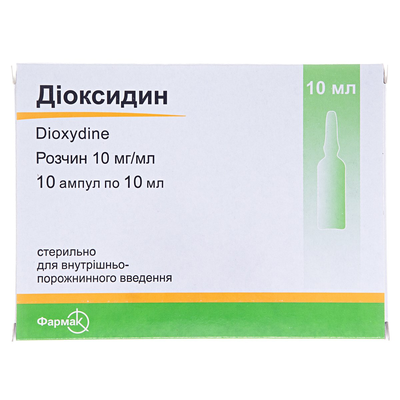
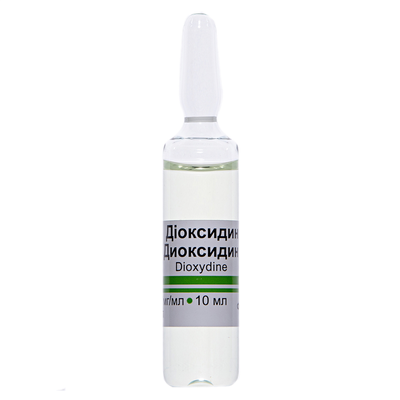
Dioxydin solution, 10 mg/mL, 10 mL, No. 10, in ampoules
Ingredients
Active ingredient: dioxidine;
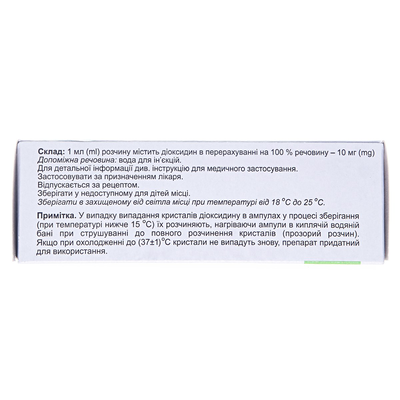
1 mL of solution contains 10 mg of dioxidine, calculated as 100% active ingredient;
excipients: water for injection.
Dosage Form
Solution.
Main physicochemical properties: a clear, greenish-yellow liquid.
Pharmacotherapeutic group
Antibacterial agents. ATC code J01X X.
Pharmacological properties
Pharmacodynamics. Dioxydin is a broad-spectrum antibacterial agent. It is effective against infections caused by Proteus vulgaris, Pseudomonas aeruginosa, Friedländer’s bacillus, Escherichia coli and Shigella, Salmonella, staphylococci, streptococci, and pathogenic anaerobes, including the causative agents of gas gangrene. It is active against bacterial strains resistant to antibiotics, sulfonamides, nitrofurans, and other drugs.
Pharmacokinetics. When applied topically, dioxidine is partially absorbed and does not cause local irritation. It is not metabolized. It does not accumulate in the body. It is excreted by the kidneys.
Indications
Purulent-inflammatory processes of various locations: purulent pleurisy, pleural empyema, lung abscess, peritonitis, cystitis, wounds with deep cavities, soft tissue abscesses, phlegmon, postoperative wounds of the urinary and biliary tracts. It is also used to prevent infectious complications following urinary catheterization.
Contraindications
Individual intolerance to the drug, adrenal insufficiency (including a history thereof).
Interactions with Other Medications and Other Types of Interactions
None reported.
Special considerations for use
Dioxydin is administered in a hospital setting. Experimental studies have shown that the drug has teratogenic and embryotoxic effects (therefore, it is contraindicated during pregnancy); the drug also has mutagenic effects. Consequently, Dioxydin is prescribed only for severe forms of infectious diseases or when other antibacterial drugs—including second- to fourth-generation cephalosporins, fluoroquinolones, and carbapenems—are ineffective. Uncontrolled use of Dioxydin and medicinal products containing it is not permitted.
Use with caution in patients with renal insufficiency; in cases of chronic renal insufficiency, reduce the dose.
If pigmented spots appear, increase the duration of administration to 1.5–2 hours, reduce the dose, prescribe antihistamines, and, if necessary, discontinue use of the drug.
Use during pregnancy or breastfeeding.
This medication is contraindicated during pregnancy or breastfeeding.
Effect on reaction time when driving or operating machinery.
Caution should be exercised when driving or engaging in other potentially hazardous activities that require increased concentration and rapid psychomotor reactions during treatment.
Dosage and Administration
Dioxydin is prescribed only for adults.
Before starting treatment, a tolerance test must be performed by injecting 10 mL of a 1% solution into the wound cavity. If no side effects (dizziness, chills, or fever) occur within 3–6 hours, begin the course of treatment. The solution is administered into the cavity via a drainage tube, catheter, or syringe—typically 10–50 mL of a 1% solution. The maximum daily dose is 70 mL of a 1% solution. Administer 1 or 2 times daily (without exceeding the daily dose of 70 mL of a 1% solution). The duration of treatment depends on the severity of the disease and the patient’s tolerance of the medication. The course of treatment may last 3 weeks or longer. If necessary, repeat the course of treatment after 1–1.5 months.
It is also used topically by applying dressings moistened with a 1% solution to the wound surface.
Children. This medication is not indicated for use in children.
Overdose
Acute adrenal insufficiency may develop.
Treatment: immediate discontinuation of the drug, appropriate hormone replacement therapy
Side Effects
With intracavitary administration, the following may occur: headache, chills, fever, dyspeptic disorders, muscle spasms, allergic reactions, and photosensitization (the appearance of pigmented spots on the body upon exposure to sunlight).
With topical application: perioral dermatitis, itching.
Shelf life
2 years.
Do not use the product after the expiration date indicated on the packaging.
Storage Conditions
Store in a place protected from light at a temperature between 18 °C and 25 °C. Keep out of reach of children.
If dioxidine crystals form in the ampoules during storage (at temperatures below 15 °C), dissolve them by heating the ampoules in a boiling water bath while shaking until the crystals are completely dissolved (clear solution). If no crystals precipitate again upon cooling to (37 ± 1) °C, the product is suitable for use.
Packaging
10 mL per ampoule. 10 ampoules per pack.
Dispensing Category
By prescription.