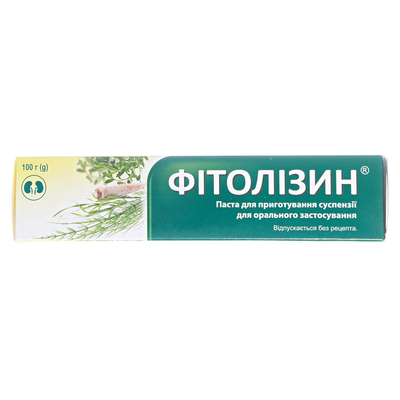
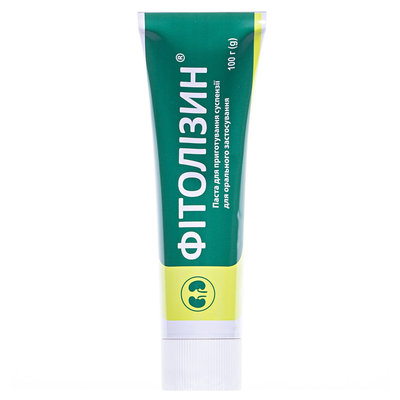
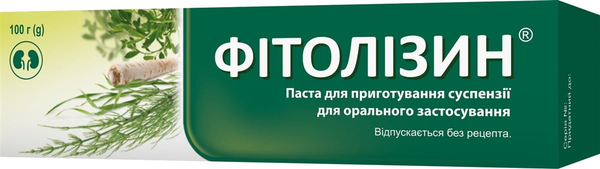
Phytolysin paste for preparing an oral suspension, 100 g per tube
Composition
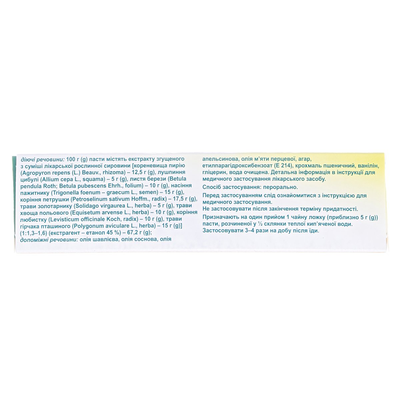
Active ingredient: 100 g of paste contains an extract concentrated from a mixture of medicinal plant materials [couch grass rhizome (Agropyron repens (L.) Beauv., rhizoma)—12.5 g, onion husks (Allium cepa L., squama)—5 g, birch leaves (Betula pendula Roth; Betula pubescens Ehrh., folium)—10 g, fenugreek seeds (Trigonella foenum-graecum L., semen)—15 g, parsley root (Petroselinum sativum Hoffm., radix)—17.5 g, goldenrod herb (Solidago virgaurea L., herba)—5 g, field horsetail herb (Equisetum arvense L., herba)—10 g, lovage root (Levisticum officinale Koch, radix) – 10 g, bird’s-foot knotweed herb (Polygonum aviculare L., herba) – 15 g] (1:1.3–1.6) (extractant – 45% ethanol) – 67.2 g;
excipients: sage oil, pine oil, orange oil, peppermint oil, agar, ethyl parahydroxybenzoate (E 214), wheat starch, vanillin, glycerin, purified water.
Dosage Form
Paste for the preparation of a suspension for oral administration.
Main physical and chemical properties: a soft, greenish-brown paste with a characteristic aromatic odor.
Pharmacotherapeutic group
Agents affecting the genitourinary system and sex hormones. Agents that promote the dissolution of urinary calculi.
ATX code G04B C.
Pharmacological Properties
The drug has diuretic, anti-inflammatory, antimicrobial, and analgesic effects. These properties are due to the biologically active substances contained in the medicinal herbs. These biologically active substances enhance the excretion of sodium and chloride ions and filtration in the renal glomeruli, while reducing reabsorption in the renal tubules. They increase diuresis without disrupting electrolyte balance.
Flavonoids inhibit the growth of Gram-positive bacteria in the urinary tract, enhance the excretion of urea, block the oxidation of ascorbic acid, and prevent its conversion to oxalic acid. Saponins have a pronounced antibacterial effect against staphylococci. Aglucones have an antispasmodic effect.
Silicates (common knotweed, field horsetail) help maintain the balance between colloids and crystalloids in urine, preventing the formation of calculi; they also improve the excretion of uric acid.
Phytolysin® promotes the flushing out of sand and small urinary calculi; it prevents the growth of calculi or the postoperative recurrence of stones.
Indications
Infectious and inflammatory diseases of the urinary system accompanying urolithiasis; prevention of urolithiasis recurrence, including after surgical removal of stones.
Contraindications
Hypersensitivity to any component of the medicinal product or to plants of the genus Asteraceae (Compositae) (goldenrod), Apiaceae (Umbelliferae), or anethole (lovage root), birch pollen (birch leaves). Conditions in which reduced fluid intake is recommended (e.g., renal failure, heart failure).
Conditions associated with increased blood clotting.
Urinary tract obstruction.
Acute nephritis, nephrosis, phosphate lithiasis.
Interactions with Other Medications and Other Types of Interactions
Due to the diuretic effect of the drug, the possibility of accelerated excretion of other concomitantly administered medications should be considered.
This drug may enhance the effects of hypoglycemic agents, nonsteroidal anti-inflammatory drugs, lithium salts, monoamine oxidase inhibitors, and anticoagulants; prolong the effects of pentobarbital, acetaminophen, and aminopyrine.
This medication may reduce the absorption of drugs in the small intestine, including beta-carotene, alpha-tocopherol, and cholesterol.
Special Considerations for Use
No cases of drug interactions have been reported.
When using this medication, glycemic control is necessary in patients with diabetes mellitus due to the possible hypoglycemic effect of fenugreek.
If pain, difficulty urinating, blood in the urine, worsening symptoms, or a fever occur, consult a doctor immediately.
This medication should not be used by patients with edema resulting from renal or heart failure.
It is recommended to drink plenty of fluids while taking this medication.
The medication contains approximately 200 mg of ethyl alcohol per dose, which is equivalent to 5 mL of beer or 2 mL of wine. Trace amounts of alcohol do not cause clinically significant reactions.
The drug contains ethyl parahydroxybenzoate, which may cause allergic reactions (possibly of the delayed type).
The medication contains a negligible amount of gluten (found in wheat starch) and is considered “gluten-free.” The likelihood that taking Phytolysin® will lead to an exacerbation of celiac disease symptoms is extremely low.
5 g of paste contains no more than 15 μg of gluten.
Patients with a wheat allergy (distinct from celiac disease) should not use this medication.
Use During Pregnancy or Breastfeeding.
There are no data on the safety and efficacy of this medication during pregnancy; therefore, it should not be used during this period.
The medication may be used only if, in the doctor’s opinion, the benefits of treatment outweigh the potential risk to the fetus.
Since it is unknown whether the use of this medication during breastfeeding is safe, breastfeeding should be discontinued for the duration of treatment.
There are no data on fertility.
Effect on reaction time when operating motor vehicles or other machinery.
There are no data on the effect of this medication on the ability to drive or operate machinery. If dizziness occurs during treatment with this medication, you should refrain from driving or operating machinery.
Dosage and Administration
Adults
Take 1 teaspoon (approximately 5 g) of the paste dissolved in ½ glass of warm boiled water in a single dose. Take 3–4 times daily after meals.
The course of treatment is usually 2 to 4 weeks. If necessary, the course of treatment may be repeated.
If there is no improvement, symptoms persist, or the condition worsens, consult a doctor.
Since urine output increases during treatment, be sure to drink plenty of fluids.
Children.
There is no experience with the use of this medication in children and adolescents under 18 years of age; therefore, it should not be prescribed to patients in this age group.
Overdose
No cases of overdose have been reported.
In the event of an overdose, side effects may be more severe.
Treatment is symptomatic.
Side Effects
Immune system:
allergic reactions, including rash, hives, itching, allergic rhinitis, and facial swelling.
Nervous system:
dizziness.
Gastrointestinal system:
nausea, vomiting, diarrhea, bloating.
Skin and subcutaneous tissue disorders:
increased sensitivity to ultraviolet rays (photosensitivity).
Urinary system:
renal colic.
Shelf life
3 years.
Do not use this medication after the expiration date!
Storage conditions
Store in the original packaging at a temperature not exceeding 25°C.
Keep out of reach of children.
Packaging
100 g of paste in an aluminum tube, in a cardboard box.
Dispensing Category
Available without a prescription.