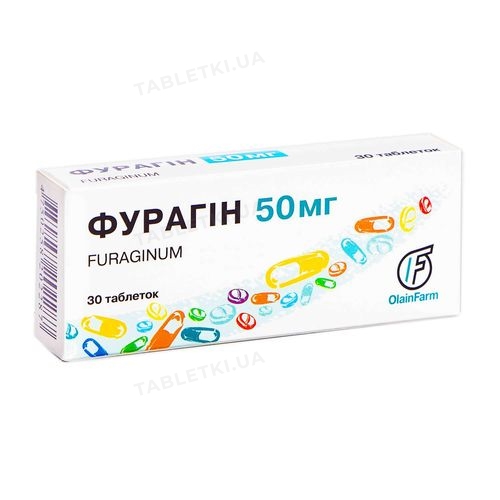
Furagin 50 mg tablets, No. 30 (10 x 3)
Ingredients
Active ingredient: furagin;
1 tablet contains 50 mg of furagin;
Excipients: lactose monohydrate; sugar; modified corn starch; stearic acid; polysorbate.
Dosage Form
Tablets.
Main physical and chemical properties: flat-cylindrical tablets with a bevel, ranging in color from yellow to yellow with an orange tint.
Pharmacotherapeutic group
Antimicrobials for systemic use. Nitrofuran derivatives. Furazidine.
ATC code J01X E03.
Pharmacological properties
Pharmacodynamics.
Furagin is a nitrofuran antibacterial agent with bacteriostatic activity. It is effective against Gram-positive (Staphylococcus epidermidis, Staphylococcus aureus, Staphylococcus faecalis) and Gram-negative (Enterobacteriaceae, Klebsiella spp., Escherichia coli) bacteria. Furagin’s high bacteriostatic activity is due to the presence of an aromatic nitro group. Resistance to furagin develops slowly. It inhibits the enzymatic systems of microorganisms, as well as other biochemical processes within the bacterial cell, which in turn causes disruption of the cytoplasmic membrane and the cell membrane of the bacterium.
Pharmacokinetics.
Absorption. Furagin is well absorbed from the gastrointestinal tract. Absorption of the drug occurs primarily in the distal small intestine via passive diffusion (at a rate several times higher than absorption from the proximal region). After a single 200-mg dose, the maximum plasma concentration of furagin is reached after 30 minutes, remains at this level for 1 hour, and then slowly decreases. A bacteriostatic concentration of furagin in blood plasma is maintained for 8–12 hours. It binds to plasma proteins.
Metabolism/Excretion. 10% of the administered dose is biotransformed in the liver and kidneys. In cases of impaired renal function, most of the administered dose undergoes biotransformation.
The half-life of furagin is short (approximately 1 hour). Furagin is excreted by the kidneys, primarily via tubular secretion (85%). 8–13% of furagin is excreted unchanged in the urine, where its concentration is many times higher than the minimum inhibitory concentration for most susceptible bacteria. The maximum concentration of furagin in urine is 5.7 μg/mL.
Furagin crosses the placental barrier well.
Indications
Acute and chronic urinary tract infections: pyelonephritis, cystitis, urethritis; prostatitis; postoperative infections of the genitourinary system.
Contraindications
Hypersensitivity to furagin, to nitrofuran derivatives, or to the drug’s excipients;
- severe renal insufficiency (creatinine clearance less than 30 mL/min);
- severe hepatic insufficiency;
- polyneuropathy (including diabetic);
- glucose-6-phosphate dehydrogenase deficiency (risk of hemolysis);
- porphyria (diseases caused by impaired metabolism of hemoglobin breakdown products);
- rarely, congenital galactose intolerance, lactase deficiency, or glucose-galactose malabsorption;
- sucrase/isomaltase/lactase deficiency, fructose/lactose intolerance.
Contraindicated in patients undergoing hemodialysis or peritoneal dialysis.
Contraindicated in children (under 18 years of age).
Do not use during pregnancy or while breastfeeding.
Furagin is not recommended for use in cases of urosepsis or renal parenchymal infection.
Drug Interactions and Other Interactions
Urine-alkalizing agents reduce the therapeutic effect of Furagin (they accelerate the excretion of Furagin in the urine).
Agents that acidify urine (acids, including ascorbic acid, as well as calcium chloride) increase the concentration of Furagin in the urine (slowing its excretion in the urine) and thereby enhance the therapeutic effect of the drug, but at the same time increase the risk of increased toxicity.
Concomitant use with levomycetin, ristomycin, and sulfonamides enhances the suppression of hematopoiesis.
Due to the antagonistic interaction between Furagin and quinolones (nalidixic acid, oxolinic acid, norfloxacin), concomitant use of these drugs should be avoided.
The use of probenecid and sulfinpyrazone reduces the excretion of Furagin, which increases the risk of adverse side effects and toxicity.
Concomitant use of Furagin and antacids (containing magnesium trisilicate) reduces the absorption of Furagin.
In patients with renal insufficiency, the concurrent use of Furagin with aminoglycosides is not recommended.
The antibacterial effect of Furagin is significantly enhanced when used concurrently with antibiotics (penicillins and cephalosporins), and it combines well with tetracycline and erythromycin.
Alcohol should not be consumed during treatment, as it may increase the severity of side effects (rapid heartbeat, chest pain, headache, nausea, vomiting, seizures, low blood pressure, fever, anxiety).
Special Precautions
This medication should be used with caution in the following cases:
- anemia;
- deficiency of B vitamins and folic acid;
- lung diseases.
Prolonged use of Furagin may lead to peripheral neuropathy (pain, sensory disturbances in the area of the affected nerve). If symptoms of neuropathy develop, use of the drug should be discontinued.
In patients with diabetes mellitus, the drug may cause polyneuropathy.
The use of Furagin is not recommended in cases of urosepsis or infection of the renal parenchyma.
Experimental studies and clinical observations of patients have shown that nitrofurans adversely affect testicular function, as evidenced by a decrease in sperm count and ejaculate volume, reduced sperm motility, and pathological changes in sperm morphology.
When using Furagin, diarrhea may occur due to the drug’s suppression of the normal microflora of the large intestine.
In rare cases, pseudomembranous colitis may develop, caused by suppression of the natural microflora of the rectum and overgrowth of Clostridium difficile. In mild cases of pseudomembranous colitis, discontinuing the drug is sufficient.
Laboratory testing of patients using Furagin may yield a false-positive result for glucose in the urine if the copper reduction method is used for detection. Furagin does not affect the results of urine glucose testing using the enzymatic method.
During long-term therapy, patients should undergo regular blood tests (white blood cell count), have their liver and kidney function monitored, and have their lung function checked, especially those over 65 years of age.
This medication contains sugar, which should be taken into account when treating patients with diabetes.
If you have been diagnosed with an intolerance to certain sugars, consult your doctor before taking this medication.
To prevent neuritis, it is recommended to take antihistamines and B vitamins (nicotinamide, thiamine) at the same time.
Use During Pregnancy or Breastfeeding
Furagin is contraindicated during pregnancy or breastfeeding.
Potential effects on reaction time while driving or operating machinery
The drug generally does not affect reaction time while driving or operating machinery; however, caution is advised for individuals who experience dizziness, drowsiness, or other central nervous system side effects during treatment.
Directions for Use and Dosage
Furagin should be taken orally, immediately after a meal, with plenty of water.
Adults: 100–200 mg (2–4 tablets) 2–3 times daily. The course of treatment is 7–10 days, depending on the severity of the condition, the effectiveness of treatment, and renal function. If necessary, the course of treatment may be repeated after 10–15 days.
The maximum daily dose is 600 mg.
If a dose is missed, the next dose should be taken as soon as the patient remembers.
Do not take a double dose to make up for a missed dose.
Children
This medication should not be used in children.
Overdose
Toxic effects are usually possible in patients with impaired kidney function.
Symptoms: headache, dizziness, depression, peripheral polyneuropathy, allergic reactions (urticaria, angioedema, bronchospasm), nausea, vomiting, hemolytic anemia (in patients with glucose-6-phosphate dehydrogenase deficiency), megaloblastic anemia, and, rarely, liver dysfunction.
Treatment: discontinuation of the drug, drinking plenty of fluids, use of enterosorbents, antihistamines, and B vitamins (thiamine bromide). Treatment is symptomatic. In severe cases, hemodialysis is performed.
There is no specific antidote.
Side Effects
Furagin, like other medications, may cause adverse reactions, which do not occur in all patients.
Frequency of adverse reactions according to the MedDRA classification: very common (≥ 1/10); common (≥ 1/100 to <1/10); uncommon (≥ 1/1,000 to <1/100); rare (≥ 1/10,000 to <1/1,000); very rare (<1/10,000), including isolated cases; unknown (cannot be estimated from the available data).
Blood and lymphatic system disorders: very rare—hematopoietic disorders (agranulocytosis, thrombocytopenia, aplastic anemia).
Immune system disorders: hypersensitivity reactions, including itching, rash, hives, angioedema.
Nervous system disorders: uncommon—dizziness, drowsiness; rare—peripheral neuropathy.
Visual disturbances: rarely—visual disturbances.
Respiratory, thoracic, and mediastinal disorders: rarely—acute and chronic pulmonary reactions.
An acute pulmonary reaction develops uncontrollably. It manifests as severe shortness of breath, fever, chest pain, and cough—with or without sputum—as well as eosinophilia (an increase in the number of eosinophils in the blood). Skin rashes, itching, hives, myalgia (muscle pain), and angioedema (swelling of the face, neck, oral mucosa, and larynx) have been reported. An acute pulmonary reaction is caused by a hypersensitivity reaction, which can develop within a few hours or, less commonly, within minutes. An acute pulmonary reaction resolves upon discontinuation of the drug. A chronic pulmonary reaction may develop over a prolonged period following the discontinuation of treatment with nitrofurans (including Furagin). It is characterized by a gradual increase in shortness of breath, rapid breathing, intermittent fever, eosinophilia, progressive cough, and interstitial pneumonitis and/or pulmonary fibrosis.
Gastrointestinal system: rare—decreased appetite, nausea; rare—vomiting, diarrhea; very rare—pancreatitis.
Skin and subcutaneous tissue disorders: rare—papular rash, pruritus; very rare—angioedema, urticaria, exfoliative dermatitis, erythema multiforme.
Musculoskeletal and connective tissue disorders: very rare—arthralgia (joint pain).
Hepatobiliary system: very rare—cholestatic jaundice, hepatitis.
General disorders: rarely—weakness, fever, temporary hair loss.
Furagin stains urine dark yellow or brown.
To reduce side effects, it is recommended to take B vitamins, antihistamines, and drink plenty of fluids. If severe side effects occur, the dose should be reduced or the medication discontinued.
If you experience any side effects not listed in the prescribing information while taking this medication, you should inform your doctor.
Shelf Life
5 years.
Storage conditions
Store in the original packaging at a temperature not exceeding 25°C.
Keep out of reach of children.
Packaging
10 tablets per blister pack. 3 blister packs per cardboard box.
Manufacturer
Olainfarm, JSC.
Address
5 Rupnicu Street, Olaine, LV-2114, Latvia.