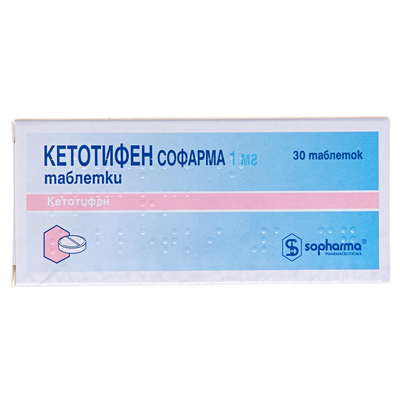
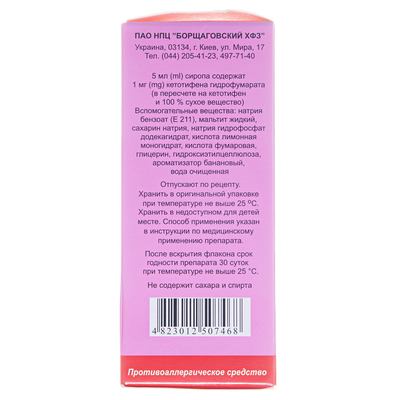
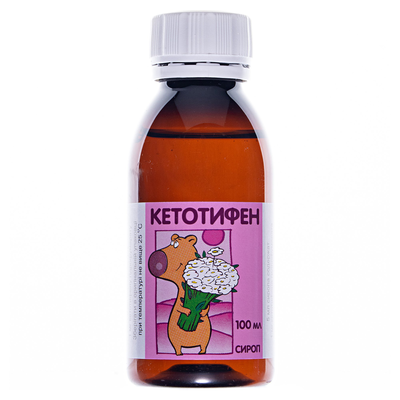
Ketotifen syrup, 1 mg/5 mL, 100 mL per bottle.
Ingredients
Active ingredient: ketotifen hydrofumarate;
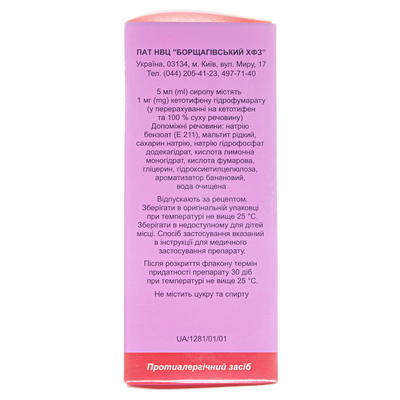
5 mL of syrup contains 1 mg of ketotifen hydrofumarate (calculated as ketotifen and 100% dry matter);
Excipients: sodium benzoate (E 211), liquid maltitol, sodium saccharin, sodium hydrophosphate dodecahydrate, citric acid monohydrate, fumaric acid, glycerin, hydroxyethylcellulose, banana flavoring, purified water.
Dosage Form
Syrup.
Main physical and chemical properties: a colorless or slightly yellowish, clear, viscous liquid with a characteristic odor.
Pharmacotherapeutic group
R06A X17.
Pharmacological properties
Pharmacodynamics.
Ketotifen has membrane-stabilizing, antiallergic, and antihistamine effects. The mechanism of action of ketotifen is due to the inhibition of the release of biologically active substances by mast cells and basophils (histamine, leukotrienes), inhibition of the sensitization of eosinophils by cytokines, thereby blocking their migration to sites of inflammation. The drug inhibits the development of airway hyperresponsiveness caused by platelet activation under the influence of platelet-activating factor (PAF) or allergens. The drug inhibits phosphodiesterase and increases cAMP levels in cells. Ketotifen causes non-competitive blockade
H1-histamine receptors. It effectively prevents bronchospasm and reduces the need for corticosteroids and bronchodilators. It has no bronchodilator effect. The therapeutic effect of the drug develops slowly, over the course of 1–2 months.
Pharmacokinetics.
When taken orally, ketotifen is almost completely absorbed. The main metabolite of ketotifen, N-glucuronide, is virtually non-toxic. Maximum plasma concentration is reached in 2–4 hours. Protein binding is approximately 75%. The elimination of ketotifen from the body is biphasic: the first half-life is 3–5 hours, and the second is 21 hours. 60–70% of the drug is excreted by the kidneys and 20–30% by the liver as metabolites; 10% of the drug is excreted unchanged. The majority of a single dose of the drug is excreted in the urine within 48 hours.
Indications
- Prophylactic treatment of bronchial asthma, especially atopic asthma.
- Symptomatic treatment of allergic conditions, including allergic rhinitis and conjunctivitis.
Contraindications
- Hypersensitivity to ketotifen or to any other components of the drug.
- Concomitant use of ketotifen and oral antidiabetic agents should be avoided (risk of reversible thrombocytopenia) until this phenomenon has been sufficiently studied.
Drug Interactions and Other Interactions
Atropine (atropine-like agents): increased risk of adverse reactions such as urinary retention, constipation, and dry mouth.
Sedatives, hypnotics: ketotifen may potentiate the effects of other drugs that depress the central nervous system (CNS).
Antihistamines: may lead to mutual potentiation of their effects.
Ethanol: enhances the depressant effect of ketotifen on the CNS.
Oral antidiabetic agents: may cause reversible thrombocytopenia.
The use of ketotifen may reduce the need for beta-adrenergic agonists, corticosteroids, and methylxanthines.
Special Considerations for Use
This medication is not intended for the emergency treatment of a bronchial asthma attack.
The maximum therapeutic effect of the drug is achieved after several weeks of regular use.
At the start of treatment with Ketotifen, anti-asthmatic agents—especially systemic glucocorticosteroids—should not be abruptly discontinued due to the potential development of adrenal insufficiency. In such cases, the period required for the hypothalamic-pituitary-adrenal axis to return to a normal response to stress may last up to 1 year.
To prevent sedation, treatment may be initiated with half the dose during the first few days.
When using Ketotifen, the need for glucocorticosteroids and bronchodilators in patients with bronchial asthma may decrease.
In the event of an intercurrent infection, specific antimicrobial therapy should be administered.
Ketotifen should be used with caution in individuals prone to seizures (e.g., those with a history of epilepsy), as the drug may lower the seizure threshold.
Alcohol should not be consumed during treatment with ketotifen, as it potentiates the drug’s depressant effect on the central nervous system.
The therapeutic effect of the drug develops gradually, 2–4 weeks after the start of treatment; therefore, the course of treatment should be prolonged (2–3 months). Treatment should be discontinued gradually, over a period of 2–4 weeks; during this time, asthma symptoms may recur.
Caution should be exercised when administering ketotifen to patients with impaired liver function.
When taken concomitantly with antidiabetic medications, peripheral blood platelet levels must be monitored (transient thrombocytopenia may occur).
People with impaired carbohydrate tolerance (e.g., those with glucose-galactose malabsorption) and patients with diabetes mellitus should be aware that the medication contains carbohydrates (the syrup contains 0.06 g of carbohydrates per 1 mL). The syrup contains maltitol (hydrated glucose syrup) in liquid form. Patients with rare hereditary fructose intolerance should not take this medication.
Frequent and prolonged use of the syrup may be harmful to the teeth (leading to tooth decay).
Experience with ketotifen indicates that no special recommendations are required for the elderly.
Clinical observations are consistent with pharmacokinetic characteristics and indicate that, to achieve optimal results in children, a higher dose per kilogram of body weight may be required than in adults. Children tolerate these higher doses just as well as the minimum doses.
Use during pregnancy or breastfeeding.
Ketotifen has no embryotoxic or teratogenic effects in animals. During pregnancy, ketotifen is contraindicated for use in the first trimester. In the second and third trimesters of pregnancy, it should be prescribed only after a rigorous assessment of the presence of direct indications and in cases where the expected benefit of treatment outweighs the potential risk to the fetus.
Ketotifen passes into breast milk; therefore, breastfeeding should be discontinued while taking this medication.
Effect on reaction time when driving or operating machinery.
At the start of treatment, Ketotifen may slow reaction times, requiring the patient to exercise increased caution when driving or operating machinery.
Dosage and Administration
For children aged 6 months to 3 years, administer the syrup in a single dose of 0.25 mL (0.05 mg of ketotifen) per 1 kg of body weight; Administer twice daily (morning and evening). Measure the required dose using the dosing spoon.
For example, a child weighing 10 kg may be given 2.5 mL (as marked on the dosing spoon) of syrup twice daily (with breakfast and dinner).
For children aged 3 years and older, administer 5 mL/1 mg of ketotifen (1 measuring spoon) of syrup twice daily (in the morning and evening with meals).
The therapeutic effect of the drug develops gradually, 2–4 weeks after the start of treatment; therefore, the course of treatment should be prolonged (2–3 months). Treatment should be discontinued gradually, over a period of 2–4 weeks; during this time, asthma symptoms may recur.
Children.
This medication is indicated for children 6 months of age and older.
Overdose
Symptoms. May manifest as severe sedation (including pronounced drowsiness), lethargy, confusion, disorientation, nystagmus, headache, tachycardia, bradycardia, arrhythmia, respiratory depression, hypotension, and coma; symptoms of CNS stimulation (especially in children) may occur: increased excitability, seizures.
Treatment. Administer symptomatic therapy: gastric lavage (if the drug was taken recently), administration of activated charcoal.
If necessary, monitor the cardiovascular and respiratory systems; in cases of agitation or seizures, administer short-acting barbiturates or benzodiazepines.
Side Effects
Adverse reactions at therapeutic doses are usually mild, typically occur at the start of treatment, and resolve spontaneously after a few days of use.
Infections and infestations: cystitis.
Immune system: skin rashes, erythema multiforme, Stevens-Johnson syndrome, and other severe skin reactions may occur.
Metabolic disorders: Weight gain has been observed, caused by increased appetite.
Psychiatric disorders: Symptoms of central nervous system stimulation, such as agitation, irritability, insomnia, and anxiety, are rarely observed (more common in children).
Nervous system: sedative effects (including drowsiness), dizziness, seizures.
Gastrointestinal tract: dry mouth, stomach pain, constipation, nausea, vomiting, dyspeptic disorders.
Hepatobiliary system: elevated liver enzymes, hepatitis.
Urinary system: dysuria.
Laboratory parameters: thrombocytopenia.
Dry mouth and dizziness may occur at the start of treatment but usually resolve spontaneously during the course of treatment. Symptoms of central nervous system stimulation, such as agitation, irritability, insomnia, and anxiety, are rarely observed, especially in children.
Shelf life
3 years.
Storage conditions
Store in the original packaging at a temperature not exceeding 25 °C. Once the vial is opened, the product is stable for 30 days at a temperature not exceeding 25 °C.
Keep out of the reach of children.
Packaging
50 mL in vials, 100 mL in vials and jars, each with a measuring spoon included in the package.
Dispensing Category
By prescription only.
Manufacturer
Public Joint-Stock Company “Scientific and Production Center ‘Borshchahivsky Chemical and Pharmaceutical Plant’.”