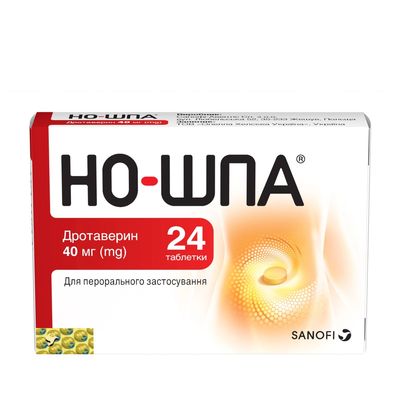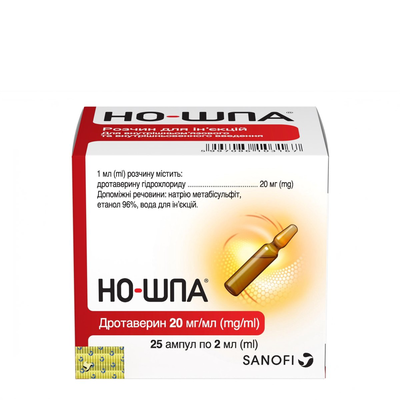
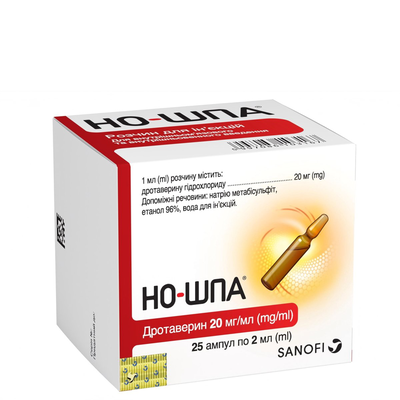
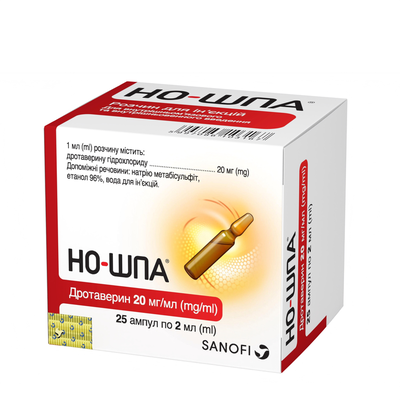
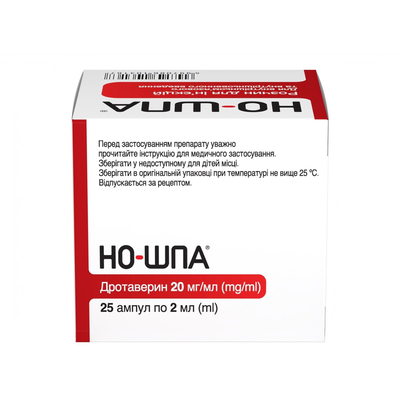
No-Spa solution for injection, 20 mg/mL, 2 mL each, No. 25 (5x5) in ampoules
Ingredients
Active ingredient: drotaverine;
1 mL of solution contains 20 mg of drotaverine hydrochloride;
excipients: sodium metabisulfite, 96% ethanol, water for injection.
Dosage Form
Solution for injection.
Main physical and chemical properties: a clear, yellowish-green liquid.
Pharmacotherapeutic group
Agents used in functional gastrointestinal disorders. ATC code A0ZA D02.
Pharmacological properties
Pharmacodynamics.
Drotaverine is an isoquinoline derivative that exerts an antispasmodic effect on smooth muscle by inhibiting the action of phosphodiesterase IV (PDE IV), which causes an increase in cAMP concentration and, through the inactivation of myosin light chain kinase (MLCK), leads to smooth muscle relaxation.
In vitro, drotaverine inhibits the activity of PDE IV and does not affect the activity of the isoenzymes phosphodiesterase III (PDE III) and phosphodiesterase V (PDE V). PDE IV plays a major role in reducing the contractile activity of smooth muscle; therefore, selective inhibitors of this enzyme may be useful for treating conditions characterized by hypermotility, as well as various diseases involving gastrointestinal spasms.
In the smooth muscle cells of the myocardium and blood vessels, cAMP is hydrolyzed primarily by the PDE III isoenzyme; therefore, drotaverine is an effective antispasmodic that does not cause significant side effects on the cardiovascular system and does not exert a strong therapeutic effect on this system.
Drotaverine is effective for spasms of smooth muscle of both nervous and muscular origin. Drotaverine acts on the smooth muscles of the gastrointestinal, biliary, genitourinary, and vascular systems, regardless of the type of their autonomic innervation. It enhances blood flow in tissues due to its ability to dilate blood vessels.
Drotaverine is more potent than papaverine; its absorption is faster and more complete, and it binds less to serum proteins. Another advantage of drotaverine is that, unlike papaverine, its parenteral administration does not cause side effects such as respiratory stimulation.
Pharmacokinetics.
Absorption. Drotaverine is rapidly absorbed following both oral and parenteral administration.
Distribution. It exhibits a high degree of binding to plasma albumin (95–98%) and to alpha- and beta-globulins. Maximum serum concentration is reached within 45–60 minutes after oral administration.
Biotransformation. After first-pass metabolism, 65% of the administered dose enters the bloodstream unchanged. It is metabolized in the liver.
Elimination. The biological half-life is 8–10 hours. Within 72 hours, drotaverine is almost completely eliminated from the body; more than 50% is excreted in the urine and approximately 30% in the feces. Drotaverine is primarily excreted as metabolites; it is not detected in urine in its unchanged form.
Indications
Smooth muscle spasms associated with diseases of the biliary tract: cholecystolithiasis, cholangiolithiasis, cholecystitis, pericholecystitis, cholangitis, papillitis.
Smooth muscle spasms associated with diseases of the urinary tract: nephrolithiasis, urethrolithiasis, pyelitis, cystitis, and bladder tenesmus.
As an adjunctive treatment (when the drug cannot be administered in tablet form):
- for smooth muscle spasms of the gastrointestinal tract: gastric and duodenal ulcers, gastritis, cardia and/or pyloric spasm, enteritis, colitis;
- for gynecological conditions: dysmenorrhea.
Contraindications
Hypersensitivity to the active ingredient or to any component of the drug (especially to sodium metabisulfite). Hypersensitivity to sodium disulfite. Severe hepatic, renal, or cardiac insufficiency (low cardiac output syndrome).
Special Safety Precautions
Due to the risk of collapse during intravenous administration of No-Spa®, the patient must remain in a supine position.
Use with caution in patients with arterial hypotension.
The drug contains metabisulfite, which may cause allergic-type reactions, including symptoms of anaphylactic shock and bronchospasm in sensitive patients, especially those with a history of asthma or allergies. In cases of hypersensitivity to sodium metabisulfite, parenteral administration of the drug should be avoided (see the “Contraindications” section).
Caution should be exercised when administering the drug parenterally to pregnant women (see the “Use During Pregnancy or Breastfeeding” section).
Children.
No clinical studies have been conducted on the use of this drug in children.
Interactions with Other Medications and Other Types of Interactions
Phosphodiesterase inhibitors (No-Spa®, papaverine) reduce the antiparkinsonian effect of levodopa. No-Spa® should be used with caution when administered concomitantly with levodopa, as the antiparkinsonian effect of levodopa is reduced, while rigidity and tremor are exacerbated.
Special Considerations for Use
Use during pregnancy or breastfeeding.
Pregnancy. As shown by the results of retrospective clinical studies and animal studies, oral administration of the drug did not cause any signs of direct or indirect effects on pregnancy, embryonic development, labor, or postnatal development. However, this drug should be used with caution in pregnant women. Drotaverine should not be used during labor.
Breastfeeding. Due to the lack of preclinical data regarding use during breastfeeding, administration of the drug is not recommended.
Fertility.
There are no data on the effect on human fertility.
Effect on reaction time when operating motor vehicles or other machinery.
Patients should be advised that after parenteral administration, especially intravenous administration, they should refrain from driving or performing tasks that require increased attention.
Dosage and Administration
Dosage.
Adults.
The recommended daily dose is 40–240 mg (in 1–3 separate administrations) intramuscularly.
For acute colic in adult patients with stones in the urinary or biliary tracts—40–80 mg intravenously.
Route of administration.
The drug is administered intramuscularly and intravenously.
Children
No clinical studies have been conducted on the use of this drug in children.
Overdose
Symptoms: In cases of significant overdoses of drotaverine, cardiac arrhythmias and conduction disturbances have been observed, including complete bundle branch block and cardiac arrest, which may be fatal.
In case of overdose, the patient should be kept under close medical supervision and receive symptomatic treatment, including induction of vomiting and/or gastric lavage.
Side Effects
Adverse reactions observed during clinical trials and possibly caused by drotaverine are categorized by organ system and frequency of occurrence: very common (> 1/10), common (> 1/100, < 1/10), uncommon (> 1/1,000, < 1/100), rare (> 1/10,000, < 1/1,000), very rare (< 1/10,000), frequency unknown (cannot be estimated from the available data).
Immune system disorders.
Rare: allergic reactions, including angioedema, urticaria, rash, pruritus, fever, chills, elevated body temperature, weakness, especially in patients with hypersensitivity to metabisulfite.
Frequency unknown: There have been reports of cases of anaphylactic shock, both fatal and non-fatal, following administration of the injectable form.
The drug contains metabisulfite, which may cause allergic-type reactions, including symptoms of anaphylactic shock and bronchospasm in sensitive patients, especially those with a history of asthma or allergies.
Cardiovascular system.
Rare: palpitations, hypotension.
Nervous system.
Rare: headache, dizziness, insomnia.
Gastrointestinal system.
Rare: nausea, constipation, vomiting.
General disorders and administration site conditions: local reactions at the injection site.
Shelf life
3 years.
Storage conditions
Keep out of reach of children.
Store in the original packaging at a temperature not exceeding 25 °C.
Packaging
No. 25 (5x5): 2 mL per ampoule, 5 ampoules per tray, 5 trays per cardboard box.
Dispensing Category
By prescription only.