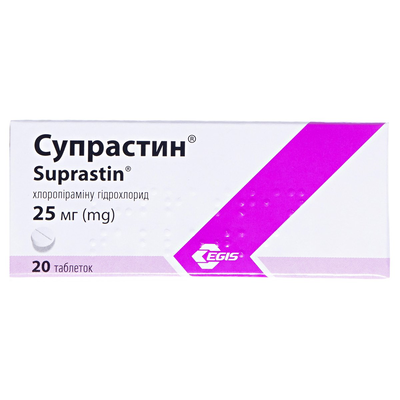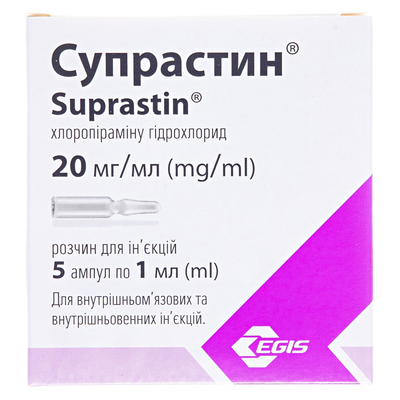
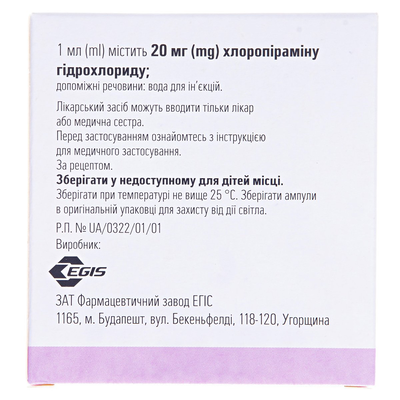
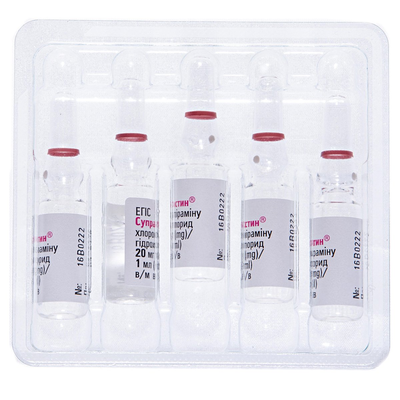

Suprastin Solution for Injection, 20 mg/mL, 1 mL, No. 5 in ampoules
Ingredients
Active ingredient: chloropyramine;
1 mL contains 20 mg of chloropyramine hydrochloride;
excipients: water for injection.
Dosage Form
Solution for injection.
Main physical and chemical properties: a colorless, clear aqueous solution with a faint characteristic odor.
Pharmacotherapeutic group
Antihistamines for systemic use.
ATC code R06A C03.
Pharmacological properties
Pharmacodynamics.
Chloropyramine, a chlorinated analog of tripelamine (pyribenzamine), is a first-generation antihistamine belonging to the ethylenediamine group.
The mechanism of action of the drug involves the blockade of histamine H1 receptors.
The drug alleviates the general symptoms of allergic diseases; in addition to its antiallergic effects, it has sedative, hypnotic, and antipruritic effects.
Pharmacokinetics.
Chloropyramine is metabolized in the liver. It is excreted primarily in the urine as metabolites. In children, the drug may be excreted more rapidly than in adult patients.
In patients with impaired renal function, excretion of the active ingredient may be reduced.
In hepatic insufficiency, the metabolism of chloropyramine is slowed, requiring dose adjustment.
Indications
- Allergic conditions—seasonal allergic rhinitis; conjunctivitis; urticaria; contact dermatitis; food allergy; drug-induced allergic reactions; insect bite allergy.
- As adjunctive therapy for systemic anaphylactic reactions and angioedema.
Contraindications
- Hypersensitivity to any component of the drug;
- acute attacks of bronchial asthma;
- angle-closure glaucoma;
- peptic ulcer disease;
- acute myocardial infarction;
- arrhythmia;
- concomitant use of monoamine oxidase inhibitors (MAOIs);
- urinary retention, prostatic hypertrophy;
- hypersensitivity to other ethylenediamine derivatives;
- pregnancy and breastfeeding.
Drug Interactions and Other Interactions
MAO inhibitors increase and prolong the anticholinergic effect of the drug. Particular caution should be exercised when prescribing this drug concomitantly with sedatives, barbiturates, hypnotics, tranquilizers, opioid analgesics, tricyclic antidepressants, atropine, or muscarinic parasympatholytics, as mutual potentiation of effects is possible.
Alcohol enhances the drug’s depressant effects on the central nervous system; therefore, alcohol consumption should be avoided during treatment with this drug.
When used in combination with ototoxic drugs, signs of ototoxicity may be masked.
Antihistamines may suppress skin reactions during allergy testing; therefore, these medications should be discontinued several days before a scheduled skin allergy test.
Special Considerations for Use
Elderly patients and debilitated patients.
SupraStin® should be prescribed with particular caution to these patient groups, as they are more sensitive to certain side effects of antihistamines (dizziness, drowsiness, decreased blood pressure).
Due to the drug’s anticholinergic and sedative effects, special caution should be exercised when administering the drug to elderly patients, patients with impaired liver function, or those with cardiovascular disorders.
If the drug is taken late in the evening, symptoms of gastroesophageal reflux may worsen.
When SupraStin® is used in combination with ototoxic agents, symptoms of ototoxicity may be masked.
Alcohol may enhance the sedative effects of antihistamines on the central nervous system.
Long-term use of antihistamines may rarely cause disorders of the hematopoietic system (leukopenia, agranulocytosis, thrombocytopenia, hemolytic anemia). If adverse effects occur during long-term use of the drug (fever, laryngitis, mouth ulcers, pallor, jaundice, hematomas, bleeding), treatment should be discontinued and blood counts monitored.
Use during pregnancy or breastfeeding.
No preclinical studies have been conducted.
No adequate and well-controlled clinical studies involving pregnant women have been conducted, although cases have been reported in which newborns whose mothers received antihistamines during the last months of pregnancy developed retrolental fibroplasia.
Therefore, use of this medication during pregnancy or while breastfeeding is contraindicated.
Effect on reaction time when operating motor vehicles or other machinery.
While taking this medication, especially at the start of treatment, drowsiness and impaired psychomotor function may occur (see the “Special Considerations for Use” section). Therefore, given the potential for adverse reactions affecting the nervous system, driving or operating machinery should be prohibited at the start of therapy for a period determined on an individual basis in each specific case. Subsequently, the extent of the restriction or prohibition should be determined by the physician on a case-by-case basis.
Dosage and Administration
SupraStin® injection solution may be administered only by a physician or nurse. The solution is administered intramuscularly. In cases of anaphylactic shock or acute, severe allergic reactions, treatment should begin with intravenous administration of Suprastin®, followed by a switch to intramuscular injections or oral administration of tablets. The duration of treatment is determined by the doctor.
Adults
The daily dose for adults is usually 1–2 mL (1–2 ampules) administered intramuscularly.
Children
Recommended initial dose:
- children aged 1–12 months: 1/4 ampule (0.25 mL) intramuscularly;
- children aged 1–6 years: 1/2 ampule (0.5 mL) intramuscularly;
- children aged 6–14 years: 1/2–1 ampoule (0.5–1 mL) intramuscularly.
In this case, an insulin syringe with a needle for intramuscular injection must be used.
The daily dose for a child should not exceed 2 mg/kg of body weight.
Elderly patients, debilitated patients
Prescribe the drug with particular caution to these patient groups, as they are more sensitive to certain side effects of antihistamines (dizziness, drowsiness, decreased blood pressure) (see the “Special Considerations for Use” section).
Liver dysfunction
A dose reduction may be necessary, as the metabolism of the active ingredient is reduced in patients with liver disease.
Renal impairment
In cases of renal impairment, a dose reduction is necessary, as the active ingredient is primarily excreted by the kidneys.
Children. Suprastin® may be used in children aged 1 month and older. It is contraindicated in newborns and premature infants.
Overdose
Symptoms
Intentional or accidental overdose of antihistamines can be fatal, especially in infants and children. In case of a Suprastin® overdose, symptoms similar to atropine intoxication develop: hallucinations, restlessness, ataxia, impaired coordination, athetosis, and seizures. In children, a state of agitation predominates. Dry mouth, dilated pupils, flushing, sinus tachycardia, urinary retention, and fever may also occur. In adults, fever and flushing are not always observed; the period of agitation is accompanied by seizures and postictal depression. In addition, coma and cardiopulmonary collapse may occur, which can lead to death within 2–18 hours.
Monitoring of cardiopulmonary function is recommended. Treatment is symptomatic.
There is no known antidote.
Side Effects
The following side effects may occur with the use of Suprastin®.
Cardiovascular system: hypotension, tachycardia, arrhythmia.
Blood system: leukopenia, agranulocytosis, thrombocytopenia, hemolytic anemia, other pathological changes in the blood.
Central nervous system: sedative effect, increased fatigue, dizziness (vertigo), ataxia, nervousness, tremors, seizures, headache, euphoria, encephalopathy, blurred vision, drowsiness, impaired psychomotor functions.
Ocular: increased intraocular pressure, glaucoma.
Gastrointestinal side effects: pain and discomfort in the epigastric region, dry mouth, nausea, vomiting, diarrhea, constipation, anorexia, increased or decreased appetite, worsening of gastroesophageal reflux symptoms.
Renal and urinary system: dysuria, urinary retention.
Skin and subcutaneous tissue disorders: photosensitivity, allergic reactions.
Musculoskeletal and connective tissue disorders: myopathy.
Immune system disorders: allergic reactions, including skin flushing, rash, itching, hives, and angioedema.
Other: changes at the injection site.
Shelf life
5 years.
Storage conditions
Store at a temperature not exceeding 25 °C. Keep the ampoules in their original packaging to protect them from light. Keep out of the reach of children.
Packaging
1 mL per ampoule; 5 ampoules per cardboard box.
Dispensing Category
By prescription only.
Manufacturer
EGIS Pharmaceutical Plant, CJSC.