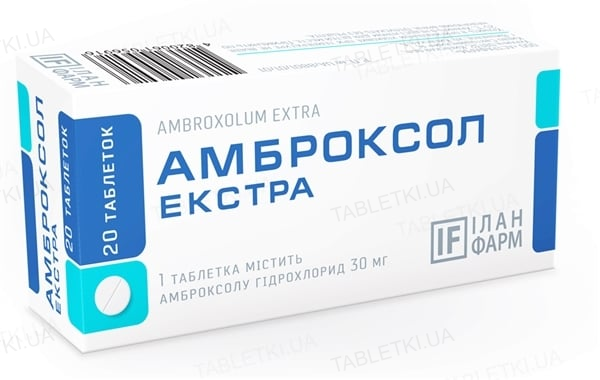
Ambroxol Extra 30 mg tablets, No. 20 (10 x 2)
Ingredients
Active ingredient: ambroxol hydrochloride;
1 tablet contains 30 mg of ambroxol hydrochloride;
inactive ingredients: lactose monohydrate; corn starch; colloidal anhydrous silicon dioxide; magnesium stearate.
Dosage Form
Tablets.
Main physical and chemical properties: white or white with a cream tint tablets, flat-cylindrical in shape, with beveled edges and a score line on one side.
Pharmacotherapeutic group
Agents used for coughs and the common cold. Mucolytics.
ATC code R05C B06.
Pharmacological Properties
Pharmacodynamics.
It has been demonstrated that the active ingredient, ambroxol hydrochloride, increases secretion from the airway glands. Ambroxol enhances the release of pulmonary surfactant by directly acting on type II pneumocytes in the alveoli and Clara cells in the bronchioles, and also stimulates ciliary activity, thereby facilitating mucus production and its removal (mucociliary clearance). Improved mucociliary clearance has been demonstrated in clinical and pharmacological studies.
The activation of fluid secretion and the increase in mucociliary clearance facilitate mucus clearance and relieve cough.
A local anesthetic effect of ambroxol hydrochloride was observed in a rabbit eye model, which may be explained by its sodium channel-blocking properties. In vitro studies have shown that ambroxol hydrochloride blocks neuronal sodium channels; the binding was reversible and concentration-dependent.
Ambroxol hydrochloride demonstrated anti-inflammatory effects in vitro. Thus, ambroxol hydrochloride significantly reduces cytokine release from mononuclear and polymorphonuclear cells in blood and tissues.
Clinical trials involving patients with pharyngitis demonstrated a significant reduction in throat pain and redness following administration of the drug.
Thanks to the pharmacological properties of ambroxol, pain was rapidly relieved during the treatment of upper respiratory tract diseases, as observed in clinical efficacy studies of inhaled forms of ambroxol.
The use of ambroxol hydrochloride increases the concentration of antibiotics (amoxicillin, cefuroxime, erythromycin, and doxycycline) in bronchopulmonary secretions and sputum.
Pharmacokinetics.
Absorption. Absorption of ambroxol hydrochloride from immediate-release oral formulations is rapid and complete, with a linear dose-response relationship within the therapeutic range. Maximum plasma concentrations are reached 1–2.5 hours after oral administration of immediate-release formulations and, on average, after 6.5 hours when using sustained-release formulations.
Distribution. Following oral administration, the distribution of ambroxol hydrochloride from the blood to tissues is rapid and extensive, with the highest concentration of the active ingredient found in the lungs. The expected volume of distribution following oral administration is 552 L. In blood plasma within the therapeutic dose range, approximately 90% of the drug is bound to proteins.
Metabolism and Excretion. Approximately 30% of the dose is eliminated via presystemic metabolism following oral administration. Ambroxol hydrochloride is metabolized primarily in the liver by glucuronidation and cleavage to dibromantranilic acid (approximately 10% of the dose). Studies on human liver microsomes have shown that CYP3A4 is responsible for the metabolism of ambroxol hydrochloride to dibromanthranilic acid.
Three days after oral administration, approximately 6% of the dose is excreted in the urine in an unchanged form, and approximately 26% of the dose is excreted in a conjugated form.
The plasma half-life is approximately 10 hours. Total clearance is approximately 660 mL/min. Renal clearance accounts for approximately 8% of total clearance. After 5 days, approximately 83% of the total dose is excreted in the urine.
Pharmacokinetics in Specific Patient Populations. In patients with impaired liver function, the elimination of ambroxol hydrochloride is reduced, resulting in 1.3- to 2-fold higher plasma levels. Since the therapeutic range of ambroxol hydrochloride is sufficiently wide, no dosage adjustment is necessary.
Age and gender have no clinically significant effect on the pharmacokinetics of ambroxol hydrochloride; therefore, no dose adjustment is necessary.
Indications
Secretolytic therapy for acute and chronic bronchopulmonary diseases associated with impaired bronchial secretion and reduced mucus clearance.
Contraindications
Hypersensitivity to ambroxol hydrochloride or to any other components of the drug.
Children under 6 years of age due to dosage considerations.
Interactions with Other Medications and Other Types of Interactions
Concomitant use of ambroxol and cough suppressants may lead to excessive mucus accumulation due to suppression of the cough reflex. Therefore, such a combination is permissible only after a physician has carefully assessed the balance between the expected benefits and the potential risks of use.
Special Considerations for Use
Only a few reports have been received of severe skin reactions: Stevens-Johnson syndrome and toxic epidermal necrolysis (Lyell’s syndrome) associated with the use of expectorants such as ambroxol hydrochloride. In most cases, these events could be attributed to the severity of the underlying disease in patients and the concomitant use of another medication.
Additionally, in the early stages of Stevens-Johnson syndrome or Lyell’s syndrome, patients may experience nonspecific symptoms similar to those of early-stage influenza, such as fever, body aches, rhinitis, cough, and sore throat. Such nonspecific symptoms, which resemble the early signs of the flu, may lead to the mistaken use of symptomatic treatments with cough and cold medications. Therefore, if new lesions appear on the skin or mucous membranes, seek medical attention immediately and discontinue treatment with ambroxol hydrochloride.
Ambroxol Extra tablets contain lactose. Patients with rare hereditary conditions such as galactose intolerance, Lapp lactase deficiency, or glucose-galactose malabsorption should not take this medication.
Since ambroxol may increase mucus secretion, the medication should be used with caution in cases of impaired bronchial motility and increased mucus secretion (for example, in a rare condition such as primary ciliary dyskinesia).
Patients with impaired renal function or severe hepatic insufficiency should take Ambroxol Extra tablets only after consulting a doctor. When ambroxol is used—as with any active ingredient that is metabolized in the liver and then excreted by the kidneys—metabolites formed in the liver accumulate in patients with severe renal insufficiency.
Use During Pregnancy or Breastfeeding.
Pregnancy. Ambroxol hydrochloride crosses the placental barrier. Animal studies have not revealed any direct or indirect harmful effects on the course of pregnancy, embryonic/fetal development, labor, or postnatal development.
Studies of the drug’s use after the 28th week of pregnancy have not revealed any harmful effects on the fetus.
However, the usual precautions regarding the use of medications during pregnancy should be observed. In particular, the use of Ambroxol Extra is not recommended during the first trimester of pregnancy.
Breastfeeding. Ambroxol hydrochloride passes into breast milk; therefore, the drug is not recommended during breastfeeding.
Fertility. Preclinical studies do not indicate any direct or indirect adverse effects on fertility.
Effect on reaction time when driving or operating machinery.
There are no data on the effect on reaction time when driving or operating machinery. No relevant studies have been conducted.
Dosage and Administration
Unless otherwise prescribed, the recommended dose is as follows:
children aged 6 to 12 years: the usual dose is 1/2 tablet 2–3 times daily (equivalent to 30–45 mg of ambroxol hydrochloride per day);
adults and children 12 years of age and older: the usual dose is 1 tablet 3 times daily for the first 2–3 days (equivalent to 90 mg of ambroxol hydrochloride per day). Continue treatment with 1 tablet twice daily (equivalent to 60 mg of ambroxol hydrochloride per day).
If necessary, the therapeutic effect for adults and children 12 years of age and older can be enhanced by taking 2 tablets twice daily (equivalent to 120 mg of ambroxol hydrochloride per day).
The tablets should be swallowed whole with a sufficient amount of liquid (e.g., water, tea, or fruit juice) after a meal.
In general, there are no restrictions on the duration of use, but long-term therapy should be conducted under medical supervision.
The medication should not be used for more than 4–5 days without consulting a doctor.
Children.
For children under 6 years of age, it is recommended to use ambroxol in another dosage form—syrup or a solution for inhalation and oral administration.
Overdose
To date, there have been no reports of overdose in humans. Symptoms reported in isolated cases of overdose and/or accidental medication use correspond to the known side effects of ambroxol at recommended doses and require symptomatic treatment.
Side Effects
General disorders: hypersensitivity reactions (skin rash, hives, mucosal reactions, angioedema, dyspnea, itching, and other allergic reactions), fever; anaphylactic reactions, including anaphylactic shock.
Skin and subcutaneous tissue disorders: erythema, severe skin lesions: Stevens-Johnson syndrome and toxic epidermal necrolysis (Lyell’s syndrome).
Gastrointestinal disorders: diarrhea, gastrointestinal complaints (e.g., nausea, vomiting, dyspepsia, abdominal pain), dry mouth, heartburn, constipation, hypersalivation.
Respiratory system: rhinorrhea, dryness of the respiratory tract.
Urinary system: dysuria.
Shelf life
5 years.
Storage conditions
Store in the original packaging at a temperature not exceeding 25 °C.
Keep out of reach of children.
Packaging
10 tablets per blister pack; 2 blister packs per cardboard box.
Dispensing Category
Over-the-counter.
Manufacturer
ASTRAFARM LLC, Ukraine.
Manufacturer’s location and address of its place of business.
6 Kyivska St., Vyshneve, Kyiv-Sviatoshyn District, Kyiv Oblast, 08132.