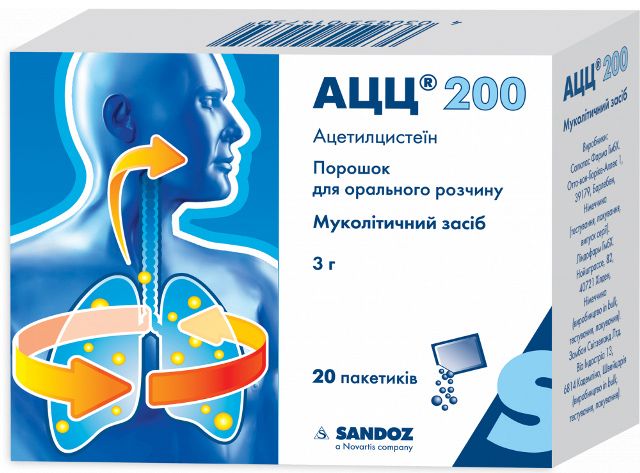
ACC-200 Powder in Sachets, No. 20
Ingredients
Active ingredient: acetylcysteine;
- 1 packet contains 100 mg or 200 mg of acetylcysteine;
excipients: sucrose, ascorbic acid, saccharin, orange flavoring.
Dosage Form
Powder for oral solution.
Main physical and chemical properties:
A white to yellowish powder, which may contain agglomerates, with an orange odor.
Pharmacotherapeutic group
Mucolytics. ATC code R05C B01.
Pharmacological properties
Acetylcysteine (ACC) is a mucolytic and expectorant agent used to thin mucus in respiratory diseases accompanied by the formation of thick mucus. Acetylcysteine is a derivative of the amino acid cysteine. The mucolytic effect of the drug is chemically mediated. Through its free sulfhydryl group, acetylcysteine breaks the disulfide bonds of acidic mucopolysaccharides, leading to the depolymerization of sputum mucoproteins and a reduction in mucus viscosity, and promotes the expectoration and clearance of bronchial secretions. The drug remains active in the presence of purulent sputum.
Acetylcysteine also possesses antioxidant and pneumoprotective properties, which result from its sulfhydryl groups binding to chemical radicals and thereby neutralizing them. In addition, the drug promotes increased synthesis of glutathione—an important factor in intracellular protection not only against exogenous and endogenous oxidative toxins but also against a number of cytotoxic substances. This property of acetylcysteine allows it to be used effectively in cases of paracetamol overdose.
After oral administration, acetylcysteine is rapidly and completely absorbed and metabolized in the liver to form cysteine, a pharmacologically active metabolite, as well as diacetylcysteine, cystine, and subsequently mixed disulfides. Bioavailability is very low—approximately 10%. Maximum plasma concentration is reached 1–3 hours after administration. Plasma protein binding is approximately 50%. Acetylcysteine is excreted by the kidneys as inactive metabolites (inorganic sulfates, diacetylcysteine).
The half-life is determined primarily by rapid biotransformation in the liver and is approximately 1 hour. In cases of impaired liver function, the half-life is prolonged to 8 hours.
Indications
- Treatment of acute and chronic diseases of the bronchopulmonary system requiring a reduction in sputum viscosity and improved sputum clearance and expectoration.
Contraindications for ACC 200
- Hypersensitivity to acetylcysteine or to any other components of the drug.
- Gastric and duodenal ulcers in the acute phase.
- Hemoptysis, pulmonary hemorrhage.
Special Considerations for Use
This medication should be used with caution in patients with a history of gastric or duodenal ulcers, especially when taken concomitantly with other medications that irritate the gastric mucosa.
There have been isolated reports of severe skin reactions (Stevens-Johnson syndrome and Lyell’s syndrome) associated with acetylcysteine use; therefore, if any changes occur in the skin or mucous membranes, stop taking the medication immediately and consult a doctor regarding further use.
Acetylcysteine should be prescribed with caution to patients with bronchial asthma due to the potential for bronchospasm. When emptying the contents of the packet into a container during solution preparation, the powder may become airborne and irritate the nasal mucosa, which may result in reflex bronchospasm.
Acetylcysteine should be prescribed with caution to patients with liver or kidney disease to avoid the accumulation of nitrogen-containing substances in the body.
The use of acetylcysteine causes bronchial secretions to become thinner. If the patient is unable to effectively cough up sputum, postural drainage and bronchial aspiration are necessary.
Acetylcysteine affects histamine metabolism; therefore, long-term therapy should not be prescribed to patients with histamine intolerance, as this may lead to the onset of intolerance symptoms (headache, vasomotor rhinitis, itching).
The drug contains sucrose and should therefore not be prescribed to patients with rare hereditary forms of fructose intolerance, sucrase-isomaltase deficiency, or glucose-galactose malabsorption syndrome.
One sachet of ACC 100 contains 2.8 g of sucrose (approximately 0.24 bread units); one packet of ACC 200 contains 2.7 g of sucrose (approximately 0.23 bread units). This should be taken into account when administering the drug to patients with diabetes mellitus.
Special Precautions.
Use during pregnancy or breastfeeding.
During pregnancy or breastfeeding, acetylcysteine may be used only if the expected benefit to the mother outweighs the potential risk to the fetus or infant.
Effect on reaction time when driving or operating machinery.
No effect.
Children.
For use in children 2 years of age and older.
Dosage and Administration of ACC 200
- Adults and children over 14 years of age are prescribed 400–600 mg of acetylcysteine per day, divided into 1–3 doses.
- Children aged 6 to 14 years are prescribed 400–600 mg per day, divided into 2–3 doses.
- Children aged 2 to 6 years are prescribed 200–400 mg per day, divided into 2 doses.
It is recommended to take the medication after meals. Dissolve the contents of the packet in ½ glass of water, juice, or cold tea. Once the solution is prepared, it should be consumed as soon as possible. In some cases, due to the presence of a stabilizer—ascorbic acid—in the medication, the prepared solution may be left for approximately 2 hours before use. Increased fluid intake enhances the mucolytic effect of the medication.
The duration of treatment for chronic conditions is determined by the doctor based on the nature and course of the disease. For acute, uncomplicated conditions, acetylcysteine is used for 5–7 days.
Overdose
There are no reports of overdose following oral administration of acetylcysteine.
Symptoms: nausea, vomiting, diarrhea. In children, there is a risk of hypersecretion.
Treatment: symptomatic therapy.
Adverse Reactions to ACC 200
The following classification is used to describe the frequency of adverse reactions: very common (≥ 1/10), common (≥ 1/100, < 1/10), uncommon (≥ 1/1,000, < 1/100), rare (≥ 1/10,000, < 1/1,000), very rare (< 1/10,000).
- Cardiovascular system: uncommon—tachycardia, arterial hypotension.
- Nervous system disorders: uncommon – headache.
- Skin disorders: uncommon – allergic reactions (itching, hives, exanthema, eczema, rashes, angioedema).
- Ear disorders: uncommon – tinnitus.
- Respiratory system: rarely—dyspnea, bronchospasm (primarily in patients with bronchial hyperreactivity associated with bronchial asthma), rhinorrhea.
- Gastrointestinal system: uncommon—heartburn, dyspepsia, stomatitis, abdominal pain, nausea, vomiting, diarrhea, bad breath.
- General disorders: infrequently—fever.
Isolated cases of severe skin reactions (Stevens-Johnson syndrome and Lyell’s syndrome) have been reported. Very rare cases of bleeding have been reported with the use of acetylcysteine, most often associated with the development of hypersensitivity reactions. Cases of reduced platelet aggregation have been noted, but there is no clinical confirmation of this. Very rare cases of angioedema, facial swelling, anemia, hemorrhage, anaphylactic reactions, or even shock have been reported.
Interactions with Other Medications and Other Types of Interactions.
Concomitant use of acetylcysteine with antitussives may increase sputum retention due to a reduction in the cough reflex.
When used concomitantly with antibiotics such as tetracyclines (except doxycycline), ampicillin, amphotericin B, cephalosporins, and aminoglycosides, an interaction with the thiol group of acetylcysteine is possible, leading to a reduction in the activity of both drugs. Therefore, the interval between administration of these drugs should be at least 2 hours. This does not apply to cefixime and loracarbef.
Activated charcoal reduces the effectiveness of acetylcysteine.
It is not recommended to dissolve acetylcysteine with other medications in the same glass.
Acetylcysteine reduces the hepatotoxic effects of acetaminophen.
Synergism between acetylcysteine and bronchodilators has been observed.
Acetylcysteine can act as a cysteine donor and increase glutathione levels, which aids in the detoxification of oxygen free radicals and certain toxic substances in the body.
Concomitant use of nitroglycerin and acetylcysteine may lead to an enhancement of nitroglycerin’s vasodilatory effect.
When in contact with metals or rubber, sulfides with a characteristic odor are formed; therefore, glassware should be used to dissolve the medication.
Shelf life
3 years.
Storage Conditions
Store at a temperature not exceeding 25 °C. Keep out of reach of children.
Packaging
3 g of powder per sachet. 20 sachets per cardboard box.
Pharmacy Dispensing Category
Over-the-counter.