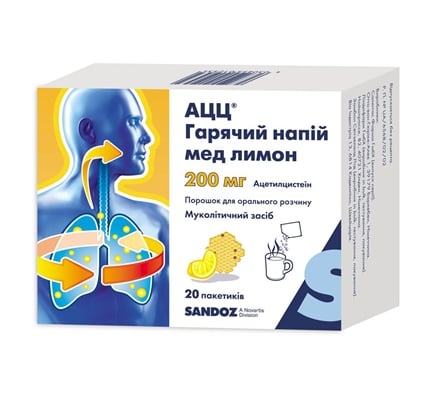
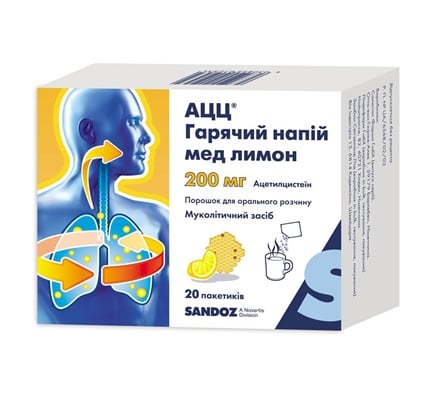
Azz Hot Drink Honey-Lemon Powder for Oral Solution, 200 mg each, No. 20 per package
Ingredients
Active ingredient: acetylcysteine;
1 packet contains 200 mg or 600 mg of acetylcysteine;
excipients: sucrose, ascorbic acid, sodium saccharin, lemon flavoring, honey flavoring.
Dosage Form
Powder for oral solution.
Main physical and chemical properties:
200 mg powder: white to yellowish powder, may contain agglomerates, with a lemon/honey odor;
600 mg powder: white to yellowish powder; may contain agglomerates; has a lemon/honey odor.
Pharmacotherapeutic group
Agents used for cough and the common cold. Mucolytics.
ATC code R05C B01.
Pharmacological Properties
Pharmacodynamics.
Acetylcysteine (ACC) is a mucolytic and expectorant used to thin mucus in respiratory diseases accompanied by the production of thick mucus. Acetylcysteine is a derivative of the amino acid cysteine. The drug’s mucolytic effect is of a chemical nature. Through its free sulfhydryl group, acetylcysteine breaks the disulfide bonds of acidic mucopolysaccharides, leading to the depolymerization of sputum mucoproteins and a reduction inviscosity of the mucus and facilitates the expectoration and clearance of bronchial secretions. The drug remains active in the presence of purulent sputum.
Acetylcysteine also possesses antioxidant and pneumoprotective properties, which are due to its sulfhydryl groups binding to chemical radicals and thereby neutralizing them. In addition, the drug promotes increased synthesis of glutathione—an important factor in intracellular protection not only against exogenous and endogenous oxidative toxins but also against a number of cytotoxic substances. This property of acetylcysteine allows it to be used effectively in cases of paracetamol overdose.
Pharmacokinetics.
After oral administration, acetylcysteine is rapidly and completely absorbed and metabolized in the liver to form cysteine, a pharmacologically active metabolite, as well as diacetylcysteine, cystine, and subsequently mixed disulfides. Bioavailability is very low—approximately 10%. Maximum plasma concentration is reached 1–3 hours after administration. Plasma protein binding is approximately 50%. Acetylcysteine is excreted by the kidneys as inactive metabolites (inorganic sulfates, diacetylcysteine).
The half-life is determined primarily by rapid biotransformation in the liver and is approximately 1 hour. In cases of impaired liver function, the half-life is prolonged to 8 hours.
Indications
Treatment of acute and chronic diseases of the bronchopulmonary system requiring a reduction in sputum viscosity and improved sputum clearance and expectoration.
Contraindications
Hypersensitivity to acetylcysteine or to any other components of the drug. Active gastric or duodenal ulcers, hemoptysis, pulmonary hemorrhage, or severe exacerbation of bronchial asthma.
Drug Interactions and Other Interactions
Interaction studies were conducted only in adults.
Concomitant use of antitussives with acetylcysteine may increase sputum retention due to a reduction in the cough reflex.
When used concomitantly with antibiotics such as tetracyclines (except doxycycline), ampicillin, amphotericin B, cephalosporins, and aminoglycosides, interactions with the thiol group of acetylcysteine are possible, leading to a reduction in the activity of both drugs. Therefore, the interval between doses of these drugs should be at least 2 hours. This does not apply to cefixime and loracarbef.
Activated charcoal reduces the effectiveness of acetylcysteine.
It is not recommended to dissolve acetylcysteine in the same glass as other medications.
Significant arterial hypotension and marked dilation of the temporal artery have been observed with the concurrent use of nitroglycerin and acetylcysteine. If simultaneous use of nitroglycerin and acetylcysteine is necessary, patients should be monitored for hypotension, which may be severe; patients should also be warned about the possibility of headaches.
Acetylcysteine reduces the hepatotoxic effects of paracetamol.
Synergistic effects of acetylcysteine with bronchodilators have been observed.
Acetylcysteine can act as a cysteine donor and increase glutathione levels, which aids in the detoxification of oxygen free radicals and certain toxic substances in the body.
When in contact with metals or rubber, sulfides with a characteristic odor are formed; therefore, glassware should be used to dissolve the drug.
Effect on laboratory tests.
Acetylcysteine may interfere with colorimetric assays for salicylates and with the determination of ketone bodies in urine.
Special considerations for use
There have been isolated reports of severe skin reactions (Stevens–Johnson syndrome and Lyell’s syndrome) associated with acetylcysteine use; therefore, if any changes occur in the skin or mucous membranes, stop taking the medication immediately and consult a doctor regarding further use.
Caution is advised when administering this medication to patients with a history of gastric or duodenal ulcers, especially when other medications that irritate the gastric mucosa are being taken concurrently.
Acetylcysteine affects histamine metabolism; therefore, long-term therapy should not be prescribed to patients with histamine intolerance, as this may lead to the onset of intolerance symptoms (headache, vasomotor rhinitis, itching).
Acetylcysteine should be prescribed with caution to patients with bronchial asthma due to the potential for bronchospasm. When emptying the contents of the packet into a container during solution preparation, the powder may become airborne and irritate the nasal mucosa, which may result in reflex bronchospasm. If bronchospasm occurs, treatment with acetylcysteine should be discontinued immediately.
Acetylcysteine should be prescribed with caution to patients with liver or kidney disease to avoid the accumulation of nitrogen-containing substances in the body.
The use of acetylcysteine, particularly at the start of treatment, may thin bronchial secretions and increase their volume, especially in children under 2 years of age. If the patient is unable to effectively cough up sputum, postural drainage and bronchial aspiration are necessary.
This medication contains sucrose and should therefore not be prescribed to patients with rare hereditary forms of fructose intolerance, sucrase-isomaltase deficiency, or glucose-galactose malabsorption syndrome.
Information for patients with diabetes.
1 packet of powder (200 mg of acetylcysteine) contains 2.5 g of sucrose (0.21 bread units).
1 packet of powder (600 mg of acetylcysteine) contains 2 g of sucrose (0.17 bread units).
Use During Pregnancy or Breastfeeding.
During pregnancy or breastfeeding, acetylcysteine may be used only if the expected benefit to the mother outweighs the potential risk to the fetus or infant.
Effect on reaction time when driving or operating machinery.
No effect.
Dosage and Administration
Adults and children 14 years of age and older should be prescribed 400–600 mg of acetylcysteine per day, divided into 1–3 doses.
For children aged 6 to 14 years, administer 400–600 mg per day, divided into 2–3 doses.
For children aged 2 to 6 years, administer 200–400 mg per day, divided into 2 doses.
It is recommended to take the medication after meals. Dissolve the contents of the packet while stirring in ½ glass of cold water, then add hot but not boiling water to fill the glass. Stir and drink the liquid as soon as possible after it has cooled to a comfortable temperature. The order of dissolving the powder (cold water first, then hot water) should not be changed. Increased fluid intake enhances the drug’s mucolytic effect.
The duration of treatment for chronic conditions is determined by the doctor based on the nature and course of the disease. For acute, uncomplicated conditions, acetylcysteine should be used for 4–5 days.
Children.
200 mg powder: Use in children 2 years of age and older.
600 mg powder: for children 14 years of age and older.
Overdose
There are no reports of overdose following oral administration of acetylcysteine.
Volunteers took 11.6 g of acetylcysteine daily for three months without experiencing any serious side effects. Oral doses of up to 500 mg of acetylcysteine per kilogram of body weight per day were well tolerated without any symptoms of toxicity.
Symptoms: nausea, vomiting, diarrhea. Children are at risk of hypersecretion.
Treatment: symptomatic therapy.
Side Effects
The following classification is used to describe the frequency of side effects: very common (≥ 1/10), common (≥ 1/100, < 1/10), uncommon (≥ 1/1,000, < 1/100), rarely (≥ 1/10,000, < 1/1,000), very rarely (< 1/10,000).
Cardiovascular system: uncommon—tachycardia, arterial hypotension.
Nervous system disorders: uncommon – headache.
Skin disorders: uncommon – allergic reactions (itching, hives, exanthema, eczema, rash, angioedema).
Ear disorders: uncommon—tinnitus.
Respiratory system: rarely—dyspnea, bronchospasm (primarily in patients with bronchial hyperreactivity associated with bronchial asthma), rhinorrhea.
Gastrointestinal system: uncommon—heartburn, dyspepsia, stomatitis, abdominal pain, nausea, vomiting, diarrhea, bad breath.
General disorders: uncommon—fever.
Isolated cases of severe skin reactions (Stevens–Johnson syndrome and Lyell’s syndrome) have been reported. Very rare cases of bleeding have been reported with the use of acetylcysteine, most often associated with the development of hypersensitivity reactions. Cases of reduced platelet aggregation have been noted; however, there is no clinical confirmation of this. Very rare reports have included angioedema, facial swelling, cases of anemia, hemorrhage, anaphylactic reactions, or even anaphylactic shock.
Shelf life
3 years.
Storage Conditions
Store at a temperature not exceeding 25 °C.
Keep out of reach of children.
Packaging
200 mg powder: 3 g of powder per sachet. 20 sachets per cardboard box.
600 mg powder: 3 g of powder per sachet. 6 sachets per cardboard box.
Dispensing Category
Available without a prescription.