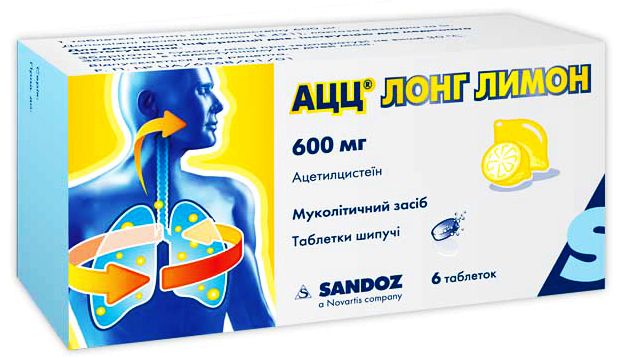
ACC-Long Lemon 600 mg Effervescent Tablets, No. 6
Ingredients
Active ingredient: acetylcysteine;
- 1 effervescent tablet contains 600 mg of acetylcysteine;
excipients: anhydrous citric acid (E 330), sodium bicarbonate, anhydrous sodium carbonate, mannitol (E 421), anhydrous lactose, ascorbic acid (E 300), sodium cyclamate (E 952), sodium saccharin (E 954), sodium citrate dihydrate (E 331), zinc sulfate monohydrate, “BB” lemon flavoring.
Dosage Form
Effervescent tablets.
Main physical and chemical properties:
White, round tablets with a score line, a surface free of defects, a lemon scent, and a characteristic odor.
Pharmacotherapeutic group
Agents used for coughs and colds. Mucolytics.
ATC code R05C B01.
Pharmacological properties
Pharmacodynamics.
N-acetyl-L-cysteine (acetylcysteine) exerts a pronounced mucolytic effect on mucous and mucopurulentpurulent secretions by depolymerizing mucoprotein complexes and nucleic acids, which contribute to the viscosity of the glassy and purulent components of sputum and other secretions. Additional properties: reduction of induced mucocyte hyperplasia, increased surfactant production through stimulation of type II pneumocytes, and stimulation of mucociliary apparatus activity, which contributes to improved mucociliary clearance.
N-acetyl-L-cysteine also exerts a direct antioxidant effect due to the presence of a nucleophilic free thiol group (SH), which is capable of directly interacting with the electrophilic groups of oxidative radicals. It should be noted that acetylcysteine prevents the inactivation of α-1-antitrypsin—an enzyme that inhibits elastase— by hypochlorous acid (HOCl)—a strong oxidizing agent produced by the myeloperoxidase of active phagocytes.
In addition, the molecular structure of acetylcysteine allows it to easily penetrate cell membranes. Inside the cell, acetylcysteine is deacetylated to form L-cysteine, an essential amino acid for glutathione synthesis. In addition, acetylcysteine, which is a precursor to glutathione, exhibits an indirect antioxidant effect. Glutathione is a highly active tripeptide found in various animal tissues and is essential for maintaining cellular function and morphological integrity. In fact, it is part of the most important intracellular defense mechanism against oxidative radicals—both exogenous and endogenous—and certain cytotoxic substances, including acetaminophen.
Paracetamol exerts a cytotoxic effect by progressively reducing glutathione levels. Acetylcysteine plays a key role in maintaining adequate glutathione levels, thereby enhancing cellular defense. Consequently, acetylcysteine serves as a specific antidote for acetaminophen poisoning.
In patients with chronic obstructive pulmonary disease (COPD), taking 1,200 mg of acetylcysteine daily for 6 weeks led to a significant increase in inspired volume and forced vital capacity (FVC), possibly due to a reduction in air trapping.
In patients with idiopathic pulmonary fibrosis (IPF), oral administration of acetylcysteine at a dose of 600 mg three times daily for one year, in combination with standard IPF therapy (prednisolone and azathioprine) helped preserve vital capacity (VC) and diffuse lung capacity, as measured by the single-breath carbon monoxide test.
When administered as inhalation therapy for one year, acetylcysteine helped slow the progression of the disease in patients with IFL.
When administered in very high doses (up to 3,000 mg daily for 4 weeks) to patients with cystic fibrosis, acetylcysteine did not cause significant toxic effects.
The antioxidant efficacy of acetylcysteine is associated with a marked reduction in elastase activity in sputum, which is the most significant indicator of lung function in patients with cystic fibrosis. In addition, treatment was associated with a reduction in the number of neutrophils in the airways, as well as in the number of neutrophils actively releasing elastase-rich granules.
Pharmacokinetics.
Absorption
In humans, acetylcysteine is completely absorbed following oral administration. Due to metabolism in the intestinal wall and the first-pass effect, the bioavailability of acetylcysteine following oral administration is very low (approximately 10%). No differences were observed among the various dosage forms. In patients with various respiratory and cardiac diseases, the maximum plasma concentration of acetylcysteine is reached 1–3 hours after administration and remains high for 24 hours.
Distribution
Acetylcysteine is distributed in the body both in its unchanged form (20%) and as (active) metabolites (80%), and is found primarily in the liver, kidneys, lungs, and bronchial secretions. The volume of distribution of acetylcysteine ranges from 0.33 to 0.47 L/kg. Plasma protein binding is approximately 50% 4 hours after administration and decreases to 20% after 12 hours.
Metabolism
After oral administration, acetylcysteine is rapidly and extensively metabolized in the intestinal wall and liver. The resulting metabolite, cysteine, is considered to be the active form. Acetylcysteine and cysteine are subsequently metabolized via the same pathway.
Excretion
Approximately 30% of the dose is excreted by the kidneys. After oral administration, the half-life (T1/2) of acetylcysteine is 6.25 (4.59–10.6) hours.
Clinical Characteristics.
Indications
- Treatment of acute and chronic diseases of the bronchopulmonary system accompanied by increased sputum production.
- Paracetamol overdose.
Contraindications for ACC Long Lemon
- Hypersensitivity to acetylcysteine or to any other components of the drug;
- Hepatitis, renal insufficiency (to avoid an increase in nitrogen-containing substances in the body);
- Active gastric or duodenal ulcers, hemoptysis, pulmonary hemorrhage;
- Children under 12 years of age. Not a contraindication for use in the treatment of paracetamol overdose.
Interactions with other medications and other types of interactions.
Interaction studies were conducted only in adults.
When this medication is used concomitantly with antitussives, dangerous mucus retention may occur due to a reduced cough reflex; therefore, a thorough diagnosis is necessary before prescribing combination therapy with such agents.
Activated charcoal reduces the effectiveness of acetylcysteine.
To date, evidence of acetylcysteine-induced inactivation of antibiotics has been obtained only in in vitro experiments involving direct mixing of the substances. If it is necessary to use acetylcysteine and any oral medications (including antibiotics) simultaneously, they should be taken at least 2 hours apart. This does not apply to loracarbef.
Significant hypotension and dilation of the temporal artery have been observed with the concurrent administration of nitroglycerin and acetylcysteine. If simultaneous use of nitroglycerin and acetylcysteine is necessary, patients should be monitored for hypotension, which may be severe; patients should also be warned about the possibility of headaches.
Concomitant use of acetylcysteine and carbamazepine may result in subtherapeutic levels of carbamazepine.
When in contact with metals or rubber, sulfides with a characteristic odor are formed; therefore, glassware should be used to dissolve the medication.
Effect on Laboratory Tests
Acetylcysteine may interfere with colorimetric tests for salicylates and with the determination of ketone bodies in urine.
Special Considerations for Use
The use of acetylcysteine, particularly at the start of treatment, may help thin sputum and increase the volume of bronchial secretions. If the patient is unable to effectively cough up sputum, postural drainage and bronchial aspiration are necessary.
It is recommended to consume an adequate amount of fluids during treatment with acetylcysteine.
Special caution is required when treating patients with histamine intolerance. Such patients are not recommended to take ACC Long Lemon for prolonged periods due to its effect on histamine metabolism, which may cause symptoms of intolerance (e.g., headache, vasomotor rhinitis, itching).
A slight sulfuric odor is not a sign of product deterioration but is characteristic of the active ingredient.
1 effervescent tablet contains 6.03 mmol (138.8 mg) of sodium. This should be taken into account by patients following a diet with restricted salt intake (low-sodium or low-salt diet).
In addition, ACC Long Lemon is contraindicated in patients with certain rare hereditary disorders, including galactose intolerance, lactase deficiency, or lactose-galactose malabsorption.
Patients with bronchial asthma should be closely monitored during treatment due to the potential for bronchospasm. If bronchospasm occurs, treatment with acetylcysteine should be discontinued immediately.
Caution is advised when administering this medication to patients with a history of gastric or duodenal ulcers, especially when other medications that irritate the gastric mucosa are being taken concurrently.
Acetylcysteine should be prescribed with caution to patients with liver or kidney disease to avoid the accumulation of nitrogen-containing substances in the body.
Use during pregnancy or breastfeeding.
Pregnancy
Clinical data on the use of acetylcysteine in pregnant women are limited. Animal studies have not revealed any direct or indirect adverse effects on reproductive toxicity.
As a precaution, the use of ACC Long Lemon effervescent tablets should be avoided during pregnancy.
Before using this medication during pregnancy, the potential risks should be weighed against the expected benefits.
Breastfeeding
There is no information available on the transfer of acetylcysteine and/or its metabolites into breast milk. A risk to the infant cannot be ruled out.
A decision must be made regarding whether to discontinue breastfeeding or to discontinue or refrain from using ACC Long Lemon, taking into account the benefits of breastfeeding for the infant and the benefits of therapy for the woman.
Fertility
There are no data on the effect of acetylcysteine on human fertility. Animal studies have not shown any adverse effects on human fertility when the drug is used at the recommended doses.
Effect on reaction time when operating motor vehicles or other machinery.
There is no evidence that acetylcysteine affects the ability to drive a car or operate other machinery.
Dosage and Administration of ACC Long Lemon
Adults and children 12 years of age and older
1 effervescent tablet once daily (equivalent to a daily dose of 600 mg of acetylcysteine).
For children under 12 years of age and in cases where the daily dose must be divided into several doses, acetylcysteine should be administered in a different dosage form or at an appropriate dosage.
Dissolve the effervescent tablet in 1/3 glass of water. Do not add other medications to this solution. Once the solution is prepared, it should be consumed as soon as possible. In some cases, due to the presence of ascorbic acid (a stabilizer) in the formulation, the prepared solution may be left for approximately 2 hours before use.
The duration of treatment is determined by the doctor, depending on the nature of the condition (acute or chronic). The course of treatment should not exceed 4–5 days. Paracetamol Overdose
Within the first 10 hours after ingestion of the toxic substance, administer ACC® Long Lemon as soon as possible at a dose of 140 mg/kg, followed by 70 mg/kg every 4 hours for 1–3 days.
No interactions between the drug and food have been reported; there are no recommendations regarding the use of the drug in relation to meals.
Children.
Use in children 12 years of age and older.
Overdose
There are no reports of overdose with oral formulations of acetylcysteine. Volunteers took 11.2 g of acetylcysteine daily for three months without experiencing any serious side effects. Acetylcysteine does not cause an overdose when administered at a dose of 500 mg/kg/day.
Overdose may cause gastrointestinal symptoms such as nausea, vomiting, and diarrhea. In children, there is a risk of hypersecretion.
There is no specific antidote for acetylcysteine poisoning; treatment is symptomatic.
Adverse Reactions to ACC Long Lemon
The most common adverse reactions associated with oral administration of acetylcysteine are gastrointestinal reactions. Hypersensitivity reactions, including anaphylactic shock, anaphylactic/anaphylactoid reactions, bronchospasm, angioedema, rash, and itching, have been reported less frequently.
Adverse reactions are classified by frequency as follows:
- very common (≥ 1/10);
- common (≥ 1/100, < 1/10);
- uncommon (≥ 1/1,000, < 1/100);
- rare (≥1/10,000, < 1/1,000);
- rare (< 1/10,000);
- frequency unknown (available data do not allow for an estimate of frequency).
General disorders and administration site conditions.
- Uncommon: headache, fever, hyperthermia, allergic reactions (pruritus, urticaria, exanthema, rash, bronchospasm, angioedema, Quincke’s edema, tachycardia, and hypotension);
- Rare: anaphylactic reactions and shock;
- Frequency unknown: facial swelling, eczema.
Blood and lymphatic system disorders.
- Frequency unknown: anemia.
Cardiac, thoracic, and mediastinal disorders.
- Uncommon: tachycardia, arterial hypotension;
- Isolated cases: shortness of breath, bronchospasm—mainly in patients with bronchial hyperreactivity due to bronchial asthma, dyspnea, hemorrhage;
- Rare: hemorrhage.
Gastrointestinal system.
- Uncommon: stomatitis, abdominal pain, vomiting, nausea, and diarrhea;
- Isolated cases: dyspepsia;
- Frequency unknown: bad breath.
Ear and labyrinth disorders.
- Uncommon: ringing in the ears.
Respiratory system.
- Rare: rhinorrhea.
Nervous system disorders.
- Uncommon: headache.
Immune system disorders.
- Uncommon: hypersensitivity reactions;
- Rare: anaphylactic shock, anaphylactic/anaphylactoid reactions.
Laboratory tests.
- Uncommon: decreased blood pressure.
In very rare cases, severe skin reactions, such as Stevens-Johnson syndrome and Lyell’s syndrome, have been reported in association with acetylcysteine administration. In most cases, at least one other medication is more likely to be the cause of the skin-mucous membrane syndrome. Therefore, if any new changes appear on the skin or mucous membranes, consult a doctor and discontinue acetylcysteine immediately.
Several studies have shown reduced platelet aggregation in the presence of acetylcysteine. The clinical significance of this finding is unknown.
Reporting of Suspected Adverse Reactions.
Reporting suspected adverse reactions after the drug’s approval is of great importance. This allows for continuous monitoring of the benefit-risk balance associated with the use of this drug. Healthcare professionals should report any suspected adverse reactions in accordance with legal requirements.
Shelf life
3 years.
Storage Conditions
No special storage conditions are required. Keep out of reach of children.
Incompatibility
In vitro incompatibility has been observed with certain semisynthetic penicillins, tetracyclines, cephalosporins, and aminoglycosides. There are no data on incompatibility with antibiotics such as amoxicillin, erythromycin, or cefuroxime.
When dissolving acetylcysteine, use glassware and avoid contact with metal and rubber surfaces.
It is not recommended to dissolve acetylcysteine in the same glass as other medications.
Packaging
1 effervescent tablet per sachet; 6, 10, or 20 sachets per cardboard box.
Pharmacy dispensing category
Over-the-counter.