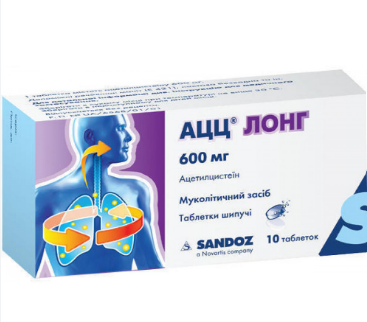
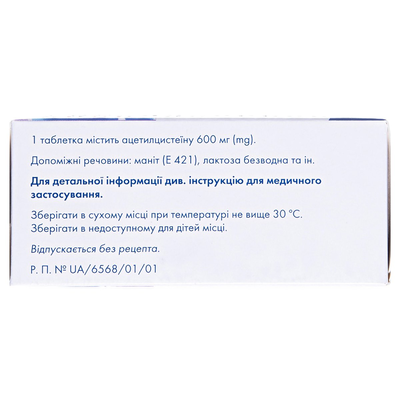
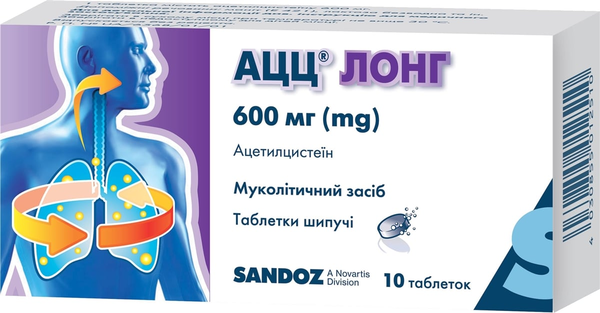
Azz Long, 600 mg coated tablets, No. 10, in tubes
Ingredients
Active ingredient: acetylcysteine;
1 tablet contains 600 mg of acetylcysteine;
Excipients: anhydrous citric acid, sodium bicarbonate, anhydrous sodium carbonate, mannitol (E 421), anhydrous lactose, ascorbic acid, sodium cyclamate, sodium saccharin, sodium citrate, blackberry flavoring “B.”
Dosage Form
Effervescent tablets.
Main physical and chemical properties: white, round tablets with a flat surface, a score line on one side, and a blackberry scent.
Pharmacotherapeutic group
Mucolytics. ATC code R05C B01.
Pharmacological properties
Pharmacodynamics.
N-acetyl-L-cysteine (acetylcysteine, ACC) is a mucolytic and expectorant agent used to thin mucus in respiratory diseases accompanied by the formation of thick mucus. Acetylcysteine is a derivative of the amino acid cysteine. The drug’s mucolytic effect is of a chemical nature. Through its free sulfhydryl group, acetylcysteine breaks the disulfide bonds of acidic mucopolysaccharides, leading to the depolymerization of sputum mucoproteins and a reduction in mucus viscosity, and promotes the expectoration and clearance of bronchial secretions. The drug remains active in the presence of purulent sputum.
Acetylcysteine also possesses antioxidant and pneumoprotective properties, which result from its sulfhydryl groups binding to chemical radicals and thereby neutralizing them. In addition, the drug promotes increased synthesis of glutathione—an important factor in intracellular protection not only against exogenous and endogenous oxidative toxins but also against a number of cytotoxic substances. This property of acetylcysteine allows it to be used effectively in cases of paracetamol overdose.
Effect on Inflammatory Processes
Depletion of GSH reserves often leads to oxidative stress and inflammation. NAC is capable of normalizing the disrupted redox state of cells by influencing cellular signaling and transcriptional pathways that are sensitive to redox processes.
Effect on bacterial biofilms
In vitro studies have shown that N-acetylcysteine can inhibit the formation of bacterial biofilms and disrupt existing biofilms.
Effect on the Frequency of Exacerbations
Long-term use of acetylcysteine (more than 3 months) may reduce the frequency of sudden exacerbations in patients with chronic bronchitis.
Pharmacokinetics.
After oral administration, acetylcysteine is rapidly and completely absorbed. Acetylcysteine is metabolized in the liver and intestinal walls to the pharmacologically active metabolite cysteine, as well as to diacetylcystine, cystine, and other mixed disulfides.
Due to significant first-pass metabolism, the bioavailability of orally administered acetylcysteine is only 10%. Maximum plasma concentration is reached in 1–3 hours, with the maximum plasma concentration of the active metabolite cysteine being approximately 2 μg/mL. The protein binding of acetylcysteine is approximately 50%. Its distribution in the lungs is quite high (48%).
After oral administration, the drug undergoes significant first-pass metabolism in the intestinal wall and in the liver. Acetylcysteine and its metabolites are found in the human body in three different forms: partly in the free form, partly bound to proteins via unstable disulfide bonds, and partly as an incorporated amino acid. Biotransformation primarily involves deacetylation; the drug and free NAC have relatively low bioavailability: approximately 10% in blood plasma and other body fluids, such as bronchoalveolar lavage fluid. The plasma half-life is approximately 1 hour, mainly due to rapid biotransformation in the liver. In cases of impaired liver function, the plasma half-life may reach 8 hours.
More than one-third (38%) of orally administered acetylcysteine is excreted as inactive metabolites (inorganic sulfates, diacetylcystine) in the urine.
In rats, acetylcysteine crosses the placenta and is detected in the amniotic fluid. At 0.5 hours, 1 hour, 2 hours, and 8 hours after oral administration of 100 mg/kg body weight of acetylcysteine, the concentration of the metabolite L-cysteine in the placenta and amniotic fluid exceeds the maternal plasma concentration.
No studies have been conducted in humans on the ability of acetylcysteine to cross the placenta or enter breast milk, or on its effects on the embryo or newborn.
No studies have been conducted on the ability of acetylcysteine to cross the blood-brain barrier in humans.
Indications
Treatment of acute and chronic diseases of the bronchopulmonary system requiring a reduction in sputum viscosity and improved sputum clearance and expectoration.
Contraindications
Hypersensitivity to acetylcysteine or to any other components of the drug. Active gastric or duodenal ulcers, hemoptysis, pulmonary hemorrhage, or severe asthma exacerbation.
Drug Interactions and Other Interactions
Interaction studies were conducted only in adults.
Concomitant use of antitussives with acetylcysteine may increase sputum retention due to a reduced cough reflex.
Activated charcoal reduces the effectiveness of acetylcysteine.
When used concomitantly with antibiotics such as tetracyclines (except doxycycline), ampicillin, amphotericin B, cephalosporins, and aminoglycosides, interactions with the thiol group of acetylcysteine may occur, leading to a reduction in the activity of both drugs. Therefore, the interval between administration of these drugs should be at least 2 hours. This does not apply to cefixime and loracarbef.
Significant hypotension and dilation of the temporal artery have been observed with the concurrent use of nitroglycerin and acetylcysteine. If simultaneous use of nitroglycerin and acetylcysteine is necessary, patients should be monitored for hypotension, which may be severe, and should be warned about the possibility of headaches.
Acetylcysteine can act as a cysteine donor and increase glutathione levels, which aids in the detoxification of oxygen free radicals and certain toxic substances in the body.
Acetylcysteine reduces the hepatotoxic effects of acetaminophen.
It is not recommended to dissolve acetylcysteine with other medications in the same glass.
When it comes into contact with metals or rubber, it forms sulfides with a characteristic odor; therefore, glassware should be used to dissolve the medication.
Effect on laboratory tests.
Acetylcysteine may interfere with colorimetric testing for salicylates and with the determination of ketone bodies in urine.
Special considerations for use
There have been isolated reports of severe skin reactions (Stevens-Johnson syndrome and Lyell’s syndrome) associated with acetylcysteine use; therefore, if any changes occur in the skin or mucous membranes, stop taking the medication immediately and consult a doctor regarding further use.
Caution is advised when administering this medication to patients with a history of gastric or duodenal ulcers, especially when taken concomitantly with other medications that irritate the gastric mucosa.
Acetylcysteine should be prescribed with caution to patients with bronchial asthma due to the potential for bronchospasm.
Acetylcysteine should be prescribed with caution to patients with liver or kidney disease to avoid the accumulation of nitrogen-containing substances in the body.
The use of acetylcysteine, particularly at the start of treatment, may thin bronchial secretions and increase their volume. If the patient is unable to effectively cough up sputum, postural drainage and bronchial aspiration are necessary.
Effervescent tablets contain sodium compounds. 1 tablet contains 6.03 mmol (138.8 mg) of sodium. This should be taken into account by patients on a low-sodium diet.
Acetylcysteine affects histamine metabolism; therefore, long-term therapy should not be prescribed to patients with histamine intolerance, as this may lead to the onset of intolerance symptoms (headache, vasomotor rhinitis, itching).
A slight sulfuric odor is not a sign of product deterioration but is characteristic of the active ingredient.
The drug contains lactose; therefore, patients with rare hereditary forms of galactose intolerance, lactase deficiency, or glucose-galactose malabsorption should not use ACC® Long.
Use during pregnancy or breastfeeding.
Pregnancy. Clinical data on the use of acetylcysteine in pregnant women are limited. Animal studies have not revealed any direct or indirect adverse effects on pregnancy, embryo-fetal development, labor, or postnatal development.
Breastfeeding. There is no information on the drug’s transfer into breast milk.
This medication should be taken during pregnancy or while breastfeeding only after a careful assessment of the benefit-risk ratio.
Effect on reaction time when operating motor vehicles or other machinery.
No effect.
Dosage and Administration
Adults and children 14 years of age and older should take 600 mg (1 tablet) once daily.
For children under 14 years of age and in cases where the daily dose must be divided into several doses, use acetylcysteine in another dosage form or at an appropriate dosage.
Take the medication after a meal. Dissolve the tablet in a glass of water and drink the solution as soon as possible. In some cases, due to the presence of the stabilizer ascorbic acid in the formulation, the prepared solution may be left for approximately 2 hours before use. Increased fluid intake enhances the drug’s mucolytic effect.
The duration of treatment is determined by the doctor on an individual basis, depending on the nature of the condition (acute or chronic). Do not take the medication for more than 4–5 days without consulting a doctor.
Children. For use in children 14 years of age and older.
Overdose
There are no reports of overdose with oral acetylcysteine.
Volunteers took 11.6 g of acetylcysteine daily for 3 months without experiencing any serious side effects.
Acetylcysteine does not cause an overdose when administered at doses of 500 mg/kg/day.
Symptoms. Overdose may manifest as gastrointestinal symptoms, such as nausea, vomiting, and diarrhea.
Treatment. There is no specific antidote for acetylcysteine poisoning; treatment is symptomatic.
Side Effects
The following classification is used to describe the frequency of adverse reactions: very common (≥ 1/10), common (≥ 1/100, < 1/10), uncommon (≥ 1/1,000, < 1/100), rare (≥ 1/10,000, < 1/1,000), rare (< 1/10,000), frequency unknown (available data do not allow for an estimate of frequency).
Immune system disorders: uncommon—hypersensitivity; rare—anaphylactic shock, anaphylactic/anaphylactoid reactions.
Blood and lymphatic system disorders: frequency unknown – anemia.
Nervous system disorders: uncommon—headache.
Ear and labyrinth disorders: uncommon—tinnitus.
Cardiovascular system: uncommon—tachycardia, arterial hypotension; rare—hemorrhages.
Respiratory system: isolated cases—dyspnea, bronchospasm (primarily in patients with bronchial hyperreactivity associated with bronchial asthma); frequency unknown—rhinorrhea.
Gastrointestinal system: uncommon—vomiting, diarrhea, stomatitis, abdominal pain, nausea; rare—dyspepsia; frequency unknown—bad breath.
Skin and subcutaneous tissue disorders: uncommon—urticaria, rash, angioedema, pruritus; frequency unknown—exanthema, eczema, angioedema.
General disorders: uncommon—hyperthermia; frequency unknown—facial edema.
Very rare cases of severe skin reactions (Stevens-Johnson syndrome and Lyell’s syndrome) have been reported. In most cases, at least one other medication is more likely to be the cause of the skin-mucous membrane syndrome. Therefore, if any new changes appear on the skin or mucous membranes, consult a doctor and discontinue acetylcysteine immediately.
Cases of reduced platelet aggregation have been reported, but the clinical significance of this is unknown.
Shelf life
3 years.
Storage Conditions
Store in a dry place at a temperature not exceeding 30 °C.
Keep out of reach of children.
Packaging
10 or 20 tablets per tube; 1 tube (10 × 1 or 20 × 1) per cardboard box.
Dispensing Category
Over-the-counter.