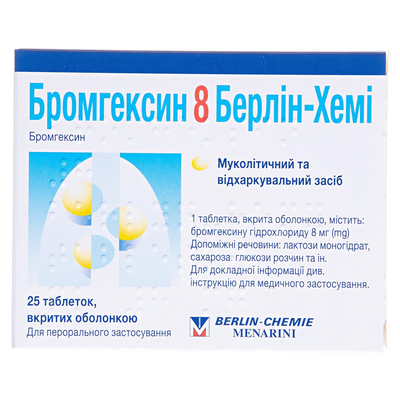
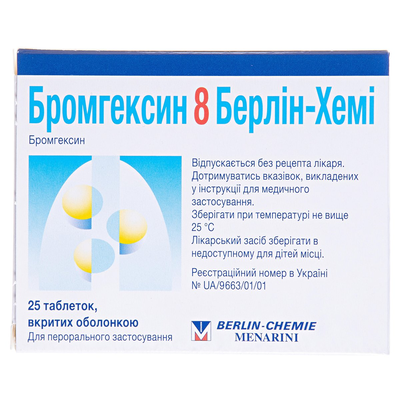

Bromhexine 8 Berlin-Chemie, coated tablets, 8 mg each, No. 25
Ingredients
Active ingredient: bromhexine hydrochloride;
1 film-coated tablet contains 8 mg of bromhexine hydrochloride;
inactive ingredients: lactose monohydrate, corn starch, gelatin, colloidal anhydrous silicon dioxide, magnesium stearate, sucrose, calcium carbonate, light magnesium carbonate, talc, polyethylene glycol 6000, povidone K 25, glucose solution, carnauba wax, titanium dioxide (E 171), quinoline yellow (E 104).
Dosage Form
Film-coated tablets.
Main physical and chemical properties: slightly convex on both sides, film-coated tablets, yellow to greenish-yellow in color, with an almost white core.
Pharmacotherapeutic group
Agents used for cough and the common cold. Mucolytics. ATC code R05C B02.
Pharmacological properties
Pharmacodynamics.
Bromhexine is a synthetic derivative of the plant-derived active substance vasicine. It exerts secretolytic and secretomotor effects in the bronchial tract. In animal studies, it increases the proportion of serous bronchial secretions. It is believed that mucus transport is facilitated by a reduction in viscosity and activation of the ciliated epithelium.
Following administration of bromhexine, the concentrations of the antibiotics amoxicillin, erythromycin, and oxytetracycline in sputum and bronchial secretions increase. The clinical significance of this is unknown.
Pharmacokinetics.
After oral administration, bromhexine is almost completely absorbed, with a half-life of approximately 0.4 hours. Tmax after oral administration is 1 hour. First-pass metabolism is approximately 80%. Biologically active metabolites are formed during this process. Plasma protein binding is 99%.
The decline in plasma concentration is multiphase. The half-life, which limits the duration of action, is approximately 1 hour. The terminal half-life is approximately 16 hours. This is due to the redistribution of small amounts of bromhexine from tissues. The volume of distribution is approximately 7 L per 1 kg of body weight. Bromhexine does not accumulate. Bromhexine crosses the placenta, enters the cerebrospinal fluid, and passes into breast milk. It is excreted primarily by the kidneys as metabolites formed in the liver. Due to its high protein binding and large volume of distribution, as well as slow redistribution from tissues into the blood, significant elimination of bromhexine via dialysis or forced diuresis is not expected.
In severe liver disease, a decrease in the clearance of the active substance is possible. In severe renal insufficiency, the possibility of an increased half-life of bromhexine metabolites cannot be ruled out. Under physiological conditions, nitrosation of bromhexine may occur in the stomach.
Preclinical Safety Data
Preclinical data obtained during conventional pharmacological safety studies do not indicate any specific risk to humans, nor do they indicate chronic toxicity, genotoxicity, carcinogenicity, or toxicity to reproductive organs or development.
Chronic toxicity
Studies in various animal species (rats, mice, dogs) using very high doses and prolonged treatment did not reveal any significant toxic potential for humans under normal therapeutic use.
Mutagenic and Carcinogenic Potential
In vitro studies (Ames test) and in vivo/in vitro studies (mammalian-mediated mutagenicity test) did not reveal any mutagenic effects of bromhexine. Carcinogenicity studies conducted in rats did not reveal any carcinogenic potential of bromhexine.
Reproductive toxicity
Bromhexine crosses the placenta. Animal studies have shown no evidence of teratogenic effects of bromhexine in rats, mice, or rabbits. Bromhexine at therapeutic doses did not affect the development or behavior of offspring. No effect of bromhexine on fertility has been observed.
Indications
Secretolytic therapy for acute and chronic bronchopulmonary diseases accompanied by impaired sputum production and clearance.
Contraindications
Hypersensitivity to the active ingredient or to any excipient. Bromhexine 8 Berlin-Chemie is contraindicated in patients with hereditary galactose or fructose intolerance, Lapp lactase deficiency, glucose-galactose malabsorption syndrome, or hereditary sucrase-isomaltase deficiency. Bromhexine 8 Berlin-Chemie must not be used in patients with gastric or duodenal ulcers, or with a history of peptic ulcer disease, as bromhexine may affect the mucous membrane of the gastrointestinal tract.
Bromhexine 8 Berlin-Chemie is contraindicated for use in children under 6 years of age due to its high active ingredient content. For this age group, medications with a reduced dosage should be prescribed.
Interactions with Other Medications and Other Types of Interactions
When Bromhexine 8 Berlin-Chemie is used in combination with antitussives (cough suppressants), a potentially dangerous increase in secretions may occur due to suppression of the cough reflex; therefore, the appropriateness of prescribing such a combination should be carefully considered, and particular caution should be exercised during therapy.
Concomitant use of bromhexine with antibiotics (amoxicillin, erythromycin, cefuroxime, doxycycline) and sulfonamide drugs increases their concentrations in sputum and bronchial secretions. When used concomitantly with substances that irritate the gastrointestinal tract, there is a possibility of a synergistic increase in the irritating effect on the gastric mucosa.
Special Considerations for Use
Skin Reactions
Severe skin reactions associated with the use of bromhexine have been reported, such as erythema multiforme, Stevens-Johnson syndrome/toxic epidermal necrolysis, and acute generalized exanthematous pustulosis. If symptoms or signs of worsening skin rashes appear (sometimes with blisters or mucosal lesions), consult a doctor immediately and discontinue use of bromhexine.
Gastric or duodenal ulcer
Bromhexine 8 Berlin-Chemie must not be used in patients with gastric or duodenal ulcers or a history of peptic ulcer disease, as bromhexine may affect the mucous membranes of the gastrointestinal tract.
Lungs and Respiratory Tract
In cases of impaired bronchial motility accompanied by the production of large amounts of bronchial secretions (for example, in a rare condition such as primary ciliary dyskinesia), Bromhexine 8 Berlin-Chemie should be used with particular caution due to the potential for secretion accumulation.
Liver and Kidney Disorders
Bromhexine 8 Berlin-Chemie should be used with particular caution (i.e., at longer intervals or in lower doses) in patients with impaired renal function or severe liver disease.
In severe renal insufficiency, accumulation of bromhexine metabolites formed in the liver is possible.
Periodic monitoring of liver function is recommended, especially during long-term use.
Lactose, glucose, sucrose
Lactose, glucose, and sucrose are components of this medication. Therefore, Bromhexine 8 Berlin-Chemie is contraindicated in patients with hereditary disorders such as galactose or fructose intolerance, lactase deficiency, glucose-galactose malabsorption, or sucrase-isomaltase deficiency.
Use during pregnancy or breastfeeding.
Pregnancy
Data on the use of bromhexine in pregnant women are limited. Therefore, Bromhexine 8 Berlin-Chemie may only be prescribed by a physician after a careful assessment of the benefit-risk ratio and is not recommended during the first trimester of pregnancy.
Breastfeeding
Since the active ingredient passes into breast milk, Bromhexine 8 Berlin-Chemie should not be used during breastfeeding.
Effect on reaction time when driving or operating machinery.
Bromhexine 8 Berlin-Chemie has no or negligible effect on reaction time when operating motor vehicles or other machinery.
Dosage and Administration
Take the film-coated tablets after meals with plenty of liquid (e.g., a glass of water).
Recommended doses of Bromhexine 8 Berlin-Chemie:
Adults and children 14 years of age and older: 1–2 film-coated tablets 3 times daily (corresponding to 24–48 mg/day of bromhexine hydrochloride).
Children aged 6 to 14 years, as well as patients weighing less than 50 kg: 1 film-coated tablet 3 times daily (equivalent to 24 mg/day of bromhexine hydrochloride).
Other special patient groups: Bromhexine 8 Berlin-Chemie should be used with particular caution (i.e., at longer intervals or in lower doses) in patients with impaired renal function or severe liver disease (see the “Special Considerations” section).
The duration of treatment is determined on an individual basis, depending on the indications and the course of the disease. Bromhexine 8 Berlin-Chemie should not be used for longer than 4–5 days without a doctor’s recommendation.
Children
Bromhexine 8 Berlin-Chemie is not intended for use in children under 6 years of age due to its high active ingredient content.
Overdose
Symptoms. To date, there have been no reports of life-threatening cases of overdose. A case report has been published regarding an overdose of bromhexine hydrochloride in toddlers, resulting in vomiting in 4 out of 25 children, and 3 children experienced altered consciousness, ataxia, diplopia, mild metabolic acidosis, and rapid breathing. When doses of up to 40 mg of bromhexine were administered to toddlers, no symptoms were observed even without decontamination.
No evidence of chronic toxic effects in humans has been found.
Therapeutic measures. In cases of significant overdose, monitor cardiovascular function and, if necessary, administer symptomatic therapy. Due to the low toxicity of bromhexine, more invasive measures to reduce absorption of the drug or to accelerate its elimination from the body are generally not indicated. Furthermore, given the pharmacokinetic characteristics of bromhexine (high volume of distribution, slow reverse distribution, and high protein binding), a significant increase in the rate of drug elimination should not be expected during dialysis or forced diuresis.
Since in children aged 2 years and older, even with a significant overdose, only mild symptoms are expected to develop, measures to reduce absorption and accelerate the elimination of bromhexine when doses of up to 80 mg of bromhexine hydrochloride (equivalent to 10 tablets of 8 mg each) are taken are not necessary; the corresponding threshold for younger children is 60 mg of bromhexine hydrochloride (6 mg/kg of body weight).
Warning. If the amount of bromhexine ingested exceeds the above limits, the potential side effects of the drug’s excipients must also be considered (see the “Special Precautions for Use” section).
Side Effects
The frequency of adverse reactions is defined as follows: very common (≥ 1/10), common (≥ 1/100 to < 1/10), uncommon (≥ 1/1,000 to < 1/100), rare (≥ 1/10,000 to < 1/1,000), very rare (< 1/10,000), unknown (frequency cannot be estimated from the available data).
Immune system disorders.
Rare: hypersensitivity reactions.
Unknown: anaphylactic reactions, including anaphylactic shock, angioedema, pruritus.
Gastrointestinal disorders.
Uncommon: nausea, stomach pain, vomiting, diarrhea.
Exacerbation of gastric or duodenal ulcers.
Skin and subcutaneous tissue disorders.
Rare: rash, hives.
Frequency unknown: severe skin reactions (including erythema multiforme, Stevens-Johnson syndrome/toxic epidermal necrolysis, and acute generalized exanthematous pustulosis).
General disorders.
Uncommon: fever.
Respiratory disorders, dizziness, respiratory distress, headache, increased sweating, transient elevation of serum aspartate aminotransferase levels, chills.
If hypersensitivity reactions, anaphylactic reactions, or any skin or mucous membrane disorders occur, discontinue bromhexine immediately and consult a physician.
Reporting Suspected Adverse Reactions.
Reporting suspected adverse reactions after a drug’s approval plays an important role. This allows for continued monitoring of the benefit-risk profile of the drug. Healthcare professionals are asked to report any suspected adverse reactions.
Shelf life
3 years.
Do not use this medication after the expiration date printed on the package.
Storage Conditions
Store at a temperature not exceeding 25 °C. Keep out of reach of children.
Packaging
25 film-coated tablets per blister pack; 1 blister pack per cardboard box.
Dispensing Category
Available without a prescription.
Manufacturer
BERLIN-CHEMIE AG.