
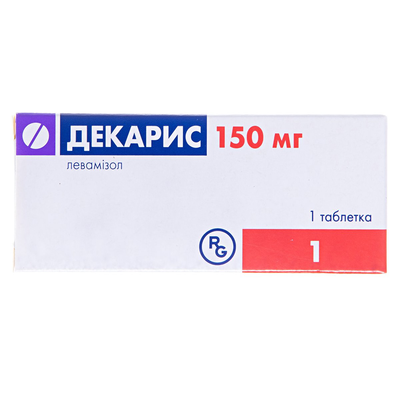
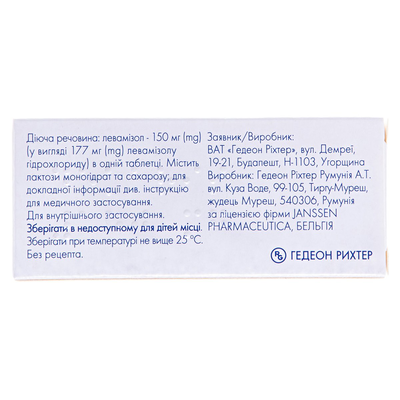
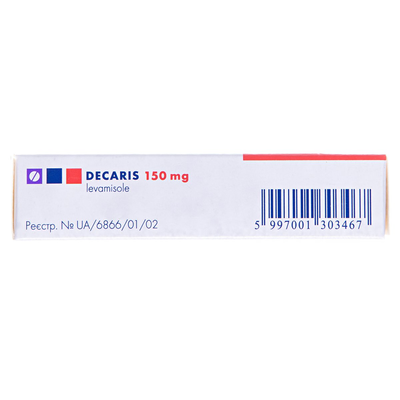
Decaris 150 mg tablets, No. 1
Ingredients
Active ingredient: levamisole;
1 tablet of 50 mg contains 50 mg of levamisole (as 59 mg of levamisole hydrochloride);
inactive ingredients: corn starch, sodium saccharin, povidone, talc, apricot flavor, magnesium stearate, Sunset Yellow FCF (E 110);
1 tablet of 150 mg contains 150 mg of levamisole (as 177 mg of levamisole hydrochloride);
Inactive ingredients: corn starch, lactose monohydrate, sucrose, povidone, talc, magnesium stearate.
Dosage Form
Tablets.
Main physical and chemical properties:
50 mg tablets—round, flat, pale orange in color, with a faint apricot odor, with a beveled edge and score lines dividing the tablet into four parts on one side. The tablet breaks into a pale orange color. Tablet diameter: approximately 7 mm;
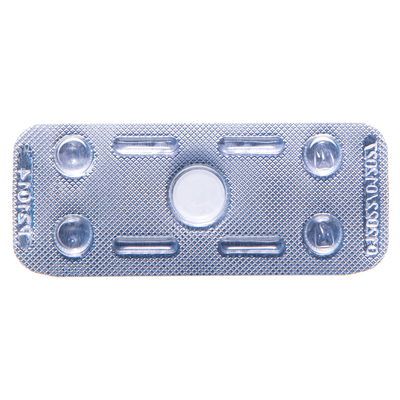
150 mg tablets—round, flat, nearly white, with a bevel and the engraving “DECARIS •150•” on one side; the other side is blank. The diameter of the tablets is approximately 9 mm.
Pharmacotherapeutic group
Anthelmintics. Agents used for nematode infections. Imidazothiazole derivatives. ATC code P02C E01.
Pharmacological Properties
Pharmacodynamics.
Levamisole exerts a rapid anthelmintic effect. In the ganglion-like structures of nematodes, levamisole causes depolarizing neuromuscular paralysis. Thus, the paralyzed nematodes are expelled from the body via normal intestinal peristalsis within 24 hours after administration of the drug. Although levamisole primarily affects the neuromuscular system of nematodes, it is quite possible that, in some helminths, inhibition of the fumarate reductase system also contributes to the anthelmintic efficacy of levamisole.
Pharmacokinetics.
A single 50-mg dose of levamisole is rapidly absorbed from the gastrointestinal tract. The maximum plasma concentration of levamisole, 0.13 μg/mL, is reached on average 1.5–2 hours after administration. Levamisole is metabolized in the liver; its major metabolites are p-hydroxy-levamisole and its glucuronide derivative. The half-life is 3–6 hours. Levamisole is metabolized in the liver into numerous metabolites, which are excreted primarily by the kidneys (approximately 70% within 3 days) and, to a lesser extent, in the feces (5%). Less than 5% of the administered dose is excreted unchanged in the urine, and less than 0.2% is excreted in the feces. The major metabolite in urine is p-hydroxylevamisole and its glucuronide conjugate (12% of the dose).
Indications
Ascariasis, necatoriasis, ankylostomiasis.
Contraindications
Hypersensitivity to levamisole or to any excipient contained in the drug.
Drug Interactions and Other Interactions
When Decaris is taken concurrently with alcoholic beverages, disulfiram-like symptoms may occur.
Use Decaris with caution when taking medications that affect blood formation.
When Decaris is taken concomitantly with coumarin-like anticoagulants, prothrombin time may increase; therefore, the dose of the oral anticoagulant must be adjusted.
Concomitant use of Decaris with albendazole significantly reduced the area under the curve (AUC) of albendazole sulfoxide. The safety and efficacy of levamisole have not been established when used concomitantly with albendazole.
Concomitant use of Decaris with ivermectin significantly increased the area under the curve (AUC) of ivermectin. The safety and efficacy of levamisole have not been established when used concomitantly with ivermectin.
Decaris increases blood levels of phenytoin; therefore, blood levels of phenytoin must be monitored when these drugs are used concomitantly.
Special Instructions for Use
Alcoholic beverages must not be consumed during and for 24 hours after taking the medication.
There is some evidence that repeated exposure to levamisole may be associated with allergic reactions, including hematological disorders such as leukopenia. Therefore, the recommended dose of the drug must not be exceeded. Caution is advised when using Decaris in combination with medications that may adversely affect hematopoiesis.
Leukocytoclastic vasculitis has been reported with the use of levamisole.
Stevens–Johnson syndrome. Cases of Stevens–Johnson syndrome have been reported in patients receiving a combination of 5-fluorouracil and levamisole; however, a causal relationship has not been established. If symptoms of Stevens–Johnson syndrome appear, treatment with Decaris should be discontinued immediately. The best outcome in the treatment of Stevens–Johnson syndrome is achieved with early diagnosis.
Leukoencephalopathy. Cases of leukoencephalopathy have been reported with doses significantly higher than recommended and during long-term treatment. In most patients, it was reversible, and early treatment with corticosteroids was effective. However, it remains unclear whether there is a causal relationship with levamisole.
Liver cirrhosis. In patients with liver cirrhosis, the Cmax of levamisole hydrochloride increases slightly, but the area under the curve (AUC) increases fourfold. Since the clinical significance of this interaction is uncertain, patients with liver cirrhosis should be closely monitored for possible adverse reactions. If such reactions occur, it may be necessary to reduce the dose or discontinue the drug.
Peripheral neuropathy. Cases of peripheral neuropathy have been reported with the concomitant use of levamisole and 5-fluorouracil; however, a causal relationship has not been established. If symptoms indicating the development of peripheral neuropathy occur during treatment, the benefit-risk ratio of continuing treatment should be reassessed.
Excipients. Decaris, 50 mg tablets, contains Sunset Yellow FCF (E 110), which may cause allergic reactions.
Decaris 150 mg tablets contain lactose monohydrate and sucrose. Patients with rare hereditary forms of galactose intolerance, lactose intolerance, or fructose intolerance, glucose-galactose malabsorption syndrome, or sucrose-isomaltose insufficiency should not take this medication.
Use during pregnancy or breastfeeding.
Pregnancy. No teratogenic effects were observed in animal studies. No well-controlled studies involving pregnant women have been conducted; therefore, Decaris may be prescribed during pregnancy only if the expected benefit outweighs the potential risk of using the drug.
Breastfeeding. It is unknown whether levamisole passes into human breast milk; however, it has been detected in cow’s milk. To prevent adverse effects on the infant, the necessity of the drug for a breastfeeding woman should be carefully evaluated.
Fertility. Reproductive studies in animals have shown no effect on fertility.
Effect on reaction time when operating motor vehicles or other machinery. It has not been established that levamisole affects the ability to drive or operate machinery, although encephalopathy has been reported as a very rare adverse reaction during treatment with levamisole.
Dosage and Administration
For adults, Decaris is prescribed as a single dose of 150 mg (1 tablet) for the treatment of helminthiasis.
For children, the drug is prescribed in the form of 50-mg tablets as a single dose (in the evening) at a dose of
2.5 mg/kg of body weight:
| Child’s age | Body weight | Single dose |
| 3–6 years | 10–20 kg | 25–50 mg (1/2–1 tablet) |
| 7–10 years | 20–30 kg | 50–75 mg (1–1.5 tablets) |
| 11–18 years | 30–60 kg | 75–100 mg (1.5–3 tablets) |
It is recommended to take the medication with a small amount of water after a meal, in the evening.
There is no need to use laxatives or follow a special diet.
If necessary, treatment may be repeated after a 7–14-day break.
Children. Do not administer 150 mg tablets to children! Administer 50 mg tablets to children aged 3 years and older only as prescribed and under a doctor’s supervision.
Overdose
When taking a large dose of levamisole (more than 600 mg), the following signs of intoxication have been reported: nausea, vomiting, lethargy, cramps, diarrhea, headache, dizziness, and confusion. Convulsions have been reported with doses higher than those recommended.
Treatment: In the event of accidental overdose, if a short time has elapsed since ingestion, gastric lavage should be performed. Monitoring of vital signs and symptomatic therapy are necessary.
If signs of anticholinesterase activity are present, atropine may be administered as an antidote.
Side Effects
Cardiovascular system: palpitations¹;
Blood and lymphatic system: agranulocytosis2, leukopenia2;
Psychiatric disorders: insomnia1;
Central nervous system: seizures1, dizziness1, encephalopathy3, headache1;
Gastrointestinal system: abdominal pain1, diarrhea1, nausea1, vomiting1;
Immune system disorders: possible hypersensitivity reactions, including skin rashes, itching, and angioedema;
General disorders and administration site conditions: pyrexia4.
1In rare cases, headache, insomnia, dizziness, palpitations, convulsions, and dyspeptic symptoms such as nausea, vomiting, abdominal pain, and diarrhea may occur. These effects are mild, short-lived, and resolve spontaneously.
2Leukopenia and agranulocytosis may occur with high doses or during long-term therapy.
3There have been reports of central nervous system reactions (encephalopathy) developing 2–5 weeks after taking the drug. In most cases, these reactions were reversible, and early treatment with a corticosteroid improved the patient’s condition.
4Rare cases of pyrexia have been reported during postmarketing surveillance with levamisole therapy.
Reporting of Suspected Adverse Reactions
Reports of suspected adverse reactions during postmarketing surveillance are very important. This allows for monitoring the benefit-risk ratio of medicinal products. Healthcare professionals should report suspected adverse reactions.
Shelf Life
5 years. Do not use after the expiration date printed on the package.
Storage Conditions
Store at a temperature not exceeding 25°C. Keep this medication out of the reach of children.
Packaging
Decaris, 50 mg—2 tablets per blister; 1 blister per cardboard package;
Decaris, 150 mg—1 tablet per blister; 1 blister per cardboard package.
Dispensing Category
Available without a prescription.
Manufacturer
Gedeon Richter Romania S.A.; Gedeon Richter JSC.
Location of manufacturers and addresses of their places of business.
99–105 Cuza Voda St., Târgu Mureș, Mureș County, 540306, Romania (full production cycle of finished products, packaging, batch control);
H-1103, Budapest, 19-21 Demreyi Street, Hungary (batch release, issuance of quality certificates). Manufactured under license from JANSSEN PHARMACEUTICA, BELGIUM.
Applicant
Gedeon Richter JSC.







