
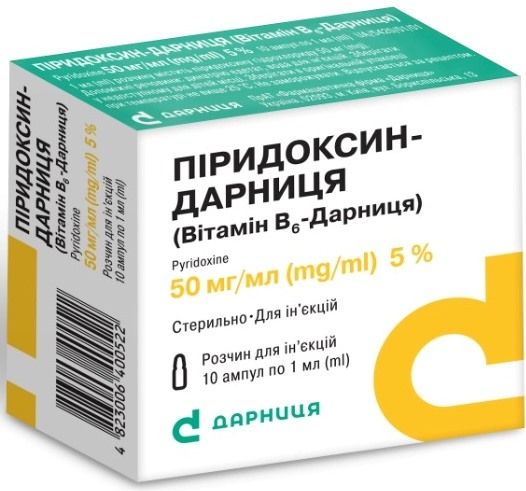
Pyridoxine Hydrochloride 5% Solution, 1 mL, No. 10
Ingredients:
active ingredient: pyridoxine;
1 mL of solution contains 50 mg of pyridoxine hydrochloride;
excipients: disodium edetate, water for injection.
Dosage form: Solution for injection.
Pharmacotherapeutic group. Simple vitamin preparations. Pyridoxine.
ATC code A11H A02.
Clinical characteristics.
Indications.
Vitamin B6 deficiency and avitaminosis. Comprehensive treatment of pregnancy-related toxicosis, atherosclerosis, anemias (including sideroblastic anemia), leukopenia, and diseases of the nervous system (radiculitis, neuritis, neuralgia, Parkinsonism, Little’s disease) depression associated with menopause; seborrheic and non-seborrheic dermatitis; herpes zoster; neurodermatitis; psoriasis; exudative diathesis; during withdrawal from alcohol intoxication and hangover syndrome. It is also prescribed for air and seasickness and Meniere’s disease. Pyridoxine hydrochloride prevents or reduces toxic effects (especially polyneuropathy) during treatment with antituberculosis drugs. Treatment of pyridoxine-dependent seizures.
Contraindications.
Hypersensitivity to any component of the drug. Gastric and duodenal ulcers (due to a possible increase in gastric acidity). Liver diseases accompanied by severe functional insufficiency. Ischemic heart disease.
Dosage and Administration.
Pyridoxine-Darnitsa is administered intramuscularly, intravenously, or subcutaneously in cases where oral administration is not possible.
The course of treatment is individualized and depends on the type and severity of the disease.
The solution is prepared immediately before use—a single dose of the drug is diluted in 1–2 mL of water for injection or a 0.9% sodium chloride solution.
Adults.
Vitamin B6 deficiency: The drug is prescribed at a daily dose of 50–100 mg (1–2 mL) in 1–2 administrations. The course of treatment is 3–4 weeks.
Sideroblastic anemia: The drug is administered intramuscularly at a daily dose of 100 mg (2 mL) twice a week. Concurrent administration of folic acid, riboflavin, and vitamin B12 is recommended.
Depression associated with the menopausal transition: The drug is administered intramuscularly at a dose of 200 mg (4 mL) per day. The course of treatment is 20–25 injections.
Use of isoniazid-group drugs: The drug is administered at a daily dose of 5–10 mg (0.1–0.2 mL) throughout the entire course of treatment with isoniazid.
Overdose of isoniazid-group drugs: For every 1 g of the overdosed drug, administer 1 g (20 mL) of pyridoxine intravenously at a rate of 0.5 g/min. In case of an isoniazid overdose exceeding 10 g, pyridoxine is administered intravenously at a dose of 4 g (80 mL) and then intramuscularly—1 g (20 mL) of the drug every 30 minutes. The total daily dose is 70–350 mg/kg.
Pregnancy-related toxicosis: the drug is administered intramuscularly at a dose of 50 mg (1 mL) per day. The course of treatment is 10–20 injections.
Pyridoxine-dependent anemia (macrocytic hypochromic anemia with elevated plasma iron levels): the drug is administered at a daily dose of 50–200 mg (1–4 mL). The course of treatment is 1–2 months. If there is no response, switch to another form of therapy.
Pyridoxine-dependent syndrome, including pyridoxine-dependent seizures: the drug is administered intravenously or intramuscularly at a dose of 50–500 mg (1–10 mL) per day. It is administered intravenously at a rate of 50 mg/min. The course of treatment is 3–4 weeks.
Parkinsonism: The drug is administered intramuscularly at a dose of 100 mg (2 mL) per day. The course of treatment is 20–25 days. A repeat course is given after 2–3 months. According to another treatment regimen:
the drug is administered intramuscularly at an initial daily dose of 50–100 mg (1–2 mL) and then the dose is increased daily by 50 mg (1 mL) until it reaches 300–400 mg (6–8 mL) per day in a single dose. Treatment is administered in courses of 12–15 days.
Other indications: The drug is prescribed at a daily dose of 50–100 mg (1–2 mL) administered in 1–2 doses.
Children.
Vitamin B6 deficiency: The doctor prescribes the dose individually at a rate of 1–2 mg/kg of body weight per day. The course of treatment is 2 weeks.
Pyridoxine-dependent seizures: The drug is administered intramuscularly or by rapid intravenous injection at a dose of 50–100 mg (1–2 mL) per day. It is administered intravenously at a rate of 50 mg/min. Maximum doses for children have not been established.
Overdose of isoniazid-group drugs: For every 1 g of the overdosed drug, administer 1 g (20 mL) of pyridoxine intravenously. If the isoniazid dose is unknown, administer pyridoxine at a rate of 70 mg/kg of body weight. The maximum dose is 5 g (100 mL).
Adverse reactions.
The following adverse reactions may occur with use of the drug:
Cardiovascular system: tachycardia, pain in the heart region;
Central and peripheral nervous system: headache, dizziness, drowsiness, agitation, impaired coordination, paresthesia, numbness in the extremities, sensation of tightness in the extremities – “stocking and glove” syndrome, loss of consciousness, and seizures following rapid intravenous administration;
Respiratory system: difficulty breathing;
Gastrointestinal system: nausea, epigastric pain, heartburn, increased gastric secretion;
Metabolic system: decreased folic acid levels;
Immune system, skin, and subcutaneous tissue: anaphylactic shock, hives, rash, itching, skin flushing, dermatitis, angioedema, photosensitivity;
Reproductive system and mammary glands: suppression of lactation during the lactogenic phase (sometimes used for therapeutic effect);
adverse reactions at the injection site: changes at the injection site, including erythema, itching, and burning at the injection site;
General disorders: weakness, fever.
Overdose.
Symptoms: exacerbation of side effects; disturbances in protein, carbohydrate, and lipid metabolism; degenerative changes in the central nervous system (peripheral neuropathy) and parenchymal organs (metabolic disturbances associated with a significant decrease in the activity of nicotinamide coenzymes NAD and NADP and a deficiency of nicotinic acid). Symptoms of peripheral neuropathy: hyperesthesia, paresthesia, and muscle weakness. Sensory neuropathies may occur, characterized by progressive gait disturbance, numbness and tingling in the legs and arms, partial hair loss, reduced resistance to infections, and decreased activity of the blood’s anticoagulant system. With prolonged use in high doses, vitamin B6 hypervitaminosis develops, characterized by a sharp decrease in protein content in muscle tissue and internal organs. In the early stages of vitamin B6 toxicity, skin rashes, dizziness, and seizures may occur. These symptoms resolve upon discontinuation of the drug.
Treatment: Discontinuation of the drug and symptomatic treatment.
Use during pregnancy or breastfeeding.
The drug is prescribed during pregnancy for morning sickness and vomiting in pregnant women. When prescribed during breastfeeding, it may suppress lactation.
Children.
The drug is used in pediatric practice. It is administered intramuscularly and intravenously. Dosages and administration schedules depend on the condition (see the “Dosage and Administration” section).
Special Considerations.
Use with caution in patients with a history of gastric or duodenal ulcers (due to a possible increase in gastric acidity) and in patients with functional hepatic insufficiency (high doses of pyridoxine may impair liver function).
Pyridoxine metabolism is impaired by regular alcohol consumption.
May result in a false-positive urobilinogen test using the Ehrlich reagent.
Potential to affect reaction time when driving or operating machinery.
During treatment, caution should be exercised when driving or operating complex machinery due to the potential for side effects affecting the nervous system.
Interactions with other medications and other types of interactions.
Diuretics—when used in combination with pyridoxine, the effect of diuretics is enhanced.
Hormonal contraceptives, cycloserine, penicillamine, isoniazid, hydralazine sulfate, ethionamide, and immunosuppressants—when used in combination with pyridoxine, the effect of pyridoxine is reduced.
Hypnotics and sedatives—when used in combination with pyridoxine, the hypnotic effect is reduced.
Antiparkinsonian agents—when used in combination with pyridoxine, the effectiveness of agents for treating Parkinson’s disease is reduced.
Phenytoin – when used in combination with pyridoxine, the effect of phenytoin is reduced.
Corticosteroids – when used in combination with pyridoxine, the amount of vitamin B6 in the body decreases.
Glutamic acid aspartame—when used in combination with pyridoxine, resistance to hypoxia increases.
Cardiac glycosides – when used in combination with pyridoxine, the synthesis of contractile proteins in the myocardium increases.
Tricyclic antidepressants—when used in combination with pyridoxine, the latter eliminates the side effects of tricyclic antidepressants associated with their anticholinergic activity (dry mouth, urinary retention).
Resorbable levomycetin preparations—when used in combination with pyridoxine, the latter prevents ophthalmic complications arising from prolonged use of resorbable levomycetin preparations (synthomycin, chloramphenicol).
Pharmacological Properties.
Pharmacodynamics.
Pyridoxine hydrochloride (vitamin B6) is found in plants and animal organs, particularly in unrefined cereal grains, vegetables, meat, fish, milk, the livers of cod and cattle, and egg yolks. Yeast contains a significant amount of vitamin B6. The body’s need for vitamin B6 is met through diet; it is also partially synthesized by the intestinal microflora.
It plays an important role in metabolism, is essential for the normal functioning of the central and peripheral nervous systems, and participates in the synthesis of neurotransmitters. In its phosphorylated form, it facilitates the decarboxylation, transamination, and deamination of amino acids; it participates in the synthesis of proteins, enzymes, hemoglobin, and prostaglandins, as well as in the metabolism of serotonin, catecholamines, glutamic acid, and GAMK, and histamine; it improves the utilization of unsaturated fatty acids, lowers blood cholesterol and lipid levels, enhances myocardial contractility, promotes the conversion of folic acid into its active form, and stimulates hematopoiesis. In atherosclerosis, vitamin B6 improves lipid metabolism.
Pyridoxine, in cases of atherosclerosis and diabetes mellitus, reduces the level of glycated hemoglobin; furthermore, pyridoxine acts as a diuretic, helping to lower high blood pressure.
It has been established that pyridoxine positively influences the production of norepinephrine and serotonin, increasing their levels in cases of depression, which is associated with its role as a cofactor for DOPA decarboxylase in the synthesis of catecholamines.
Pyridoxine may prolong clotting time and inhibit platelet aggregation, which is explained by the binding of pyridoxal phosphate to fibrinogen and to specific amino groups on the surface of platelets.
Pharmacokinetics.
It is metabolized in the liver to form pharmacologically active metabolites (pyridoxal phosphate and pyridoxamine phosphate). Pyridoxal phosphate is 90% bound to plasma proteins. It penetrates well into all tissues. It accumulates primarily in the liver and, to a lesser extent, in muscles and the central nervous system. It crosses the placenta and is excreted into breast milk. Half-life (T1/2) is 15–20 days. It is excreted by the kidneys (following intravenous administration, 2% is excreted in bile) and during hemodialysis.
Pharmaceutical characteristics.
Main physicochemical properties: a clear, colorless or slightly colored liquid.
Incompatibilities.
Do not mix pyridoxine solution in the same syringe with thiamine (vitamin B1) solution, cyanocobalamin (vitamin B12) solution, alkaline solutions, iron salts, or oxidizing agents. It is recommended to administer pyridoxine injections no earlier than 12 hours after a thiamine injection.
It is not recommended to mix the following medications in the same infusion set or syringe: adrenomimetics, ampicillin sodium salt, amphotericin B, ascorbic acid, other B vitamins, phytomenadione, dipyridamole, sodium oxyferiscorbate, phenothiazine derivatives (chlorpromazine), furosemide, etamsylate, and euphilin.
Shelf life: 3 years.
Storage conditions.
Store out of the reach of children in the original packaging at a temperature not exceeding 25 °C. Do not freeze.
Packaging.
1 mL per ampoule; 10 ampoules per box; 10 ampoules per blister pack; 1 blister pack per package; 5 ampoules per blister pack; 2 blister packs per carton.
Manufacturer. PJSC “Darnitsa Pharmaceutical Company.”
Location: Ukraine 02093, Kyiv, 13 Boryspilskaya St.







