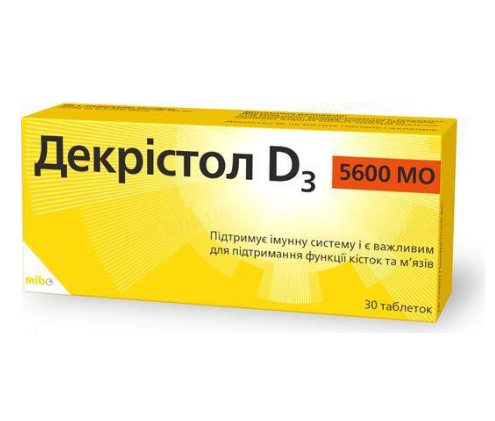
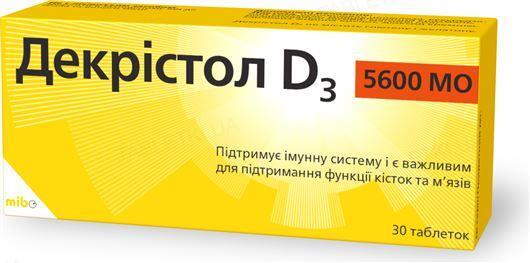
Decristol D3 5600 IU, 30 tablets (10 x 3)
Composition
| Active Ingredient | Per tablet | Equivalent to the daily recommended intake |
| Vitamin D3 | 140 mcg (5,600 IU) | 20 mcg (800 IU) |
Mannitol, cellulose, magnesium salts of food-grade fatty acids, cholecalciferol.
Decristol D3 is lactose-, gluten-, and gelatin-free.
GMO-free.
Nutritional (food) and energy (caloric) value per 100 g: protein – 0.06 g, fat – 1.1 g, carbohydrates – 68.45 g, 1,192 kJ/281 kcal.
Directions and Dosage
Take 1 tablet per week with a meal, with plenty of water.
To indicate the dosage of vitamin D, the unit “IU” (International Units) is sometimes used, and sometimes the unit “mcg” (micrograms). The conversion is as follows: 1 μg = 40 IU; 1 IU = 0.025 μg.
Warning
Do not use as a substitute for a balanced diet.
Keep out of reach of children.
Overdose may cause a laxative effect.
Store at a temperature not exceeding 25 °C and in a place protected from moisture.
General Characteristics
Vitamin D
- supports normal immune system function
- helps maintain healthy bones
- contributes to normal muscle function
- contributes to the normal absorption of calcium and phosphorus
- helps maintain normal blood calcium levels
- contributes to the maintenance of normal teeth
- plays a role in cell division
Vitamin D, also known as cholecalciferol, can be produced naturally by the human body. This requires sufficient exposure of the skin to ultraviolet light. For this reason, vitamin D is often simply called the “sunshine vitamin.”
Therefore, sunlight is necessary for the body to obtain sufficient vitamin D. The ultraviolet spectrum of sunlight facilitates the conversion of provitamin D into its active form.
How Much Sunlight Is Needed
The required duration of daily sun exposure varies. The amount of time needed in the sun depends on the season and skin color. The table below shows the recommended duration of sun exposure:
Duration of sun exposure for...
| Skin type I/II (light to very light skin, light red or light hair, blue or green eyes) | Skin type III (medium skin tone, dark hair, brown eyes) | |
| March–May | 10–20 minutes | 15–25 minutes |
| June–August | 5–10 minutes | 10–15 minutes |
| September–October | 10–20 minutes | 15–25 minutes |
These figures apply to the midday hours between 12:00 p.m. and 3:00 p.m. Before or after midday, it is recommended to double the specified time. In general, at least 25% of the body’s surface area should be exposed to sunlight (source: Federal Institute for Risk Assessment, 2012, Germany).
The body’s ability to produce vitamin D on its own declines with age. For this reason, older adults should make a special effort to spend sufficient time outdoors during the summer months. If the body does not produce enough vitamin D on its own—or does not produce it at all—it requires an increased intake of this vitamin through diet. The need for dietary vitamin D increases the less time a person spends in the sun. In winter, in our latitudes, there is generally not enough sunlight for the skin to produce the necessary amount of vitamin D. During this time, the body relies on its own stored reserves of vitamin D.
Vitamin D has a wide range of effects
Our understanding of vitamin D has expanded significantly in recent years. People of all ages have experienced firsthand the support vitamin D provides for muscles and bones. It is now also understood that vitamin D plays a role in other metabolic processes in the body and performs various functions within the human body. Vitamin D supports the immune system and promotes dental health, as well as the absorption of calcium and phosphorus and the regulation of blood calcium levels. This is explained by the fact that virtually all cells have vitamin D receptors.
Data from the European Food Safety Authority
The European Food Safety Authority (EFSA) has established maximum tolerable daily intake levels for vitamin D*.
| Age (years) | Maximum Daily Intake of Vitamin D |
| 0–1 year | 25 μg (1,000 IU) |
| 1–10 years | 50 mcg (2,000 IU) |
| 11–17 years | 100 mcg (4,000 IU) |
| Adults (18 years and older), pregnant women, and women who are breastfeeding | 100 mcg (4,000 IU) |
* Scientific Opinion on the Tolerable Upper Intake Level of Vitamin D, EFSA Panel on Dietetic Products, Nutrition, and Allergies (NDA); EFSA Journal 2012; 10 (7): 2813.
Do not exceed the recommended daily intake.
Not a medication!
Dietary supplement containing vitamin D3.
Shelf life
3 years.