

Doxycycline-Teva 100 mg tablets, No. 10
Composition
Active ingredient: doxycycline monohydrate;
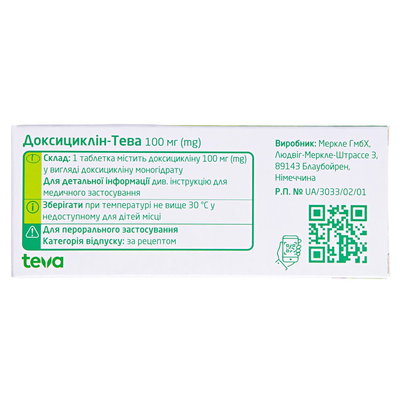
1 tablet contains 100 mg of doxycycline as doxycycline monohydrate;
Excipients: microcrystalline cellulose, sodium starch glycolate (type A), talc, magnesium stearate, colloidal anhydrous silicon dioxide, purified water.
Dosage Form
Tablets.
Main physical and chemical properties: greenish-yellow with uniform or non-uniform coloring, “speckled,” round biconvex tablets with a score line on one side.
Pharmacotherapeutic group
Antibacterial agent for systemic use. ATC code J01A A02.
Pharmacological Properties
Pharmacodynamics.
Doxycycline exerts a bacteriostatic effect; its antimicrobial action is mediated by inhibition of protein synthesis. The drug is effective against a broad spectrum of Gram-positive and Gram-negative bacteria and certain other microorganisms.
Pharmacokinetics.
Absorption. After oral administration, doxycycline is almost completely absorbed in the upper small intestine (>90% of the dose). Significant concentrations are reached as early as 30 minutes after administration, and peak plasma concentrations are reached within 1–2 hours. After a single 200-mg dose, peak concentrations ranged from 3 to 5.3 mg/L. When administered under therapeutic conditions (200 mg on the first day of treatment and 100 mg on subsequent days), steady-state concentrations are reached rapidly and are nearly as high as after a single 200-mg dose.
The plasma half-life in healthy individuals is approximately 16 ± 6 hours; it may be slightly prolonged in patients with impaired renal function and significantly prolonged in patients with liver disease. Doxycycline is 80–90% protein-bound.
Distribution. The drug is rapidly distributed throughout the body, although it penetrates the central nervous system in relatively small amounts, even through inflamed meninges. High concentrations in the gallbladder and good tissue penetration are achieved in the liver, kidneys, lungs, spleen, bones, and reproductive organs. The apparent volume of distribution of doxycycline is approximately 0.75 L/kg.
Biotransformation. Doxycycline is metabolized only to a minor extent in the human body (≤10% of the dose).
Excretion. Excretion occurs primarily in the form of the microbiologically active substance via the intestines (through transintestinal secretion or via the gallbladder), and 30–55% is excreted by the kidneys. Approximately 41% (range: 22–60%) of the doxycycline dose is detected in the urine within 24 hours. Due to these pharmacokinetic characteristics, the half-life of doxycycline is only slightly prolonged in patients with significant renal impairment.
Indications
For the treatment of infections caused by susceptible strains of Gram-positive and Gram-negative microorganisms and certain other microorganisms, namely:
Respiratory tract infections: pneumonia and other lower respiratory tract diseases caused by susceptible strains of Streptococcus pneumoniae, Haemophilus influenzae, Klebsiella pneumoniae, and others. Pneumonia caused by Mycoplasma pneumoniae. Chronic bronchitis and sinusitis.
Urinary tract infections: infections caused by susceptible strains of Klebsiella, Enterobacter, as well as Escherichia coli, Streptococcus faecalis, and others.
Sexually transmitted diseases: infections caused by Chlamydia trachomatis, including uncomplicated urethral and endocervical infections and rectal infections. Nongonococcal urethritis caused by Ureaplasma urealyticum (T-mycoplasma). Chancroid, inguinal granuloma, and venereal granuloma. Doxycycline is an alternative treatment for gonorrhea and syphilis.
Skin infections: acne, when antibiotic therapy is necessary.
Since doxycycline belongs to the tetracycline class of antibiotics, it can be used to treat infections caused by microorganisms susceptible to tetracyclines, namely:
Ophthalmic infections: infections caused by susceptible bacteria such as gonococci, staphylococci, and Haemophilus influenzae. The infection that causes trachoma is not always eliminated, as confirmed by immunofluorescence analysis. For the treatment of paratrachoma, doxycycline may be used as monotherapy or in combination with other medications.
Rickettsial infections: Rocky Mountain spotted fever, group of typhus fevers, Q fever, endocarditis caused by Coxiella, tick-borne fever.
Other infections: ornithosis, brucellosis (when used in combination with streptomycin), cholera, bubonic plague, epidemic relapsing fever; tick-borne relapsing fever; tularemia, melioidosis, chloroquine-resistant tropical malaria, and acute intestinal amebiasis (when used in combination with amebicide).
Doxycycline is an alternative treatment for leptospirosis, gas gangrene, and tetanus.
Doxycycline is indicated for the prevention of the following conditions: Japanese river fever, traveler’s diarrhea (caused by enterotoxigenic Escherichia coli), leptospirosis, and malaria. Malaria prophylaxis should be administered in accordance with current practice due to the potential for resistance to develop.
Contraindications
- Hypersensitivity to doxycycline or other tetracyclines, or to any excipient in the medication;
- severe liver dysfunction;
- pregnancy or breastfeeding (see also the section “Use During Pregnancy or Breastfeeding”);
- children under 12 years of age (see also the section “Children”).
Interactions with Other Medications and Other Types of Interactions
Effect of Other Medications on the Action of Doxycycline
Absorption of doxycycline from the gastrointestinal tract may be reduced when taken concomitantly with antacids containing aluminum, calcium, or magnesium, or when taken concomitantly with other medications or foods containing these cations (e.g., milk, dairy products, and fruit juices containing calcium), or when taken orally with zinc, iron or bismuth salts, activated charcoal, colestipol, or cholestyramine. The administration of doxycycline together with such medications should be spaced as far apart as possible.
Rifampicin, barbiturate-class inducers, anticonvulsant medications such as carbamazepine, diphenylhydantoin (phenytoin), and primidone, as well as chronic alcohol use, can accelerate the breakdown of doxycycline in the liver by inducing liver enzymes, making it impossible to achieve therapeutically effective blood concentrations of doxycycline when taking a standard dose. In such cases, an increase in the daily dose of doxycycline should be considered.
Effect of Doxycycline on the Action of Other Drugs
Doxycycline may enhance the hypoglycemic effect of sulfonylurea derivatives (oral antidiabetic agents). When used in combination, blood glucose levels should be monitored and, if necessary, the doses of these drugs should be reduced.
There have been reports of prolonged prothrombin time in patients taking anticoagulants (e.g., warfarin, phenprocoumon) and doxycycline. Tetracyclines reduce the activity of plasma prothrombin; therefore, a reduction in the dose of anticoagulants may be necessary.
Doxycycline may increase plasma concentrations of cyclosporine A, thereby increasing the toxic effects of the immunosuppressant. Concomitant use of these drugs should be accompanied by close monitoring.
Concomitant use with methotrexate may lead to increased toxicity of the latter.
Other Types of Interactions
Concomitant use of methoxyflurane or other potentially nephrotoxic agents with doxycycline may cause potentially fatal nephrotoxic adverse reactions.
The use of doxycycline should be avoided for some time before, during, and after treatment of acne with isotretinoin (or other retinoids), as both drugs may, in some cases, lead to a reversible increase in intracranial pressure (pseudotumor cerebri) (see the “Adverse Reactions” section).
When used concomitantly with digoxin or digoxin derivatives, there is a risk of increased digoxin concentrations in the blood plasma, which may lead to digoxin toxicity (nausea, vomiting, dizziness, fatigue, and cardiac arrhythmias).
Bacteriostatic agents may adversely affect bactericidal drugs; therefore, the concurrent use of doxycycline and beta-lactam antibiotics should be avoided, as this may reduce their antibacterial activity.
Concomitant use of theophylline and doxycycline increases the risk of gastrointestinal side effects.
Several cases of pregnancy and breakthrough bleeding have been reported with the concurrent use of tetracycline-class antibiotics and oral contraceptives.
Tetracycline may inhibit the breakdown of ergot alkaloids in the liver (isolated cases of ergotism are possible).
False-positive laboratory test results
Urine glucose tests may yield false-positive results when using the copper sulfate (Benedict’s) method. Urine glucose tests using glucose oxidase reagents may yield false-negative results. When using fluorometric tests, a false elevation in urinary catecholamine levels may be observed.
Taking tetracyclines may lead to inaccurate laboratory test results for protein and urobilinogen levels in urine.
Special Considerations for Use
Photosensitivity. Cases of photosensitivity with clinical manifestations of a severe sunburn-like reaction may occur in patients taking tetracycline-class drugs after exposure to direct sunlight or ultraviolet radiation. Patients should be informed of the risk of developing these reactions if they are exposed to direct sunlight or ultraviolet radiation while taking tetracycline-class drugs, and of the need to discontinue treatment at the first signs of erythema. Cases of photoonycholysis have been reported in patients taking doxycycline (see the “Adverse Reactions” section). During treatment with doxycycline, patients should avoid sunbathing outdoors or using tanning beds.
Patients with Impaired Liver Function. Doxycycline should be used with caution in patients with impaired liver function, as well as in those concurrently taking potentially hepatotoxic medications. Abnormal liver function test results have been rarely reported with both oral and parenteral administration of tetracyclines, including doxycycline. During long-term use (i.e., longer than 21 days), blood tests and monitoring of liver and kidney function should be performed regularly. During long-term treatment, the possibility of a B-vitamin deficiency should be considered.
Patients with impaired renal function. In patients with normal renal function, approximately 40% of doxycycline is excreted by the kidneys within 72 hours. This rate may decrease to 1–5% over 72 hours in patients with severe renal insufficiency (creatinine clearance < 10 mL/min). Studies have shown that there is no significant difference in the serum half-life of doxycycline between patients with normal renal function and those with renal insufficiency. Hemodialysis does not affect the half-life of doxycycline in serum.
The antianabolic effect of tetracyclines may increase blood urea levels. Studies have not shown that this antianabolic effect occurs when doxycycline is administered to patients with renal insufficiency.
Tetracyclines may cause nephrotoxic damage or exacerbate existing kidney damage (characterized by elevated serum levels of creatinine and urea).
Serious skin reactions. The following serious skin reactions have been reported in patients taking doxycycline: exfoliative dermatitis, erythema multiforme, Stevens–Johnson syndrome, toxic epidermal necrolysis, and drug rash with eosinophilia and systemic symptoms (DRESS) (see the “Adverse Reactions” section). If serious skin reactions occur, doxycycline should be discontinued immediately and appropriate therapy initiated.
Overgrowth of microflora. Treatment with doxycycline may result, due to selection, in excessive microbial overgrowth on the skin or mucous membranes, specifically in the genital tract and the oral or intestinal mucosa, of non-susceptible pathogens (e.g., Candida) (see the “Adverse Reactions” section). Any infections that develop require treatment.
Cases of pseudomembranous colitis have been reported in patients receiving antibacterial agents, including doxycycline. The severity of the condition ranged from mild to life-threatening. It is important to consider this diagnosis in patients with diarrhea resulting from antibiotic therapy.
During treatment with antibacterial agents, including doxycycline, cases of Clostridium difficile-associated diarrhea (CDAD) have been reported, ranging in severity from mild to fatal colitis. The use of antibacterial drugs affects the normal intestinal flora and leads to increased growth of C. difficile. C. difficile produces toxins A and B, which, in turn, contribute to the development of CDAD.
Toxin-producing strains of C. difficile may increase morbidity and mortality, as such infections are resistant to antibiotic therapy and may require colectomy. It is important to consider this diagnosis in patients with diarrhea resulting from antibiotic therapy. If confirmed, doxycycline must be discontinued immediately, and appropriate treatment initiated without delay. The use of intestinal motility inhibitors is contraindicated. A thorough review of the patient’s medical history is necessary, as cases of CDAD have been reported even more than 2 months after completion of antibiotic therapy.
Esophagitis. Cases of esophagitis and esophageal ulcers have been reported with the use of tetracyclines, including doxycycline, in tablet and capsule form. Most patients with these complaints took the medication immediately before bedtime or with insufficient fluid intake.
Porphyria. Rare cases of porphyria have been reported in patients taking tetracyclines.
Sexually transmitted diseases. During treatment for sexually transmitted diseases, if syphilis is suspected as a concomitant condition, appropriate diagnostic tests must be performed, including dark-field microscopy. In such cases, serological tests should be performed monthly for at least 4 months.
In some patients with spirochetal infections, a Jarisch–Herxheimer reaction may occur shortly after the start of treatment with doxycycline. In such cases, patients should be informed that this reaction is a consequence of antibiotic therapy for spirochetal infections and usually resolves on its own.
Infections caused by β-hemolytic streptococci. For infections caused by group A β-hemolytic streptococci, treatment should be continued for at least 10 days.
Myasthenia gravis. Due to the possibility of mild neuromuscular blockade, the drug should be used with caution in patients with myasthenia gravis.
Systemic lupus erythematosus. The use of tetracyclines may lead to an exacerbation of systemic lupus erythematosus.
Methoxyflurane. Methoxyflurane should be used with caution in combination with tetracyclines (see the section “Interactions with Other Medications and Other Types of Interactions”).
Benign intracranial hypertension. Cases of fontanelle bulging have been reported in infants receiving tetracycline therapy. Benign intracranial hypertension (pseudotumor cerebri) has been associated with the use of tetracyclines (including doxycycline). Benign intracranial hypertension (pseudotumor cerebri) is usually transient, but cases of irreversible vision loss due to benign intracranial hypertension (pseudotumor cerebri) have been reported with the use of tetracyclines (including doxycycline). If visual disturbances occur during treatment, an urgent ophthalmological examination is necessary. Since intracranial pressure may remain elevated for several weeks after discontinuation of the drug, patients should be monitored until their condition stabilizes. Concomitant use of isotretinoin, as well as other systemic retinoids, with doxycycline should be avoided, as isotretinoin is also known to cause benign intracranial hypertension (pseudotumor cerebri). (See the section “Interactions with Other Medications and Other Types of Interactions.”)
Children. The use of tetracycline-class drugs during tooth development (in the second half of pregnancy, in infants, and in children under 8 years of age) may lead to irreversible discoloration of the teeth (yellow–gray–brown). This adverse reaction occurs more frequently with long-term treatment, but has also been observed after repeated short courses of treatment. Cases of dental enamel hypoplasia have also been reported.
Use during pregnancy or breastfeeding.
Pregnancy
This medication is contraindicated during pregnancy. The risks associated with the use of tetracyclines during pregnancy are primarily due to their effects on the development of teeth, bones, and the skeleton (see the “Special Considerations for Use” section regarding use during tooth development).
During pregnancy, there is an increased risk of liver damage when taking tetracyclines.
Breastfeeding
Tetracyclines pass into breast milk; therefore, use of this medication is contraindicated during breastfeeding (see the “Special Considerations” section regarding use during tooth development).
Effect on reaction time when driving or operating machinery.
The effect of doxycycline on the ability to drive or operate machinery has not been studied. If adverse reactions such as hypotension, tinnitus, blurred vision, scotoma, diplopia, or prolonged vision loss occur, patients should refrain from driving or operating machinery.
Dosage and Administration
Take the medication regularly in the morning with breakfast or another meal, with plenty of liquid (not milk or dairy products), while sitting or standing upright. It is not recommended to lie down immediately after taking the medication. Taking the medication after or during a meal helps reduce the incidence of gastrointestinal disturbances and has only a minor effect on the rate of absorption.
Adults. The usual dose of doxycycline for the treatment of acute infections in adults is 200 mg on the first day of treatment (as a single dose or 100 mg every 12 hours) and 100 mg daily on subsequent days. For the treatment of severe infections, the drug should be administered at a dose of 200 mg per day throughout the entire treatment period.
Exceeding the recommended dose may increase the incidence of adverse reactions. Treatment should continue for 24–48 hours after the resolution of symptoms and fever.
For streptococcal infections, treatment should be continued for 10 days to prevent the development of rheumatic fever or glomerulonephritis.
Children. For children aged 12 years and older weighing up to 45 kg, the recommended dose is 4.4 mg/kg of body weight (on the first day of treatment, administer the recommended dose in 1 or 2 doses); on subsequent days, the dose is 2.2 mg/kg of body weight (in 1 or 2 doses); for more severe infectious diseases, up to 4.4 mg/kg of body weight may be prescribed.
For children weighing more than 45 kg, administer the standard adult dose.
Treatment of specific infections.
Acne: The recommended dose is 50 mg daily with food (including liquids) for 6–12 weeks.
Sexually transmitted diseases: For the treatment of conditions such as uncomplicated gonococcal infections (with the exception of anorectal infections in men), uncomplicated urethral and endocervical infections and rectal infections caused by Chlamydia trachomatis, and non-gonococcal urethritis caused by Ureaplasma urealyticum, the recommended dose is 100 mg twice daily for 7 days.
For the treatment of acute epididymo-orchitis caused by Chlamydia trachomatis or Neisseria gonorrhoeae, the drug should be administered at a dose of 100 mg twice daily for 10 days.
For the treatment of primary and secondary syphilis, the recommended dose for patients without confirmed pregnancy and with a penicillin allergy is 200 mg orally twice daily for 2 weeks (as an alternative to penicillin therapy).
Epidemic typhus, tick-borne typhus: The recommended dose is 100–200 mg as a single dose, depending on the severity of the disease.
Tropical malaria resistant to chloroquine: the recommended dose is 200 mg daily for at least 7 days due to the potential for a severe course of the infectious disease.
A fast-acting schizonticide (e.g., quinine) should always be used as adjunctive therapy with doxycycline; the dose varies depending on the case, due to the potential for a severe course of the infectious disease.
Malaria prophylaxis: The recommended dose for adults is 100 mg per day. For children aged 12 years and older, the recommended dose ranges from 2 mg/kg per day up to a total daily dose of 100 mg. Prophylaxis may be started 1–2 days before traveling to a malaria-endemic region. Prophylactic use of the drug should be continued daily while in a malaria-endemic region and for 4 weeks after leaving the region. Current standards for the treatment of malaria should also be taken into account.
Prevention of Japanese river fever: The recommended dose is 200 mg as a single dose.
Prevention of traveler’s diarrhea in adults: The recommended dose is 200 mg on the first day of travel (administered as a single 200 mg dose or 100 mg every 12 hours) and 100 mg daily for the remainder of the trip. There is no information available regarding the use of this medication for more than 21 days for prophylaxis.
Prevention of leptospirosis: The recommended dose is 200 mg once a week for the entire duration of stay in a region where leptospirosis is present and 200 mg at the end of the trip. There is no information available regarding the use of this medication for more than 21 days for prophylaxis.
Use in Elderly Patients: The drug may be administered at the usual doses without special precautions. No dose adjustment is necessary in patients with impaired renal function.
Use in patients with impaired renal function: Use of the drug at the recommended doses does not lead to accumulation of the antibiotic in this patient population (see the “Special Considerations for Use” section).
Use in patients with hepatic impairment: see the “Special Considerations for Use” section.
Children.
This medication is contraindicated for use in children under 12 years of age.
Like other tetracyclines, Doxycycline-Teva forms stable calcium complexes in any bone-forming tissue. Slowed growth of the tibia has been observed in premature infants who received tetracyclines orally at a dose of 25 mg/kg every 6 hours. This adverse reaction is reversible upon discontinuation of the drug.
Overdose
Doxycycline is not acutely toxic following a single oral administration of several therapeutic doses. Acute intoxication caused by doxycycline has not yet been described in the literature. Overdose may manifest as damage to the liver and kidney parenchyma and the development of pancreatitis.
In case of overdose, discontinue the drug immediately, perform gastric lavage, and provide symptomatic treatment. In the event of an overdose of orally administered doxycycline, antacids, magnesium salts, or calcium salts may be used to bind the unabsorbed portion of the drug, since tetracycline can form chelate complexes with these substances that are not absorbed. Dialysis has almost no effect on the drug’s half-life in serum, so it is of little use in cases of overdose.
Side Effects
The following adverse reactions have been observed in patients treated with tetracyclines, including doxycycline. Adverse reactions are classified by frequency as follows: very common (≥1/10); common (≥1/100, <1/10); uncommon (≥1/1,000, <1/100); rare (≥1/10,000, <1/1,000); very rare (<1/10,000); frequency unknown (cannot be estimated from the available data).
Infections and infestations
Rare: Candida colonization of the skin or mucous membranes (specifically the genital tract and the mucous membranes of the oral cavity or intestines) with symptoms such as inflammation of the mucous membranes of the oral cavity and nasopharynx (glossitis, stomatitis), acute inflammation of the external genitalia and vagina in women (vulvovaginitis), proctitis, and anal itching (anal pruritus).
Hematopoietic and Lymphatic System
Uncommon: blood clotting disorders.
Rare: leukocytosis, thrombocytopenia, hemolytic anemia, neutropenia, eosinophilia, lymphocytopenia, lymphadenopathy, presence of atypical lymphocytes, and toxic granulation of granulocytes.
Immune system
Common: anaphylactic reactions (including hypersensitivity, Henoch–Schönlein purpura, hypotension, pericarditis, angioedema, exacerbation of systemic lupus erythematosus, asthma, dyspnea, serum sickness, peripheral edema, tachycardia, urticaria).
Rare: anaphylactic shock, drug rash with eosinophilia and systemic symptoms (DRESS).
Frequency unknown: Jarisch–Herxheimer reaction (see the “Special Considerations for Use” section).
Metabolism and Nutrition
Rare: anorexia, porphyria.
Psychiatric and Nervous System Disorders
Common: headache.
Rare: agitation, anxiety; paresthesias; benign intracranial hypertension (pseudotumor cerebri), possible symptoms of which include headache, nausea, vomiting, visual disturbances (blurred vision, scotoma, diplopia), or vision loss due to optic disc edema (cases of irreversible vision loss have been reported); bulging fontanelle; impaired or lost sense of smell and taste, which in some cases may be partially irreversible.
Very rare: seizures.
Ocular disorders
Very rare: transient myopia.
Ear and labyrinth disorders
Rare: ringing in the ears.
Vascular system
Rare: hot flashes.
Gastrointestinal system
Common: nausea, vomiting, flatulence, steatorrhea.
Uncommon: dyspepsia (heartburn/gastritis), inflammation of the oral mucosa and nasopharynx, dysphonia, black “hairy” tongue, irreversible discoloration of the teeth with enamel damage when used during teething.
Rare: pancreatitis, pseudomembranous colitis (diarrhea caused by C. difficile), esophageal ulcers, esophagitis, enterocolitis, abdominal pain, diarrhea, dysphagia, glossitis. Common symptoms of esophagitis and esophageal ulcers include odynophagia, chest pain, and dysphagia.
Frequency unknown: tooth discoloration (reversible discoloration of the surface of permanent teeth has been reported with doxycycline use).
Hepatobiliary system
Rare: liver failure, hepatitis, abnormal liver function, jaundice, hepatotoxicity with transient elevations in liver function tests.
Skin and subcutaneous tissue disorders
Very common: photosensitivity reactions with erythema, skin swelling, and blistering.
Common: rashes, including maculopapular and erythematous rashes.
Rare: severe skin symptoms with systemic reactions that may be life-threatening (e.g., erythema multiforme, exfoliative dermatitis, Stevens–Johnson syndrome, toxic epidermal necrolysis), detachment and discoloration of the nails.
Musculoskeletal and connective tissue disorders
Uncommon: reversible bone growth retardation when used during pregnancy and in children under 8 years of age.
Rare: myalgia, arthralgia.
Renal and urinary tract disorders
Uncommon: hematuria.
Rare: elevated blood urea nitrogen levels.
Very rare: renal disorders, such as interstitial nephritis, acute renal failure, anuria.
Other disorders
Frequency unknown: Microscopic brown-to-black discoloration of thyroid tissue has been observed following prolonged treatment (without any abnormalities in thyroid function).
Shelf life
5 years.
Storage conditions
Store at a temperature not exceeding 30 °C, out of reach of children.
Packaging
10 tablets per blister pack; 1 blister pack per box.
Dispensing Category
By prescription.