
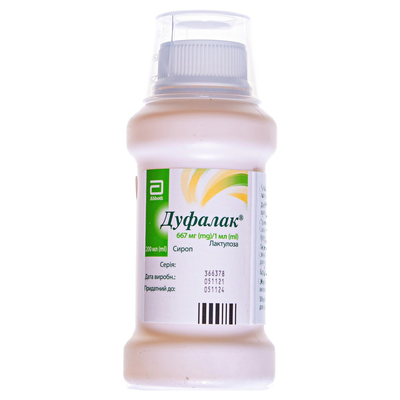
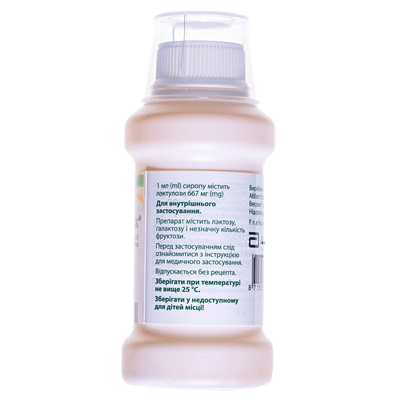
Dufalac syrup, 667 g/1000 mL, 200 mL per bottle.
Ingredients
Active ingredient: lactulose;
1 mL of syrup contains 667 mg of lactulose;
excipient: purified water.
Dosage Form
Syrup.
Main physical and chemical properties: a clear, viscous liquid ranging in color from colorless to brownish-yellow.
Pharmacotherapeutic group
Osmotic laxatives. ATC code A06AD11.
Pharmacological properties
Pharmacodynamics.
In the large intestine, lactulose is broken down by intestinal bacteria into low-molecular-weight organic acids. These acids lower the pH in the lumen of the large intestine and, through an osmotic effect, increase the volume of intestinal contents. This stimulates colonic peristalsis and normalizes stool consistency. Constipation is relieved, and the physiological rhythm of the bowel is restored.
In hepatic encephalopathy (or hepatic coma and precoma), the drug’s action is due to the inhibition of the growth of proteolytic bacteria by increasing the number of acidophilic bacteria (e.g., lactobacilli), by binding ammonia in its ionic form through acidification of the intestinal contents, cleansing the large intestine due to a low pH, as well as an osmotic effect and a change in bacterial nitrogen metabolism by stimulating the utilization of ammonia by bacteria for the synthesis of bacterial proteins. In light of the above, it is important to note, however, that the neuropsychiatric manifestations of hepatic encephalopathy cannot be explained solely by hyperammonemia. Nevertheless, ammonia can be considered representative of other nitrogenous compounds.
Lactulose, as a prebiotic, promotes the growth of beneficial bacteria, such as Bifidobacteria and Lactobacilli, while the growth of potentially pathogenic bacteria, such as Clostridia and E. coli, may be inhibited. This may lead to a more favorable balance of the gut flora.
Pharmacokinetics.
Lactulose is hardly absorbed after oral administration and reaches the large intestine unchanged, where it is metabolized by the bacterial flora. When Dufalac® is administered at a dose of 25–50 g or 40–75 mL, lactulose is completely metabolized. At higher doses, some lactulose may be excreted unchanged.
Indications
- Constipation: regulation of the physiological bowel rhythm.
- Conditions requiring facilitation of defecation (hemorrhoids, post-surgery in the large intestine and anorectal region).
- Hepatic encephalopathy: treatment and prevention of hepatic coma and precoma.
Contraindications
Hypersensitivity to the active ingredient or to other components of the drug, galactosemia, gastrointestinal obstruction, perforation of the digestive tract, or risk of perforation of the digestive tract.
Interactions with Other Medications and Other Types of Interactions
No interaction studies have been conducted.
Lactulose may increase potassium loss induced by other medications (e.g., thiazide diuretics, corticosteroids, and amphotericin B). Potassium deficiency may enhance the effect of cardiac glycosides.
Special Considerations for Use
Consultation with a physician is recommended if:
- painful abdominal symptoms of unknown origin are present before starting treatment;
- the therapeutic effect is insufficient after several days of treatment.
Patients with lactose intolerance should use Dufalac® with caution.
The dose of the medication typically used to treat constipation generally does not cause problems in patients with diabetes. However, the dose for treating hepatic encephalopathy is usually much higher, so this should be taken into account when treating patients with diabetes.
Long-term use of the drug without dose adjustment or improper use may lead to diarrhea and electrolyte imbalance.
This medication contains lactose, galactose, and a small amount of fructose. Therefore, patients with rare hereditary galactose or fructose intolerance, lactase deficiency, or glucose-galactose malabsorption should not take this medication.
This medication contains sulfites, which are a byproduct of the manufacturing process.
Patients with gastrocardial syndrome (Riemheld syndrome) should use lactulose only after consulting a doctor. To prevent flatulence, it is recommended to increase the dose gradually. If flatulence occurs, the dose should be reduced or treatment discontinued.
Use during pregnancy or breastfeeding.
Pregnancy
No adverse effects are expected during pregnancy, as the systemic effect of lactulose on the pregnant woman is negligible.
Dufalac®, syrup, may be used during pregnancy.
Breastfeeding
No effects on the newborn or infant are expected during breastfeeding, as the systemic exposure to lactulose in breastfeeding women is negligible.
Dufalac®, syrup, may be used during breastfeeding.
Fertility
No effects are expected, as the systemic exposure to lactulose is negligible.
Effect on reaction time when driving or operating machinery.
Dufalac® has no or negligible influence on the ability to drive a car or operate complex machinery.
Dosage and Administration
Dufalac® may be taken either diluted or undiluted.
The dose should be adjusted according to the patient’s individual needs.
A single dose of lactulose should be swallowed immediately and should not be held in the mouth for an extended period of time.
If the patient is prescribed the medication once daily, the dose should always be taken at the same time of day, for example, during breakfast. During treatment with laxatives, it is recommended to drink an adequate amount of fluid (1.5–2 liters, equivalent to 6–8 glasses) over the course of a day.
When using the medication in vials, you may use the measuring cap.
When using the medication in 15-ml single-dose sachets, tear off the corner of the sachet and consume the contents immediately.
Dosage for constipation or to soften stools for medical purposes
Lactulose may be taken as a single daily dose or divided into 2 doses; when using Dufalac® in vials, the measuring cap may be used.
After a few days, the initial dose may be adjusted to a maintenance dose based on the response to treatment. It may take several days of therapy (2–3 days) for the therapeutic effect to become apparent.
| Age | Initial dose, per day | Maintenance dose, per day |
| Adults and children 14 years of age and older | 15–45 mL (= 1–3 packets) | 15–30 mL (= 1–2 packets) |
| Children aged 7–14 years | 15 mL (= 1 packet) | 10–15 mL (= 1 packet)* |
| Children aged 1–6 years* | 5–10 mL | 5–10 mL |
| Children under 1 year of age* | up to 5 mL | up to 5 mL |
* If the maintenance dose is less than 15 mL, and for precise dosing in infants and children under 7 years of age, Dufalac® in vials should be used.
Dosage for hepatic encephalopathy (adults only)
Initial dose: 30–45 mL (2–3 packets) 3–4 times daily.
This dose may be adjusted to a maintenance dose to achieve soft stools 2 to 3 times a day.
Children
The safety and efficacy of this medication in children (from birth to 18 years of age) with hepatic encephalopathy have not been established. No data are available.
Elderly patients and patients with renal or hepatic impairment
Since the systemic effects of lactulose are negligible, there are no specific dosing recommendations for these patient groups.
Children.
The use of laxatives in children should be limited to exceptional cases and requires medical supervision.
It should be noted that the defecation reflex may be impaired during treatment.
Overdose
If doses are too high, symptoms such as abdominal pain and diarrhea may occur. Recommended treatment includes discontinuing the medication or reducing the dose, and correcting electrolyte imbalances in cases of excessive fluid loss caused by diarrhea or vomiting.
Side Effects
Overall Safety Profile
Flatulence may occur during the first few days of treatment but usually resolves within a few days. Abdominal pain and diarrhea may occur when the drug is used at doses exceeding the recommended ones. In such cases, the dose should be reduced. When high therapeutic doses are used for an extended period (usually only in patients with hepatic encephalopathy), electrolyte imbalance may occur as a result of diarrhea.
During postmarketing use, hypersensitivity reactions, primarily limited to skin manifestations, have been observed and identified as possible adverse reactions. Since these reactions were reported spontaneously from a patient population of unknown size, it is not possible to reliably estimate their frequency.
List of Adverse Reactions
The adverse reactions listed below occurred with the indicated frequency in patients treated with lactulose in placebo-controlled clinical trials [very common (≥1/10), common (≥1/100 to <1/10), uncommon (≥1/1,000 to <1/100), rare (≥1/10,000 to <1/1,000), very rarely (<1/10,000)], or were reported spontaneously during postmarketing use [frequency unknown (the exact frequency cannot be determined from the available data)].
Immune system disorders: unknown frequency—hypersensitivity.
Gastrointestinal disorders: very common—diarrhea; common—flatulence, abdominal pain, nausea, and vomiting.
Skin and subcutaneous tissue disorders: frequency unknown—rash, pruritus, urticaria, erythema.
Abnormal laboratory test results: uncommon—electrolyte imbalance due to diarrhea.
Children
The safety profile in children is expected to be the same as in adults.
Shelf life
3 years.
Storage conditions
Store at a temperature not exceeding 25 °C. Keep out of reach of children!
Packaging
Bottles of 200 mL, 300 mL, 500 mL, or 1,000 mL made of high-density polyethylene with a cap and a polypropylene measuring cap. The measuring cap is marked in 2.5 mL, 5 mL, 10 mL, 15 mL, 20 mL, 25 mL, and 30 mL increments.
Sachets made of polyester-aluminum-polyethylene laminate, each containing 15 mL of syrup, are packaged in cardboard boxes of 10, 20, and 50 pieces.
Dispensing Category
Over-the-counter.







