
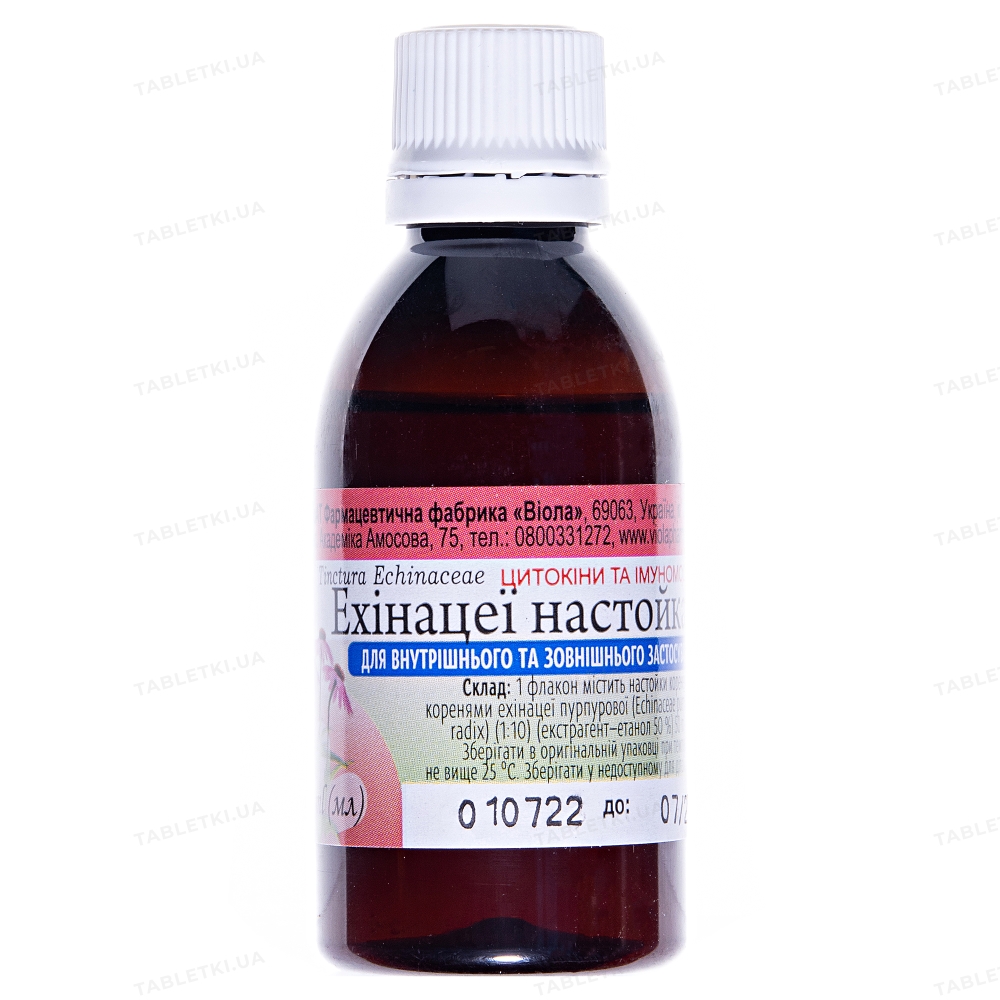
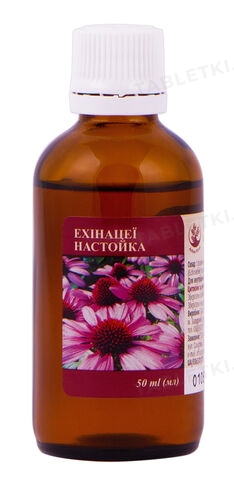
Echinacea tincture, 50 ml per bottle.
Composition
Active ingredient: tincture of purple coneflower rhizomes with roots (Echinaceae purpureae radix) (1:10) (extractant—50% ethanol).
1 bottle contains 20 mL of tincture of purple coneflower rhizomes and roots (Echinacea purpurea radix) (1:10) (extractant—50% ethanol), 25 mL, or 50 mL.
Dosage Form
Tincture.
Main physical and chemical properties: a clear, reddish-brown liquid. Sediment formation is permissible during storage.
Pharmacotherapeutic group
Cytokines and immunomodulators. ATC code L03A X.
Pharmacological properties
Pharmacodynamics.
The complex of active ingredients increases the phagocytic activity of neutrophils and macrophages, stimulates the synthesis of interleukin-1, promotes the transformation of B-lymphocytes into plasma cells, and enhances T-helper cell function. Inulin, lavulose, and betaine improve metabolic processes, particularly in the liver and kidneys. It has antiviral, antibacterial, and antifungal properties.
Pharmacokinetics. Not studied.
Indications
As part of a comprehensive treatment regimen for immunodeficiency states associated with chronic, recurrent inflammatory diseases of various locations. Post-treatment conditions following antibiotic therapy, cytostatic therapy, immunosuppressive therapy, or radiation therapy. Early symptoms of acute respiratory viral infections (ARVI) and during prolonged antibiotic use. Topical treatment of wounds that have not healed for a long time.
Contraindications
Hypersensitivity to any component of the drug or to plants of the Asteraceae family; connective tissue diseases (collagenoses), multiple sclerosis, and other autoimmune diseases.
Progressive systemic diseases (tuberculosis, diabetes mellitus), diseases of the blood’s leukocyte system (leukemia, agranulocytosis), cancer, rheumatism, AIDS, HIV infection, systemic lupus erythematosus, immunosuppression or immunodeficiency of various etiologies, and other chronic viral diseases.
Pregnancy or breastfeeding. Children under 12 years of age.
Special Safety Precautions
The duration of treatment with echinacea tincture should not exceed 8 weeks. During storage, the tincture may become cloudy and develop a sediment consisting of active polysaccharides; therefore, the bottle must be shaken before use.
Interactions with Other Medications and Other Types of Interactions
Due to echinacea’s immunostimulatory effect, this medication may reduce the effectiveness of drugs that have an immunosuppressive effect.
This medication is not recommended for use concurrently with hepatotoxic drugs, such as amiodarone, methotrexate, ketoconazole, and steroids.
This medication contains ethanol, which may increase the absorption and pharmacological effects of certain sedatives and, indirectly, by altering the activity of the cytochrome P450 system, affect the elimination of drugs metabolized by enzymes of this system. Ethanol may cause a disulfiram-like reaction when used concomitantly with, for example, certain antibacterial agents.
Special Considerations for Use
Use during pregnancy or breastfeeding.
Pregnant and breastfeeding women should not use the tincture, as the product contains alcohol.
Effect on reaction time when driving or operating machinery.
The product contains ethyl alcohol; therefore, patients should refrain from driving or operating complex machinery.
Dosage and Administration
To achieve a rapid effect at the start of treatment, adults should take 40 drops of the tincture, followed by an additional 20 drops within 2 hours. Thereafter, take 20 drops three times daily. The course of treatment should not exceed 8 weeks. For children 12 years of age and older, administer the tincture diluted 1:2 or 1:3, 5–10 drops 2–3 times daily, 30 minutes before meals. When treating wounds, apply the tincture topically to the affected areas. For external use, apply as compresses or swabs. Dilute 20–60 drops of the tincture in 100 mL of isotonic sodium chloride solution; moisten gauze with this solution, apply it to the wound, and cover with compress paper. Change the dressing twice daily. The recommended duration of treatment with this medication is 1 to 8 weeks.
Children.
This medication should not be used in children under 12 years of age due to its ethanol content.
Overdose
Nausea, vomiting, gastrointestinal disturbances, sleep disturbances, increased nervous system excitability, and sleep disorders. Treatment is symptomatic.
Side Effects
Allergic reactions: skin redness, itching, facial swelling, rash, hives, Stevens-Johnson syndrome, angioedema, Quincke’s edema, anaphylactic shock.
Respiratory system: difficulty breathing, obstructive bronchospasm, asthma.
Central nervous system: dizziness.
Cardiovascular system: hypotension.
Gastrointestinal system: nausea, vomiting, diarrhea.
There have been isolated reports of an association with autoimmune diseases (disseminated encephalomyelitis, erythema nodosum, immune thrombocytopenia, Evans syndrome, Sjögren–Larsen syndrome with impaired renal tubular function).
Leukopenia may occur with long-term use (more than 8 weeks).
Shelf life
3 years.
Storage conditions
Store in the original packaging at a temperature not exceeding 25 °C. Keep out of reach of children.
Packaging
20 mL, 25 mL, or 50 mL in glass vials sealed with stoppers and caps; 50 mL in plastic vials with caps; 50 mL in a glass or plastic bottle in a pack; 20 mL, 25 mL, or 50 mL in glass bottles sealed with dropper stoppers; 20 mL, 25 mL, or 50 mL in a glass vial, sealed with a dropper stopper, in a pack.
Dispensing category
Over-the-counter.
Manufacturer
PJSC Pharmaceutical Factory “Viola.”
Address
75 Akademika Amosova St., Zaporizhzhia, 69063, Ukraine.
Applicant
Viola Pharmaceutical Factory PJSC.







