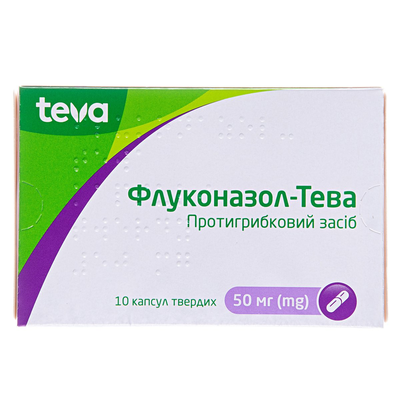
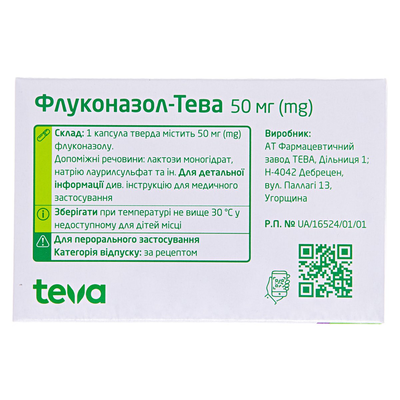
Fluconazole-Teva, 50 mg hard capsules, No. 10
Composition
Active ingredient: fluconazole;
1 hard capsule contains 50 mg, 100 mg, or 200 mg of fluconazole;
Inactive ingredients:
Capsule composition: lactose monohydrate, corn starch, colloidal anhydrous silicon dioxide, sodium lauryl sulfate, magnesium stearate;
Capsule shell: titanium dioxide (E 171), brilliant blue FCF (E 133), gelatin, azorubine (E 122) (only for 200 mg capsules).
Dosage Form
Hard capsules.
Main physicochemical properties:
50 mg hard capsules: hard gelatin capsules filled with a white or yellowish-white homogeneous powder, with an opaque blue cap and an opaque white body;
100 mg hard capsules: hard gelatin capsules filled with a white or yellowish-white homogeneous powder, with an opaque blue cap and an opaque white body;
200 mg hard capsules: hard gelatin capsules filled with a white or yellowish-white homogeneous powder, with an opaque purple cap and an opaque white body.
Pharmacotherapeutic group
Antifungal agents for systemic use, triazole derivatives. ATC code J02A C01.
Pharmacological Properties
Pharmacodynamics.
Mechanism of action.
Fluconazole is an antifungal drug belonging to the triazole class. Its primary mechanism of action is the inhibition of the cytochrome P450-mediated demethylation of 14α-alanosterol, which is an essential step in the biosynthesis of fungal ergosterol. The accumulation of 14α-methylsterols correlates with the subsequent loss of ergosterol through the fungal cell membrane and may be responsible for the antifungal effect of fluconazole. Fluconazole is more selective for fungal cytochrome P450 enzymes than for various mammalian cytochrome P450 enzyme systems.
Administration of fluconazole at a dose of 50 mg daily for 28 days did not affect plasma testosterone levels in men or endogenous steroid levels in women of reproductive age. Fluconazole at doses ranging from 200 to 400 mg per day showed no clinically significant effect on endogenous steroid levels or on the response to adrenocorticotropic hormone (ACTH) in healthy male volunteers.
Interaction studies with antipyrine demonstrated that a single or multiple doses of 50 mg of fluconazole do not affect the metabolism of antipyrine.
In vitro susceptibility
It has been shown that, in vitro, fluconazole exhibits antifungal activity against most clinically common Candida species (including C. albicans, C. parapsilosis, and C. tropicalis). C. glabrata exhibits reduced susceptibility to fluconazole, whereas C. krusei and C. auris are resistant to fluconazole.
Fluconazole also exhibits in vitro activity against Cryptococcus neoformans and Cryptococcus gattii, as well as against the endemic fungal species Blastomyces dermatitidis, Coccidioides immitis, Histoplasma capsulatum, and Paracoccidioides brasiliensis.
Pharmacodynamic/Pharmacokinetic Relationship
Animal studies have shown a correlation between the minimum inhibitory concentration (MIC) and efficacy in an experimental model of Candida mycosis. Clinical studies have demonstrated a linear relationship between AUC and the dose of fluconazole, with a ratio of nearly 1:1. There is also a direct, but insufficient, relationship between AUC or dose and a positive clinical response to treatment of oral candidiasis and, to a lesser extent, candidemia. In addition, treatment is less effective for infections caused by strains with a higher MIC for fluconazole.
Mechanism of Resistance
The genus Candida possesses several mechanisms of resistance to azole antifungal agents. It is known that fungal strains that have developed one or more of these resistance mechanisms have high minimum inhibitory concentrations (MICs) for fluconazole, which negatively affects efficacy in vivo and in clinical settings. Cases of superinfection with Candida species other than C. albicans—which have a naturally reduced susceptibility (C. glabrata) or are resistant to fluconazole (e.g., C. krusei and C. auris). Such infections may require alternative antifungal therapy.
Breakpoints (in accordance with the recommendations of the European Committee on Antimicrobial Susceptibility Testing (EUCAST))
Based on an analysis of pharmacokinetic/pharmacodynamic (PK/PD) data, in vitro susceptibility, and clinical response, breakpoints for fluconazole against Candida species were established. These are divided into species-independent breakpoints, which were determined primarily based on PK/PD data and are independent of species-specific MIC distributions, and species-dependent breakpoints, which are most commonly associated with human infections. These threshold values are listed in the table below:
| Antifungal drug | Species-specific cut-off values (S≤/R>) | Threshold values not specific to type A (S≤/R>) | ||||
| Candidiasis
Albicans |
Candidiasis
Glabrata |
Candidiasis
Cruze |
Candidiasis
Parapsilosis |
Candidiasis
tropicalis |
||
| Fluconazole | 2/4 | IE |
|
2/4 | 2/4 | 2/4 |
S – susceptible, R – resistant
A – Non-species-specific breakpoints were determined primarily based on FC/PD data and do not depend on the species-specific distribution of MICs. They are used only for organisms that do not have specific breakpoints.
- - Susceptibility testing is not recommended, as this type is not a target for drug therapy.
IE – there is insufficient evidence regarding whether this type is a target for drug therapy.
Pharmacokinetics.
The pharmacokinetic properties of fluconazole are similar following intravenous and oral administration.
Absorption. Fluconazole is well absorbed following oral administration, and plasma levels and systemic bioavailability exceed 90% of the plasma fluconazole levels achieved with intravenous administration of the drug. Concomitant food intake does not affect the absorption of the drug when administered orally. Peak plasma concentration is reached 0.5–1.5 hours after administration, with a plasma half-life of approximately 30 hours. Plasma concentrations are proportional to the dose. Steady-state concentrations of 90% can be achieved by day 45 when the daily dose is administered in divided doses. A steady-state concentration of 90% is reached on the second day of treatment with a loading dose that is twice the usual daily dose on the first day.
Distribution. The volume of distribution is approximately equal to the total body fluid volume. Plasma protein binding is low (11–12%).
Fluconazole penetrates well into all studied body fluids. Fluconazole levels in saliva and sputum are similar to plasma concentrations. In patients with fungal meningitis, fluconazole levels in cerebrospinal fluid reach 80% of plasma concentrations.
High concentrations of fluconazole in the skin, exceeding serum concentrations, are achieved in the stratum corneum, epidermis, dermis, and sweat. Fluconazole accumulates in the stratum corneum. At a dose of 50 mg once daily, the concentration of fluconazole after 12 days of treatment was 73 μg/g, and 7 days after the end of treatment, the concentration remained at 5.8 μg/g. At a dose of 150 mg once weekly, the concentration of fluconazole in the stratum corneum on day 7 of treatment was 23.4 μg/g; 7 days after administration of the next dose, the concentration was still 7.1 μg/g.
The concentration of fluconazole in the nails after 4 months of treatment with 150 mg once a week was 4.05 μg/g in healthy volunteers and 1.8 μg/g in patients with nail disorders; Fluconazole was detected in nail samples 6 months after completion of therapy.
Biotransformation. Fluconazole is metabolized to a minor extent. Following administration of a dose labeled with radioactive isotopes, only 11% of fluconazole is excreted in the urine in a metabolized form. Fluconazole is a selective inhibitor of the CYP2C9 and CYP4 isoenzymes, as well as an inhibitor of the CYP2C19 isoenzyme.
Elimination. The plasma half-life of fluconazole is approximately 30 hours. Most of the drug is excreted by the kidneys, and 80% of the administered dose is found unchanged in the urine. The clearance of fluconazole is proportional to creatinine clearance. No circulating metabolites have been detected.
The drug’s long half-life in blood plasma makes it possible to administer a single dose for vaginal candidiasis, as well as to administer the drug once a week for other indications.
Pharmacokinetics in Renal Insufficiency
In patients with severe renal insufficiency (eGFR < 20 mL/min), the half-life increases from 30 to 98 hours, requiring a dose reduction. Fluconazole is removed by hemodialysis and, to a lesser extent, by peritoneal dialysis. A 3-hour hemodialysis session reduces plasma fluconazole levels by approximately 50%.
Pharmacokinetics in Children
Pharmacokinetic parameters in children were evaluated in 5 studies: 2 single-dose studies, 2 multiple-dose studies, and 1 study involving preterm newborns.
Following administration of fluconazole at a dose of 28 mg/kg to children aged 9 months to 15 years, an AUC of approximately 38 μg·h/mL per 1 mg/kg dose was observed. With multiple doses, the mean plasma half-life of fluconazole ranged from 15 to 18 hours, and the volume of distribution was approximately 880 mL/kg. A longer plasma half-life of fluconazole, approximately 24 hours, was observed following a single dose. This is comparable to the plasma half-life of fluconazole following a single intravenous dose of 3 mg/kg in children aged 11 days to 11 months. The volume of distribution in this age group was approximately 950 mL/kg.
Experience with fluconazole in newborns is limited to pharmacokinetic studies in 12 preterm newborns with a gestational age of approximately 28 weeks. The mean age at the first dose was 24 hours (range 9–36 hours), and the mean birth weight was 0.9 kg (range 0.75–1.10 kg). A maximum of 5 intravenous injections of fluconazole at a dose of 6 mg/kg were administered every 72 hours. The mean half-life was 74 hours (44–185) on the first day, then decreased to 53 hours (30–131) on day 7 and to 47 hours (27–68) on day 13. The area under the curve (μg·h/mL) was 271 (173,385) on the first day, increased to 490 (292–734) on day 7, then decreased to 360 (167,566) on day 13. The volume of distribution (mL/kg) was 1,183 (10,701,470) on the first day, increasing to 1,184 (5,102,130) on day 7 and to 1,328 (10,401,680) on day 13, respectively.
Pharmacokinetics in Elderly Patients
In a study involving 22 patients (aged 65 years and older), fluconazole was administered orally at a dose of 50 mg. Ten participants were concurrently taking diuretics. Cmax was 1.54 μg/mL and was reached within 1.3 hours after fluconazole administration. The mean AUC was 76.4 ± 20.3 μg·h/mL. The mean half-life was 46.2 hours. These pharmacokinetic parameters were higher compared to those in healthy young volunteers. Concomitant use of diuretics had no significant effect on Cmax and AUC. In addition, creatinine clearance (74 mL/min), the percentage of fluconazole excreted unchanged in urine (0.24 hours, 22%), and renal clearance of fluconazole (0.124 mL/min/kg) in patients in this age group were lower than in younger volunteers. Thus, changes in pharmacokinetics in elderly patients appear to depend on renal function parameters.
Indications
Treatment of the following conditions in adults:
— cryptococcal meningitis;
— coccidioidomycosis;
— invasive candidiasis;
— candidiasis of the mucous membranes, including oropharyngeal candidiasis and esophageal candidiasis, candiduria, and chronic candidiasis of the skin and mucous membranes;
— chronic atrophic candidiasis (candidiasis caused by the use of dentures) when local oral hygiene measures are ineffective;
— vaginal candidiasis (acute or recurrent), when local therapy is not appropriate;
— candidal balanitis, when local therapy is not appropriate;
— dermatomycoses, including mycoses of smooth skin, inguinal dermatomycoses, tinea, and candidal skin infections, when systemic therapy is indicated;
— dermatophyte onychomycosis, when the use of other medications is not appropriate.
Prevention of the following conditions in adults:
— recurrence of cryptococcal meningitis in patients at high risk of developing it;
— recurrence of oropharyngeal or esophageal candidiasis in HIV-positive patients at high risk of developing it;
— reducing the frequency of recurrent vaginal candidiasis (4 or more episodes per year);
— prevention of candidal infections in patients with prolonged neutropenia (e.g., patients with hematologic malignancies undergoing chemotherapy or patients who have undergone hematopoietic stem cell transplantation).
Children.
Fluconazole may be used in children to treat candidiasis of the mucous membranes (oropharyngeal candidiasis, esophageal candidiasis), invasive candidiasis, cryptococcal meningitis, and for the prevention of candidal infections in immunocompromised patients. The drug may be used as maintenance therapy to prevent recurrence of cryptococcal meningitis in children at high risk of developing the condition.
Treatment with this drug may be initiated before the results of bacterial culture and other laboratory tests are available; once the results are available, antibiotic therapy should be adjusted accordingly.
Contraindications
- Hypersensitivity to fluconazole, other azole agents, or any of the drug’s excipients;
- Concomitant use of fluconazole with terfenadine is contraindicated in patients receiving repeated doses of fluconazole at 400 mg per day or higher (based on the results of multiple-dose interaction studies);
- Concomitant use of fluconazole with other drugs that cause QT interval prolongation and are metabolized by the CYP4A4 enzyme (e.g., cisapride, astemizole, pimozide, quinidine, amiodarone, and erythromycin). See also the sections “Special Warnings and Precautions for Use” and “Drug Interactions and Other Forms of Interaction.”
Interactions with Other Medications and Other Forms of Interaction
Concomitant use with the following drugs is contraindicated
Cisapride. Cardiac events, such as “pirouette”-type paroxysmal ventricular tachycardia, have been reported in patients taking fluconazole and cisapride concomitantly. A controlled study found that the concomitant use of fluconazole 200 mg once daily and cisapride 20 mg four times daily resulted in a significant increase in cisapride plasma levels and QT interval prolongation. Concomitant treatment with fluconazole and cisapride is contraindicated (see Table 1, “Contraindications” section).
Terfenadine. Drug interaction studies were conducted due to serious cardiac arrhythmias secondary to QTc prolongation in patients taking azole antifungal agents with terfenadine. In a study with a daily dose of 200 mg of fluconazole, no QTc interval prolongation was demonstrated. Another study with daily doses of 400 mg and 800 mg of fluconazole showed that fluconazole, when administered at a dose of 400 mg per day or higher, significantly increases plasma levels of terfenadine when taken concomitantly. Concomitant use of fluconazole at doses of 400 mg or higher with terfenadine is contraindicated (see the “Contraindications” section). If fluconazole is used concomitantly with terfenadine at doses below 400 mg per day, the patient should be closely monitored.
Astemizole. Concomitant use of fluconazole with astemizole may reduce the clearance of astemizole. The resulting increase in astemizole plasma concentrations may lead to QT interval prolongation and, in rare cases, to “pirouette” paroxysmal ventricular tachycardia. Concomitant use of fluconazole and astemizole is contraindicated (see the “Contraindications” section).
Pimozide. Concomitant use of fluconazole with pimozide may lead to inhibition of pimozide metabolism, although no relevant in vitro or in vivo studies have been conducted. Elevated plasma concentrations of pimozide may lead to QT interval prolongation and, in rare cases, paroxysmal ventricular tachycardia of the “pirouette” type. Concomitant use of fluconazole with pimozide is contraindicated (see the “Contraindications” section).
Quinidine. Concomitant use of fluconazole and quinidine may inhibit quinidine metabolism, although no relevant in vitro or in vivo studies have been conducted. The use of quinidine has been associated with QT interval prolongation and, in rare cases, paroxysmal ventricular tachycardia of the “pirouette” type. Concomitant use of fluconazole with quinidine is contraindicated (see the “Contraindications” section).
Erythromycin. Concomitant use of fluconazole with erythromycin may increase the risk of cardiotoxicity (QT interval prolongation and “pirouette”-type paroxysmal ventricular tachycardia), and, consequently, to sudden coronary death. Concomitant use of fluconazole and erythromycin is contraindicated (see the “Contraindications” section).
Amiodarone. Concomitant use of fluconazole with amiodarone may lead to inhibition of amiodarone metabolism. A link has been observed between the use of amiodarone and QT interval prolongation. Concomitant use of fluconazole and amiodarone is contraindicated (see the “Contraindications” section).
Concomitant use with the following medications is not recommended
Halofantrine. Fluconazole may increase the plasma concentration of halofantrine due to its inhibitory effect on CYP3A4. Concomitant use of fluconazole and halofantrine may increase the risk of cardiotoxicity (QT interval prolongation, “pirouette”-type paroxysmal ventricular tachycardia) and, as a result, lead to sudden cardiac death. This drug combination should be avoided (see the “Special Instructions and Precautions for Use” section).
Concomitant use of fluconazole with the following medications requires caution and dose adjustment
Effects of Other Medications on Fluconazole
Rifampicin. Concomitant use of fluconazole and rifampicin resulted in a 25% decrease in AUC and a 20% reduction in the half-life of fluconazole. Therefore, for patients taking rifampicin, an increase in the fluconazole dose should be considered.
Interaction studies have shown that when fluconazole is administered orally with food, cimetidine, antacids, or following total-body irradiation in combination with bone marrow transplantation, no clinically significant effect on the absorption of fluconazole was observed.
Hydrochlorothiazide. In a pharmacokinetic interaction study, concomitant multiple doses of hydrochlorothiazide in healthy volunteers receiving fluconazole increased the plasma concentration of fluconazole by 40%. These interaction parameters do not require a change in the dosing regimen of fluconazole in patients receiving concomitant diuretics.
Effect of Fluconazole on Other Medications
Fluconazole is a potent inhibitor of cytochrome P450 (CYP) 2C9 and a moderate inhibitor of CYP3A4. Fluconazole is also an inhibitor of CYP2C19. In addition to these interactions that have been observed or documented, there is a risk of increased concentrations of other compounds metabolized by CYP2C9, CYP2C19, and CYP3A4 when used concomitantly with fluconazole. Therefore, caution is advised with these combinations, and the patient’s condition should be closely monitored. The inhibitory effect of fluconazole on these enzymes persists for 4–5 days after discontinuation of fluconazole treatment due to the drug’s long half-life.
Alfentanil. When fluconazole (400 mg) was administered intravenously concurrently with alfentanil (20 μg/kg) to healthy volunteers, the AUC of alfentanil doubled, possibly due to CYP3A4 inhibition. A dose adjustment of alfentanil may be required.
Amitriptyline, nortriptyline. Fluconazole potentiates the effects of amitriptyline and nortriptyline. It is recommended to measure 5-nortriptyline and/or S-amitriptyline at the start of combination therapy and one week later. If necessary, the dose of amitriptyline/nortriptyline should be adjusted.
Concomitant use of fluconazole with amphotericin B in infected mice with normal and immunosuppressed conditions demonstrated the following results: a slight additive antifungal effect on systemic C. albicans infection, no interaction with intracranial Cryptococcus neoformans infection, and antagonism between the two drugs in systemic A. fumigatus infection. The clinical significance of the results obtained in this study is unknown.
Anticoagulants. During the postmarketing period, as with other azole antifungal agents, episodes of bleeding (hematomas, epistaxis, gastrointestinal bleeding, hematuria, and melena) associated with an increase in warfarin levels episodes of bleeding (hematomas, epistaxis, gastrointestinal bleeding, hematuria, and melena) associated with an increase in prothrombin time have been reported. When fluconazole and warfarin were administered concomitantly, a twofold prolongation of prothrombin time was observed, possibly due to inhibition of warfarin metabolism via CYP2C9. Patients taking coumarin-derived anticoagulants or indandione concurrently with fluconazole should have their prothrombin time carefully monitored. An adjustment to the anticoagulant dose may be necessary.
Short-acting benzodiazepines, such as midazolam and triazolam. Administration of fluconazole following oral administration of midazolam resulted in a significant increase in midazolam concentrations and an intensification of psychomotor effects. Concomitant oral administration of 200 mg of fluconazole and 7.5 mg of midazolam resulted in a 3.7-fold and 2.2-fold increase in AUC and half-life, respectively. Fluconazole 200 mg/day and 0.25 mg of triazolam administered orally resulted in a 4.4-fold and 2.3-fold increase in the AUC and half-life of triazolam, respectively. When fluconazole and triazolam were administered concomitantly, potentiation and prolongation of triazolam’s effects were observed.
If a patient receiving fluconazole must also be treated with benzodiazepines, the dose of benzodiazepines should be reduced, and the patient should be closely monitored.
Carbamazepine. Fluconazole inhibits the metabolism of carbamazepine and causes a 30% increase in serum carbamazepine levels. There is a risk of carbamazepine toxicity. The carbamazepine dose may need to be adjusted depending on its serum concentration and the drug’s effects.
Calcium channel blockers. Some calcium channel blockers (nifedipine, isradipine, amlodipine, verapamil, and felodipine) are metabolized by the CYP3A4 enzyme. Fluconazole has the potential to increase the systemic exposure of calcium channel blockers. Close monitoring for adverse reactions is recommended.
Celecoxib. Concomitant use of fluconazole (200 mg daily) and celecoxib (200 mg) increased the Cmax and AUC of celecoxib by 68% and 134%, respectively. When celecoxib and fluconazole are used concomitantly, the celecoxib dose may need to be reduced by half.
Cyclophosphamide. Concomitant use of cyclophosphamide and fluconazole leads to increased levels of bilirubin and creatinine in serum. These drugs may be used concomitantly, given the risk of increased serum bilirubin and creatinine concentrations.
Fentanyl. One fatal case of fentanyl intoxication has been reported due to a possible interaction between fentanyl and fluconazole. In addition, a study involving 12 healthy volunteers demonstrated that fluconazole significantly slows the elimination of fentanyl. Elevated fentanyl concentrations may lead to respiratory depression; therefore, the patient should be closely monitored. A dose adjustment of fentanyl may be required.
HMG-CoA reductase inhibitors. Concomitant use of fluconazole and HMG-CoA reductase inhibitors metabolized by CYP3A4 (atorvastatin and simvastatin) or HMG-CoA reductase inhibitors metabolized by CYP2C9 (fluvastatin), increases the risk of myopathy and rhabdomyolysis. If concomitant use of these drugs is necessary, the patient should be closely monitored for symptoms of myopathy and rhabdomyolysis, and creatine kinase levels should be monitored. In the event of a significant increase in creatine kinase levels, and if myopathy or rhabdomyolysis is diagnosed or suspected, HMG-CoA reductase inhibitors should be discontinued.
Immunosuppressants (e.g., cyclosporine, everolimus, sirolimus, and tacrolimus)
Cyclosporine. Fluconazole significantly increases the concentration and AUC of cyclosporine. Concomitant use of fluconazole 200 mg/day and cyclosporine 2.7 mg/kg/day resulted in a 1.8-fold increase in the AUC of cyclosporine. These drugs may be used concomitantly, provided that the cyclosporine dose is reduced based on its concentration.
Everolimus. Although no in vitro or in vivo studies have been conducted, fluconazole may increase the serum concentration of everolimus due to inhibition of CYP4A4.
Sirolimus. Fluconazole increases the plasma concentration of sirolimus, presumably by inhibiting the metabolism of sirolimus by CYP3A4 and P-glycoprotein. These drugs may be used concomitantly, provided that the sirolimus dose is adjusted based on drug concentrations and effects.
Tacrolimus. Fluconazole may increase tacrolimus serum concentrations up to 5-fold when taken orally due to inhibition of tacrolimus metabolism by the CYP3A4 enzyme in the intestine. No significant changes in pharmacokinetics were observed with intravenous administration of tacrolimus. Elevated tacrolimus levels are associated with nephrotoxicity. The oral dose of tacrolimus should be reduced based on tacrolimus concentrations.
Losartan. Fluconazole inhibits the metabolism of losartan to its active metabolite (E-31 74), which accounts for the majority of angiotensin II receptor antagonism following administration of losartan. Continuous monitoring of blood pressure in patients is recommended.
Methadone. Fluconazole may increase serum methadone concentrations. When methadone and fluconazole are used concomitantly, a dose adjustment of methadone may be required.
Nonsteroidal anti-inflammatory drugs (NSAIDs). When used concomitantly with fluconazole, the Cmax and AUC of flurbiprofen increased by 23% and 81%, respectively, compared with flurbiprofen alone. Similarly, when fluconazole was administered concomitantly with racemic ibuprofen (400 mg), the Cmax and AUC of the pharmacologically active isomer S-(+)-ibuprofen increased by 15% and 82%, respectively, compared with racemic ibuprofen alone.
Although no specific studies have been conducted, fluconazole has the potential to increase the systemic exposure of other NSAIDs metabolized by CYP2C9 (e.g., naproxen, lornoxicam, meloxicam, diclofenac). Periodic monitoring for NSAID-related adverse reactions and toxicity is recommended. Adjustment of the NSAID dose may be necessary.
Phenytoin. Fluconazole inhibits the hepatic metabolism of phenytoin. Concomitant intravenous administration of 200 mg of fluconazole and 250 mg of phenytoin results in a 75% increase in phenytoin’s AUC₂₄ and a 128% increase in Cmin. When these drugs are used concomitantly, phenytoin serum concentrations should be monitored to avoid phenytoin toxicity.
Prednisolone. There is a reported case in which a patient who had undergone a liver transplant and was receiving prednisolone developed acute adrenal insufficiency following the discontinuation of a three-month course of fluconazole therapy. Discontinuation of fluconazole likely caused an increase in CYP3A4 activity, which led to accelerated metabolism of prednisolone. Patients who have been taking fluconazole and prednisolone concomitantly for a prolonged period should be closely monitored to prevent adrenal insufficiency following discontinuation of fluconazole.
Rifabutin. Fluconazole increases serum rifabutin concentrations, leading to an increase in rifabutin AUC of up to 80%. Cases of uveitis have been reported with the concomitant use of fluconazole and rifabutin. When using this combination of drugs, symptoms of rifabutin toxicity should be monitored.
Saquinavir. Fluconazole increases the AUC and Cmax of saquinavir by approximately 50% and 55%, respectively, due to inhibition of saquinavir’s hepatic metabolism by the CYP3A4 enzyme and inhibition of P-glycoprotein. The interaction between fluconazole and saquinavir/ritonavir has not been studied; therefore, it may be more pronounced. A dose adjustment of saquinavir may be required.
Sulfonylurea derivatives. Concomitant use of fluconazole prolongs the half-life of oral sulfonylureas (chlorpropamide, glibenclamide, glipizide, and tolbutamide) when administered to healthy volunteers. It is recommended to monitor blood glucose levels frequently and reduce the dose of sulfonylurea derivatives accordingly when used concomitantly with fluconazole.
Theophylline. In a placebo-controlled study examining the interaction between fluconazole and theophylline, it was found that administration of fluconazole at a dose of 200 mg for 14 days resulted in a 18% decrease in the mean plasma clearance of theophylline. Patients receiving high doses of theophylline or who are at increased risk of theophylline toxicity for other reasons should be monitored for signs of theophylline toxicity. Therapy should be adjusted if signs of toxicity appear.
Periwinkle alkaloids. Although no studies have been conducted, fluconazole, presumably due to CYP3A4 inhibition, may cause an increase in the plasma concentrations of periwinkle alkaloids (e.g., vincristine and vinblastine), leading to neurotoxic effects.
Vitamin A. It has been reported that a patient receiving both transretinoic acid (the acid form of vitamin A) and fluconazole experienced central nervous system (CNS) adverse reactions in the form of a pseudotumor cerebri; This effect resolved after discontinuation of fluconazole. These drugs may be used concomitantly, but the risk of CNS adverse reactions should be kept in mind.
Voriconazole (an inhibitor of CYP2C9, CYP2C19, and CYP4). Concomitant administration of oral voriconazole (400 mg every 12 hours for 1 day, followed by 200 mg every 12 hours for 2.5 days) and oral fluconazole (400 mg on the first day, followed by 200 mg every 24 hours for 4 days) in 8 healthy male volunteers resulted in an increase in voriconazole’s Cmax and AUC by an average of 57% (90% CI: 20%, 107%) and 79% (90% CI: 40%, 128%), respectively. It is unknown whether reducing the dose and/or frequency of voriconazole or fluconazole reverses this effect. When voriconazole is administered following fluconazole, adverse effects associated with voriconazole should be monitored.
Zidovudine. Fluconazole increases the Cmax and AUC of zidovudine by 84% and 74%, respectively, due to a reduction in zidovudine clearance of approximately 45% following oral administration. The half-life of zidovudine was also increased by approximately 128% following the combination of fluconazole and zidovudine. Patients using this drug combination should be monitored for the development of adverse reactions associated with zidovudine use. A reduction in the zidovudine dose may be considered.
Azithromycin. In an open-label, randomized, three-way crossover study involving 18 healthy volunteers, the effect of azithromycin and fluconazole on each other’s pharmacokinetics was evaluated following simultaneous oral administration as single doses of 1200 mg and 800 mg, respectively. No significant pharmacokinetic interactions were observed.
Oral contraceptives. Data from two pharmacokinetic studies of repeated doses of fluconazole and a combined oral contraceptive indicate that 50 mg of fluconazole did not affect hormone levels, whereas 200 mg of fluconazole administered daily increased the AUC of ethinyl estradiol by 40% and that of levonorgestrel by 24%. This suggests that multiple doses of fluconazole are unlikely to affect the efficacy of combined oral contraceptives.
Ivacaftor. Concomitant use with ivacaftor, a cystic fibrosis transmembrane conductance regulator (CFTR) enhancer, increases the exposure of ivacaftor 3-fold and that of hydroxymethylivacaftor (M1) 1.9-fold. For patients also taking moderate CYP3A inhibitors, such as fluconazole and erythromycin, a reduction in the ivacaftor dose to 150 mg once daily is recommended.
Special Considerations for Use
Dermatophytosis. According to the results of a study of fluconazole for the treatment of dermatophytosis in children, fluconazole is no more effective than griseofulvin, and the overall efficacy rate is less than 20%. Therefore, fluconazole should not be used to treat dermatophytosis.
Cryptococcosis. There is insufficient evidence of fluconazole’s efficacy for treating cryptococcosis in other sites (e.g., pulmonary cryptococcosis and cutaneous cryptococcosis); therefore, there are no dosage regimen recommendations for treating such conditions.
Deep-seated endemic mycoses. There is insufficient evidence of the efficacy of fluconazole for the treatment of other forms of endemic mycoses, such as paracoccidioidomycosis, histoplasmosis, and cutaneous-lymphatic sporotrichosis; therefore, there are no dosage recommendations for the treatment of these conditions.
Candidiasis. Studies have shown an increase in the prevalence of infections caused by Candida species other than C. albicans. These are often inherently resistant (e.g., C. krusei and C. auris) or exhibit reduced susceptibility to fluconazole (C. glabrata). Such infections may require alternative antifungal therapy. Therefore, it is recommended to take into account the prevalence of fluconazole resistance among different Candida species.
Renal system. In patients with impaired renal function, the drug should be used with caution (see the “Dosage and Administration” section).
Adrenal insufficiency. Ketoconazole is known to cause adrenal insufficiency, and this may also occur with fluconazole, although it is rarely observed. Adrenal insufficiency associated with concomitant prednisolone therapy is described in the “Interactions with Other Medications and Other Forms of Interaction” section.
Hepatobiliary system. The drug should be used with caution in patients with impaired liver function. The use of fluconazole has been associated with rare cases of severe hepatotoxicity, including fatal outcomes, primarily in patients with severe underlying medical conditions. In cases where hepatotoxicity was associated with fluconazole use, it was not clearly related to the total daily dose of the drug, duration of therapy, or the patient’s sex or age. Fluconazole-induced hepatotoxicity is usually reversible and resolves after discontinuation of therapy.
Patients with abnormal liver function tests while taking fluconazole should be closely monitored for possible more severe liver damage.
Patients should be informed of symptoms that may indicate serious liver complications (severe asthenia, anorexia, persistent nausea, vomiting, and jaundice). In such cases, fluconazole should be discontinued immediately, and a physician should be consulted.
Cardiovascular system. Some azoles, including fluconazole, are associated with QT interval prolongation on an electrocardiogram. Very rare cases of QT interval prolongation and “pirouette”-type paroxysmal ventricular tachycardia have been reported with fluconazole. These reports involved patients with severe illness and a combination of several risk factors, such as structural heart disease, electrolyte imbalances, and concomitant use of other medications that affect the QT interval.
Fluconazole should be used with caution in patients at risk of developing arrhythmias. Concomitant use with drugs that prolong the QT interval and are metabolized by the cytochrome P450 CYRZA4 enzyme is contraindicated.
Halofantrine. Halofantrine is a substrate of the CYP4 enzyme and prolongs the QTc interval when used at recommended therapeutic doses. Concomitant use of halofantrine and fluconazole is not recommended.
Dermatological reactions. Exfoliative skin reactions, such as Stevens-Johnson syndrome and toxic epidermal necrolysis, have rarely been reported with fluconazole. Patients with AIDS are more likely to develop severe skin reactions when taking many medications. If a patient with a superficial fungal infection develops a rash that may be related to fluconazole, further use of the drug should be discontinued. If a patient with an invasive/systemic fungal infection develops a skin rash, their condition should be closely monitored; if a bullous rash or erythema multiforme occurs, fluconazole should be discontinued. Drug reaction with eosinophilia and systemic symptoms (DRESS) has been reported.
Hypersensitivity. In rare cases, anaphylactic reactions have been reported.
Cytochrome P450. Fluconazole is a potent inhibitor of CYP2C9 and a moderate inhibitor of CYP4. Fluconazole is also an inhibitor of CYP2C19. Patients receiving fluconazole concomitantly with drugs that have a narrow therapeutic index and are metabolized by CYP2C9, CYP2C19, and CYP3A4 should be monitored.
Terfenadine. Patients should be closely monitored when terfenadine is used concomitantly with fluconazole at a dose of less than 400 mg per day.
Excipients. This medication contains lactose. Patients with rare hereditary disorders, such as galactose intolerance, Lapp lactase deficiency, and glucose-galactose malabsorption, should not take this medication.
Pregnancy and lactation.
Pregnancy
An observational study showed an increased risk of spontaneous abortion in women who received fluconazole during the first trimester.
Data from several thousand pregnant women who received a cumulative dose of 150 mg of fluconazole or less during the first trimester do not indicate an increased overall risk of fetal malformations. In one large observational cohort study, oral fluconazole use during the first trimester was associated with a slight increase in the risk of musculoskeletal malformations, corresponding to approximately 1 additional case per 1,000 women receiving cumulative doses ≤ 450 mg, compared with women receiving topical azoles, and approximately 4 additional cases per 1,000 women receiving cumulative doses greater than 450 mg. The adjusted relative risk was 1.29 (95% CI 1.05 to 1.58) for oral fluconazole at a dose of 150 mg and 1.98 (95% CI 1.23–3.17) for doses above 450 mg of fluconazole.
Multiple congenital anomalies (including brachycephaly, auricular dysplasia, excessive enlargement of the anterior fontanelle, hip deformity, and brachioradial synostosis) have been reported in children whose mothers were treated for coccidioidomycosis for at least three or more months with high doses (400–800 mg per day) of fluconazole. The relationship between these effects and fluconazole has not been fully established.
Animal studies have demonstrated reproductive toxicity.
Routine doses of fluconazole and short-term courses of fluconazole should not be used during pregnancy unless absolutely necessary.
High doses of fluconazole and/or long-term courses of fluconazole should not be used during pregnancy, except for the treatment of potentially life-threatening infections.
Breastfeeding
Fluconazole passes into breast milk at concentrations lower than those in plasma. Breastfeeding may be continued after a single dose of fluconazole 200 mg or less. Breastfeeding is not recommended following repeated doses or high doses of fluconazole.
Fertility
Animal studies have shown that fluconazole did not affect fertility in male and female rats.
Effects on the ability to drive and operate machinery.
The effect of fluconazole on reaction time while driving or operating machinery has not been studied. Patients should be warned about the possibility of dizziness or seizures while taking fluconazole and advised to refrain from driving or operating machinery if any of these symptoms occur.
Dosage and Administration
Capsules should be swallowed whole. The medication may be taken with or without food.
Dosage
The dose should be determined based on the type and severity of the fungal infection. Treatment of infections requiring multiple doses should be continued until clinical signs or laboratory tests confirm the resolution of the fungal infection. Insufficient duration of treatment may lead to a recurrence of the active infection. For most cases of vaginal candidiasis, a single dose of the medication is sufficient.
Adults
Cryptococcosis.
- Treatment of cryptococcal meningitis: the loading dose is 400 mg on the first day. The maintenance dose is 200–400 mg/day. The duration of treatment is usually at least 6–8 weeks. For life-threatening infections, the daily dose may be increased to 800 mg.
- Maintenance therapy to prevent recurrence of cryptococcal meningitis in patients at high risk of developing the condition: the recommended dose is 200 mg/day indefinitely.
Coccidioidomycosis.
- The recommended dose is 200–400 mg/day. The duration of treatment is 11–24 months or longer, depending on the patient’s condition. For the treatment of certain forms of infection, and especially for the treatment of meningitis, a dose of 800 mg/day may be appropriate.
Invasive candidiasis.
- The loading dose is 800 mg on the first day. The maintenance dose is 400 mg/day. The usual recommended duration of treatment for candidemia is 2 weeks after the first negative results of bacteriological blood tests and the resolution of signs and symptoms of candidemia.
Mucosal candidiasis.
- Oropharyngeal candidiasis: a loading dose of 200–400 mg on the first day, followed by a maintenance dose of 100–200 mg/day. The duration of treatment is 7–21 days (until remission is achieved), but may be extended for patients with severely compromised immune systems.
- Esophageal candidiasis: a loading dose of 200–400 mg on the first day, followed by a maintenance dose of 100–200 mg/day. The duration of treatment is 14 to 30 days (until remission is achieved), but may be extended for patients with severely compromised immune systems.
- Candiduria: The recommended dose is 200–400 mg/day for 7–21 days. For patients with severely compromised immune systems, the duration of treatment may be extended.
- Chronic atrophic candidiasis: The recommended dose is 50 mg/day for 14 days.
- Chronic candidiasis of the skin and mucous membranes: the recommended dose is 50–100 mg/day. The duration of treatment is up to 28 days, but may be extended depending on the severity and type of infection or the degree of immunosuppression.
Prevention of recurrent candidiasis of the mucous membranes in HIV-positive patients at high risk of developing the condition.
- Oropharyngeal candidiasis, esophageal candidiasis: the recommended dose is 100–200 mg/day or 200 mg 3 times a week. For immunocompromised patients, the duration of treatment is not limited.
Prevention of candidal infections in patients with prolonged neutropenia.
- The recommended dose is 200–400 mg. Treatment should begin several days before the expected onset of neutropenia and continue for 7 days after the neutrophil count exceeds 1,000/mm³.
Genital candidiasis.
- Acute vaginal candidiasis, candidal balanitis: the recommended dose is 150 mg as a single dose.
- Treatment and prevention of recurrent vaginal candidiasis (4 or more episodes per year): the recommended dose is 150 mg once every 3 days. A total of 3 doses should be administered (on days 1, 4, and 7). This should be followed by a maintenance dose of 150 mg once a week for 6 months.
Dermatomycosis.
- Athlete’s foot, tinea corporis, tinea cruris, and candidal skin infections: the recommended dose is 150 mg once a week, or 50 mg once daily. The duration of treatment is 24 weeks. Treatment for athlete’s foot may last up to 6 weeks.
- Pityriasis versicolor: The recommended dose is 300–400 mg once a week for 1–3 weeks or 50 mg daily for 2–4 weeks.
- Dermatophyte onychomycosis: The recommended dose is 150 mg once a week. Treatment should continue until the infected nail is replaced by a healthy one. It usually takes 3–6 months for fingernails and 6–12 months for toenails, respectively, to grow back healthy. However, nail growth rates can vary from patient to patient and depend on age. After successful treatment of long-standing chronic infections, the shape of the nail sometimes remains altered.
Children.
As with similar infections in adults, the duration of treatment depends on the clinical and mycological response. The medication is taken once daily. Capsules should be swallowed whole and taken regardless of meals. The maximum daily dose of 400 mg should not be exceeded.
For children with impaired renal function, see the dosage information in the “Renal Insufficiency” section. The pharmacokinetics of fluconazole in children with renal insufficiency have not been studied.
Infants, preschoolers, and older children (28 days to 11 years)
| Indications | Dosage | Recommendation |
| Candidiasis of the mucous membranes | Initial dose: 6 mg/kg;
Maintenance dose: 3 mg/kg/day |
The initial dose may be administered on the first day to achieve a steady-state concentration more quickly |
| Invasive candidiasis
Cryptococcal meningitis |
6 to 12 mg/kg/day | Depending on the severity of the disease |
| Maintenance therapy to prevent recurrence
Cryptococcal meningitis in children at high risk of developing the condition |
6 mg/kg/day | Depending on the severity of the disease |
| Prevention of candidiasis in immunocompromised patients | 3 to 12 mg/kg/day | Depending on the severity and duration of induced neutropenia. |
Adolescents (ages 12 to 17)
Depending on body weight and sexual maturation, the physician must determine which dose (adult or pediatric) is most appropriate for the patient. Clinical data indicate that fluconazole clearance is higher in children than in adults. Doses of 100, 200, and 400 mg in adults and doses of 3, 6, and 12 mg/kg in children result in comparable systemic exposure.
Safety and efficacy in the treatment of genital candidiasis in children have not been established. If treatment of genital candidiasis is necessary in adolescents (ages 12 to 17), the dosage should be the same as for adults.
Method of Administration
Fluconazole may be administered orally or as an intravenous infusion, depending on the patient’s clinical condition. When switching from intravenous to oral administration or vice versa, there is no need to change the daily dose.
Special Patient Populations
Elderly patients
The dosage should be adjusted according to renal function (see Dosage. “Renal Insufficiency”).
Renal Insufficiency
No adjustment is required for a single dose. In patients (including children) with impaired renal function, if repeated administration of fluconazole is required, the initial dose should be 50 to 400 mg, depending on the indication. The daily dose (depending on the indication) should be calculated using the table below:
| Creatinine clearance (mL/min)
> 50 ≤ 50 (without dialysis) Regular dialysis |
Percentage of Recommended Dose
100% 50% 100% after each dialysis session |
Patients undergoing regular dialysis should receive 100% of the recommended dose after each dialysis session; on days when dialysis is not performed, patients should receive a reduced dose based on creatinine clearance.
Hepatic impairment
Fluconazole should be used with caution in patients with hepatic impairment, as data on its use in this patient population are limited (see the sections “Special Warnings and Precautions for Use” and “Adverse Reactions”).
Children.
Capsules may be used in this patient population when children are able to safely swallow capsules, which is generally possible from the age of 5 years.
Overdose
Cases of fluconazole overdose have been reported; hallucinations and paranoid behavior have also been reported.
In case of overdose, symptomatic and supportive therapy should be provided, and gastric lavage should be performed if necessary.
Fluconazole is extensively excreted in the urine; forced diuresis may accelerate the elimination of the drug. A 3-hour hemodialysis session reduces plasma fluconazole levels by approximately 50%.
Side Effects
The most common adverse reactions (>1/10) were headache, abdominal pain, diarrhea, nausea, vomiting, rash, and elevated levels of alanine aminotransferase (ALT), aspartate aminotransferase (AST), and alkaline phosphatase in the blood. Drug-induced reaction with eosinophilia and systemic symptoms (DRESS) associated with fluconazole use has been reported.
The following classification is used to assess the frequency of adverse reactions: very common (≥1/10), common (≥1/100 to <1/10), uncommon (≥1/1,000 to <1/100), rare (≥1/10,000 to <1/1,000), very rare (<1/10,000), frequency unknown (cannot be estimated from the available data).
Disorders of the circulatory and lymphatic systems.
Uncommon: anemia.
Rare: agranulocytosis, leukopenia, neutropenia, thrombocytopenia.
Immune system disorders.
Rare: anaphylaxis.
Metabolic and nutritional disorders.
Uncommon: decreased appetite.
Rare: hypertriglyceridemia, hypercholesterolemia, hypokalemia.
Psychiatric disorders.
Uncommon: insomnia, drowsiness.
Nervous system disorders.
Common: headache.
Uncommon: seizures, dizziness, paresthesias, taste disturbances.
Rare: tremor.
Hearing and balance disorders.
Uncommon: dizziness.
Cardiac disorders.
Rare: paroxysmal ventricular tachycardia of the “pirouette” type, QT interval prolongation.
Gastrointestinal disorders.
Common: abdominal pain, diarrhea, nausea, vomiting.
Uncommon: constipation, dyspepsia, flatulence, dry mouth.
Hepatobiliary disorders.
Common: elevated levels of ALT, AST, and alkaline phosphatase in the blood.
Uncommon: cholestasis, jaundice, elevated bilirubin.
Rare: liver failure, hepatocellular necrosis, hepatitis, hepatocellular damage.
Skin and subcutaneous tissue disorders.
Common: rash.
Uncommon: pruritus, drug-induced dermatitis (including fixed drug eruption), urticaria, increased sweating.
Rare: toxic epidermal necrolysis, Stevens-Johnson syndrome, acute generalized exanthematous pustulosis, exfoliative dermatitis, angioedema, facial edema, alopecia.
Frequency unknown: drug reaction with eosinophilia and systemic symptoms (DRESS).
Musculoskeletal and connective tissue disorders.
Uncommon: myalgia.
General disorders and administration site conditions.
Uncommon: fatigue, malaise, asthenia, fever.
Children
The frequency and nature of adverse reactions and laboratory abnormalities in children, as recorded in clinical trials—with the exception of genital candidiasis—are comparable to those in adults.
Reporting of Suspected Adverse Reactions
Reporting suspected adverse reactions after the drug’s approval is important. This allows for continuous monitoring of the benefit-risk profile associated with the drug’s use. Healthcare professionals should report suspected adverse reactions in accordance with local regulations.
Shelf Life
3 years.
Storage conditions
Store at a temperature not exceeding 30 °C, out of the reach of children.
Packaging
50 mg or 100 mg hard capsules: 7 or 10 capsules per blister pack, 1 blister pack per box.
200 mg hard capsules: 1, 4, 7, or 10 capsules per blister pack, 1 blister pack per box.
Manufacturer
Teva Pharmaceutical Factory, JSC.