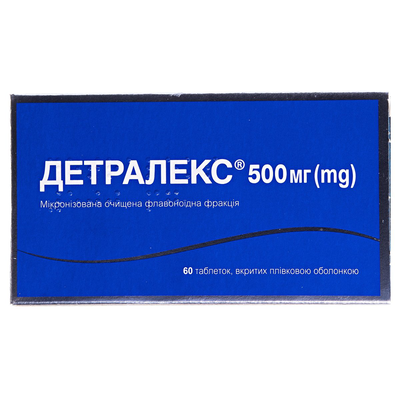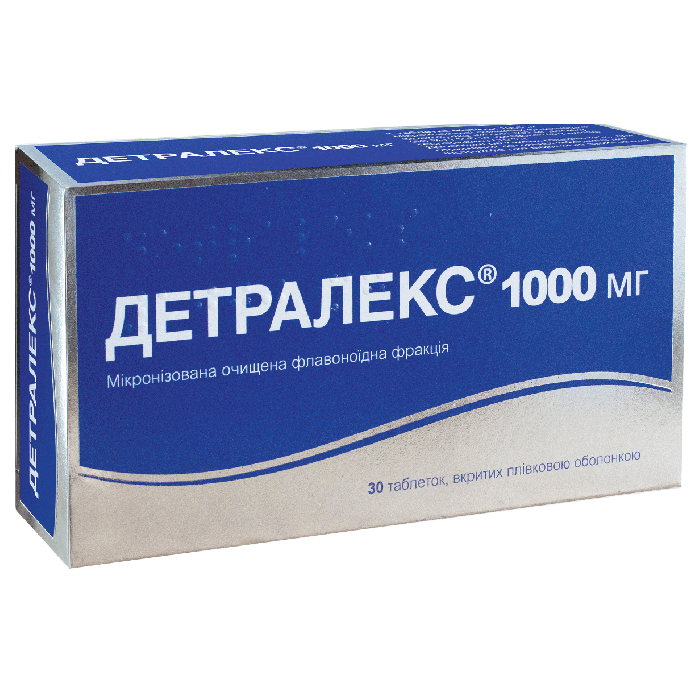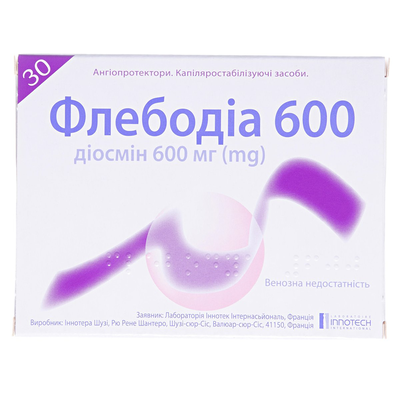
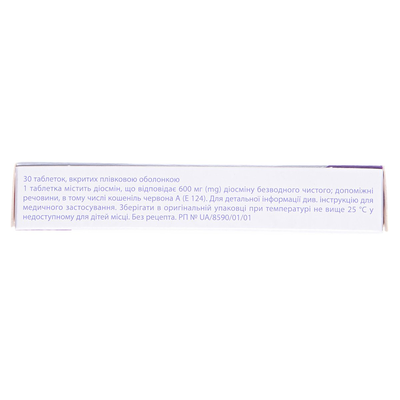
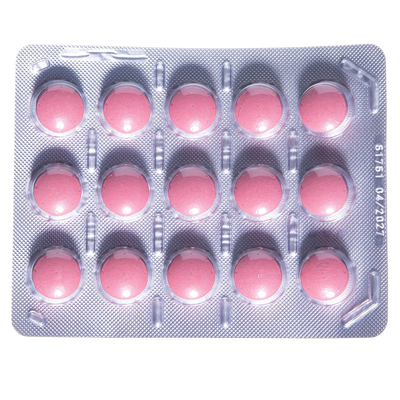
Phlebodia 600 tablets, film-coated, 600 mg each, No. 30 (15 x 2)
Ingredients
Active ingredient: diosmin;
1 tablet contains diosmine equivalent to 600 mg of anhydrous pure diosmine;
excipients: microcrystalline cellulose, talc, stearic acid, hydrophobic colloidal silicon dioxide, coating (hypromellose, microcrystalline cellulose, macrogol stearate 400), Opaglos 6000 (palm wax, white beeswax, gum lac, anhydrous ethanol), Sepisperse dye (cochineal red A (E 124), propylene glycol, hypromellose, titanium dioxide (E 171), red iron oxide (E 172), black iron oxide (E 172)).
Dosage Form
Film-coated tablets.
Main physical and chemical properties: film-coated tablets, pink in color.
Pharmacotherapeutic group
Angioprotectants. Capillary-stabilizing agents. Bioflavonoids. ATC code C05C A03.
Pharmacological properties
Pharmacodynamics.
A venotonic and angioprotective agent that improves venous outflow, increases vascular resistance, and reduces vascular permeability; it also has anti-edematous and anti-inflammatory effects.
Phlebodia 600 increases the tone of small-caliber veins, thereby improving venous outflow and lymphatic drainage. Venous tone is increased by enhancing the tropism of paravascular norepinephrine toward venous myocytes (increases the synthesis and/or release of norepinephrine; inhibits the activity of catechol-O-methyltransferase; moderately reduces the activity of phosphodiesterase). The drug’s vasoconstrictive effect is limited to the venous and lymphatic systems. The drug does not affect arterial tone. In animals, Phlebodia 600 improves tissue trophism and microcirculation and reduces tissue edema by decreasing capillary permeability and increasing their resistance. The drug exerts a moderate antiplatelet and anti-inflammatory effect. In humans, the anti-inflammatory effect is mediated by anticomplementary activity, inhibition of the peroxide anion release reaction, and reduced leukotriene production.
Pharmacodynamic studies in humans have demonstrated the following properties of the drug.
Venotonic properties demonstrated in clinical pharmacology:
- Enhances the vasoconstrictive effects of epinephrine, norepinephrine, and serotonin on the superficial veins of the upper extremities or on an isolated subcutaneous vein.
- It increases venous tone, as confirmed by measurement of venous capacity using tensometric plethysmography; it reduces venous stasis.
- The venotonic effect is dose-dependent.
- It reduces mean venous pressure (in both the superficial and deep venous systems), as demonstrated in a double-blind, Doppler-monitored study compared to placebo.
- It increases systolic and diastolic blood pressure in cases of postoperative orthostatic hypotension.
- It has been shown to be effective following venectomy.
Angioprotective properties:
- The increase in capillary resistance is dose-dependent.
Pharmacokinetics.
Absorption
After oral administration, diosmin is metabolized by intestinal bacteria to form diosmetin. Diosmetin is then absorbed and appears in the blood compartment in the form of glucuronide conjugates and sulfoconjugates. Diosmetin-3-O-glucuronide has been identified as the major metabolite of diosmin.
Maximum plasma concentration is reached 12–15 hours after administration of the drug.
Distribution
Pharmacokinetic studies using C14-labeled diosmin have shown that in animals, the drug is rapidly absorbed from the gastrointestinal tract, and it has been established diosmin is evenly distributed throughout all layers of the venous wall, primarily in the vena cava, the subcutaneous veins of the lower extremities, and to a lesser extent in the kidneys, liver, and lungs. The drug is present in only trace amounts in other tissues. The selective accumulation of diosmin in the walls of venous vessels peaks 9 hours after administration and persists for the next 96 hours.
Elimination
In animals, the drug is excreted in the urine (79%) and, via the enterohepatic circulation, in feces (11%) and bile (2.4%).
In humans, diosmin is excreted in the urine and is detected as diosmetin-3-O-glucuronide.
Indications
- Comprehensive treatment of functional conditions accompanied by increased capillary permeability.
- Treatment of symptoms of venous and lymphatic insufficiency, including: heaviness in the legs, edema, pain, and trophic disorders.
- Treatment of functional symptoms of acute hemorrhoids.
Contraindications
Hypersensitivity to the active ingredient or to any of the drug’s excipients.
Interactions with Other Medications and Other Types of Interactions
Diosmin may enhance the vasoconstrictive effects of epinephrine and norepinephrine.
Special considerations for use
Chronic venous and lymphatic insufficiency. This medication is most effective when combined with a healthy lifestyle. Prolonged exposure to the sun and overheating, prolonged standing or sitting, and lifting excessive weights should be avoided. Walking and, in some cases, wearing special medical compression stockings help normalize microcirculation and improve blood flow.
Acute hemorrhoids. Use of this medication does not replace specific treatment for other proctological conditions and does not interfere with the treatment of other diseases.
Treatment is administered as a short course.
If symptoms do not resolve after a short course of treatment, a proctological examination should be performed and the current therapy reviewed.
This medication contains cochineal red A (E 124), which may cause allergic reactions.
Use during pregnancy or breastfeeding.
In animal studies, no teratogenic effects of diosmin on the fetus were observed. In clinical practice, there have been no reports of any side effects associated with the use of this medication in pregnant women. Pregnant women should use this medication with caution. Consult your doctor before use. As a precaution, it is advisable to avoid using this medication during pregnancy.
Due to the lack of data on the drug’s transfer into breast milk, use of this medication during breastfeeding should be avoided. The decision to discontinue breastfeeding or to discontinue or refrain from treatment with Phlebodia 600 should be made by weighing the benefits of breastfeeding for the infant against the benefits of therapy for the woman.
Effect on reaction time when driving or operating machinery.
No studies have been conducted on the effect of diosmin on the ability to drive or operate machinery. Nevertheless, based on the safety profile of diosmin in various countries around the world, the drug Phlebodia 600 has little or no effect on reaction time when driving or operating machinery.
Directions for Use and Dosage
For oral use.
Dosage
- For venous and lymphatic insufficiency: 1 tablet daily with a meal. The duration of treatment is determined by the physician depending on the course of the disease. The first symptoms disappear after the first month of treatment. Treatment may last from 1 to 6 months. The average duration of treatment is 2–3 months.
- For acute hemorrhoids: 2–3 tablets daily with meals for 7 days. If hemorrhoid symptoms do not subside after treatment, consult a doctor to adjust the treatment. The maximum daily dose is 1,800 mg (3 tablets).
Children.
The safety and efficacy of Phlebodia 600 for children and adolescents (under 18 years of age) have not been established; therefore, this medication should not be used in children.
Overdose
No cases of overdose have been reported.
Side Effects
Gastrointestinal:
common (≥ 1/100 < 1/10): abdominal pain;
uncommon (≥ 1/1,000 < 1/100): bloating, diarrhea, dyspepsia, nausea;
rare (≥ 1/10,000 < 1/1,000): vomiting.
In isolated cases, gastrointestinal disturbances rarely lead to discontinuation of treatment.
To reduce the frequency of adverse reactions, take this medication with food.
Skin and subcutaneous tissue disorders:
uncommon (≥ 1/1,000 < 1/100): allergic reactions, such as rash, itching, hives, angioedema.
Reporting Suspected Adverse Reactions
It is important to report suspected adverse reactions after the drug has been granted marketing authorization. This allows for ongoing monitoring of the benefit-risk profile of this drug. Healthcare professionals should report any suspected adverse reactions through the national pharmacovigilance system.
Shelf Life
5 years. Do not use the drug after the expiration date printed on the package.
Storage conditions
Store in the original packaging at a temperature not exceeding 25 °C, out of the reach of children.
Packaging
15 tablets per blister pack; 1 or 2 blister packs per cardboard box.
Dispensing Category
Available without a prescription.