

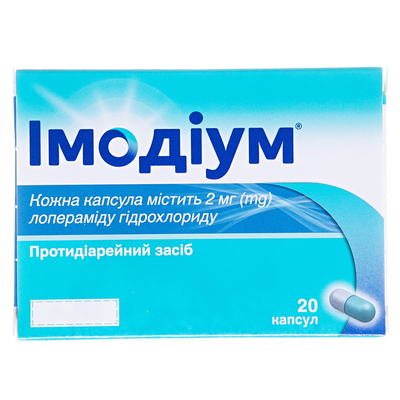


Imodium 2 mg capsules, No. 20 in a blister pack.
Ingredients
Active ingredient: loperamide;
1 capsule contains 2 mg of loperamide hydrochloride;
excipients: lactose monohydrate, corn starch, talc, magnesium stearate; capsule shell: yellow iron oxide (E 172), black iron oxide (E 172), titanium dioxide (E 171), indigo carmine (E 132), erythrosine (E 127), gelatin.
Dosage Form
Capsules.
Main physical and chemical properties: Size 4 capsules with a green cap and a dark gray body, containing a white powder.
Pharmacotherapeutic group
Antispasmodics.
ATC code A07D A03.
Pharmacological properties
Pharmacodynamics.
Loperamide hydrochloride binds to opioid receptors in the intestinal wall. As a result, the release of acetylcholine and prostaglandins is inhibited, thereby reducing propulsive peristalsis and increasing the transit time of contents through the gastrointestinal tract, as well as the intestinal wall’s ability to absorb fluid. Loperamide hydrochloride increases the tone of the anal sphincter, thereby reducing fecal incontinence and the urge to defecate.
Pharmacokinetics.
Absorption: Most of the loperamide taken orally is absorbed from the intestine, but due to extensive first-pass metabolism, systemic bioavailability is only approximately 0.3%.
Distribution: Results of studies on the distribution of loperamide in rats show a high affinity for the intestinal wall, with predominant binding to receptors in the longitudinal layer of the muscularis mucosae. Loperamide is 95% protein-bound, primarily to albumin. Preclinical data have shown that loperamide is a substrate for P-glycoprotein.
Metabolism: Loperamide is almost completely taken up by the liver, where it is predominantly metabolized, conjugated, and excreted in the bile. Oxidative N-demethylation is the primary metabolic pathway for loperamide; this process is mediated primarily by the CYP3A4 and CYP2C8 isoforms. As a result of this very intense first-pass effect in the liver, plasma concentrations of the unchanged drug remain very low.
Elimination: The half-life of loperamide in humans is approximately 11 hours, with a range of 9–14 hours. Excretion of unchanged loperamide and its metabolites occurs primarily in the feces.
Pediatric population: No pharmacokinetic studies have been conducted in the pediatric population. The pharmacokinetic behavior of loperamide and drug interactions with loperamide are expected to be similar to those observed in adults.
Indications
Symptomatic treatment of acute diarrhea in adults and children 12 years of age and older.
Symptomatic treatment of acute episodes of diarrhea caused by irritable bowel syndrome in adults 18 years of age and older following an initial diagnosis by a physician.
Contraindications
Imodium® is contraindicated:
- patients with known hypersensitivity to loperamide hydrochloride or to any of the drug’s components;
- children under 12 years of age;
- patients with acute dysentery characterized by the presence of blood in the stool and a fever;
- patients with acute ulcerative colitis or pseudomembranous colitis associated with the use of broad-spectrum antibiotics;
- patients with bacterial enterocolitis caused by microorganisms of the Salmonella, Shigella, and Campylobacter families.
Imodium® should not be used at all if suppression of peristalsis must be avoided due to the potential risk of serious complications, including intestinal obstruction, megacolon, and toxic megacolon.
Treatment should be discontinued immediately if constipation, abdominal distension, or intestinal obstruction develops.
Drug Interactions and Other Interactions
Cases of interactions with medications having similar pharmacological properties have been reported. Medications that have a depressant effect on the central nervous system should not be administered concurrently with Imodium® to children.
Preclinical data have shown that loperamide is a substrate of P-glycoprotein. Concomitant administration of loperamide (at a dose of 16 mg) with P-glycoprotein inhibitors (quinidine, ritonavir) resulted in a 2- to 3-fold increase in plasma loperamide levels. The clinical significance of this pharmacokinetic interaction when loperamide is used at the recommended doses is unknown.
Concomitant administration of loperamide (4 mg as a single dose) and itraconazole, an inhibitor of CYP3A4 and P-glycoprotein, resulted in a 3- to 4-fold increase in loperamide plasma concentrations. In the same study, the CYP2C8 inhibitor gemfibrozil increased loperamide levels by approximately 2-fold. The combined use of itraconazole and gemfibrozil resulted in a 4-fold increase in the maximum plasma concentration of loperamide and a 13-fold increase in total plasma exposure. This increase was not associated with any effects on the central nervous system (CNS), as assessed by psychomotor tests (i.e., subjective drowsiness and the digit-substitution test).
Concomitant administration of loperamide (16 mg as a single dose) and ketoconazole, an inhibitor of CYP3A4 and P-glycoprotein, resulted in a 5-fold increase in loperamide plasma concentrations. This increase was not associated with an increase in pharmacodynamic effects, as determined by pupillometry.
Concomitant treatment with oral desmopressin resulted in a 3-fold increase in desmopressin plasma concentrations, likely due to slower gastrointestinal motility.
It is expected that medications with similar pharmacological properties may enhance the effect of loperamide, while medications that accelerate the passage of food through the gastrointestinal tract may reduce its effect.
Special Considerations for Use
Treatment of diarrhea is symptomatic. If the cause of the condition can be determined (or if it is indicated that this should be done), specific treatment should be administered whenever possible.
Patients with diarrhea, especially children, debilitated patients, and the elderly, may experience dehydration and electrolyte imbalance. In such cases, the most important measure is to administer replacement therapy to replenish fluids and electrolytes.
Use of this medication does not replace the administration of an adequate amount of fluids and the restoration of electrolyte balance.
Since persistent diarrhea may indicate potentially more serious conditions, this medication should not be used for an extended period until the cause of the diarrhea has been investigated.
In cases of acute diarrhea, if no clinical improvement is observed within 48 hours, treatment with loperamide hydrochloride should be discontinued and a doctor consulted.
Loperamide must not be used in situations where inhibition of peristalsis should be avoided due to the potential risk of serious complications, such as megacolon and toxic megacolon.
Patients with acquired immunodeficiency syndrome (AIDS) who are taking Imodium® for diarrhea must immediately discontinue treatment at the first signs of abdominal distension. There have been isolated reports of intestinal obstruction with an increased risk of toxic megacolon in patients with AIDS who have infectious colitis of both viral and bacterial origin during treatment with loperamide hydrochloride.
Abuse of loperamide or its misuse as an opioid substitute has been reported in individuals with opioid dependence.
Although pharmacokinetic data for patients with hepatic impairment are lacking, Imodium® should be used with caution in such patients due to slowed first-pass metabolism. This medication should be prescribed with caution to patients with impaired liver function, as it may lead to a relative overdose, which could result in toxic central nervous system damage.
Medications that prolong transit time may lead to the development of toxic megacolon in patients in this group.
Since loperamide is well metabolized and loperamide or its metabolites are excreted in the feces, it is generally not necessary to adjust the dose of loperamide in patients with renal impairment.
Since the drug contains lactose, it should not be used in patients with rare hereditary forms of galactose intolerance, Lapp lactase deficiency, or glucose-galactose malabsorption syndrome.
Loperamide is not associated with significant cardiac complications within the therapeutic concentration range. However, when these concentrations are substantially exceeded (up to 47 times), loperamide has been shown to cause cardiac complications: inhibition of potassium (hERG) and sodium currents and arrhythmias in in vivo and in vitro animal models.
Cardiac complications, including QT prolongation and torsades de pointes, have been reported in association with overdose (see the “Overdose” section). Patients should not exceed the recommended dose and/or the recommended duration of treatment.
If the drug is taken to control episodes of diarrhea caused by irritable bowel syndrome that has been previously diagnosed by a physician, and no clinical improvement is observed within 48 hours, stop taking loperamide hydrochloride and consult a doctor. You should also consult a doctor if the nature of your symptoms has changed or if recurrent bouts of diarrhea last longer than two weeks.
For the treatment of acute episodes of diarrhea caused by irritable bowel syndrome, Imodium® should be taken only if a doctor has previously diagnosed this condition.
In the cases listed below, do not use this medication without first consulting a doctor, even if you know you have irritable bowel syndrome (IBS):
- the patient is 40 years of age or older and some time has passed since the last IBS episode;
- the patient is 40 years of age or older and the IBS symptoms are different this time;
- recent intestinal bleeding;
- severe constipation;
- nausea or vomiting;
- loss of appetite or weight loss;
- difficulty or pain when urinating;
- fever;
- recent travel abroad.
If new symptoms develop, existing symptoms worsen, or if symptoms have not improved within two weeks, consult a doctor.
Use During Pregnancy or Breastfeeding
Use during pregnancy
Although there are no data on the teratogenic or embryotoxic properties of loperamide hydrochloride, the expected therapeutic benefit should be weighed against the potential risks before starting treatment with loperamide hydrochloride, especially during the first trimester of pregnancy.
Use During Breastfeeding
Since small amounts of loperamide may appear in breast milk, loperamide hydrochloride is not recommended for use during breastfeeding.
This medication is not recommended during pregnancy. Therefore, pregnant women and breastfeeding women should be advised to consult their doctor for appropriate treatment.
Effect on reaction time when driving or operating machinery
Increased fatigue, dizziness, or drowsiness may occur with diarrhea syndrome during treatment with loperamide hydrochloride. Therefore, caution is advised when taking this medication while driving or operating machinery.
Dosage and Administration
Imodium® is not intended for the initial treatment of severe diarrhea accompanied by fluid and electrolyte depletion. In children, in particular, it is advisable to compensate for this loss through parenteral or oral replacement therapy.
The capsules should be taken with liquid.
Symptomatic treatment of acute diarrhea in adults and children 12 years of age and older
The initial dose is 2 capsules (4 mg), followed by 1 capsule (2 mg) after each subsequent loose stool. The usual dose is 3–4 capsules (6–8 mg) per day. The maximum daily dose for acute diarrhea should not exceed 6 capsules (12 mg).
In cases of acute diarrhea, if no clinical improvement is observed within 48 hours, Imodium® should be discontinued.
Symptomatic treatment of acute episodes of diarrhea caused by irritable bowel syndrome in adults 18 years of age and older following an initial diagnosis by a physician
The initial dose is 2 capsules (4 mg); thereafter, take 1 capsule (2 mg) after each subsequent loose stool or as previously recommended by a doctor. The maximum daily dose should not exceed 6 capsules (12 mg).
Use in elderly patients.
No dose adjustment is required for elderly patients.
Use in patients with renal impairment.
No dose adjustment is required for patients with renal impairment.
Use in patients with hepatic impairment.
Although there are no pharmacokinetic data on the drug’s effects in patients with hepatic impairment, Imodium® should be prescribed with caution to such patients due to their slowed first-pass metabolism (see the “Special Considerations” section).
Children
This medication is indicated for children 12 years of age and older for the symptomatic treatment of acute diarrhea.
Overdose
Symptoms
In case of overdose (including relative overdose due to impaired liver function), central nervous system (CNS) depression (stupor, impaired coordination, drowsiness, miosis, muscle hypertonicity, and respiratory depression), constipation, urinary retention, and intestinal obstruction. Children and patients with impaired liver function may be more sensitive to the effects on the central nervous system.
In individuals who have exceeded the recommended dose of loperamide, QT interval prolongation and/or serious ventricular arrhythmias, including torsades de pointes (a “pirouette”-like rhythm), which are associated with the abuse or misuse of loperamide.
In individuals who intentionally took higher doses of loperamide (doses ranging from 40 to 792 mg per day have been reported), cardiac arrest and syncope have been observed. Fatalities have also been reported. (See the “Special Safety Precautions” section.)
Abuse, misuse, and/or intentional overdose with excessively high doses of loperamide may lead to Brugada syndrome.
Treatment
In case of overdose, the patient should seek medical attention immediately. If symptoms of overdose appear, naloxone may be used as an antidote. Since the duration of action of loperamide hydrochloride is longer than that of naloxone (1–3 hours), repeated administration of naloxone may be necessary. To detect possible central nervous system depression, the patient should remain under close observation for at least 48 hours.
Side Effects
Adults and children 12 years of age and older
Side effects in patients with acute diarrhea
The safety of loperamide hydrochloride was evaluated in 2,755 patients aged 12 years and older who participated in 26 controlled and uncontrolled clinical trials evaluating the use of loperamide hydrochloride for the treatment of acute diarrhea. Adverse effects occurring at a frequency of 1% or higher that were reported in these clinical trials:
Nervous system: headache.
Gastrointestinal system: constipation, bloating, nausea.
Adverse effects occurring at a frequency of less than 1% in the above-mentioned clinical trials:
Nervous system: dizziness.
Gastrointestinal disorders: dry mouth, flatulence, abdominal pain and discomfort, vomiting, upper abdominal pain.
Skin and subcutaneous tissue disorders: rash.
Postmarketing experience.
The following adverse reactions have been reported in spontaneous reports (listed by frequency of occurrence):
| Very common (≥ 1/10); |
| Common (≥ 1/100, < 1/10); |
| Uncommon (≥ 1/1,000, < 1/100); |
| Rare (≥ 1/10,000, < 1/1,000); |
| Very rare (< 1/10,000), including isolated reports. |
Immune system disorders: very rare—hypersensitivity reactions, anaphylactic reactions (including anaphylactic shock), and anaphylactoid reactions.
Nervous system disorders: very rare—impaired coordination, loss of consciousness, impaired consciousness, hypertension, drowsiness, stupor.
Eye disorders: very rare—miosis.
Gastrointestinal system: very rare—intestinal obstruction (including paralytic ileus), megacolon (including toxic megacolon).
Skin and appendages: very rare – angioedema, bullous eruptions, including Stevens-Johnson syndrome, erythema multiforme, and toxic epidermal necrolysis, urticaria, and pruritus.
Renal and urinary system: very rare—urinary retention.
General disorders: very rare—increased fatigue.
Shelf life
5 years.
Storage conditions
Store at a temperature not exceeding 25 °C, out of reach of children.
Packaging
6 or 20 capsules per blister pack; 1 blister pack per cardboard box.
Dispensing Category
Available without a prescription.







