
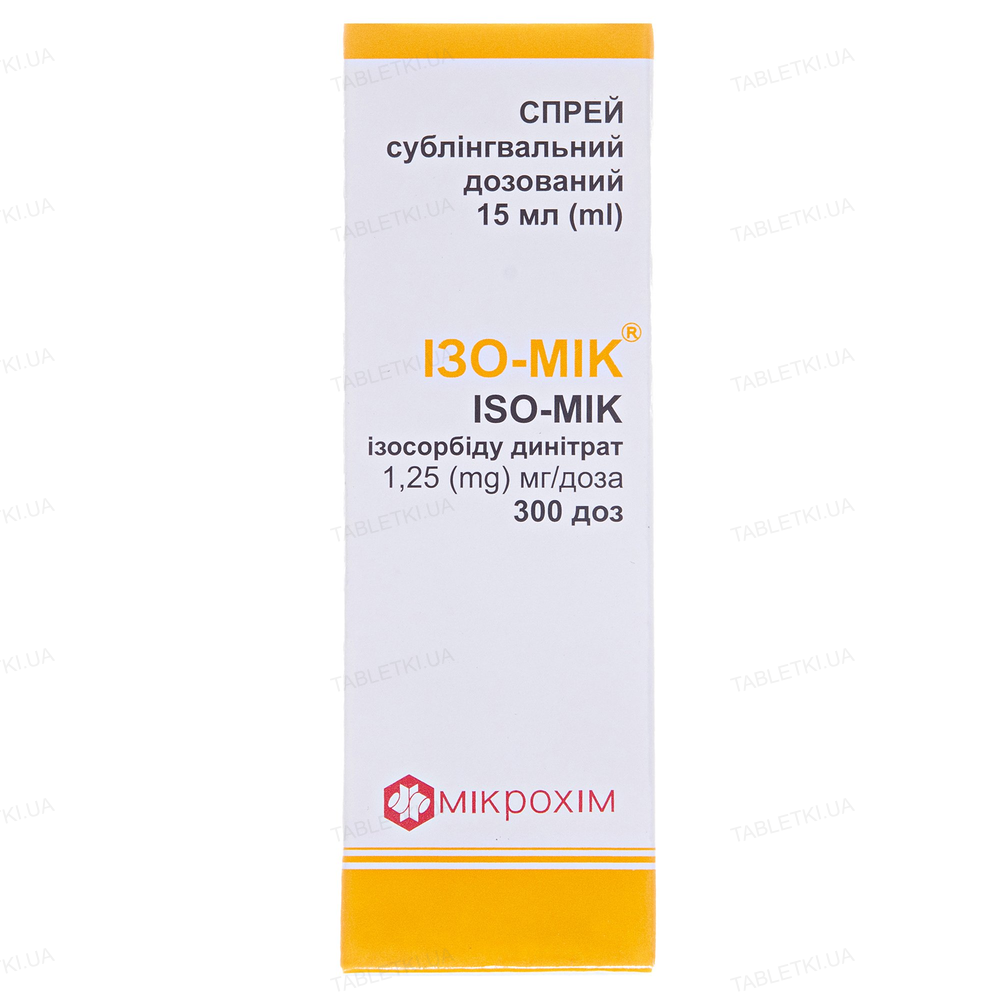
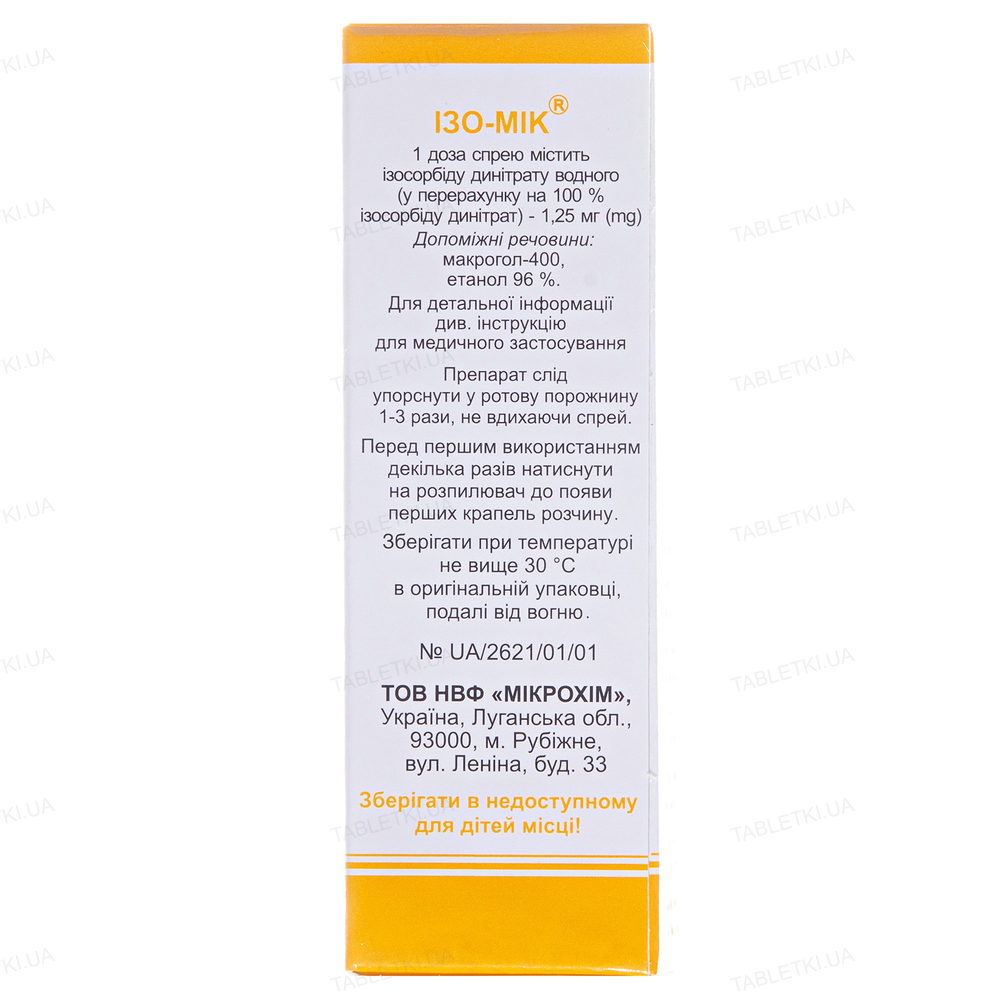
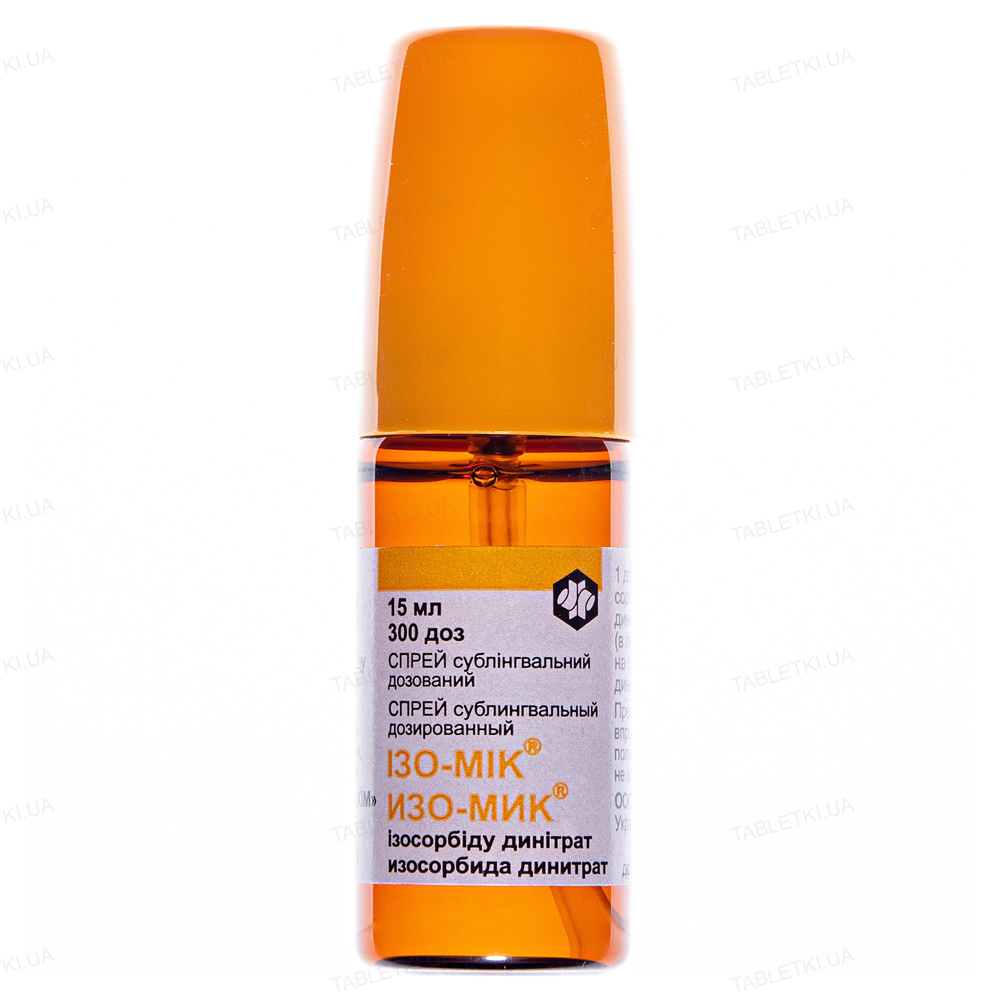
Izo-Myk sublingual spray, 1.25 mg/dose, 15 mL (300 doses) per bottle.
Ingredients
Active ingredient: isosorbide dinitrate;
1 spray dose contains 1.25 mg of isosorbide dinitrate solution (equivalent to 100% isosorbide dinitrate);
excipients: polyethylene glycol 400; 96% ethanol.
Dosage Form
Sublingual metered-dose spray.
Main physical and chemical properties: a clear, colorless liquid with an alcoholic odor.
Pharmacotherapeutic group
Vasodilators used in cardiology. Organic nitrates. ATC code C01D A08.
Pharmacological properties
Pharmacodynamics.
Isosorbide dinitrate relaxes the smooth muscles of blood vessels, causing vasodilation. This relaxes both peripheral arteries and veins. This effect promotes venous “pooling” of blood and reduces venous return to the heart; thus, ventricular end-diastolic pressure and volume (preload) are reduced. Its effect on arteries—and, at higher doses, on arterioles—leads to a decrease in systemic vascular resistance (afterload). This, in turn, reduces the workload on the heart.
The effects on both preload and afterload lead to a further reduction in the heart’s oxygen consumption.
Isosorbide dinitrate also causes a redistribution of blood flow to the subendocardial regions of the heart when coronary circulation is partially impaired by atherosclerotic lesions. This effect is likely due to the selective dilation of large coronary vessels. The dilation of collateral arteries caused by nitrates may improve perfusion of the post-stenotic myocardium. In addition, nitrates prevent and relieve coronary spasms.
In patients with congestive heart failure, nitrates improve hemodynamics at rest and during exercise. This beneficial effect results from a number of pathophysiological mechanisms, including improved valve regurgitation (due to reduced ventricular volume) and a decrease in myocardial oxygen demand.
By reducing oxygen demand and increasing oxygen supply, nitrates limit myocardial damage during a heart attack. Thus, the use of isosorbide dinitrate may be beneficial for patients who have suffered a myocardial infarction.
Effects on other organ systems include relaxation of the bronchial muscles, as well as the muscles of the gastrointestinal tract, biliary tract, and urinary tract. There are also reports of relaxation of the smooth muscles of the uterus.
Mechanism of Action.
Like all organic nitrates, isosorbide dinitrate acts as a donor of nitric oxide (NO). Nitric oxide causes relaxation of vascular smooth muscle by stimulating guanylate cyclase and subsequently increasing the concentration of cyclic intracellular guanosine monophosphate (cGMP). This stimulates cGMP-dependent protein kinase, which in turn alters protein phosphorylation in smooth muscle cells. This, in turn, causes the dephosphorylation of myosin light chains and a decrease in contractility.
Pharmacokinetics.
After spraying into the oral cavity, the active ingredient—isosorbide dinitrate—is absorbed very rapidly. The drug begins to take effect within 1–3 minutes after administration, and peak plasma concentration is reached within 3–6 minutes. The half-life is 30–60 minutes. Within 90–120 minutes, the concentration in plasma returns to baseline levels. Isosorbide dinitrate is metabolized to form isosorbide-2-mononitrate and isosorbide-5-mononitrate, with half-lives of 1.5–2 hours and 4–6 hours, respectively. Both metabolites are pharmacologically active.
When administered orally, isosorbide dinitrate bypasses rapid metabolism in the liver, resulting in significantly higher bioavailability—60–100% (compared to 15–30% with oral administration).
Indications
Prescribed to adults:
- for the treatment of angina attacks, except in cases caused by hypertrophic obstructive cardiomyopathy;
- for the prevention of angina attacks;
- in acute myocardial infarction;
- in acute left ventricular heart failure.
Contraindications
This medication is contraindicated in cases of:
- hypersensitivity to isosorbide dinitrate, other nitrate compounds, or other components of the drug;
- acute circulatory failure (shock, circulatory collapse);
- cardiogenic shock, if left ventricular end-diastolic pressure cannot be corrected by appropriate measures;
- hypertrophic obstructive cardiomyopathy;
- constrictive pericarditis;
- cardiac tamponade;
- severe arterial hypotension (systolic blood pressure below 90 mm Hg);
- severe hypovolemia (isosorbide dinitrate may reduce venous return and cause loss of consciousness);
- severe anemia;
- head injuries;
- bleeding;
- aortic and/or mitral stenosis;
- angle-closure glaucoma;
- hemorrhagic stroke;
- hypothermia;
- severe liver and kidney disorders.
This medication should not be used during therapy with phosphodiesterase-5 inhibitors (e.g., sildenafil, vardenafil, tadalafil) (see the sections “Special Considerations for Use” and “Interactions with Other Medications and Other Types of Interactions”).
The soluble guanylate cyclase stimulator riociguat should not be used during therapy with nitrates (see the section “Interactions with Other Medications and Other Types of Interactions”).
Interactions with Other Medications and Other Types of Interactions
When used concomitantly with other vasodilators, such as β-blockers, calcium channel blockers, vasodilators, neuroleptics, or tricyclic antidepressants, or ethanol, the drug’s hypotensive effect may be potentiated. Angiotensin-converting enzyme (ACE) inhibitors, monoamine oxidase (MAO) inhibitors, phenothiazines, other nitrates/nitrites, quinidine, procainamide, and narcotic analgesics potentiate the hypotensive effect of isosorbide dinitrate; orthostatic collapse may occur.
Interaction may be desirable when isosorbide dinitrate is used concomitantly with ACE inhibitors or arterial vasodilators, provided that the antihypertensive effect is not excessive and a dose reduction of one or both drugs is warranted.
The hypotensive effect of the drug is potentiated when used concomitantly with phosphodiesterase inhibitors (e.g., sildenafil, vardenafil, tadalafil) (see the sections “Special Considerations for Use” and “Interactions with Other Medications and Other Types of Interactions”). This may lead to life-threatening cardiovascular complications. Patients receiving isosorbide dinitrate therapy should not use phosphodiesterase inhibitors (e.g., sildenafil, vardenafil, tadalafil).
Patients receiving therapy with phosphodiesterase inhibitors (e.g., sildenafil, vardenafil, tadalafil) must not use isosorbide dinitrate to treat acute conditions within 24 hours after discontinuing sildenafil or vardenafil, and within 48 hours after discontinuing tadalafil.
There are reports indicating an increase in blood concentrations of dihydroergotamine when it is used in combination with isosorbide dinitrate, which may potentiate the hypertensive effect of dihydroergotamine.
The use of isosorbide dinitrate with the guanylate cyclase stimulator riociguat is contraindicated (see the “Contraindications” section), as concomitant use may cause arterial hypotension.
Sapropterin (tetrahydrobiopterin, BH4) is a cofactor for nitric oxide synthase. Use caution when administering sapropterin-containing preparations with any medications that exert a vasodilatory effect through nitric oxide metabolism or contain nitric oxide donors (including nitroglycerin, isosorbide dinitrate, isosorbide mononitrate, and others).
Norepinephrine, acetylcholine, and histamine—their effects may be attenuated when used with nitrates, as isosorbide dinitrate may act as their physiological antagonist.
When used concomitantly with sympathomimetic agents (epinephrine, ephedrine, norepinephrine, naphazoline, mezaton, isadrine), the antianginal effect of isosorbide dinitrate may be reduced.
Special Considerations for Use
The drug should be used with extreme caution and under constant medical supervision:
- in hypothyroidism;
- in cases of increased intracranial pressure (including brain trauma and hemorrhagic shock)—since dilation of cerebral blood vessels may cause a further increase in intracranial pressure. Although a further increase in pressure has been observed only with intravenous administration of high doses of nitroglycerin;
- in cases of reduced filling pressure, such as in acute myocardial infarction or impaired left ventricular function (left ventricular failure). A decrease in systolic blood pressure below 90 mm Hg should be avoided;
- in cases of orthostatic dysfunction;
- in cases of hypoxemia and ventilation-perfusion imbalance associated with lung disease or ischemic heart disease;
- in cases of malnutrition;
- in elderly patients—due to age-related changes in liver, kidney, and heart function, comorbidities, and the use of other medications.
Tolerance to other nitrate-containing medications may develop with the use of isosorbide dinitrate. To prevent this, high doses of the medication should be avoided.
Patients should be advised that the antianginal effect of isosorbide dinitrate is closely related to its dosing regimen; therefore, the recommended dosing schedule should be strictly followed. To prevent arterial hypotension and “nitrate” headaches, treatment should begin with the minimum dose. Treatment with this medication may cause orthostatic reactions, which occur more frequently with concomitant use of alcohol or other vasodilators.
Precautions should be taken in patients with hypoxemia and ventilation/perfusion imbalance due to lung disease or ischemic heart failure.
As a potent vasodilator, isosorbide dinitrate may lead to increased perfusion of poorly ventilated areas, worsening ventilation/perfusion imbalance, and a subsequent decrease in arterial partial pressure of oxygen.
Alcohol consumption should be avoided during treatment with isosorbide dinitrate, as it may enhance the drug’s hypotensive effect.
In patients with glucose-6-phosphate dehydrogenase deficiency, acute hemolysis (favism) may develop with the use of isosorbide dinitrate. Isosorbide dinitrate may affect the results of colorimetric cholesterol testing.
This medication should not be used as emergency treatment in patients who have recently taken phosphodiesterase inhibitors (e.g., sildenafil, vardenafil, tadalafil). When using this medication as emergency treatment, patients should be aware that phosphodiesterase inhibitors (e.g., sildenafil, vardenafil, tadalafil) must not be used concurrently (see the sections “Contraindications” and “Drug Interactions and Other Interactions”)).
Patients receiving maintenance therapy with this drug should be informed that they must not use medications containing phosphodiesterase inhibitors (e.g., sildenafil, vardenafil, tadalafil) due to the risk of angina attacks.
The drug contains a small amount of ethanol (alcohol), less than 100 mg/dose of 85% alcohol by volume.
Discontinuation of the medication should be done by gradually reducing the dose. Avoid contact with the eyes. If the medication comes into contact with a large area of skin, rinse it off immediately. Absorption of the medication through the skin may lead to severe adverse reactions (see the “Adverse Reactions” section).
Use during pregnancy or breastfeeding.
Pregnancy.
This medication is contraindicated during the first trimester of pregnancy. During the second and third trimesters of pregnancy, this medication should be used only if the expected benefit to the mother outweighs the potential risk to the fetus.
Reproductive studies in animals have not shown any harmful effects of isosorbide dinitrate on the fetus. However, there are no adequate and well-controlled studies in pregnant women.
Breastfeeding.
Based on available data, it is not possible to determine the risk to infants during breastfeeding. There is evidence that nitrates pass into breast milk and may cause methemoglobinemia in infants. The amount of isosorbide dinitrate and its metabolites that passes into human breast milk has not been determined; therefore, breastfeeding should be discontinued if use of the drug is necessary.
Fertility.
There are no data on the effect of isosorbide dinitrate on fertility in humans.
Effect on reaction time when driving or operating machinery.
This medication may impair reaction time or cause dizziness; therefore, patients should refrain from driving or operating machinery during treatment. This effect is exacerbated by alcohol consumption.
Dosage and Administration
This medication is intended for adults only. For oral spray administration. The dose should be adjusted according to the patient’s individual characteristics.
To relieve an angina attack or before physical or emotional stress that may trigger an attack, spray the medication into the mouth 1–3 times, with a 30-second interval between sprays.
A single dose (up to 3 sprays) to relieve a angina attack may be increased only as directed by a doctor.
In cases of acute myocardial infarction or acute heart failure, start with 1–3 sprays. If no effect is observed within 5 minutes, one additional spray may be administered. If no improvement is observed within the next 10 minutes, the spray may be re-administered while carefully monitoring blood pressure.
No dose adjustment is required for elderly patients.
Tolerance (decreased efficacy) has been reported, as well as cross-tolerance with other nitrate-based medications (reduced effect following prior therapy with another nitrate). To prevent a reduction or loss of effect, frequent administration of high doses should be avoided.
Directions for Use.
Before using the medication for the first time, press the spray nozzle several times, directing the spray into the air until a uniform mist forms. The medication is now ready for use.
If more than 24 hours have passed since the last use of the medication, the first spray should be directed into the air to prevent administration of an incomplete dose.
When using the product, hold the bottle upright with the spray nozzle facing upward.
Bring the bottle close to your mouth and, pressing the spray nozzle, spray the solution into your mouth as follows:
- take a deep breath;
- hold your breath;
- while pressing the spray nozzle, spray the solution into your mouth (this may cause a slight burning sensation on your tongue);
- close your mouth and breathe only through your nose for the next 30 seconds.
Do not inhale the solution. To ensure proper operation, press the spray nozzle all the way down and then release it. Check the spray nozzle periodically, especially after prolonged periods of non-use.
Children.
Do not use.
Overdose
Symptoms:
- Decrease in blood pressure to a systolic blood pressure < 90 mm Hg, orthostatic hypotension.
- Paleness.
- Excessive sweating.
- Weak pulse.
- Tachycardia.
- Dizziness.
- Headache.
- Weakness.
- Nausea.
- Vomiting.
- Diarrhea.
- Methemoglobinemia. Cases of methemoglobinemia have been reported in patients taking other nitrates. During the biotransformation of isosorbide dinitrate, nitrite ions are released, which may induce methemoglobinemia and cyanosis, followed by tachypnea, anxiety, loss of consciousness, and cardiac arrest. The possibility of this adverse reaction cannot be ruled out in the event of an isosorbide dinitrate overdose.
- Excessive doses may cause an increase in intracranial pressure, which sometimes leads to cerebral symptoms.
Treatment:
- Discontinue use of the drug.
General measures in case of nitrate-induced hypotension:
- Place the patient in a horizontal position with the head lowered and the legs elevated above the level of the head;
- ensure oxygen supply;
- increase circulating plasma volume;
- Administer specific anti-shock therapy (the patient must be in the intensive care unit).
Special measures:
- raise blood pressure if it is too low;
- additional use of vasoconstrictors if there is no adequate response to fluid therapy.
Treatment of methemoglobinemia:
- recovery therapy with vitamin C, methylene blue, or toluidine blue;
- oxygen therapy (if necessary);
- mechanical ventilation;
- hemodialysis (if necessary);
- if signs of respiratory or circulatory arrest appear, immediately perform resuscitation measures.
Side Effects
The frequency of adverse effects is defined as: very common (more than 10%), common (1% to 10%), uncommon (0.1% to 1%), occasional (0.01% to 0.1%), rare (less than 0.01%), and frequency unknown (frequency cannot be estimated based on available data).
The following adverse events may occur during treatment with this medication.
Nervous system disorders: very common—headache (so-called “nitrate” headache, which occurs at the start of treatment, usually gradually decreases or resolves with continued use of the drug, but may be severe and persistent); common – dizziness, drowsiness; frequency unknown – pituitary hemorrhage in patients with an undiagnosed pituitary tumor.
Cardiac: common – tachycardia; rare – worsening of angina symptoms; frequency unknown – peripheral edema (usually in patients with left ventricular failure).
Vascular system: common – orthostatic hypotension; uncommon – vascular collapse (sometimes accompanied by bradyarrhythmia, cardiac arrhythmia, and loss of consciousness); frequency unknown – hypotension.
Gastrointestinal system: uncommon—nausea; vomiting; rare—heartburn.
Skin and subcutaneous tissue disorders: uncommon—allergic skin reactions (e.g., rash), transient facial flushing, hot flashes; rare – angioedema, Stevens-Johnson syndrome; frequency unknown – exfoliative dermatitis, pruritus.
General disorders: common – asthenia (feeling of weakness), redness of the tongue at the injection site
Hematologic side effects may occur, including methemoglobinemia; there is a reported case of isosorbide dinitrate-induced hemolytic anemia in a patient with concomitant glucose-6-phosphate dehydrogenase deficiency.
Cases of tolerance to isosorbide dinitrate, as well as cross-tolerance to other nitrates, have been reported. Prolonged use of high doses and/or shortening the interval between doses may lead to a reduction or even loss of the drug’s therapeutic effect.
Severe hypotensive reactions have been reported with the use of organic nitrates, accompanied by nausea, vomiting, restlessness, pallor, and increased sweating.
Use of the drug may cause temporary hypoxemia due to a relative redistribution of blood flow to alveolar zones with hypoventilation. In patients with ischemic heart disease, this may lead to temporary myocardial hypoxia.
Shelf life
5 years.
Storage conditions
Store at a temperature not exceeding 30 °C in the original packaging, away from fire.
Keep out of reach of children.
Packaging
15 mL (300 doses) in spray bottles in a cardboard box.
Manufacturer
LLC NVP “MIKROCHIM” (production site (all stages of the manufacturing process))
To report an adverse event associated with the use of this medication, please call +38 (050) 309-83-54 (24 hours a day).







