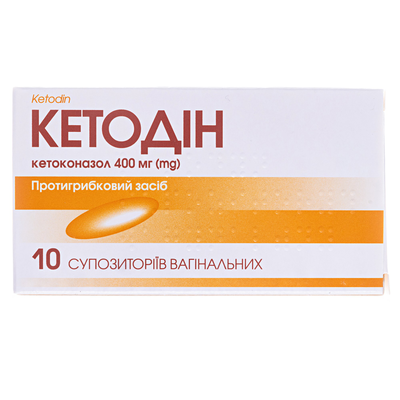
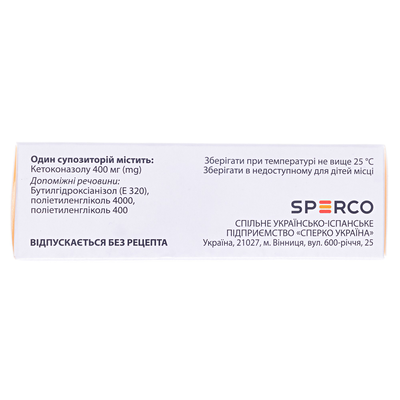
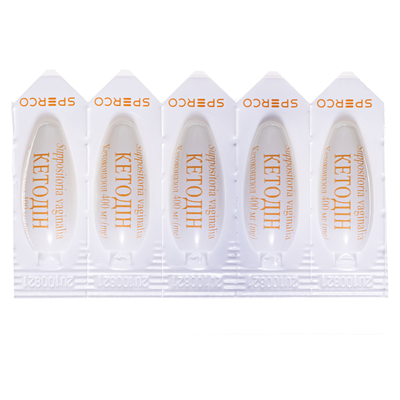
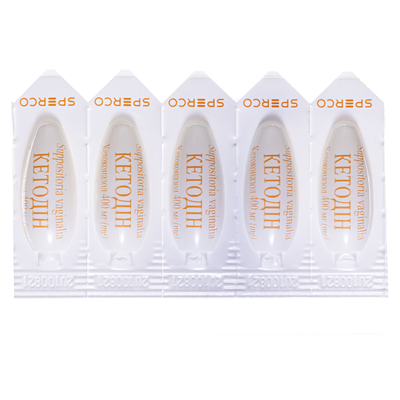
Ketodin vaginal suppositories, 400 mg each, No. 10 (5 x 2)
Ingredients
Active ingredient: ketoconazole;
1 suppository contains 400 mg of ketoconazole;
excipients: polyethylene glycol 400, polyethylene glycol 4000, butylhydroxyanisole (E 320)
Dosage Form
Vaginal suppositories.
Main physical and chemical properties: white to almost white suppositories, torpedo-shaped.
Pharmacotherapeutic group
Antimicrobial and antiseptic agents used in gynecology. Imidazole derivatives.
ATC code G01A F11.
Pharmacological properties
Pharmacodynamics.
Ketoconazole is a synthetic imidazolodioxolane derivative. It exerts a pronounced fungicidal and fungistatic effect on dermatophytes (Trichophyton spp., Epidermophyton floccosum, Microsporum spp.), yeast fungi (Candida spp., Pityrosporum spp., Torulopsis spp., Cryptococcus spp., Rhodotorula spp.), dimorphic fungi, and higher fungi (zomycetes). Aspergillus spp., Sporothrix schenckii, certain Dermatiaceae, Mucor spp., and other fucomycetes, with the exception of Entomophthales, are less sensitive to ketoconazole. Ketoconazole is also active against Gram-positive cocci (Staphylococcus spp., Streptococcus spp.). Its mechanism of action involves inhibiting ergosterol biosynthesis and altering the lipid composition of the fungal membrane, leading to lysis. Ketodin is also active against pathogens resistant to antifungal antibiotics (nystatin, levorin) as well as to clotrimazole. The development of secondary resistance during treatment with ketoconazole has not been observed to date.
Pharmacokinetics.
With intravaginal administration, only a negligible (<1%) amount of ketoconazole enters the systemic circulation. The maximum plasma concentration in women following intravaginal administration of 400 mg of ketoconazole ranges from 0 to 10.7 ng/mL, which is considered a trace amount and has no systemic effect.
Indications
Acute and chronic recurrent vulvovaginal candidiasis; prevention of vaginal fungal infections in cases of reduced immune resistance and during treatment with medications that disrupt the normal vaginal microflora.
Contraindications
Hypersensitivity to ketoconazole or other components of the drug.
Interactions with Other Medications and Other Types of Interactions
Concomitant use of ketoconazole with rifampicin and isoniazid reduces the plasma concentration of ketoconazole. When used concomitantly with cyclosporine, indirect anticoagulants, and methylprednisolone, ketoconazole may increase the plasma concentrations of these agents. The clinical significance of these interactions during treatment with ketoconazole vaginal suppositories is unknown.
Special Considerations for Use
In rare cases, local allergic reactions may occur in the sexual partner. To reduce the risk of disease recurrence, concurrent treatment of the sexual partner is recommended. Contact with latex products (contraceptive diaphragms, condoms) should be avoided due to reduced reliability of mechanical contraception; therefore, the possibility of pregnancy or infection with sexually transmitted diseases cannot be ruled out. Sexual activity should be avoided during treatment.
Ketodin is recommended for use at night, as the medication has an osmotic and draining effect, which is accompanied by an increase in vaginal discharge. It is recommended to use sanitary pads at night during treatment with Ketodin.
If hypersensitivity reactions develop, the medication should be discontinued.
Use During Pregnancy or Breastfeeding
Although systemic absorption following intravaginal administration of ketoconazole is extremely low or absent, there are no adequate controlled clinical studies on the safety of Ketodin in pregnant women. Ketodin should not be used during the first trimester of pregnancy. During the second and third trimesters and while breastfeeding, the drug should be used only if the expected benefit to the mother outweighs the potential risk to the fetus or infant.
Effect on reaction time when driving or operating machinery
No effect.
Dosage and Administration
Remove the suppository from the strip and insert it deeply into the vagina while lying on your back with your knees bent and your legs drawn up to your chest, or while squatting. Suppositories should not be cut into pieces, as such a change in storage conditions may lead to an uneven distribution of the active ingredient. Administer 1 suppository daily before bedtime for 3–5 days. If necessary, repeat the course of treatment until clinical and laboratory recovery is achieved. For chronic candidiasis, use 1 suppository daily for 10 days.
Children
There is no experience with the use of ketoconazole in the form of vaginal suppositories in children.
Overdose
In case of local overdose, hyperemia, burning, itching, and irritation of the vaginal mucosa may occur. In such cases, douching with water is recommended.
Side Effects
Side effects are rare and resolve quickly after discontinuation of the medication.
Skin and mucous membranes: itching, rash, burning sensation, redness, irritation of the vaginal mucosa, skin rashes, hives, and possible reactions at the site of application.
Gastrointestinal system: rarely—nausea, abdominal pain.
Nervous system: rarely—dizziness.
Hypersensitivity reactions: rarely—hives, anaphylactic and anaphylactoid reactions, angioedema.
Shelf life
2 years.
Do not use this medication after the expiration date printed on the package.
Storage conditions
Store at a temperature not exceeding 25 °C. Keep out of the reach of children.
Packaging
5 suppositories per strip. One or two strips per cardboard package.
Dispensing Category
Available without a prescription.
Manufacturer
Sperco Ukraine, a Ukrainian-Spanish joint venture.