
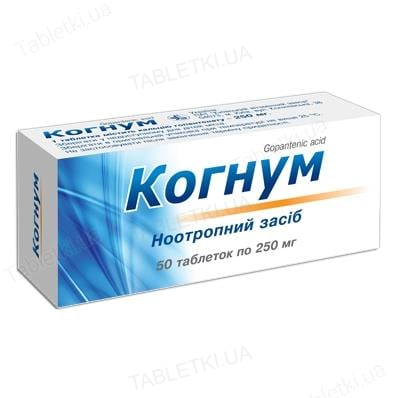
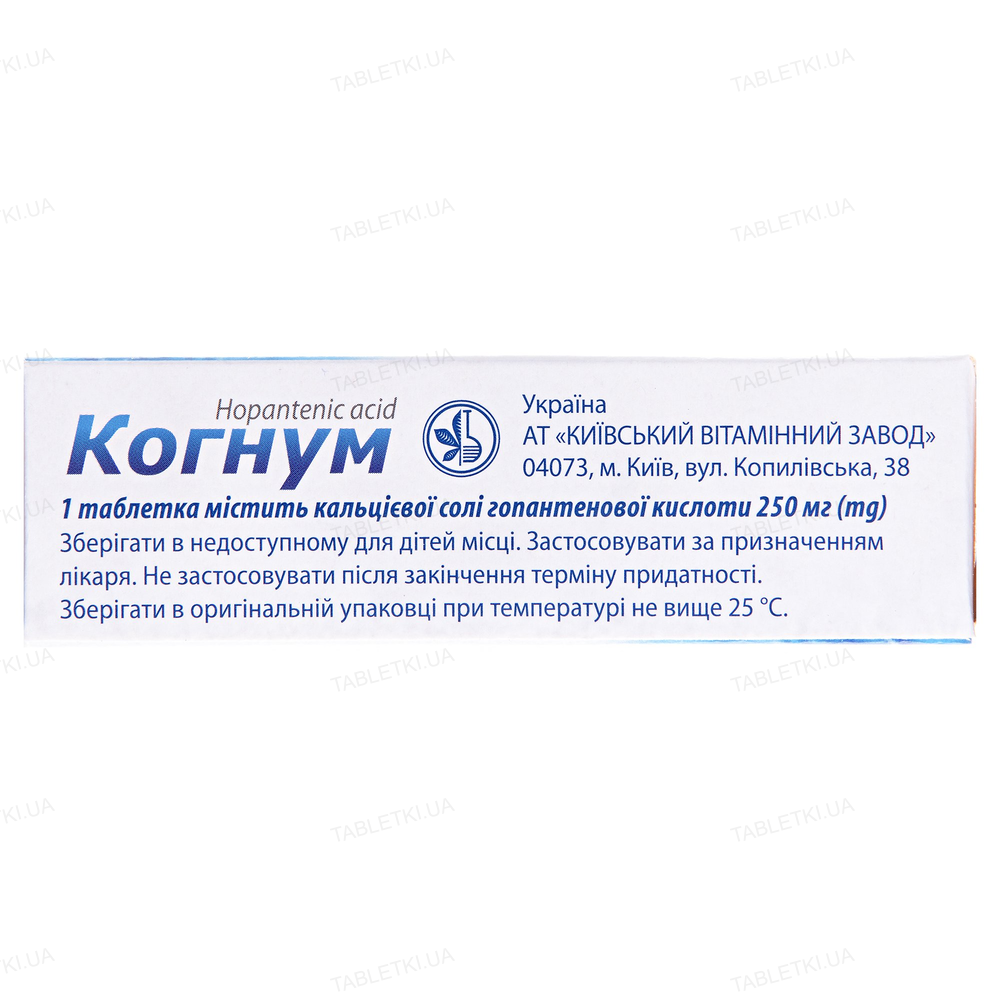
Cognum 250 mg tablets, No. 50 (10 x 5)
Ingredients
Active ingredient: calcium salt of hopantenic acid;
1 tablet contains 250 mg or 500 mg of the calcium salt of hopantenic acid;
inactive ingredients: heavy magnesium carbonate, potato starch, talc, calcium stearate.
Dosage Form
Tablets.
Main physical and chemical properties: white, flat-cylindrical tablets with a bevel and a score line.
Pharmacotherapeutic group
Psychostimulants and nootropics. ATC code N06B X.
Pharmacological properties
Pharmacodynamics.
The mechanism of action is due to the direct effect of hopantenic acid on the GABA_B receptor-channel complex. The drug has nootropic and anticonvulsant effects, increases the brain’s resistance to hypoxia and the effects of toxic substances, stimulates anabolic processes in neurons, combines a moderate sedative effect with a mild stimulant effect, and reduces motor excitability. It enhances mental and physical performance. It helps normalize GABA levels in cases of chronic alcohol intoxication and subsequent ethanol withdrawal. It prolongs the action of novocaine and sulfanilamides by inhibiting their acetylation reactions. It inhibits a pathologically increased bladder reflex and detrusor tone.
Pharmacokinetics.
Cognum is rapidly absorbed from the gastrointestinal tract and crosses the blood-brain barrier; the highest concentrations are found in the liver, kidneys, and skin.
Time to reach Cmax is 1 hour. The drug is not metabolized and is excreted unchanged within 48 hours: 67.5% of the administered dose is excreted in the urine, and 28.5% in the feces.
Indications
As part of combination therapy:
- cognitive impairment associated with organic brain lesions (including the consequences of neuroinfections and traumatic brain injuries);
- cerebrovascular insufficiency caused by atherosclerotic changes in the cerebral vessels;
- extrapyramidal disorders (myoclonus-epilepsy, Huntington’s chorea, hepatolenticular degeneration, Parkinson’s disease);
- epilepsy with slowed mental processes (as part of a comprehensive treatment regimen with anticonvulsant medications);
- psychoemotional overload, decreased mental and physical performance (to improve concentration and memory);
- neurogenic urinary disorders: enuresis, pollakiuria, urgent urges, urge incontinence;
- The medication is indicated for children aged 3 years and older with perinatal encephalopathy, mental retardation of varying severity, and developmental delays (cognitive, speech, and motor), various forms of cerebral palsy, hyperkinetic disorders (attention-deficit hyperactivity disorder, tics), stuttering (primarily of the clonic type), and neurosis-like conditions.
Contraindications
Hypersensitivity to any component of the drug; acute, severe kidney disease.
Interactions with Other Medications and Other Types of Interactions
During long-term treatment, the concurrent use of Cognum with other nootropic and stimulant agents is not recommended.
The drug prolongs the effects of barbiturates, enhances the effects of anticonvulsants and central nervous system stimulants, and prevents the side effects of phenobarbital, carbamazepine, and antipsychotics (neuroleptics), and enhances the effects of local anesthetics (novocaine).
The drug is capable of inhibiting acetylation reactions, which are part of the mechanisms of inactivation of novocaine and sulfanilamides, thereby prolonging the action of the latter.
The effect of Cognum is enhanced when combined with glycine, etidronic acid, and xidifon.
Special Considerations for Use
During long-term treatment, the concurrent use of other nootropic and stimulant agents is not recommended. Given the drug’s nootropic effect, it is taken primarily in the morning and during the day.
Use during pregnancy or breastfeeding.
Cognum is contraindicated during pregnancy or breastfeeding.
Effect on reaction time when driving or operating machinery.
Caution should be exercised when driving or operating machinery while taking this medication.
Dosage and Administration
Kognum is used as part of a comprehensive treatment regimen.
Tablets should be taken 15–30 minutes after a meal.
The single dose for children aged 12 years and older and adults is 250–1,000 mg; for children aged 3 to 12 years, it is 250–500 mg.
The daily dose for children aged 12 years and older and adults is 1,500–3,000 mg; for children aged 3 to 12 years, it is 750–3,000 mg.
The course of treatment lasts 1 to 4 months; in some cases, up to 6 months. A repeat course of treatment may be administered after 3–6 months.
For sequelae of neuroinfections and traumatic brain injuries: children aged 3 years and older and adults—250 mg 3–4 times daily.
For cerebrovascular insufficiency: adults—250 mg 3–4 times daily.
For the treatment of extrapyramidal disorders caused by the use of neuroleptics: children 12 years of age and older and adults—500–1,000 mg 3 times daily; children aged 3 to 12 years: 250–500 mg 3–4 times daily. The course of treatment is 1–3 months.
For epilepsy, in combination with anticonvulsants: children aged 3 to 12 years—250–500 mg 3–4 times daily; children 12 years of age and older and adults: 500–1,000 mg 3–4 times daily, every day, for an extended period (up to 6 months).
For psychoemotional stress and decreased mental and physical performance: children aged 3 years and older and adults—250 mg 3 times daily.
For urinary disorders: children 12 years of age and older and adults—500–1,000 mg 2–3 times daily; for children aged 3 to 12 years—250–500 mg (daily dose ≈ 25–50 mg/kg body weight) 2–3 times daily. The course of treatment is 1 to 3 months.
For children aged 3 to 12 years with perinatal encephalopathy, mental retardation, developmental delay, or cerebral palsy, Cognum is prescribed at 500 mg 4–6 times daily, daily, for 3 months; for speech development delay—500 mg 3–4 times daily for 2–3 months.
For hyperkinetic disorders, tics, stuttering, and neurosis-like conditions, the drug is prescribed to children aged 3 to 12 years at a dose of 250–500 mg 3–6 times daily, daily, for 1–4 months; for children aged 12 years and older and adults—1,500–3,000 mg daily for 1–5 months.
Dosage regimen: increase the dose over 7–12 days, maintain the maximum dose for 15–40 days, and gradually reduce the dose until Cognum is discontinued over 7–8 days. The interval between treatment courses is 1 to 3 months.
Children. Use in children aged 3 years and older.
Overdose
Worsening of side effect symptoms.
Treatment: activated charcoal, gastric lavage, symptomatic therapy.
Side Effects
Allergic reactions may occur, including rhinitis, conjunctivitis, and skin rash. If allergic reactions occur, discontinue use of the medication.
While taking this medication, the following may occur: hives, itching, skin flushing, facial flushing, or peeling skin. In such cases, the dose should be reduced or the medication discontinued. Neurological disorders may occur, including sleep disturbances or drowsiness and tinnitus, which are usually transient and do not require discontinuation of the medication.
Shelf life
3 years.
Storage Conditions
Store in the original packaging at a temperature not exceeding 25 °C.
Keep out of reach of children.
Packaging
10 tablets per blister; 5 blisters per pack.
Manufacturer
JSC “KYIV VITAMIN PLANT.”
Manufacturer’s location and address of its place of business.
04073, Ukraine, Kyiv, 38 Kopylivska St.
Website: www.vitamin.com.ua.







