
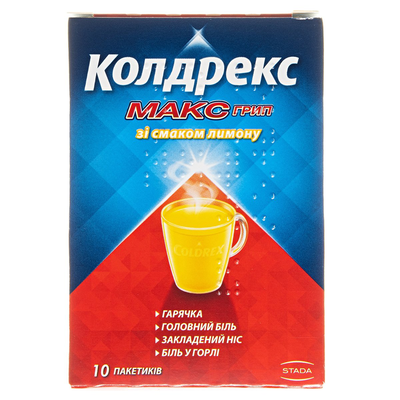
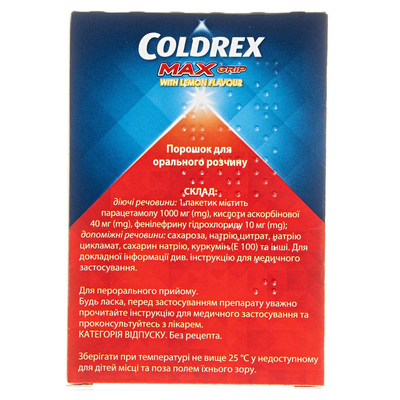
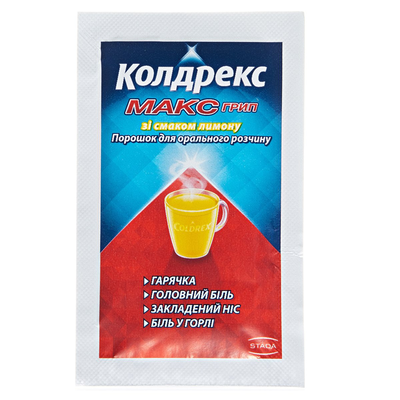
Coldrex MaxGrip Lemon-Flavored Powder for Oral Solution, No. 10, per package
Composition
Active ingredients: acetaminophen, phenylephrine hydrochloride, ascorbic acid;
1 packet contains 1,000 mg of acetaminophen, 10 mg of phenylephrine hydrochloride, and 40 mg of ascorbic acid;
inactive ingredients: sucrose, anhydrous citric acid, sodium citrate, corn starch, sodium cyclamate, sodium saccharin, colloidal anhydrous silicon dioxide, lemon flavoring, curcumin (E 100).
Dosage Form
Powder for oral solution.
Main physical and chemical properties: a light yellow, free-flowing, heterogeneous powder with a lemon odor.
Pharmacotherapeutic group
Analgesics and antipyretics. Paracetamol, combinations without psycholeptics. ATC code N02B E51.
Pharmacological properties
Pharmacodynamics.
Paracetamol is an analgesic and antipyretic. Its mechanism of action is attributed to the inhibition of prostaglandin synthesis, primarily in the central nervous system. The absence of inhibition of peripheral prostaglandin synthesis ensures the preservation of protective prostaglandins in the gastrointestinal tract. Therefore, acetaminophen is particularly suitable for patients with a history of certain conditions or those receiving concomitant therapy in which inhibition of peripheral prostaglandin synthesis would be undesirable (for example, in patients with a history of gastrointestinal bleeding or in the elderly).
Phenylephrine hydrochloride is a sympathomimetic. Its action is primarily associated with direct stimulation of adrenoreceptors, mainly alpha-adrenoreceptors. Phenylephrine hydrochloride reduces swelling of the nasal mucosa.
Ascorbic acid is an essential vitamin added to the formulation to compensate for vitamin C loss that may occur at the onset of a viral infection.
Pharmacokinetics.
Paracetamol is rapidly and almost completely absorbed from the gastrointestinal tract. Plasma protein binding at therapeutic concentrations is minimal. Paracetamol is metabolized in the liver and excreted in the urine primarily as glucuronides and sulfate conjugates. Less than 5% is excreted as unchanged paracetamol.
Phenylephrine is absorbed unevenly from the gastrointestinal tract. It undergoes presystemic metabolism by monoamine oxidases in the intestine and liver; therefore, the bioavailability of phenylephrine is reduced following oral administration. It is almost completely excreted in the urine as sulfate conjugates.
Ascorbic acid is rapidly absorbed from the gastrointestinal tract and is widely distributed throughout the body. Plasma protein binding is 25%. Excess ascorbic acid is excreted from the body in the urine as metabolites.
Indications
Short-term relief of symptoms of the common cold and flu, such as headache, sore throat, nasal congestion, sinusitis and associated pain, body aches and pains, and fever.
Contraindications
Hypersensitivity to any component of the drug; severe cardiovascular insufficiency; severe liver and/or kidney dysfunction; congenital hyperbilirubinemia; glucose-6-phosphate dehydrogenase deficiency; alcoholism, blood disorders (including severe anemia, leukopenia), thrombosis, thrombophlebitis, states of increased agitation, acute pancreatitis, prostatic hypertrophy with urinary retention, severe forms of diabetes mellitus, epilepsy, pheochromocytoma, hyperthyroidism, angle-closure glaucoma, severe forms of hypertension, atherosclerosis, ischemic heart disease; sleep disorders.
Do not use concomitantly with monoamine oxidase (MAO) inhibitors or within 2 weeks after discontinuing their use, with tricyclic antidepressants, beta-blockers, or other antihypertensive medications.
Drug Interactions and Other Interactions
The rate of paracetamol absorption may increase when used concomitantly with metoclopramide and domperidone and may decrease when used with cholestyramine. The anticoagulant effect of warfarin and other coumarins may be enhanced, increasing the risk of bleeding, with concomitant long-term, regular, daily use of paracetamol. With short-term use in accordance with the recommended dosage regimen, these interactions are not clinically significant.
Barbiturates reduce the antipyretic effect of acetaminophen.
Anticonvulsants (including phenytoin, barbiturates, and carbamazepine), which stimulate the activity of hepatic microsomal enzymes, may enhance the toxic effect of paracetamol on the liver by increasing the extent of the drug’s conversion to hepatotoxic metabolites.
Concomitant use of high doses of paracetamol with isoniazid increases the risk of developing hepatotoxic syndrome. Paracetamol reduces the effectiveness of diuretics. Do not use concomitantly with alcohol.
The interaction of phenylephrine with MAO inhibitors causes a hypertensive effect; with tricyclic antidepressants (e.g., amitriptyline) and other sympathomimetics—it increases the risk of cardiovascular side effects; when combined with digoxin and cardiac glycosides—it leads to arrhythmias or myocardial infarction. Phenylephrine may reduce the effectiveness of beta-blockers and other antihypertensive drugs (including debrisoquine, guanethidine, reserpine, methyldopa), increasing the risk of hypertension and other adverse cardiovascular reactions. Concomitant use with ergot alkaloids (e.g., ergotamine and metisergide) may increase the risk of ergotism.
When taken orally, ascorbic acid enhances the absorption of penicillin and iron, reduces the effectiveness of heparin and indirect anticoagulants, and increases the risk of crystalluria during treatment with salicylates. Antidepressants, antiparkinsonian and antipsychotic drugs, and phenothiazine derivatives increase the risk of urinary retention, dry mouth, and constipation. Glucocorticosteroids increase the risk of glaucoma; high doses of the drug reduce the effectiveness of tricyclic antidepressants.
Vitamin C absorption is reduced when taken concurrently with oral contraceptives, fruit or vegetable juices, or alkaline beverages.
Ascorbic acid should be taken only 2 hours after a deferoxamine injection, as their concurrent use increases iron toxicity, particularly in the myocardium.
Long-term use of high doses in individuals being treated with disulfiram inhibits the disulfiram-alcohol reaction.
Special Instructions for Use
Consult a doctor before using this medication. Contains acetaminophen.
Concomitant use with other medications containing acetaminophen may lead to an overdose. An acetaminophen overdose can cause liver failure, which may result in the need for a liver transplant or death.
Cases of liver dysfunction/failure have been reported in patients with reduced glutathione levels, such as those who are severely malnourished, anorexia, have a low body mass index, or suffer from chronic alcohol dependence.
Patients with hypertension, cardiovascular disease, diabetes, hyperthyroidism, angle-closure glaucoma, pheochromocytoma, benign prostatic hyperplasia, Raynaud’s disease, or impaired liver or kidney function should consult a doctor before using this medication. Underlying liver disease increases the risk of paracetamol-associated liver injury.
In patients with severe infections, such as sepsis, which are accompanied by decreased glutathione levels, the risk of metabolic acidosis may increase when taking acetaminophen. Symptoms of metabolic acidosis include deep, rapid, or labored breathing, nausea, vomiting, and loss of appetite. Seek medical attention immediately if these symptoms occur. Phenylephrine, which is a component of this medication, may cause angina attacks.
This medication should not be used by patients taking other sympathomimetics (such as decongestants, cold and flu medications, appetite suppressants, and amphetamine-like psychostimulants). Do not exceed the recommended doses. If symptoms do not subside or worsen within 7 days of treatment with this medication, or are accompanied by a high fever, rash, or persistent headache, consult a doctor.
Patients with rare hereditary disorders such as fructose intolerance, glucose-galactose malabsorption, or sucrase-isomaltase deficiency should not take this medication. One packet (1 dose) contains 3.725 g of sucrose. Patients with diabetes should take this into account. 1 dose contains 130 mg of sodium. Patients on a sodium-restricted diet should take this into account.
Use During Pregnancy or Breastfeeding.
This medication should not be used during pregnancy unless the expected benefit to the woman justifies the potential risk to the fetus. It should be used at the lowest effective dose and for the shortest possible duration of treatment. Use only as directed by a doctor.
Paracetamol and phenylephrine may be excreted into breast milk. Use during breastfeeding should be limited to cases prescribed by a doctor.
Effect on reaction time when driving or operating machinery.
If dizziness occurs while taking this medication, it is not recommended to drive or operate complex machinery.
Dosage and Administration
This medication is intended for oral use.
Dissolve the contents of one packet in half a glass of hot water. Stir until completely dissolved. Add cold water if necessary.
Adults and children 12 years of age and older: 1 packet every 4–6 hours as needed. Do not take more frequently than every 4 hours. The maximum daily dose is 4 packets. The duration of treatment without medical consultation should not exceed 7 days. Do not exceed the specified doses. If the patient’s condition does not improve with treatment, consult a doctor. Use the lowest effective dose.
Children.
This medication is not recommended for children under 12 years of age.
Overdose
The risk of overdose is increased in patients with liver disease.
Overdose is usually caused by acetaminophen and manifests as pale skin, loss of appetite, nausea, vomiting, abdominal pain, hepatic necrosis, elevated liver transaminases, and an increased prothrombin index. Symptoms of liver damage appear 24–48 hours after overdose and may peak after 4–6 days. Glucose metabolism disorders and metabolic acidosis may occur. In severe poisoning, liver failure may progress and lead to the development of toxic encephalopathy with impaired consciousness, hemorrhages, hypoglycemia, cerebral edema, and, in rare cases, may require a liver transplant or result in death.
Acute renal dysfunction with acute tubular necrosis may manifest as severe lower back pain, hematuria, and proteinuria and may develop even in the absence of severe liver damage. Cardiac arrhythmias have also been reported. Acute pancreatitis has been observed in patients with liver dysfunction and toxic liver injury.
Liver damage is possible in adults who have taken more than 10 g of acetaminophen and in children who have taken more than 150 mg/kg of body weight. Taking 5 g or more of acetaminophen may lead to liver damage in patients with risk factors (long-term treatment with carbamazepine, phenobarbital, phenytoin, primidone, rifampicin, St. John’s wort, or other medications that induce liver enzymes; regular consumption of excessive amounts of ethanol; glutathione deficiency (gastrointestinal disorders, cystic fibrosis, HIV infection, starvation, cachexia).
Treatment. In the event of a paracetamol overdose, emergency medical care must be provided, even if no symptoms of overdose are present. The patient should be taken to a hospital immediately, even if there are no early symptoms of overdose. Symptoms may be limited to nausea and vomiting or may not reflect the severity of the overdose or the risk of organ damage.
Treatment with activated charcoal should be considered if an excessive dose of paracetamol was taken within the past hour. Plasma paracetamol concentrations should be measured 4 hours or more after ingestion (earlier measurements are unreliable). Treatment with N-acetylcysteine may be administered within 24 hours after paracetamol ingestion, but the maximum protective effect occurs when it is administered within 8 hours after ingestion. The effectiveness of the antidote decreases sharply after this period. If necessary, N-acetylcysteine is administered intravenously to the patient according to the established dosage schedule. In the absence of vomiting, methionine may be administered orally as an appropriate alternative in remote areas outside a hospital setting.
An overdose caused by phenylephrine may lead to effects similar to those listed in the “Adverse Reactions” section. Other symptoms may include irritability, restlessness, hypertension, and possibly reflex bradycardia. In severe cases, confusion, hallucinations, seizures, and arrhythmia may occur. However, the dose of the drug required to cause serious phenylephrine toxicity is higher than the dose required to cause paracetamol-induced liver toxicity.
Treatment: In case of overdose, gastric lavage, administration of activated charcoal, symptomatic therapy, and the use of alpha-blockers, such as phentolamine, are indicated for severe hypertension.
High doses of ascorbic acid (over 3,000 mg) may cause temporary osmotic diarrhea and gastrointestinal disturbances, such as nausea and abdominal discomfort. The consequences of ascorbic acid overdose may be attributed to severe liver failure caused by paracetamol overdose.
Side Effects
Skin and subcutaneous tissue: rash, hives, allergic dermatitis, Stevens-Johnson syndrome, itching, erythema multiforme, toxic epidermal necrolysis.
Immune system disorders: allergic reactions (including angioedema), anaphylactic shock, hypersensitivity reactions.
Psychiatric disorders: psychomotor agitation and disorientation, anxiety, nervousness, fear, irritability, sleep disturbances, insomnia, confusion, depression, hallucinations.
Nervous system disorders: headache, dizziness, paresthesia.
Ear and vestibular system disorders: tinnitus.
Ophthalmic disorders: mydriasis, acute angle-closure glaucoma (more common in patients with glaucoma), visual disturbances, and accommodation disorders.
Gastrointestinal system: nausea, vomiting, dry mouth, hypersalivation, abdominal discomfort and pain, decreased appetite, heartburn, diarrhea.
Hepatobiliary system: liver dysfunction, elevated liver enzymes, hepatonecrosis (dose-dependent effect), liver failure.
Blood and lymphatic system disorders: anemia (including hemolytic anemia), sulfhemoglobinemia, and methemoglobinemia, thrombocytopenia, leukopenia, agranulocytosis, pancytopenia, bruising, or bleeding.
Renal and urinary system disorders: urinary dysfunction, urinary retention (more likely in patients with benign prostatic hyperplasia), renal colic, nephrotoxicity.
Cardiovascular system: increased blood pressure, tachycardia or reflex bradycardia, palpitations, shortness of breath, chest pain.
Respiratory, thoracic, and mediastinal disorders: bronchospasm in patients sensitive to aspirin and other nonsteroidal anti-inflammatory drugs.
Other: general weakness, fever, hypoglycemia, glucosuria, and disturbances in zinc and copper metabolism.
The drug may have a mild laxative effect.
Shelf life
3 years.
Storage conditions
Store at a temperature not exceeding 25 °C, out of the reach and sight of children.
Packaging
5 or 10 packets per cardboard box.
Dispensing Category
Available without a prescription.







