
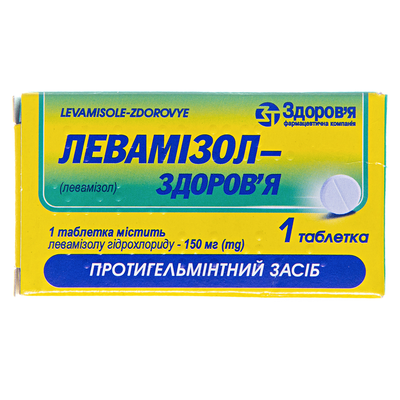
Levamisole-Zdorovye, 150 mg tablets, No. 1
Composition
Active ingredient: Each tablet contains 150 mg of levamisole hydrochloride;
inactive ingredients: corn starch, lactose monohydrate, povidone, stearic acid.
Dosage Form
Tablets.
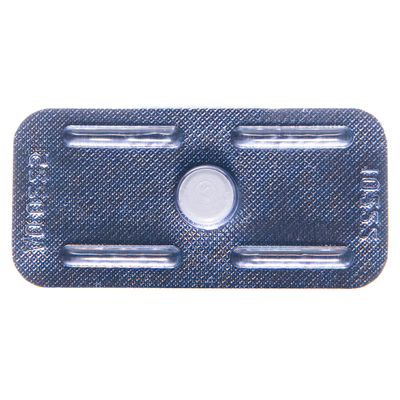
Main physical and chemical properties: white or almost white tablets, flat-cylindrical in shape, with a bevel and a score line.
Pharmacotherapeutic group
Anthelmintics. Agents used in nematode infections. Imidazothiazole derivatives. ATC code P02C E01.
Pharmacological properties
Pharmacodynamics. Levamisole has a rapid anthelmintic effect. In the ganglion-like structures of nematodes, levamisole causes depolarizing neuromuscular paralysis. Thus, the paralyzed nematodes are eliminated from the body via normal intestinal peristalsis within 24 hours after administration of the drug.
Pharmacokinetics. The drug is rapidly absorbed from the gastrointestinal tract. The maximum plasma concentration of levamisole is reached, on average, 1.5–2 hours after administration. Levamisole is metabolized in the liver; its main metabolites are p-hydroxy-levamisole and its glucuronide derivative. The half-life is 3–6 hours. Less than 5% of the administered dose is excreted unchanged in the urine, and less than 0.2% is excreted in the feces.
Indications
Ascariasis, necatoriasis, ankylostomiasis.
Contraindications
Hypersensitivity to levamisole or to any of the excipients.
Drug Interactions and Other Interactions
Disulfiram-like symptoms may occur when this medication is taken with alcoholic beverages.
Use levamisole with caution when taking medications that affect hematopoiesis.
When taken concomitantly with coumarin-like anticoagulants, prothrombin time may increase; therefore, the dose of the oral anticoagulant must be adjusted.
This medication increases blood levels of phenytoin; therefore, blood levels of phenytoin must be monitored when used concomitantly with phenytoin.
Levamisole must not be used concomitantly with lipophilic agents such as tetrachloromethane, tetrachloroethylene, henopodium oil, chloroform, or ether, as this may increase the toxicity of levamisole.
Special Instructions for Use
Alcoholic beverages must not be consumed during treatment or for 24 hours after taking the medication.
If a patient has been diagnosed with an intolerance to certain sugars, they should consult a doctor before taking this medication.
Use During Pregnancy or Breastfeeding
During pregnancy, this medication may be prescribed only if the expected benefit outweighs the potential risk of use. While breastfeeding, to protect the infant, a decision must be made as to whether the mother needs to take this medication.
Effect on reaction time when driving or operating machinery
It has not been proven that levamisole depresses the nervous system. Mild and transient dizziness may occur while taking this medication; therefore, caution should be exercised when driving, working in high-risk environments, or operating machinery.
Dosage and Administration
For the treatment of helminthiasis in adults, administer a single dose of 150 mg (1 tablet).
It is recommended to take the medication after a meal with a small amount of water, in the evening.
There is no need to take laxatives or follow a special diet.
If necessary, repeat the treatment after a 7- to 14-day break.
Children
Do not administer this medication at this dosage to children.
Overdose
When large doses of levamisole (over 600 mg) are taken, the following signs of toxicity have been reported: nausea, vomiting, lethargy, cramps, diarrhea, headache, dizziness, and confusion.
Treatment: In case of accidental overdose—if a short time has elapsed since ingestion—perform gastric lavage. Vital signs should be monitored, and symptomatic therapy should be administered.
If signs of anticholinesterase activity are present, atropine may be administered as an antidote.
Side Effects
Cardiovascular system: palpitations¹;
Blood and lymphatic system: agranulocytosis2, leukopenia2;
Psychiatric disorders: insomnia1;
Central nervous system: seizures1, dizziness1, encephalopathy3, headache1;
Gastrointestinal system: abdominal pain1, diarrhea1, nausea1, vomiting1;
Immune system disorders: hypersensitivity reactions may occur, including skin rashes, itching, and angioedema.
1In rare cases, headaches, insomnia, dizziness, palpitations, cramps, and dyspeptic symptoms such as nausea, vomiting, abdominal pain, and diarrhea may occur. These effects are mild, short-lived, and resolve on their own.
2Leukopenia and agranulocytosis may occur with high doses or during long-term therapy.
3There have been reports of central nervous system reactions (encephalopathy) developing 2–5 weeks after taking the medication. In most cases, these reactions were reversible, and early treatment with a corticosteroid improved the patient’s condition.
Shelf life
3 years.
Storage Conditions
Store in the original packaging at a temperature not exceeding 25 °C. Keep out of the reach of children.
Packaging
150 mg tablets, No. 1, in a blister pack inside a box.
Dispensing Category
Available without a prescription.







