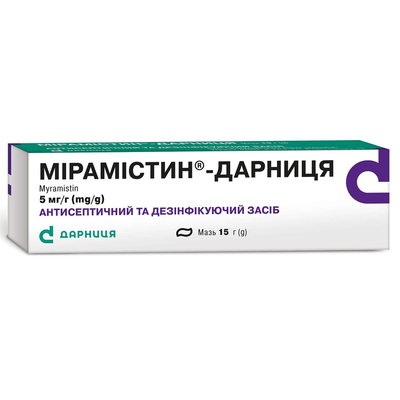
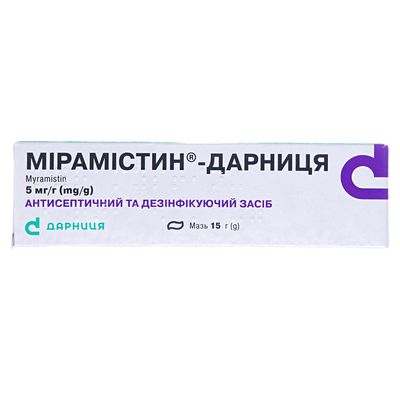
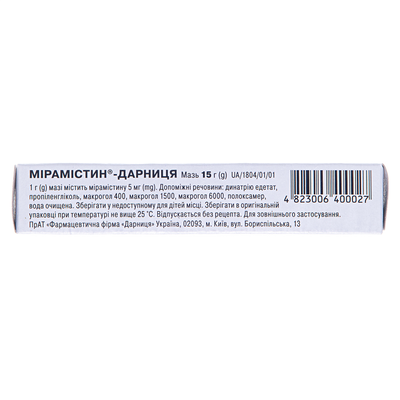
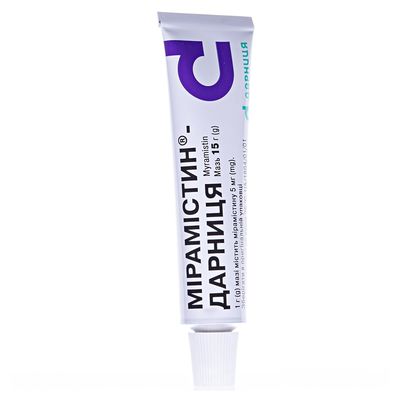
Miramistin-Darnitsa Ointment, 5 mg/g, 15 g in tubes
Ingredients
Active ingredient: miramistin;
1 g of ointment contains 5 mg of miramistin;
Inactive ingredients: disodium edetate, propylene glycol, macrogol 400, macrogol 1500, macrogol 6000, poloxamer, purified water.
Dosage Form
Ointment.
Main physical and chemical properties: a homogeneous white ointment.
Pharmacotherapeutic group
Antiseptics and disinfectants. ATX code D08A J.
Pharmacological properties
Pharmacodynamics.
The active ingredient of the drug is miramistin—a cationic surfactant (surfactant) with antimicrobial (antiseptic) activity. Its action is based on the direct hydrophobic interaction of the miramistin molecule with the lipids of microbial membranes, leading to their fragmentation and destruction.
It exhibits pronounced antimicrobial activity against Gram-positive (Staphylococcus spp., Streptococcus spp., Streptococcus pneumoniae) and Gram-negative, aerobic and anaerobic, spore-forming and non-spore-forming bacteria in the form of monocultures and microbial associations, including hospital strains with multidrug resistance to antibiotics. It exerts antifungal activity against ascomycetes (genera Aspergillus and Penicillium), yeasts (Rhodotorula rubra, Torulopsis gabrata), and yeast-like fungi (Candida albicans, Candida tropicalis, Candida krusei), dermatophytes (Trichophyton rubrum, Trichophyton mentagrophytes, Trichophyton verrucosum, Trichophyton schoenleini, Trichophyton violacent, Epidermophyton Kaufman-Wolf, Epidermophyton floccosum, Microsporum gypseum, Microsporum canis), as well as other pathogenic fungi (e.g., Pityrosporum orbiculare (Malassezia furfur)), in the form of monocultures and microbial associations, including fungal microflora resistant to chemotherapeutic agents. Under the influence of miramistin, the resistance of microorganisms to antibiotics is reduced.
Upon application, it stimulates regenerative processes.
Thanks to its broad-spectrum antimicrobial activity, miramistin effectively prevents infection of wounds and burns. The preparation exhibits pronounced hyperosmolar activity, which alleviates wound and perifocal inflammation, absorbs purulent exudate, and selectively dehydrates necrotic tissue, promoting the formation of a dry scab. At the same time, the ointment does not damage granulation tissue or viable skin cells and does not inhibit marginal epithelialization.
Pharmacokinetics.
Due to the physicochemical properties of the ointment base, the drug acts not only on the surface microflora of the wound but also on pathogens located in the tissues surrounding the wound; therefore, it cannot be ruled out that a small portion of miramistin may enter the systemic circulation.
Indications
Surgery, traumatology: topical treatment of infected wounds of various locations and etiologies; prevention of secondary infection in granulating wounds.
Burn treatment: treatment of second- and third-degree A burns; preparation of burn wounds for dermatoplasty.
Dermatology: streptococcal and staphylococcal dermatitis, dermatomycoses of the smooth skin, feet, and major skin folds (including dyshidrotic forms and forms complicated by pyoderma), nails (onychomycosis), keratomycosis (including pityriasis versicolor), candidiasis of the skin and mucous membranes.
Prevention of complications from wound infections—in cases of minor occupational and household injuries.
Contraindications
Hypersensitivity to the active ingredient or to any other components of the drug.
Interactions with Other Medications and Other Forms of Interaction
When miramistin is applied topically at the same time as anionic surfactants (soap solutions), it is inactivated.
Concomitant use of Miramistin with systemic or topical antibiotics reduces the resistance of microorganisms to the latter.
Special Considerations for Use
The drug’s effectiveness is enhanced if the ointment is applied to a wound surface that has been previously rinsed with an aseptic solution.
The presence of purulent-necrotic material in the wound requires additional application of the ointment.
Pregnancy and lactation.
Due to a lack of sufficient experience, consult a doctor before using this medication during pregnancy or lactation.
Effects on the ability to operate vehicles and machinery.
This medication does not affect reaction time when driving or operating machinery.
Dosage and Administration
The drug should be administered topically to adults.
Treatment of wounds and burns.
After standard treatment of wounds and burns, apply the ointment directly to the affected area, then apply a sterile gauze bandage or apply the ointment to the bandage and then to the wound.
You may also use swabs soaked in the ointment, carefully filling the cavities of purulent wounds after their surgical debridement, or gauze tampons with the ointment, inserting them into fistula tracts.
The medication is applied once daily when treating purulent wounds and burns during the first phase of the wound healing process and once every 1–3 days during the second phase, depending on the condition of the wound. The dose depends on the wound surface area and the degree of purulent exudation. The duration of treatment is determined by the progress of wound debridement and healing. If the infection is deeply localized in soft tissues, the drug may be used in combination with systemic antibiotics; in this case, the duration of treatment is determined by the duration of the antibiotic course.
Treatment of dermatological conditions.
The medication should be applied in a thin layer to the affected areas of the skin, or the ointment should be applied to a dressing and then to the affected area 1–2 times a day. Duration of treatment: the medication should be used until negative results are obtained from microbiological testing. In cases of advanced dermatomycosis, particularly rubromycosis, the ointment may be used for 5–6 weeks as part of combination therapy with griseofulvin or systemic antifungal medications. For fungal nail infections, the nail plates should be removed before starting treatment.
Children.
Due to a lack of sufficient experience, the drug should not be used in pediatric practice.
Overdose
No cases of overdose have been observed. However, when the medication is applied to large areas of affected skin, it is possible that some of the ointment’s active ingredients may enter the systemic circulation in amounts insufficient to cause acute poisoning. The systemic effect of miramistin manifests as that of a cationic detergent and may prolong bleeding time.
Treatment: reduce the dose or discontinue the medication; prescribe oral calcium supplements and Vikasol.
Side Effects
In some cases, when treating burns and trophic ulcers, the medication may cause a mild burning sensation, which subsides within 15–20 seconds and does not require the use of analgesics or discontinuation of the ointment.
Hypersensitivity reactions may also occur, including rash, itching, erythema, dry skin, dermatitis, weeping, and skin irritation due to the presence of propylene glycol in the medication.
Shelf life
3 years.
Storage Conditions
Store in the original packaging at a temperature not exceeding 25 °C.
Keep out of reach of children.
Packaging
15 g or 30 g in a tube; 1 tube per pack; 1,000 g per jar.
Sales Conditions
Available without a prescription.
Manufacturer
Darnitsa Pharmaceutical Company, PJSC.