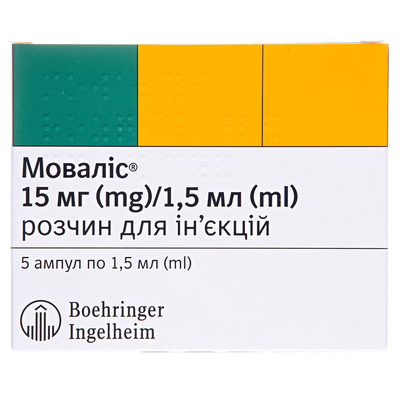
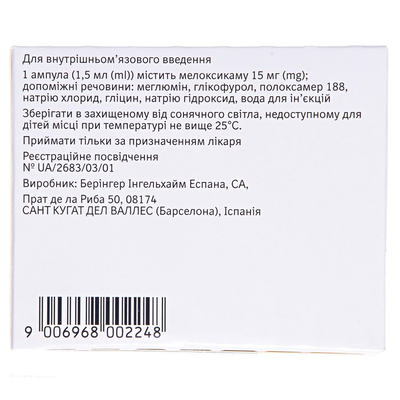
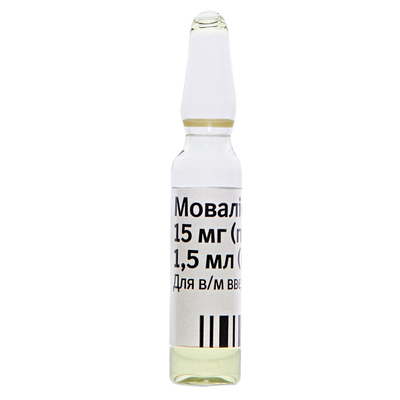

Movalis Solution for Injection, 15 mg/1.5 mL, 1.5 mL, No. 5 in ampoules
Composition
Active ingredient: 1.5 mL of the product contains 15 mg of meloxicam;
excipients: meglumine, glycofurol, poloxamer 188, sodium chloride, glycine, sodium hydroxide, water for injection.
Dosage Form
Solution for injection.
Main physical and chemical properties: a clear, yellow solution with a greenish tint, practically free of particles.
Pharmacotherapeutic group
Nonsteroidal anti-inflammatory and antirheumatic agents. Oxicams.
ATC code M01A C06.
Pharmacological properties
Pharmacodynamics.
Movalis is a nonsteroidal anti-inflammatory drug (NSAID) of the oxicam class that has anti-inflammatory, analgesic, and antipyretic effects.
Meloxicam has demonstrated high anti-inflammatory activity in standard models of inflammation. As with other NSAIDs, its exact mechanism of action remains unknown. However, there is a common mechanism of action for all NSAIDs (including meloxicam): inhibition of the biosynthesis of prostaglandins, which are mediators of inflammation.
Pharmacokinetics.
Absorption. Meloxicam is completely absorbed following intramuscular injection. Relative bioavailability compared to that following oral administration is nearly 100%. Therefore, no dose adjustment is necessary when switching from the intramuscular to the oral route of administration. Following an intramuscular injection of 15 mg, the maximum plasma concentration is approximately 1.6–1.8 μg/mL and is reached within 1–6 hours.
Distribution. Meloxicam binds very strongly to plasma proteins, primarily to albumin (99%). Meloxicam penetrates into the synovial fluid, where its concentration is half that in plasma. The volume of distribution is low, averaging 11 L following intramuscular or intravenous administration, with individual variations ranging from 7–20%. The volume of distribution following repeated oral doses of meloxicam (7.5 to 15 mg) is 16 L, with a coefficient of variation ranging from 11% to 32%. Biotransformation. Meloxicam undergoes extensive biotransformation in the liver.
Four different metabolites of meloxicam, which are pharmacodynamically inactive, have been identified in urine. The major metabolite, 5’-carboxymeloxicam (60% of the dose), is formed by the oxidation of the intermediate metabolite 5’-hydroxymethylmeloxicam, which is also excreted to a lesser extent (9% of the dose). In vitro studies suggest that CYP 2C9 plays an important role in the metabolic process, while the CYP 3A4 isoenzyme contributes to a lesser extent. Peroxidase activity in patients may be responsible for the other two metabolites, which account for 16% and 4% of the prescribed dose, respectively.
Elimination. Meloxicam is excreted primarily as metabolites in equal proportions in the urine and feces. Less than 5% of the daily dose is excreted unchanged in the feces, and a negligible amount is excreted in the urine. The half-life ranges from 13 to 25 hours, depending on the route of administration (oral, intramuscular, or intravenous). Plasma clearance is approximately 7–12 mL/min following a single oral dose, intravenous administration, or rectal administration.
Dose Linearity. Meloxicam exhibits linear pharmacokinetics within the therapeutic dose range of 7.5 mg to 15 mg following oral and intramuscular administration. Special Patient Populations.
Patients with hepatic or renal impairment. Mild to moderate hepatic or renal impairment does not significantly affect the pharmacokinetics of meloxicam. Patients with moderate renal insufficiency had significantly higher total clearance. Reduced plasma protein binding was observed in patients with end-stage renal insufficiency. In end-stage renal failure, an increase in the volume of distribution may lead to an increase in the concentration of free meloxicam (see the “Dosage and Administration” and “Contraindications” sections).
Elderly patients. In elderly male patients, the mean pharmacokinetic parameters are similar to those in young male volunteers. In elderly female patients, AUC values are higher and the half-life is longer compared with the corresponding values in young volunteers of both sexes. The mean steady-state plasma clearance in elderly patients was slightly lower than in young volunteers (see the “Dosage and Administration” section).
Indications
Short-term symptomatic treatment of acute flare-ups of rheumatoid arthritis and ankylosing spondylitis when other routes of administration are not feasible. MOVALIS, solution for injection, is indicated for the treatment of adults.
Contraindications
- Third trimester of pregnancy (see the “Use During Pregnancy or Breastfeeding” section);
- patients under 18 years of age;
- Hypersensitivity to the active ingredient or to other components of the medication;
- Hypersensitivity to active substances with similar effects, such as NSAIDs or aspirin. Meloxicam should not be prescribed to patients who have experienced symptoms of asthma, nasal polyps, angioedema, or hives after taking aspirin or other NSAIDs;
- a history of gastrointestinal bleeding or perforation associated with previous NSAID therapy;
- a history of active or recurrent peptic ulcer/bleeding (two or more separate confirmed episodes of ulcer or bleeding);
- severe hepatic insufficiency;
- severe renal insufficiency, without dialysis;
- history of gastrointestinal bleeding, cerebrovascular bleeding, or other coagulation disorders;
- hemostatic disorders or concomitant use of anticoagulants (contraindications related to the route of administration);
- severe heart failure;
- treatment of perioperative pain during coronary artery bypass grafting (CABG).
Interactions with Other Medications and Other Types of Interactions
Risks Associated with Hyperkalemia
Certain medications or therapeutic classes may contribute to hyperkalemia: potassium salts, potassium-sparing diuretics, angiotensin-converting enzyme (ACE) inhibitors, angiotensin II receptor antagonists, nonsteroidal anti-inflammatory drugs (NSAIDs), (low-molecular-weight or unfractionated) heparins, cyclosporine, tacrolimus, and trimethoprim.
The onset of hyperkalemia may depend on the presence of associated factors. The risk of hyperkalemia increases when the aforementioned medications are used concomitantly with meloxicam.
Pharmacodynamic interactions.
Other nonsteroidal anti-inflammatory drugs (NSAIDs) and acetylsalicylic acid. Combination with other NSAIDs (see the “Special Considerations” section) or with acetylsalicylic acid at doses of ≥ 500 mg per dose or ≥ 3 g total daily dose is not recommended.
Corticosteroids (e.g., glucocorticoids). Concomitant use with corticosteroids requires caution due to an increased risk of bleeding or the development of ulcers in the gastrointestinal tract.
Anticoagulants or heparin. The risk of bleeding is significantly increased due to inhibition of platelet function and damage to the gastroduodenal mucosa. NSAIDs may enhance the effects of anticoagulants such as warfarin (see the “Special Considerations for Use” section). The concomitant use of NSAIDs and anticoagulants or heparin is not recommended in geriatric practice or at therapeutic doses. Due to intramuscular administration, the meloxicam injection solution is contraindicated in patients receiving anticoagulant therapy (see the “Contraindications” and “Special Precautions for Use” sections).
In other cases (e.g., when using prophylactic doses), caution is required when using heparin due to an increased risk of bleeding.
Thrombolytic and antiplatelet agents. Increased risk of bleeding due to inhibition of platelet function and damage to the gastroduodenal mucosa.
Selective serotonin reuptake inhibitors (SSRIs). Increased risk of gastrointestinal bleeding.
Diuretics, ACE inhibitors, and angiotensin II antagonists. NSAIDs may reduce the effect of diuretics and other antihypertensive medications. In some patients with impaired renal function (e.g., patients with dehydration or elderly patients with impaired renal function), the concomitant use of ACE inhibitors or angiotensin II antagonists and medications that inhibit cyclooxygenase may lead to further deterioration of renal function, including possible acute renal failure, which is usually reversible. Therefore, this combination should be used with caution, especially in elderly patients. Patients should receive adequate fluid intake, and renal function should be monitored after initiation of combination therapy and periodically thereafter (see the “Special Considerations for Use” section).
Other antihypertensive medications (e.g., beta-blockers). As with the use of the drugs listed below, the antihypertensive effect of beta-blockers may be reduced (due to the inhibition of vasodilatory prostaglandins).
Calcineurin inhibitors (e.g., cyclosporine, tacrolimus). The nephrotoxicity of calcineurin inhibitors may be exacerbated by NSAIDs through the mediation of renal prostaglandin effects. Renal function should be monitored during treatment. Close monitoring of renal function is recommended, especially in elderly patients.
Deferasirox.
Concomitant use of meloxicam and deferasirox may increase the risk of gastrointestinal adverse reactions. Caution should be exercised when combining these drugs.
Pharmacokinetic interaction: effect of meloxicam on the pharmacokinetics of other drugs.
Lithium. There is evidence that NSAIDs increase plasma lithium concentrations (by reducing renal excretion of lithium), which may reach toxic levels. Concomitant use of lithium and NSAIDs is not recommended. If combination therapy is necessary, plasma lithium levels should be closely monitored at the start of treatment, during dose adjustment, and upon discontinuation of meloxicam.
Methotrexate. NSAIDs may reduce the tubular secretion of methotrexate, thereby increasing its concentration in plasma. For this reason, concomitant use of NSAIDs is not recommended in patients receiving high-dose methotrexate (more than 15 mg/week) (see the “Special Considerations for Use” section). The risk of interaction between NSAIDs and methotrexate should also be considered in patients receiving low-dose methotrexate, including those with impaired renal function. If combination therapy is necessary, blood test results and renal function should be monitored. Caution should be exercised when NSAIDs and methotrexate are taken for 3 consecutive days, as plasma methotrexate levels may increase and lead to increased toxicity. Although the pharmacokinetics of methotrexate (15 mg/week) were not affected by concomitant treatment with meloxicam, it should be noted that the hematologic toxicity of methotrexate may increase during NSAID therapy (see above) (see the “Adverse Reactions” section).
Pemetrexed. When meloxicam is used concomitantly with pemetrexed in patients with creatinine clearance between 45 and 79 mL/min, meloxicam administration should be suspended 5 days prior to pemetrexed administration, on the day of administration, and for 2 days following administration. If the combination of meloxicam and pemetrexed is necessary, patients should be closely monitored, particularly for the development of myelosuppression and gastrointestinal adverse reactions. For patients with severe renal impairment (creatinine clearance below 45 mL/min), concomitant use of meloxicam with pemetrexed is not recommended.
For patients with normal renal function (creatinine clearance ≥ 80 mL/min), a 15-mg dose of meloxicam may reduce the elimination of pemetrexed and, consequently, increase the incidence of pemetrexed-related adverse reactions. Therefore, caution should be exercised when prescribing 15 mg of meloxicam concomitantly with pemetrexed to patients with normal renal function (creatinine clearance ≥ 80 mL/min).
Pharmacokinetic Interaction: Effect of Other Medications on the Pharmacokinetics of Meloxicam.
Cholestyramine accelerates the elimination of meloxicam by disrupting intrahepatic circulation; therefore, meloxicam clearance increases by 50% and the half-life decreases to 13±3 hours. This interaction is clinically significant.
Pharmacokinetic interaction: effect of the combination of meloxicam and other drugs on pharmacokinetics.
Oral antidiabetic agents (sulfonylureas, nateglinide)
Meloxicam is almost entirely eliminated through hepatic metabolism, approximately two-thirds of which is mediated by cytochrome (CYP) P450 enzymes (the major pathway is CYP 2C9 and the minor pathway is CYP 3A4) and one-third by other pathways, such as peroxidase oxidation. The possibility of pharmacokinetic interactions should be considered when meloxicam is administered concomitantly with drugs that are known to inhibit or be metabolized by CYP 2C9 and/or CYP 3A4. Interactions mediated by CYP 2C9 can be expected when meloxicam is combined with drugs such as oral antidiabetic agents (sulfonylureas, nateglinide); this interaction may lead to increased plasma levels of these agents and meloxicam. Patients taking meloxicam and sulfonylureas or nateglinide should be closely monitored for the development of hypoglycemia.
No clinically significant pharmacokinetic interactions have been observed when taken concomitantly with antacids, cimetidine, and digoxin.
Children
Interaction studies have been conducted only in adults.
Special Considerations for Use
Adverse reactions can be minimized by using the lowest effective dose for the shortest duration of treatment necessary to control symptoms (see the “Dosage and Administration” section and the information on gastrointestinal and cardiovascular risks below).
The recommended maximum daily dose should not be exceeded if the therapeutic effect is insufficient, nor should additional NSAIDs be used, as this may increase toxicity while the therapeutic benefits have not been established. Concomitant use of meloxicam with NSAIDs, including selective cyclooxygenase-2 inhibitors, should be avoided.
Meloxicam should not be used to treat patients who require relief from acute pain.
If there is no improvement after several days, the clinical benefit of treatment should be reevaluated.
Attention should be paid to a history of esophagitis, gastritis, and/or peptic ulcer to ensure their complete resolution before initiating meloxicam therapy. Patients treated with meloxicam and those with a history of such conditions should be monitored regularly for possible recurrence.
Gastrointestinal disorders.
As with other NSAIDs, potentially fatal gastrointestinal bleeding, ulcers, or perforation may occur at any time during treatment, with or without prior symptoms or a history of serious gastrointestinal disease.
The risk of gastrointestinal bleeding, ulcers, or perforation is greater with higher doses of NSAIDs in patients with a history of ulcers, especially those complicated by bleeding or perforation (see the “Contraindications” section), and in elderly patients. Treatment in such patients should be initiated at the lowest effective dose. For such patients, combination therapy with protective medications (such as misoprostol or proton pump inhibitors) should be considered, as well as for patients who require concomitant use of low-dose aspirin or other medications that increase gastrointestinal risks (see the information below and the “Drug Interactions and Other Interactions” section).
Patients with a history of gastrointestinal toxicity, especially elderly patients, should report any unusual abdominal symptoms (particularly gastrointestinal bleeding), especially during the early stages of treatment.
Patients who are concurrently taking medications that may increase the risk of ulcers or bleeding, such as heparin—whether as radical therapy or in geriatric practice— or other nonsteroidal anti-inflammatory drugs, or acetylsalicylic acid in doses of ≥ 500 mg per dose or ≥ 3 g total daily dose), the use of meloxicam is not recommended (see the section “Interactions with Other Medications and Other Types of Interactions”).
If gastrointestinal bleeding or ulcers occur in patients taking meloxicam, treatment should be discontinued.
NSAIDs should be used with caution in patients with a history of gastrointestinal diseases (ulcerative colitis, Crohn’s disease), as these conditions may be exacerbated (see the “Adverse Reactions” section).
Liver disorders.
Up to 15% of patients taking NSAIDs (including MOVALIS) may experience elevated levels of one or more liver function tests. These laboratory abnormalities may progress, remain unchanged, or be transient with continued treatment. Significant elevations in ALT or AST (approximately three times or more above normal) were observed in 1% of patients during clinical trials with NSAIDs. In addition, rare cases of severe hepatic reactions, including jaundice, fulminant fatal hepatitis, hepatic necrosis, and hepatic failure, have been reported during clinical trials with NSAIDs, some of which were fatal.
Patients with symptoms and/or signs of hepatic dysfunction or who have abnormal liver function tests should be monitored for the development of symptoms of more severe hepatic failure during treatment with MOVALIS. If clinical signs and symptoms are consistent with the development of liver disease or if systemic manifestations of the disease are observed (e.g., eosinophilia, rash, and others), treatment with MOVALIS should be discontinued.
Cardiovascular disorders and cerebrovascular disorders.
Patients with a history of hypertension and/or mild to moderate congestive heart failure are recommended to be closely monitored, as fluid retention and edema have been observed during NSAID therapy.
Patients with risk factors should have their blood pressure monitored at the start of therapy, especially at the beginning of a course of treatment with meloxicam.
Research and epidemiological data suggest that the use of certain NSAIDs, including meloxicam (especially at high doses and during long-term treatment), may be associated with a slight increase in the risk of vascular thrombotic events (such as myocardial infarction or stroke). There are insufficient data to rule out such a risk for meloxicam.
In patients with uncontrolled hypertension, congestive heart failure, established ischemic heart disease, peripheral arterial disease, and/or cerebrovascular disease should receive meloxicam therapy only after a thorough evaluation. A similar evaluation is necessary before initiating long-term treatment in patients with risk factors for cardiovascular disease (e.g., hypertension, hyperlipidemia, diabetes mellitus, or smokers).
NSAIDs may increase the risk of serious cardiovascular thrombotic complications, myocardial infarction, and stroke, which can be fatal. The increased risk is associated with the duration of use. Patients with cardiovascular disease or risk factors for cardiovascular disease may be at increased risk of thrombotic complications.
Skin reactions.
Life-threatening severe skin reactions—including Stevens-Johnson syndrome and toxic epidermal necrolysis—have been reported with the use of meloxicam. Patients should be informed of the signs and symptoms of severe skin reactions and should closely monitor their skin for any reactions. The greatest risk of developing Stevens-Johnson syndrome or toxic epidermal necrolysis occurs during the first few weeks of treatment. If a patient exhibits symptoms or signs of Stevens-Johnson syndrome or toxic epidermal necrolysis (e.g., a progressive skin rash, often with blisters, or mucosal involvement), treatment with meloxicam should be discontinued. It is important to diagnose and discontinue any medications that may cause severe skin reactions—such as Stevens-Johnson syndrome or toxic epidermal necrolysis—as soon as possible. This is associated with a better prognosis in cases of severe skin lesions. If a patient is diagnosed with Stevens-Johnson syndrome or toxic epidermal necrolysis while taking meloxicam, the medication must not be resumed at any time in the future.
Cases of fixed drug eruption have been reported with the use of meloxicam. Meloxicam should not be re-administered to patients with a history of fixed drug eruption associated with meloxicam use. Potential cross-reactivity may occur with other oxicams.
Anaphylactoid reactions.
As with other NSAIDs, anaphylactoid reactions may occur in patients with no known history of a reaction to MOVALIS. MOVALIS should not be used in patients with the aspirin triad. This symptomatic complex occurs in patients with asthma who have a history of rhinitis with or without nasal polyps, or who have experienced severe, potentially fatal bronchospasm following the use of aspirin or other NSAIDs. Emergency measures should be taken immediately if an anaphylactoid reaction is detected.
Liver and kidney function.
As with treatment with most NSAIDs, isolated cases of elevated serum transaminase levels, serum bilirubin, or other liver function parameters, as well as elevated serum creatinine and blood urea nitrogen levels, and other laboratory abnormalities. In most cases, these abnormalities were mild and transient. If such abnormalities are significant or persistent, meloxicam should be discontinued and follow-up tests performed.
Functional renal insufficiency.
NSAIDs may induce functional renal insufficiency by reducing glomerular filtration rate due to inhibition of the vasodilatory effect of renal prostaglandins. This adverse effect is dose-dependent. At the start of treatment or after a dose increase, careful monitoring of renal function, including urine output, is recommended in patients with the following risk factors:
- advanced age;
- concomitant use with ACE inhibitors, angiotensin II antagonists, sartans, or diuretics (see the section “Interactions with Other Medications and Other Types of Interactions”);
- hypovolemia (of any origin);
- congestive heart failure;
- renal insufficiency;
- nephrotic syndrome;
- lupus nephropathy;
- severe hepatic dysfunction (serum albumin < 25 g/L or ≥ 10 on the Child-Pugh scale).
In rare cases, NSAIDs may cause interstitial nephritis, glomerulonephritis, renal medullary necrosis, or nephrotic syndrome.
The dose of meloxicam for patients with end-stage renal failure who are on dialysis should not exceed 7.5 mg. For patients with mild to moderate renal insufficiency, the dose does not need to be reduced (creatinine clearance greater than 25 mL/min).
Sodium, potassium, and water retention.
NSAIDs may exacerbate sodium, potassium, and water retention and affect the natriuretic effects of diuretics. In addition, the antihypertensive effect of antihypertensive medications may be reduced (see the “Interactions with Other Medications and Other Types of Interactions” section). As a result, edema, heart failure, or hypertension may be accelerated or exacerbated in susceptible patients. Therefore, clinical monitoring is recommended for patients at risk of sodium, potassium, and water retention (see the sections “Dosage and Administration” and “Contraindications”).
Hyperkalemia.
Hyperkalemia may be exacerbated by diabetes mellitus or the concomitant use of medications that increase serum potassium levels (see the “Drug Interactions and Other Interactions” section). In such cases, potassium levels should be monitored regularly.
Combination with pemetrexed.
In patients with mild to moderate renal impairment receiving pemetrexed, treatment with meloxicam should be suspended at least 5 days prior to pemetrexed administration, on the day of administration, and for at least 2 days after administration (see the section “Interactions with Other Medications and Other Types of Interactions”).
Other Precautions and Safety Measures.
Adverse reactions are often less well tolerated by elderly patients, frail, or debilitated patients, who require close monitoring. As with treatment with other NSAIDs, caution is advised in elderly patients, who are more likely to have reduced renal, hepatic, and cardiac function. Elderly patients have a higher incidence of adverse reactions to NSAIDs, particularly gastrointestinal bleeding and perforation, which can be fatal (see the “Dosage and Administration” section).
Meloxicam, like any other NSAID, may mask the symptoms of infectious diseases.
As with intramuscular administration of other NSAIDs, an abscess or necrosis may develop at the injection site.
The use of meloxicam may adversely affect reproductive function and is not recommended for women who are trying to conceive. Therefore, women who are planning to become pregnant or undergoing infertility testing should consider discontinuing meloxicam (see the section “Use During Pregnancy or Breastfeeding”).
This medication contains less than 1 mmol of sodium (23 mg) per 1.5-mL ampoule; that is, it is essentially sodium-free.
Masking of inflammation and fever.
The pharmacological action of MOVALIS, which is aimed at reducing fever and inflammation, may reduce the diagnostic value of certain tests when identifying complications related to a suspected non-infectious pain condition.
Treatment with corticosteroids.
MOVALIS cannot be considered a substitute for corticosteroids in the treatment of corticosteroid insufficiency.
Hematologic effects.
Anemia may occur in patients receiving NSAIDs, including MOVALIS. This may be associated with fluid retention, gastrointestinal bleeding of unknown origin, or macroscopic bleeding, or with an incompletely understood effect on erythropoiesis. In patients undergoing long-term treatment with NSAIDs, including MOVALIS, hemoglobin or hematocrit levels should be monitored if symptoms and signs of anemia are present.
NSAIDs inhibit platelet aggregation and may prolong bleeding time in some patients. Unlike aspirin, their effect on platelet function is quantitatively smaller, short-lived, and reversible. Patients prescribed MOVALIS who are at risk of adverse effects related to changes in platelet function, such as coagulation disorders, or patients receiving anticoagulants, require careful monitoring.
Use in patients with existing asthma.
Patients with asthma may have aspirin-sensitive asthma. The use of aspirin in patients with aspirin-sensitive asthma is associated with severe bronchospasm, which can be fatal. Due to cross-reactivity, including bronchospasm, between aspirin and other NSAIDs, MOVALIS should not be used in patients sensitive to aspirin and should be used with caution in patients with existing asthma.
Use During Pregnancy or Breastfeeding
Pregnancy. Inhibition of prostaglandin synthesis may adversely affect pregnancy and/or the development of the embryo/fetus. Data from epidemiological studies suggest an increased risk of miscarriage and the development of heart defects and gastroschisis following the use of prostaglandin synthesis inhibitors in early pregnancy. The absolute risk of heart defects increased from less than 1% to approximately 1.5%. It is believed that this risk increases with higher doses and longer duration of treatment. It has been established that, in animals, administration of a prostaglandin synthesis inhibitor led to an increase in pre- and post-implantation losses and embryofetal mortality. In addition, in animals treated with a prostaglandin synthesis inhibitor during organogenesis, an increased incidence of various malformations, including cardiovascular defects, has been reported.
Starting at the 20th week of pregnancy, the use of meloxicam may cause oligohydramnios due to fetal renal dysfunction. This may occur shortly after the start of treatment and is usually reversible after discontinuation of treatment. In addition, there have been reports of ductus arteriosus stenosis following treatment in the second trimester, most of which resolved after discontinuation of treatment. Consequently, meloxicam should not be used during the first and second trimesters of pregnancy unless absolutely necessary. If a woman who is trying to conceive or is in the first or second trimester of pregnancy uses meloxicam, the dosage and duration of treatment should be kept to a minimum. Prenatal monitoring for oligohydramnios and ductus arteriosus stenosis should be considered following meloxicam exposure for several days, beginning at 20 weeks of gestation. If oligohydramnios or ductus arteriosus stenosis is detected, meloxicam should be discontinued.
During the third trimester of pregnancy, all prostaglandin synthesis inhibitors may pose a risk to the fetus:
- cardiopulmonary toxicity (with premature narrowing/closure of the ductus arteriosus and pulmonary hypertension);
- renal dysfunction (see above);
potential risks in the late stages of pregnancy for the mother and newborn:
- the possibility of prolonged bleeding time and an antiplatelet effect even at very low doses;
- inhibition of uterine contractions, leading to delayed or prolonged labor.
Therefore, meloxicam is contraindicated during the third trimester of pregnancy.
Breastfeeding. Although there are no specific data on Movalis, it is known that NSAIDs can pass into breast milk. Therefore, its use is not recommended for women who are breastfeeding.
Fertility. Meloxicam, like other drugs that inhibit cyclooxygenase/prostaglandin synthesis, may adversely affect reproductive function and is not recommended for women who are trying to conceive. Therefore, women who are planning a pregnancy or undergoing infertility testing should consider discontinuing meloxicam.
Effect on the ability to drive or operate machinery
No specific studies have been conducted on the drug’s effect on the ability to drive or operate machinery. However, based on its pharmacodynamic profile and the observed adverse reactions, meloxicam is unlikely to affect or has only a minor effect on these activities. Nevertheless, patients who have experienced visual disturbances, including blurred vision, dizziness, drowsiness, vertigo, or other central nervous system disorders, are advised to refrain from driving or operating machinery.
Directions for Use and Dosage
Dosage.
One 15-mg injection once daily.
DO NOT EXCEED A DOSE OF 15 mg/day.
Treatment should be limited to a single injection at the start of therapy, with a maximum duration of 2–3 days in justified exceptional cases (i.e., when other routes of administration are not possible). Adverse reactions can be minimized by using the lowest effective dose for the shortest duration of treatment necessary to control symptoms (see the “Special Considerations” section).
The patient’s need for symptomatic relief and their response to treatment should be assessed periodically.
Special Patient Populations.
Elderly patients (see the “Pharmacokinetics” section)
The recommended dose for elderly patients is 7.5 mg per day (half of a 1.5-mL ampoule) (see also the “Dosage and Administration” section—“Patients at Increased Risk of Adverse Reactions” and the “Special Precautions for Use” section).
Patients at increased risk of adverse reactions (see the “Special Considerations” section)
For patients at increased risk of adverse reactions, such as a history of gastrointestinal disorders or risk factors for cardiovascular disease, treatment should be initiated at a dose of 7.5 mg per day (half of a 1.5-mL ampoule).
Renal insufficiency.
This medication is contraindicated in patients with severe renal insufficiency who are not on hemodialysis (see the “Contraindications” section).
For patients with end-stage renal failure who are on hemodialysis, the dose should not exceed 7.5 mg per day (half of a 1.5-mL ampoule).
For patients with mild to moderate renal insufficiency (specifically, patients with a creatinine clearance greater than 25 mL/min), no dose reduction is necessary.
Hepatic impairment.
No dose reduction is necessary for patients with mild or moderate hepatic impairment. For patients with severe hepatic impairment, see the “Contraindications” section.
Method of Administration.
For intramuscular use.
The 15 mg/1.5 mL solution for injection is administered by deep intramuscular injection into the upper outer quadrant of the buttock, using strict aseptic technique. For repeated administration, it is recommended to alternate between the left and right buttocks. Before injection, it is important to ensure that the needle tip does not enter a blood vessel.
The injection should be stopped immediately if severe pain occurs during the injection.
If the patient has a hip replacement, the injection should be given in the other buttock.
To continue treatment, oral forms of the medication (tablets) should be used.
Children
MOVALIS, solution for injection 15 mg/1.5 mL, is contraindicated in children (under 18 years of age) (see the “Contraindications” section).
Overdose
Symptoms.
Symptoms of acute NSAID overdose are usually limited to lethargy, drowsiness, nausea, vomiting, and epigastric pain, which are generally reversible with supportive therapy. Gastrointestinal bleeding may occur. Severe poisoning may lead to hypertension, acute renal failure, liver dysfunction, respiratory depression, coma, seizures, cardiovascular failure, and cardiac arrest. Anaphylactoid reactions have been reported with the therapeutic use of NSAIDs and may also occur with overdose.
Treatment.
In cases of NSAID overdose, symptomatic and supportive measures are recommended for patients. Studies have shown accelerated elimination of meloxicam with oral doses of cholestyramine 4 g three times daily.
Side Effects
General Description
Clinical trial and epidemiological data suggest that the use of certain NSAIDs (especially at high doses and during long-term treatment) may be associated with a slight increase in the risk of vascular thrombotic events (such as myocardial infarction or stroke) (see the “Special Considerations for Use” section).
Edema, hypertension, and heart failure have been observed during treatment with NSAIDs.
Most of the observed side effects are of gastrointestinal origin. Peptic ulcers, perforation, or gastrointestinal bleeding, sometimes fatal, may occur, especially in elderly patients (see the “Special Considerations for Use” section). Nausea, vomiting, diarrhea, flatulence, constipation, dyspepsia, abdominal pain, melena, hematemesis, ulcerative stomatitis, and exacerbations of colitis and Crohn’s disease (see the “Special Precautions for Use” section). Gastritis has been observed less frequently.
Severe skin reactions have been reported: Stevens-Johnson syndrome and toxic epidermal necrolysis (see the “Special Considerations” section).
The frequency of adverse reactions listed below is based on reports of adverse events recorded in 27 clinical studies with a treatment duration of at least 14 days. The information is based on clinical studies involving 15,197 patients who took meloxicam orally at a daily dose of 7.5 mg or 15 mg for up to one year.
Also included are adverse reactions identified from reports received during postmarketing experience.
Criteria for assessing the frequency of adverse drug reactions: very common (≥ 1/10); common (≥ 1/100, < 1/10); uncommon (≥ 1/1,000, < 1/100); rare (≥ 1/10,000, < 1/1,000); rare (<1/10,000); unknown (cannot be estimated from the available data).
Blood and lymphatic system disorders:
uncommon – anemia;
isolated cases – abnormal blood test results (including changes in white blood cell count), leukopenia, thrombocytopenia.
Very rare cases of agranulocytosis have been reported (see “Selected serious and/or frequent adverse reactions”).
Immune system disorders:
uncommon – allergic reactions, other than anaphylactic or anaphylactoid;
frequency unknown – anaphylactic shock, anaphylactic reaction, anaphylactoid reaction, including shock.
Psychiatric disorders:
rare – mood changes, nightmares;
frequency unknown – confusion, disorientation, insomnia.
Nervous system disorders:
common – headache;
uncommon – dizziness, drowsiness.
Eye disorders:
rare – visual disturbances, including blurred vision; conjunctivitis.
Ear and vestibular system disorders:
Uncommon – dizziness;
Rare – ringing in the ears.
Cardiac disorders:
Rare – palpitations
Cases of heart failure associated with the use of NSAIDs have been reported.
Vascular disorders:
Uncommon – increased blood pressure (see the “Special Considerations for Use” section), hot flashes.
Respiratory, thoracic, and mediastinal disorders:
Rare – asthma in patients allergic to aspirin and other NSAIDs;
frequency unknown – upper respiratory tract infections, cough.
Gastrointestinal system:
very common – gastrointestinal disorders: dyspepsia, nausea, vomiting, abdominal pain, constipation, flatulence, diarrhea;
uncommon – occult or macroscopic gastrointestinal bleeding, stomatitis, gastritis, belching;
rare – colitis, gastroduodenal ulcer, esophagitis;
rare – gastrointestinal perforation;
frequency unknown – pancreatitis.
Gastrointestinal bleeding, ulcers, or perforation can be severe and potentially life-threatening, especially in elderly patients (see the “Special Considerations for Use” section).
Hepatobiliary system:
Uncommon – abnormal liver function tests (e.g., elevated transaminases or bilirubin);
rare – hepatitis;
frequency unknown – jaundice, liver failure.
Skin and subcutaneous tissue disorders:
uncommon – angioedema, pruritus, rash;
isolated cases – Stevens-Johnson syndrome, toxic epidermal necrolysis, urticaria;
rare – bullous dermatitis, erythema multiforme;
Frequency unknown – photosensitivity reactions, exfoliative dermatitis, fixed drug eruption (see the “Special Considerations for Use” section).
Urinary system:
Uncommon – sodium and water retention, hyperkalemia (see sections “Special Considerations for Use” and “Interactions with Other Medications and Other Types of Interactions”), changes in renal function parameters (increased serum creatinine and/or urea);
rare – acute renal failure, particularly in patients with risk factors (see the “Special Precautions for Use” section);
frequency unknown – urinary tract infections, changes in urinary frequency.
Reproductive system and mammary glands:
unknown – female infertility, delayed ovulation.
General disorders and administration site conditions:
common – induration at the injection site, pain at the injection site;
uncommon – edema, including edema of the lower extremities;
unknown – flu-like symptoms.
Musculoskeletal system:
unknown – arthralgia, back pain, signs and symptoms related to the joints.
Selected serious and/or common adverse reactions.
Very rare cases of agranulocytosis have been reported in patients taking meloxicam and other potentially myelotoxic medications (see the “Interactions with Other Medications and Other Types of Interactions” section).
Adverse reactions not associated with the use of this drug but which are generally characteristic of other compounds in this class.
Organic renal damage, which is likely to lead to acute renal failure: Very rare cases of interstitial nephritis, acute tubular necrosis, nephrotic syndrome, and papillary necrosis have been reported (see the “Special Precautions for Use” section).
Reporting of Suspected Adverse Reactions
Reporting adverse reactions after the drug’s approval is of great importance. This allows for monitoring the benefit-risk profile of this drug. Healthcare and pharmaceutical professionals, as well as patients or their legal representatives, should report all cases of suspected adverse reactions and lack of efficacy of the drug through the automated pharmacovigilance information system at the following link: https://aisf.dec.gov.ua
Shelf Life
3 years.
Storage Conditions
Store in a place protected from sunlight and out of the reach of children at a temperature not exceeding 25 °C.
Packaging
1.5 mL per glass ampoule; 5 ampoules per cardboard box.
Manufacturer
Boehringer Ingelheim Espana, S.A., Spain.
Manufacturer’s location and business address.
Prat de la Riba, 50, 08174 SANT CUGAT DEL VALLÈS (Barcelona), Spain/ Prat de la Riba, 50, 08174 SANT CUGAT DEL VALLÈS (Barcelona), Spain.