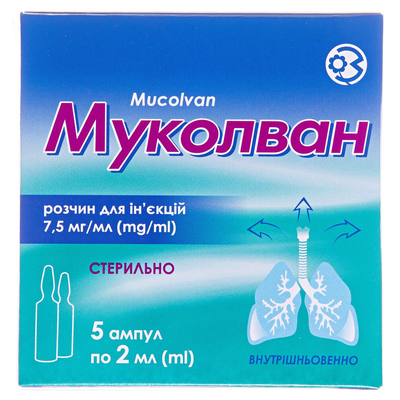
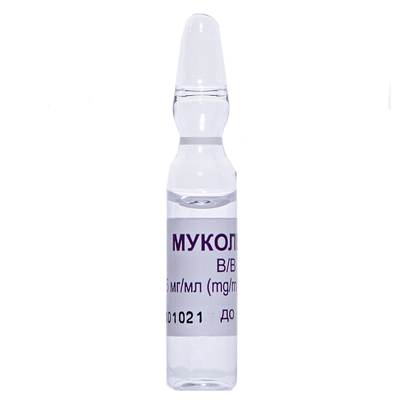
Mucolvan solution for injection, 7.5 mg/mL, 2 mL, No. 5 in ampoules
Ingredients
Active ingredient: ambroxol;
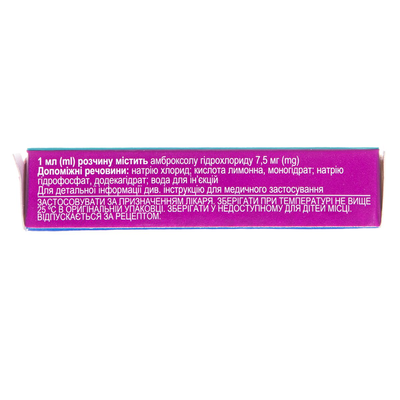
1 mL of solution contains 7.5 mg of ambroxol hydrochloride;
excipients: sodium chloride; citric acid, monohydrate; sodium hydrophosphate, dodecahydrate; water for injection.
Dosage Form
Solution for injection.
Main physical and chemical properties: colorless, clear liquid.
Pharmacotherapeutic group
Agents used for cough and the common cold. Mucolytics. ATC code R05C B06.
Pharmacological properties
Pharmacodynamics. Ambroxol hydrochloride, the active ingredient of this medication, has been shown to increase mucus secretion in the respiratory tract. It also enhances the release of pulmonary surfactant and stimulates the activity of the ciliated epithelium. These actions improve mucus separation and its clearance (mucociliary clearance). The activation of fluid secretion and the increase in mucociliary clearance facilitate mucus clearance and relieve coughing.
It is known that ambroxol hydrochloride reduces the levels of cytokines, as well as the number of circulating and tissue-bound mononuclear and polymorphonuclear cells.
Antioxidant effects of ambroxol have also been observed.
Following administration of ambroxol hydrochloride, the concentration of antibiotics (amoxicillin, cefuroxime, erythromycin) in bronchopulmonary secretions and sputum increases.
Pharmacokinetics. Ambroxol hydrochloride binds to plasma proteins by approximately 90% in adults and 60–70% in newborns. The drug crosses the placental barrier and reaches the fetal lungs. The large volume of distribution—410 L—indicates greater accumulation in tissues than in plasma; the concentration in lung tissue exceeds the corresponding plasma concentration by a factor of >17.
Metabolism and Excretion. Ambroxol hydrochloride is metabolized primarily in the liver via glucuronidation and, to a lesser extent, via cleavage to dibromanthranilic acid (the latter accounting for approximately 10% of the dose); other minor metabolites are also formed. Studies of human liver microsomes have shown that the CYP3A4 enzyme is responsible for the metabolism of ambroxol hydrochloride to dibromanthranilic acid.
Three days after intravenous administration, 4.6% of the dose is excreted unchanged, while 35.6% of the dose is excreted in a conjugated form in the urine.
The half-life of ambroxol hydrochloride in plasma is approximately 10 hours. In newborns, following repeated intravenous administration, the half-life approximately doubles, indicating a decrease in clearance.
In patients with severe liver disease, the clearance of ambroxol is reduced by 20–40%. In patients with severe renal impairment, accumulation of ambroxol metabolites—namely, dibromantranilic acid and glucuronides—may occur.
Ambroxol crosses the blood-brain and placental barriers and is excreted into breast milk.
Indications
To enhance the production of pulmonary surfactant in premature infants and newborns with respiratory distress syndrome.
Contraindications
Hypersensitivity to ambroxol hydrochloride or other components of the drug.
Interactions with Other Medications and Other Types of Interactions
To date, no clinically significant interactions between this medication and other drugs have been identified.
Concomitant use of this medication with cough suppressants may lead to excessive mucus accumulation due to suppression of the cough reflex; such a combination is permissible only after a physician has carefully assessed the balance between the expected benefits and the potential risks of use.
Special Considerations for Use
Since ambroxol may increase mucus secretion, the drug should be used with caution in cases of impaired bronchial motility and increased mucus secretion (for example, in a rare condition such as primary ciliary dyskinesia).
The drug should be used with caution in patients with impaired renal function or severe liver disease. When using ambroxol, as with any active ingredient that is metabolized in the liver and then excreted by the kidneys, accumulation of metabolites formed in the liver has been observed in patients with severe renal insufficiency.
Very rarely, severe skin reactions, such as Stevens-Johnson syndrome or Lyell’s syndrome, have occurred, sometimes in association with the use of ambroxol. Most of these cases are associated with the underlying disease or with the concomitant use of another medication. If any changes in the skin or mucous membranes occur, ambroxol should be discontinued and a doctor should be consulted immediately.
This medication contains less than 1 mmol (23 mg) of sodium per dose, meaning it is essentially sodium-free.
Use during pregnancy or breastfeeding. This medication is used in premature infants and newborns.
Effect on reaction time when operating motor vehicles or other machinery. This medication is used in premature infants and newborns.
Dosage and Administration
A total daily dose of 30 mg of ambroxol hydrochloride per 1 kg of body weight has been shown to be effective.
Administer the dose in 4 divided doses by slow intravenous infusion; it is recommended to administer each individual dose by intravenous infusion using an infusion pump for at least 5 minutes.
The contents of 1–6 ampules should be diluted in 250–500 mL of saline or Ringer’s solution.
From a microbiological standpoint, if opening the ampoules and diluting the solution poses a risk of microbiological contamination, the solution should be used immediately after preparation. If this is not done, the user is responsible for the storage conditions and duration. If none of these diluents are available, a 5% glucose solution may be used as an alternative. When using a 5% glucose solution, the contents of the ampoules should be diluted immediately before use. If the solution is not used immediately after preparation, it must be discarded.
Duration of treatment: 5 days.
Children. Use in premature infants and newborns as indicated.
Overdose
There are currently no reports of specific symptoms of overdose. Symptoms observed in cases of accidental overdose or medical error are similar to the known adverse reactions when used at recommended doses and may require symptomatic treatment.
Side Effects
Immune system, skin, and subcutaneous adipose tissue disorders: erythema; anaphylactic reactions (including shock); angioedema, skin rashes, hives, itching, and other hypersensitivity reactions; severe skin lesions: Stevens-Johnson syndrome and Lyell’s syndrome.
Gastrointestinal system: dry mouth, constipation, hypersalivation, dry throat; nausea, vomiting, diarrhea, dyspepsia, abdominal pain.
Respiratory, thoracic, and mediastinal disorders: rhinorrhea, dyspnea (as a symptom of a hypersensitivity reaction).
Renal and urinary system: urinary disorders.
General disorders and administration site conditions: fever and chills, mucosal reactions.
Shelf life
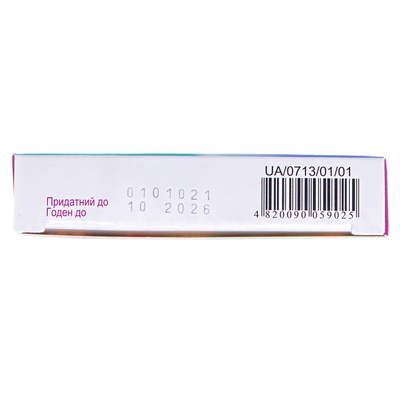
5 years.
Storage conditions
Store at a temperature not exceeding 25 °C in the original packaging.
Keep out of reach of children.
Incompatibility
This medication should not be mixed with any other medications except those listed in the “Dosage and Administration” section.
Packaging
2 mL in ampoules, 5 per pack; 5 in a blister pack per pack.
Dispensing Category
By prescription only.