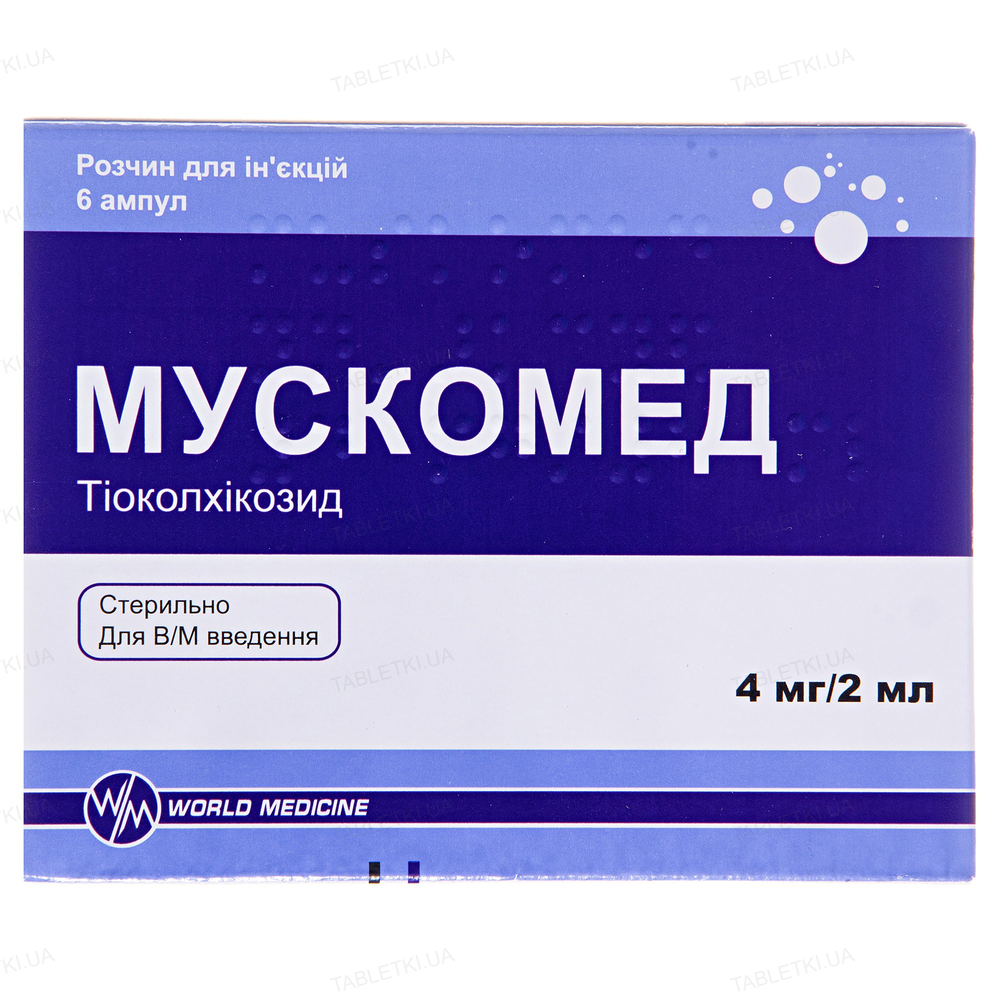
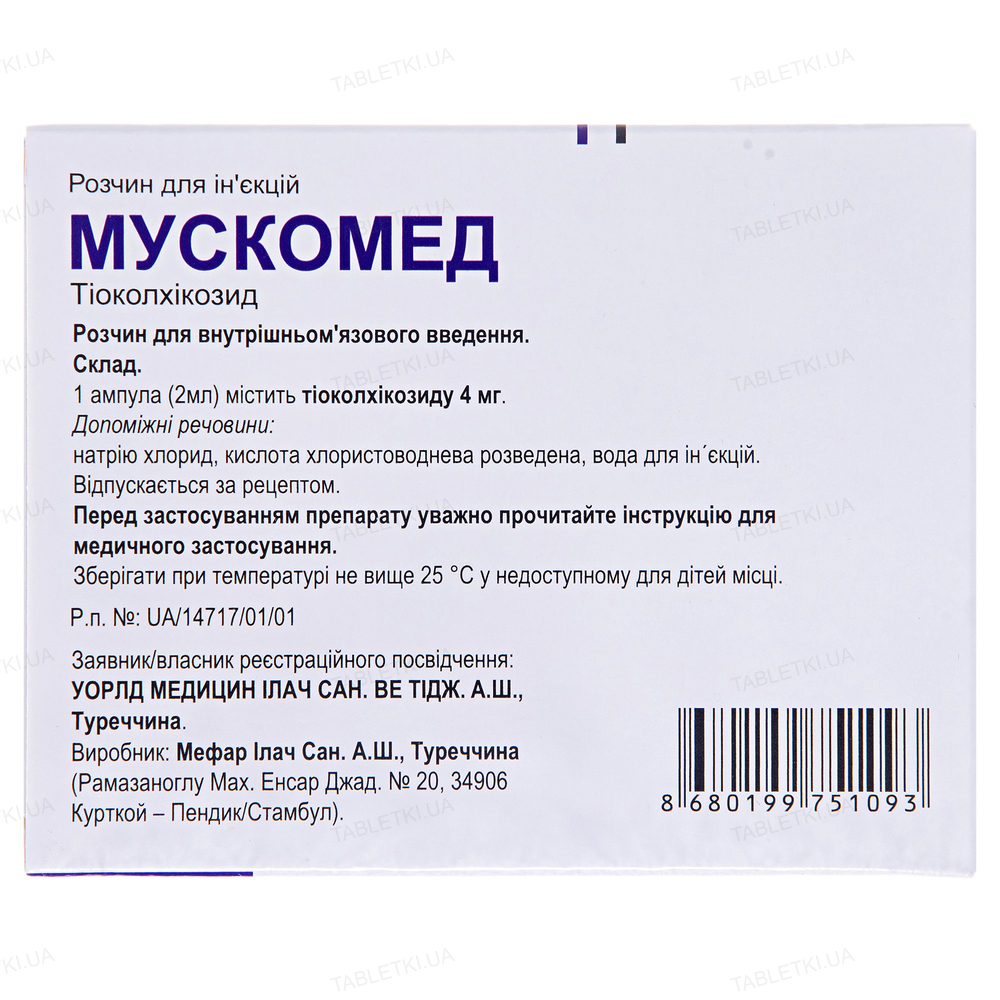
Muscomed solution for injection, 4 mg/2 mL, 2 mL per ampoule, No. 6
Ingredients
Active ingredient: thiocolchicoside;
1 ampule (2 mL) contains 4 mg of thiocolchicoside;
excipients: sodium chloride, diluted hydrochloric acid, water for injection.
Dosage Form
Solution for injection.
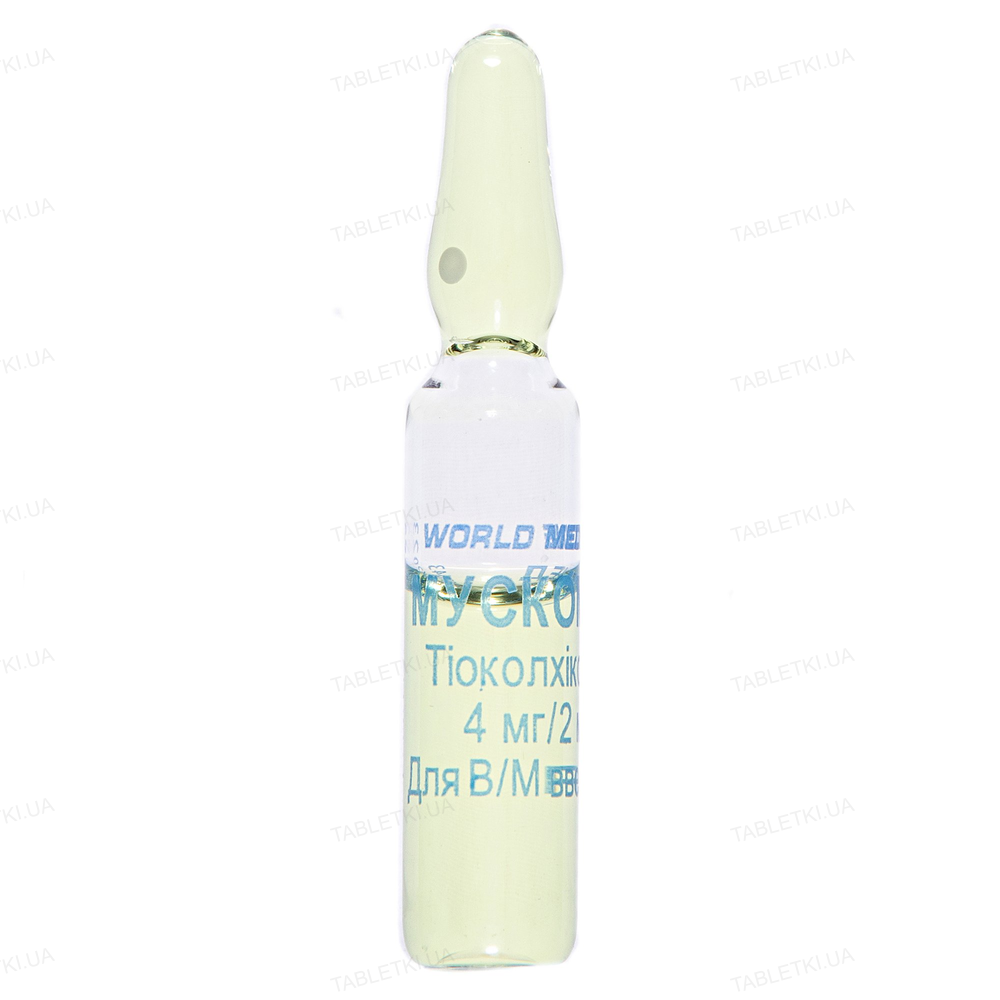
Main physical and chemical properties: a clear, light-yellow solution.
Pharmacotherapeutic group
Central-acting muscle relaxants. ATC code M0ZV X05.
Pharmacological properties
Pharmacodynamics.
Thiocolchicoside is a semisynthetic sulfide derivative of colchicoside that exerts a muscle-relaxing effect.
In in vitro studies, thiocolchicoside binds exclusively to GABA and strychnine-sensitive glycine receptors. Thiocolchicoside exhibits selective affinity for GABA receptors and produces an effective muscle-relaxing effect through regulatory complex mechanisms at various levels of the nervous system; however, its glycinergic mechanism of action cannot be ruled out.
The characteristics of thiocolchicoside’s interaction with GABA receptors are the same as those of its glucuronide derivative, which is the major metabolite (see below).
In in vivo studies, the muscle-relaxing properties of thiocolchicoside and its major metabolite were demonstrated in various experimental models.
Additionally, electroencephalographic studies have shown that thiocolchicoside and its major metabolite do not cause a sedative effect.
Pharmacokinetics.
Absorption.
Following intramuscular administration, the maximum plasma concentration (Cmax) of thiocolchicoside is observed after 30 minutes; levels of 113 ng/mL are reached after administration of a 4 mg dose, and 175 ng/mL after an 8-mg dose. The corresponding area under the pharmacokinetic curve (AUC) values are 283 and 417 ng·h/mL.
The pharmacologically active metabolite SL18.0740 is also detected at lower concentrations, with a Cmax of 11.7 ng/mL, which is reached 5 hours after dosing, and an AUC of 83 ng·h/mL.
No data are available for the inactive metabolite SL59.0955.
Distribution.
The apparent volume of distribution of thiocolchicoside is approximately 42.7 L following intramuscular administration of 8 mg. No data are available for either metabolite.
Elimination.
The half-life of thiocolchicoside is 1.5 hours, and its plasma clearance is 19.2 L/h.
Indications
Adjunctive therapy for painful muscle contractures in cases of acute spinal disorders in adults and adolescents aged 16 years and older.
Contraindications
- Hypersensitivity to the active ingredient or to any of the drug’s excipients;
- flaccid paralysis, muscle hypotonia;
- pregnancy;
- breastfeeding;
- use in women of childbearing age who are not using appropriate contraception.
Interactions with Other Medications and Other Types of Interactions
No information on interactions is available.
Special considerations for use
Cases of vasovagal syncope have been reported following intramuscular injection of thiocolchicoside; therefore, the patient’s condition should be monitored after administration of the drug (see the “Adverse Reactions” section).
During the postmarketing period, cases of liver damage associated with the use of thiocolchicoside have been reported. Severe cases of liver damage (e.g., fulminant hepatitis) have been reported in patients who were concurrently taking nonsteroidal anti-inflammatory drugs (NSAIDs) or acetaminophen. If signs of liver damage develop during treatment with this medication, treatment should be discontinued and a doctor should be consulted (see the “Adverse Reactions” section).
While taking thiocolchicoside, epileptic seizures may occur in patients with epilepsy or conditions associated with a risk of seizures (see the “Adverse Reactions” section).
Do not exceed the maximum recommended dose of thiocolchicoside of 8 mg per day, which should be divided into 2 doses administered 12 hours apart. If a dose is missed, the next dose should be taken at the usual time.
According to preclinical studies, one of the metabolites of thiocolchicoside, SL59.0955 causes aneuploidy (a change in the number of chromosomes in dividing cells) at concentrations approximating 8 mg twice daily when administered orally, which had a similar effect in humans.
Aneuploidy is considered a risk factor for teratogenicity, embryo/fetal toxicity, miscarriage, changes in male fertility, and a potential risk factor for cancer. As a precaution, exceeding the recommended dose of the drug or prolonged use should be avoided (see the “Dosage and Administration” section).
Patients should be thoroughly informed about the potential risks to a possible pregnancy and about effective methods of contraception that should be used.
This medication contains less than 1 mmol (23 mg) of sodium per dose, meaning it is essentially sodium-free.
Use During Pregnancy or Breastfeeding.
Pregnancy.
Information on the use of thiocolchicoside in pregnant women is limited; therefore, the potential risk to the embryo and fetus is unknown. Animal studies have shown that thiocholchicoside has teratogenic effects. This medication is contraindicated during pregnancy and for women of childbearing age who are not using appropriate contraception (see the “Contraindications” section).
Breastfeeding.
Thiocholchicoside passes into breast milk. The drug is contraindicated during breastfeeding (see the “Contraindications” section).
Fertility.
Fertility studies conducted in animals showed no changes in fertility at doses not exceeding 12 mg/kg, i.e., at doses that did not produce a clinical effect. Thiocholchicoside and its metabolites have an aneugenic effect at various concentration levels, which is a risk factor for human fertility.
Effect on the ability to react while driving or operating machinery.
No studies have been conducted on the effect of thiocolchicoside on the ability to drive or operate machinery.
Drowsiness may occur during treatment with thiocolchicoside, which should be taken into account when driving or operating machinery.
Dosage and Administration
This medication is intended for intramuscular administration.
The recommended maximum daily dose is 4 mg every 12 hours (8 mg per day).
Treatment should not exceed 5 consecutive days.
Do not exceed the recommended dose or duration of use (see the “Special Instructions for Use” section).
Children.
This medication is contraindicated for use in children under 16 years of age.
Overdose
There are no reports of overdose. In the event of an overdose, close medical supervision of the patient and symptomatic treatment are recommended.
Side Effects
The adverse reactions listed below are categorized according to MedDRA organ system classes and frequency: very common (≥1/10), common (≥1/100, <1/10), uncommon (≥1/1,000, <1/100), rare (≥1/10,000, <1/1,000), very rare (<1/10,000), unknown (frequency cannot be estimated from the available data).
Immune system disorders:
uncommon – pruritus; rare – urticaria; very rare – hypotension; unknown – angioedema and anaphylactic reactions, including anaphylactic shock.
Nervous system disorders:
common – drowsiness; rare – agitation or transient confusion; unknown – malaise, with or without vasovagal syncope, occurring within the first few minutes after intramuscular injection; convulsions (see the “Special Considerations for Use” section).
Gastrointestinal system:
Common – diarrhea, stomach pain; Uncommon – nausea, vomiting; Rare – heartburn.
Hepatobiliary system:
frequency unknown – liver damage (see the “Special Precautions for Use” section).
Skin and subcutaneous tissue disorders:
uncommon – allergic skin reactions.
Reporting of Suspected Adverse Reactions.
Reporting suspected adverse reactions that occur after the drug’s approval is very important. This allows for ongoing monitoring of the drug’s benefit-risk balance. Healthcare professionals are asked to report any suspected adverse reactions through the national reporting system.
Shelf life
3 years.
Storage Conditions
Store at a temperature not exceeding 25 °C, out of the reach of children.
Packaging
2 mL of solution in a colorless glass ampoule; 6 ampoules in a blister pack; 1 blister pack in a cardboard box.
Manufacturer
Mefar Ilac San. A.Ş., Turkey/
Mefar Ilac San. A.S., Turkey.
Address
Ramazanoglu Mah. Ensar St. No. 20, 34906 Kurtkoy – Pendik/Istanbul, Turkey.
Applicant
WORLD MEDICINE, LLC, Ukraine/
WORLD MEDICINE, LLC, Ukraine.