
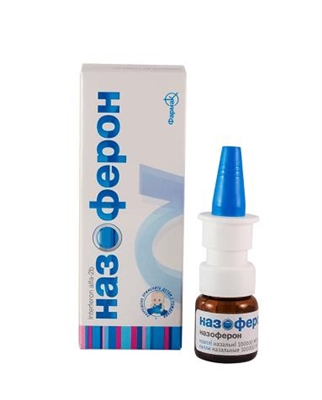
Nazoferon nasal drops, 100,000 IU/mL, 5 mL per glass bottle.
Composition
Active ingredient: interferon alfa-2b;
1 mL of drops contains 100,000 IU of recombinant human interferon alfa-2b;
excipients: trometamol, trometamol hydrochloride, hypromellose, disodium edetate, lysine hydrochloride, potassium chloride, methyl parahydroxybenzoate (E 218), water for injection.
Dosage Form
Nasal drops.
Main physical and chemical properties: clear, colorless liquid.
Pharmacotherapeutic group
Immunostimulants. Interferons. Interferon alpha-2b.
ATC code L03A B05.
Pharmacological properties
Pharmacodynamics.
NAZOFERON® is an antiviral, antimicrobial, anti-inflammatory, immunomodulatory, and antiproliferative agent. The biological action of interferon is characterized by the following effects: antiviral—inhibits viral replication (adenoviruses, influenza viruses) by inhibiting transcription and translation processes; antiproliferative—inhibits cell proliferation (of most DNA- and RNA-containing viruses). Interferon initiates the synthesis of a specific enzyme—protein kinase—which inhibits translation by phosphorylating one of the initiation factors of this process; activates a specific ribonuclease that damages the viral messenger RNA. The effects of interferon also include: stimulation of the production of other cytokines, induction of specific enzymes, inhibition of cell proliferation, and immunomodulation (enhancement of macrophage phagocytic activity and specific cytotoxicity of lymphocytes against target cells). Interferon is an immune mediator with pronounced tissue specificity that protects the body against infectious agents.
Pharmacokinetics.
Not studied.
Indications
Prevention and treatment of acute respiratory viral infections (ARVI) in children aged 1 month and older and adults:
- in patients who frequently and chronically suffer from upper respiratory tract diseases;
- upon contact with individuals with ARVI;
- in cases of hypothermia;
- during seasonal spikes in incidence in organized groups (children and adults), particularly among high-risk groups such as healthcare workers and teachers, especially during an epidemic.
Contraindications
Hypersensitivity to interferon alfa-2b and other components of the drug; a history of severe allergic diseases. Pregnancy or breastfeeding.
Interactions with Other Medications and Other Types of Interactions
Concomitant use of intranasal vasoconstrictors is not recommended, as they contribute to dryness of the nasal mucosa.
Special Instructions for Use
Administer the medication into each nostril.
Before using the medication, lie on your back or sit down, tilt your head back slightly, and turn it toward the nostril into which the drops will be administered, and, without letting the dropper touch the inner walls of the nose, instill the medication. Immediately after instillation, to ensure even distribution of the medication over the nasal mucosa, it is recommended to gently massage the sides of the nose with your fingers for several minutes.
Administer the drops to children under adult supervision.
This medication contains methyl parahydroxybenzoate, which may cause allergic reactions, including delayed reactions, and, in rare cases, bronchospasm.
Do not use the product if the packaging is damaged or the label is missing, if the physical properties (color or clarity of the liquid) have changed, or after the expiration date has passed.
To prevent the spread of infection, individual use is recommended.
Avoid contact with the mucous membranes of the eyes.
Use during pregnancy or breastfeeding.
Use is contraindicated.
Effect on reaction time when operating motor vehicles or other machinery.
No effect.
Dosage and Administration
At the first signs of an acute respiratory viral infection (within 5 days)
Children aged 1 month to 1 year: 1 drop in each nostril 5 times daily (single dose: 8,000 IU; daily dose: 40,000 IU).
Children aged 1 to 3 years: 2 drops in each nostril 3–4 times daily (single dose: 16,000 IU; daily dose: 48,000–64,000 IU).
Children aged 3 to 14 years: 2 drops in each nostril 4–5 times a day (single dose: 16,000 IU; daily dose: 64,000–80,000 IU).
Children aged 14 to 18 years: 2 drops in each nostril 5–6 times a day (single dose: 16,000 IU; daily dose: 80,000–96,000 IU).
Adults: 3 drops in each nostril 5–6 times a day (single dose: 24,000 IU; daily dose: 120,000–144,000 IU).
For the prevention of respiratory viral infections
Upon contact with an infected person or in case of hypothermia—administer according to the age-based dosage twice daily for 5–7 days. Repeat preventive courses as needed. A single application is sufficient for a one-time exposure.
During seasonal spikes in illness—administer a single dose in the morning at age-appropriate dosage, with an interval of 1–2 days between doses.
Directions for use of nasal drops in a bottle sealed with a dropper:
1. Remove the protective cap from the bottle.
2. Turn the bottle upside down with the nozzle facing down; before using the drops for the first time, press the pump dispenser a few times to test it.
3. Place the tip of the nozzle alternately into each nostril and press the pump dispenser the required number of times according to the dosage.
4. After use, replace the cap on the bottle.

Children.
Use in children 1 month of age and older.
Overdose
Not studied.
Side Effects
In rare cases, skin rash may occur.
If any adverse reactions occur, consult a doctor.
Shelf Life
3 years.
Shelf life after opening the vial, when stored at a temperature between 2 °C and 8 °C (in the refrigerator), is 10 days.
Do not use the product after the expiration date indicated on the packaging.
Storage Conditions
Store in a place protected from light at a temperature between 2 °C and 8 °C. Keep out of the reach of children.
Packaging
5 mL in glass vials sealed with dropper caps. One vial per pack.
Dispensing Category
Available without a prescription.
Manufacturer
JSC “Farmak.”







