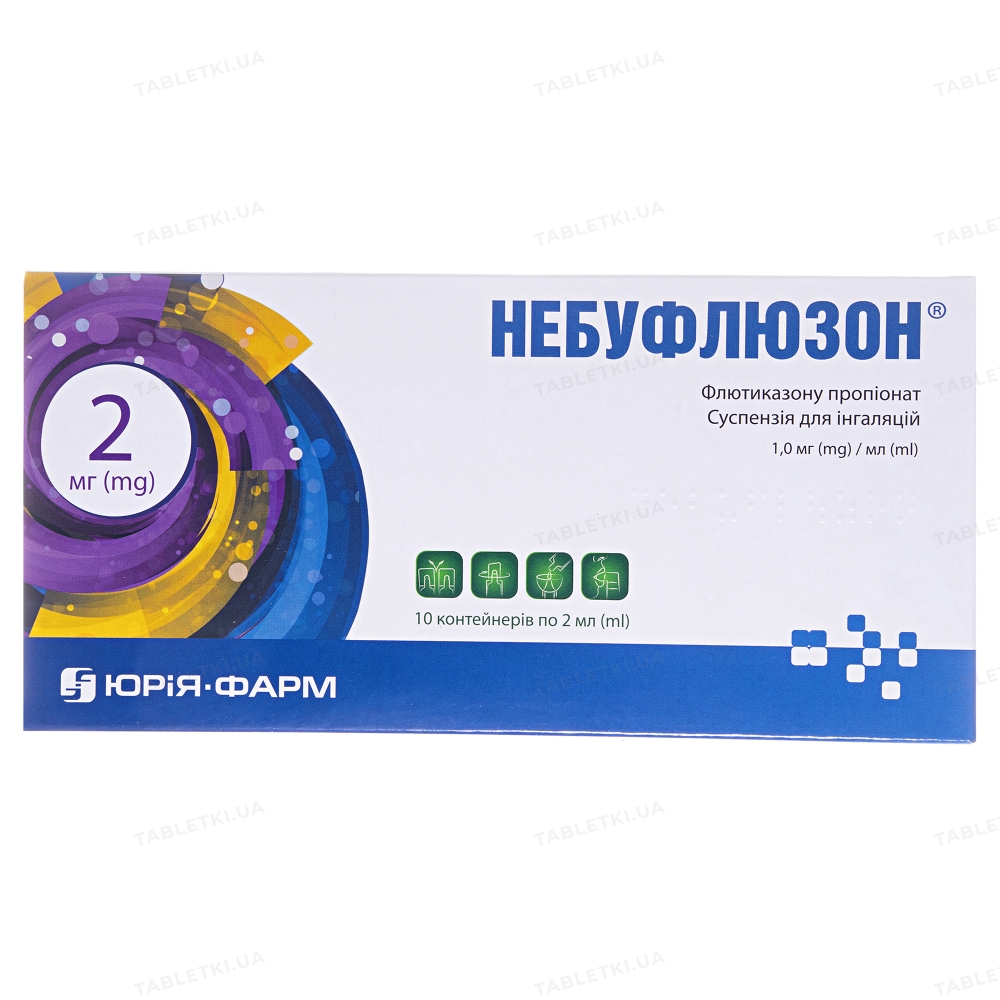
Nebufluzone suspension for injection, 1 mg/mL, 2 mL each, No. 10 in single-use containers.
Composition
Active ingredient: fluticasone propionate;
1 mL of suspension contains 1 mg of fluticasone propionate;
excipients: decamethoxin; polysorbate 80; sodium dihydrogen phosphate dihydrate; anhydrous sodium hydrogen phosphate; sodium chloride; water for injection.
Dosage Form
Suspension for inhalation.
Main physical and chemical properties: a white, opaque suspension that disperses easily.
Pharmacotherapeutic group
Anti-asthmatic agents for inhalation. Glucocorticoids. ATC code R03B A05.
Pharmacological properties
Pharmacodynamics.
The glucocorticosteroid fluticasone propionate, when used at the recommended doses for inhalation, exerts a potent anti-inflammatory effect on the lungs, leading to a reduction in symptoms and the frequency of asthma attacks.
Pharmacokinetics.
Following inhalation, the systemic bioavailability of non-nebulized fluticasone propionate in healthy volunteers is expected to be 8%, compared to 26% when the drug is administered via a metered-dose inhaler. Systemic absorption occurs primarily through the respiratory tract, initially rapidly and then over a prolonged period. Any residual inhaled dose in the mouth may be swallowed.
Absolute oral bioavailability is very low (<1%) due to a combination of incomplete absorption from the gastrointestinal tract and extensive first-pass metabolism. 87–100% of the oral dose is excreted in the feces, up to 75% as the parent compound and as the inactive major metabolite.
Safety Data
Toxicological studies have shown only effects typical of potent corticosteroids, but at doses many times higher than those indicated for therapeutic use. In studies investigating the drug’s effects on reproductive function and the presence of teratogenic properties, no new data were identified. Fluticasone propionate has no mutagenic activity in vitro or in vivo. Animal studies have demonstrated that the drug has no carcinogenic potential and exhibits no irritant or sensitizing properties.
Indications
Adults and adolescents aged 16 years and older
Prophylactic use in severe asthma in patients requiring high doses of inhaled or oral corticosteroids. For patients being treated with high doses of oral corticosteroids, to reduce or eliminate the use of oral corticosteroids.
Children and adolescents aged 4 to 16 years
Treatment of asthma exacerbations. Appropriate maintenance therapy may be supplemented with a metered-dose aerosol or powder inhaler.
Inhaled fluticasone propionate has a potent glucocorticoid anti-inflammatory effect in the lungs. It reduces asthma symptoms and exacerbations in patients who were previously treated with bronchodilators alone or in combination with other preventive medications. Short-term symptomatic exacerbations can generally be relieved with fast-acting bronchodilators, but longer-lasting exacerbations require the early addition of corticosteroid therapy to control inflammation.
Contraindications
A history of hypersensitivity to any of the drug’s components.
Drug Interactions and Other Interactions
Under normal conditions, low plasma concentrations of fluticasone propionate are achieved following inhalation due to extensive first-pass metabolism and high systemic clearance of the drug, mediated by cytochrome P450 3A4 in the liver and intestines. Therefore, the likelihood of clinically significant drug interactions mediated by fluticasone propionate is very low.
According to drug interaction studies in healthy volunteers with intranasal fluticasone propionate, it was shown that ritonavir (a potent inhibitor of cytochrome P450 3A4) 100 mcg twice daily can increase the plasma concentration of fluticasone propionate by a factor of 100, leading to a significant decrease in serum cortisol concentration. There is insufficient information regarding such an interaction with inhaled fluticasone propionate, but the aforementioned increase in fluticasone propionate plasma concentrations may occur. There have also been reports of Cushing’s syndrome and adrenal suppression. Concomitant use of fluticasone propionate and ritonavir should be avoided, unless the benefit of such use outweighs the risk of systemic corticosteroid effects.
In a small study conducted with healthy volunteers, ketoconazole, a less potent CYP3A inhibitor, increased the concentration of fluticasone propionate after a single inhalation by up to 150%, resulting in a significant decrease in serum cortisol concentrations compared with the use of fluticasone propionate alone. When used concomitantly with other potent CYP3A inhibitors, such as itraconazole, an increase in systemic fluticasone propionate concentrations and a risk of systemic effects are also expected. Caution should be exercised, and prolonged use of this drug combination should be avoided whenever possible.
Concomitant use of fluticasone propionate with other potent CYP3A inhibitors, including cobicistat-containing medications, is expected to increase the risk of systemic adverse effects.
Other CYP3A4 inhibitors cause a very small (erythromycin) and small (ketoconazole) increase in systemic exposure to fluticasone propionate without a noticeable decrease in serum cortisol concentrations. Such combinations should be avoided unless the expected benefit outweighs the potential increased risk of systemic corticosteroid side effects; in such cases, patients should be monitored for the development of systemic adverse events.
Special Considerations for Use
Treatment of bronchial asthma should be conducted according to a stepwise program; the patient’s condition must be monitored regularly, both clinically and through the assessment of pulmonary function parameters.
A sudden and progressive worsening of asthma control is a potentially life-threatening condition, and consideration should be given to increasing the dose of corticosteroids. If such a risk arises, the patient should undergo daily peak flow measurement.
Nebufluzone is not intended to relieve acute asthma attacks, for which fast-acting and short-acting inhaled bronchodilators must be used. Patients should be advised to carry these medications with them at all times. Nebufluzone should be prescribed for long-term preventive treatment.
Nebufluzone is not a substitute for injectable or oral corticosteroids in emergency situations (e.g., severe, life-threatening asthma exacerbations).
Severe asthma requires constant medical monitoring, including assessment of pulmonary function, as there is a risk of acute asthma attacks and even death in such patients.
An increase in the frequency of use and dose of short-acting inhaled beta-2 agonists indicates a gradual loss of asthma control. If short-acting bronchodilators become less effective or if the patient needs to use them more frequently, the patient should consult a doctor. In such situations, patients need to undergo additional evaluation to determine whether anti-inflammatory therapy should be intensified (for example, by increasing the dose of inhaled corticosteroids or prescribing a course of oral corticosteroids). In cases of severe asthma exacerbation, standard therapy for this condition should be administered.
There have been isolated reports of elevated blood glucose levels in both patients with diagnosed diabetes mellitus and in patients without diabetes mellitus (see the “Adverse Reactions” section). This should be taken into account when prescribing Nebufluzone to patients with diabetes.
As with treatment using other inhaled medications, paradoxical bronchospasm with rapidly worsening shortness of breath may occur following inhalation. In this case, Nebufluzone inhalation should be discontinued immediately; the patient should be evaluated, and alternative therapy should be prescribed if necessary.
When inhaled corticosteroids are used in high doses and for prolonged periods, systemic effects may occur, but the likelihood of this is significantly lower than with oral steroids. Systemic effects may manifest as Cushing’s syndrome, Cushingoid features, adrenal suppression, growth retardation in children and adolescents, decreased bone mineralization, and, in rare cases, psychiatric disorders and behavioral changes, including psychomotor hyperactivity, sleep disturbances, restlessness, and depressive or aggressive states (primarily in children). Therefore, it is important that the dose of inhaled corticosteroids be reviewed regularly and reduced to the lowest possible dose that maintains effective control of asthma symptoms.
Long-term use of high doses of inhaled corticosteroids may cause adrenal suppression and an acute adrenal crisis. Children under 16 years of age are at particular risk when using doses of fluticasone that exceed the approved doses (usually ≥ 1,000 mcg/day). The development of an acute adrenal crisis may be triggered by trauma, surgery, infections, or a sudden reduction in the dose of the medication. Symptoms are usually nonspecific and may include anorexia, abdominal pain, weight loss, fatigue, headache, nausea, vomiting, altered mental status, hypoglycemia, and seizures. In cases of stress or surgical procedures, additional systemic corticosteroids may be required.
It is recommended to regularly monitor the growth of children undergoing long-term treatment with inhaled corticosteroids. If growth has slowed, therapy should be reviewed with the aim of reducing the dose of inhaled corticosteroids, if possible, to the minimum dose that maintains effective control of asthma symptoms. In addition, the child should be evaluated by a pediatric pulmonologist.
Some patients may be more sensitive to inhaled corticosteroids than most patients.
The use of inhaled fluticasone propionate should reduce the need for oral steroids. However, when switching from oral steroids to inhaled fluticasone propionate, patients remain at risk of adrenal suppression. The risk of adverse reactions persists for some time. Such patients may require specialized consultations to assess the extent of adrenal suppression before undergoing certain procedures. The possibility of residual adrenal insufficiency in emergency situations, including surgical procedures and other stressful situations, should be kept in mind, and the need for appropriate corticosteroid therapy should be considered.
Patients should receive doses of inhaled fluticasone propionate appropriate to the severity of their condition. The dosage should be reduced to the minimum effective dose that provides effective control of the disease. The use of systemic steroids and/or antibiotics may be necessary if effective control of the disease is not achieved.
Switching from systemic steroid therapy to inhaled therapy may sometimes unmask allergic conditions, such as allergic rhinitis or eczema, that were previously controlled by systemic steroid use. These allergic manifestations should be treated symptomatically with antihistamines and/or topical medications, including topical corticosteroids.
As with all inhaled corticosteroids, special attention is required for patients with active or latent pulmonary tuberculosis.
Treatment with Nebufluzone should not be discontinued abruptly.
Switching patients treated with oral corticosteroids to inhaled therapy.
The transition of patients being treated with oral steroids to Nebufluzone inhalation therapy and their subsequent treatment requires special attention, as the recovery of adrenal function—which has been weakened by prolonged systemic steroid therapy—may take a long time.
Long-term use of high doses of inhaled corticosteroids may cause adrenal suppression. Adrenal function in such patients should be monitored regularly. Doses of systemic steroids should be tapered with caution (see the “Dosage and Administration” section).
Some patients experience a nonspecific worsening of their condition during the transition period, despite stable or even improved respiratory function. They should continue the transition from systemic steroids to treatment with inhaled fluticasone propionate, unless objective symptoms of adrenal insufficiency develop.
Patients who have discontinued oral steroid therapy but whose adrenal function remains impaired, must carry a special card warning of the need for additional systemic steroid administration in stressful situations, such as an acute asthma attack, respiratory tract infections, significant intercurrent illnesses, surgical procedures, or trauma.
Ritonavir can significantly increase the plasma concentration of fluticasone propionate. Therefore, the concomitant use of fluticasone propionate and ritonavir should be avoided, except in cases where the benefit of such use outweighs the risk of systemic corticosteroid effects. There is also an increased risk of systemic effects of fluticasone propionate when used concomitantly with CYP3A4 inhibitors (see the section “Interactions with Other Medications and Other Types of Interactions”).
Visual Disturbances
Visual disturbances may occur with both systemic and topical use of corticosteroids. If a patient experiences symptoms such as blurred vision or other visual disturbances, they should be referred to an ophthalmologist to evaluate possible causes, which may include cataracts, glaucoma, or rare conditions such as central serous chorioretinopathy, the occurrence of which has been reported following the use of systemic and topical corticosteroids.
Use during pregnancy or breastfeeding.
Fertility
There are no data on the effects on human fertility. Animal studies have not shown any effect of fluticasone propionate on fertility.
Pregnancy
Experience with use during pregnancy in humans is limited.
When deciding whether to prescribe the drug during this period, the expected benefit to the mother and the potential risk to the fetus must be weighed. The results of a retrospective epidemiological study did not reveal an increased risk of major congenital malformations following exposure to fluticasone propionate during the first trimester of pregnancy compared with other inhaled corticosteroids.
Breastfeeding
It is currently unknown whether fluticasone propionate is excreted in breast milk; however, based on the drug’s pharmacological profile, this is unlikely. The drug should be used during breastfeeding only if the expected benefit to the mother outweighs the potential risk to the fetus.
Effect on reaction time when driving or operating machinery.
Any effect is unlikely.
Dosage and Administration
The drug is intended for inhalation use only.
Nebufluzone should be administered as an aerosol from a jet nebulizer. Since numerous factors affect drug delivery, follow the manufacturer’s recommendations for the nebulizer.
The use of Nebufluzone with ultrasonic nebulizers is generally not recommended.
Patients should be advised that treatment with inhaled fluticasone propionate is prophylactic and therefore must be used regularly even in the absence of symptoms.
If the effectiveness of short-acting bronchodilators decreases or if the patient needs to use them more frequently, the patient should consult a doctor.
The initial dose should be based on the severity of the disease. The dosage may be increased until control is achieved or reduced to the minimum effective dose that provides effective control of the disease.
Adults and adolescents 16 years of age and older: 0.5–2 mg of suspension twice daily.
Fluticasone propionate is effective at a dose that is half that of other inhaled corticosteroids. For example, 100 mcg of fluticasone propionate is approximately equivalent to a 200 mcg dose of beclomethasone dipropionate (containing CFC) or budesonide.
There is always a risk of systemic effects when using high doses of corticosteroids (see the “Special Considerations” and “Adverse Reactions” sections).
The initial dose of inhaled fluticasone propionate should be based on the severity of the patient’s condition.
The dosage should be reduced to the minimum effective dose that provides effective control of the disease.
Children and adolescents aged 4–16 years: 1 mg of suspension twice daily.
The dosage should be reduced to the lowest effective dose that provides effective control of the disease.
Specific patient groups.
No dose adjustment is necessary for elderly patients or patients with impaired liver or kidney function.
Switching patients who have been treated with oral corticosteroids to inhaled therapy.
Gradual withdrawal of systemic steroids begins approximately one week later. Dose reductions should correspond to the maintenance level of systemic steroids and occur at intervals of at least one week. In general, for a maintenance dose of prednisolone (or analogs) of 10 mg per day or less, the dose reduction should not exceed 1 mg per day at intervals of at least one week. For maintenance doses of prednisolone exceeding 10 mg per day, a dose reduction of more than 1 mg per day at intervals of at least one week is permitted, but with particular caution.
Nebufluzone must not be administered by injection.
It is recommended to administer the medication via a mouthpiece to prevent the development of atrophic changes in the facial skin, which may occur with prolonged use of a face mask.
When using a face mask, the facial skin exposed to the medication should be protected with a protective cream or by washing the face thoroughly after use.
Instructions for Use of Nebufluzone
Read the nebulizer manufacturer’s instructions.
Before use, make sure the contents of the container are well mixed. Hold the container horizontally by the edge with the label and shake it several times from the opposite end. Repeat this process several times until the contents are thoroughly mixed. To open the container, twist off the cap located on top.
If necessary, the medication can be diluted with a sodium chloride solution. Any unused solution remaining in the nebulizer container must not be reused. It must be discarded.
Children. Use in children 4 years of age and older.
Overdose
When Nebufluzone is used in doses exceeding the recommended ones, acute overdose may occur, manifested by temporary suppression of adrenal gland function. This does not require emergency care, as adrenal cortex function recovers within a few days, as confirmed by measurement of plasma cortisol levels.
However, when doses higher than recommended are used for an extended period, some suppression of adrenal function may occur; therefore, it may be necessary to assess adrenal reserve.
In the event of an overdose, therapy may be continued at doses necessary to control asthma symptoms. Patients receiving doses higher than recommended should be under close medical supervision, and their dose should be reduced gradually (see the “Special Considerations” section).
Side Effects
The side effects listed below are categorized by organ system and frequency of occurrence: very common (≥ 1/10), common (≥ 1/100 and < 1/10), uncommon (≥ 1/1,000 and < 1/100), rare (≥ 1/10,000 and < 1/1,000), very rare (< 1/10,000) and frequency unknown (frequency cannot be estimated from available data), including isolated reports. Data on adverse reactions occurring very commonly, commonly, and uncommonly are primarily based on clinical trials. Data on adverse reactions occurring rarely and very rarely are primarily obtained through spontaneous reports.
Infections and infestations
Very common: oral and pharyngeal candidiasis.
Some patients may develop oral and pharyngeal candidiasis (thrush). To prevent this, rinse the mouth after using Nebufluzone via a nebulizer. If necessary, prescribe a topical antifungal medication throughout the entire treatment period while continuing Nebufluzone therapy.
Common: Patients with COPD (chronic obstructive pulmonary disease) may develop pneumonia.
In clinical studies of patients with COPD who received fluticasone propionate at a dose of 500 mcg, an increase in the incidence of pneumonia was reported. Healthcare providers should be vigilant for the possible development of pneumonia in patients with COPD, as the clinical symptoms of pneumonia and COPD exacerbations often overlap.
Rare: esophageal candidiasis.
Immune system disorders
Hypersensitivity reactions with the manifestations listed below have been reported.
Uncommon: cutaneous hypersensitivity reactions.
Very rare: angioedema (primarily of the face and oropharynx), respiratory symptoms (dyspnea and/or bronchospasm), and anaphylactic reaction.
Eyes
Frequency unknown: blurred vision.
Endocrine system
Systemic effects are possible, very rarely including Cushing’s syndrome, Cushingoid features, adrenal suppression, growth retardation in children and adolescents, decreased bone mineralization, cataracts, and glaucoma (see the “Special Considerations for Use” section).
Metabolic disorders
Very rare: hyperglycemia (see the “Special Precautions for Use” section).
Gastrointestinal system
Very rare: dyspepsia.
Musculoskeletal and connective tissue disorders
Very rare: arthralgia.
Psychiatric disorders
Very rare: restlessness, sleep disturbances, behavioral changes, including hyperactivity and agitation (mainly in children).
Frequency unknown: depression, aggression (mainly in children).
Respiratory system and chest
Common: hoarseness.
In some patients, inhaled fluticasone propionate may cause hoarseness; in such cases, gargling with water immediately after inhalation may be helpful.
Very rare: paradoxical bronchospasm (see the “Special Considerations for Use” section).
Frequency unknown: nosebleeds.
Skin and subcutaneous tissue
Common: bruising.
Shelf life
3 years.
Storage conditions
Store out of the reach of children at a temperature not exceeding 25 °C. Do not freeze or expose to direct sunlight.
Opened containers should be stored in the refrigerator and used within 12 hours after opening.
Store in an upright position.
Packaging
2 mL per single-dose container; 10 containers per package; 1 package per cardboard box.
Manufacturer
Yuria-Pharm LLC.
Manufacturer’s location and address of operations.
Ukraine, 18030, Cherkasy Oblast, Cherkasy, 108 Kobzarska St. Tel.: (044) 281-01-01.