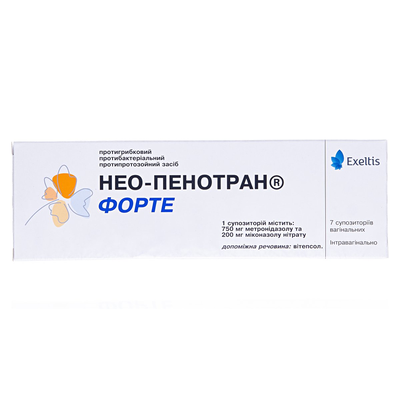
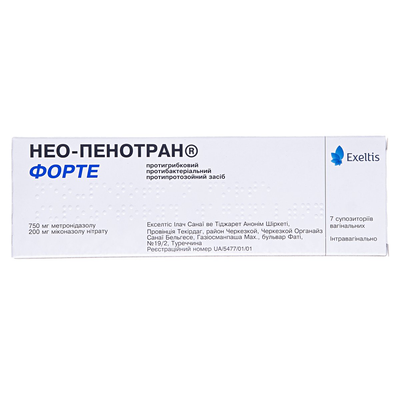

Neo-Penotran Forte Vaginal Suppositories, No. 7
Composition
Active ingredients: metronidazole and miconazole nitrate;
1 suppository contains 750 mg of metronidazole and 200 mg of miconazole nitrate;
Excipient: Vitepsol.
Dosage Form
Vaginal suppositories.
Main physical and chemical properties: suppositories in the form of flat, white to yellowish tablets.
Pharmacotherapeutic group
Antimicrobial, antiprotozoal, and antifungal agents.
ATC code G01A F20.
Pharmacological properties
Pharmacodynamics.
Neo-Penotran® Forte contains miconazole nitrate, which has antifungal activity, and metronidazole, which has antibacterial and antitrichomonal activity. Miconazole nitrate, an antifungal agent and a synthetic imidazole derivative, has a broad spectrum of activity and is particularly effective against pathogenic fungi, including Candida albicans. In addition, miconazole nitrate is effective against Gram-positive bacteria. Miconazole exerts its effect by inhibiting ergosterol synthesis in the cytoplasmic membrane. Miconazole nitrate alters the permeability of fungal cells of the Candida species and inhibits glucose utilization in vitro.
Metronidazole, a 5-nitroimidazole derivative, is an antiprotozoal and antibacterial agent; it is effective against several infections caused by anaerobic bacteria and protozoa, such as Trichomonas vaginalis, Gardnerella vaginalis, and anaerobic bacteria, including anaerobic streptococci.
Miconazole nitrate and metronidazole do not have synergistic or antagonistic effects.
The clinical cure rate achieved in an open-label, multicenter, uncontrolled clinical trial of the efficacy and safety of Neo-Penotran® Forte, was 96.6% for candidal vulvovaginitis, 98.1% for bacterial vaginosis, 97.3% for trichomonal vaginitis, and 98.5% for mixed vaginal infections. The microbiological cure rate was 89.8%, 96.2%, 100%, and 91.7% for each type of infection, respectively.
In a randomized, open-label comparative study of the efficacy, safety, and tolerability of Neo-Penotran® Forte, the rates of clinical and microbiological cure were 84% and 76%, respectively.
Pharmacokinetics.
Absorption.
Miconazole nitrate. The absorption of miconazole nitrate following intravaginal administration is very low (approximately 1.4% of the dose). Following intravaginal administration of NEO-PENOTRAN® FORTE, miconazole nitrate was not detected in plasma.
Metronidazole: The bioavailability of metronidazole via this route of administration is 20% compared to oral administration. Steady-state plasma concentrations of metronidazole ranged from 1.1 to 5 μg/mL following once-daily intravaginal administration of NEO-PENOTRAN® FORTE.
Distribution.
Miconazole nitrate. Plasma protein binding is 90%–93%. Its penetration into the cerebrospinal fluid is low, but it is widely distributed in other tissues. The volume of distribution is 1,400 L.
Metronidazole. It penetrates into body tissues and fluids, including bile, bone, mammary glands, breast milk, cerebral abscesses, cerebrospinal fluid, liver and liver abscesses, saliva, seminal fluid, and vaginal secretions, and reaches concentrations similar to those found in plasma. It crosses the placental barrier and rapidly enters the fetal circulation. No more than 20% binds to plasma proteins. The volume of distribution is 0.25–0.85 L/kg.
Biotransformation.
Miconazole nitrate. Metabolized in the liver. Two inactive metabolites have been identified (2,4-dichlorophenyl-1H-imidazole ethanol and 2,4-dichloro mandelic acid).
Metronidazole. Metabolized by the liver via oxidation; the hydroxyl metabolite is active. The major metabolites of metronidazole—hydroxyl and acetic acid metabolites—are excreted in the urine. The hydroxyl metabolite has 30% of the biological activity of metronidazole.
Elimination.
Miconazole nitrate. The half-life is 24 hours. Less than 1% is excreted in the urine. Approximately 50% is excreted in the feces, usually unchanged.
Metronidazole. The half-life is 6–11 hours. Approximately 6–15% of the metronidazole dose is excreted in the feces; 60–80% remains unchanged and is excreted in the urine, as are its metabolites. Approximately 20% of metronidazole is excreted in the urine as the unchanged drug.
Data from preclinical studies.
The results of standard preclinical studies on repeated-dose toxicity, genotoxicity, carcinogenicity, and reproductive toxicity do not indicate any specific risk to humans.
In an in vitro microbiological study, no synergistic or antagonistic interactions were observed between the active ingredients in the formulation when tested against Candida albicans, Streptococcus (Gram B according to Lancefield), Gardnerella vaginalis, and Trichomonas vaginalis.
Preclinical studies of the combination of 750 mg of metronidazole and 200 mg of miconazole nitrate showed no potentiation or synergy of the lethal or toxic effects of either component in female rats.
In a study of vaginal mucosal irritation in female Beagle dogs using the same combination of drugs, it was determined that it does not cause vaginal mucosal irritation and does not lead to clinical, biochemical, or hematological abnormalities. In the same study, no local or systemic toxic effects were observed.
Indications
For the treatment of candidal vulvovaginitis caused by Candida albicans, bacterial vaginosis caused by anaerobic bacteria and Gardnerella vaginalis, trichomoniasis caused by Trichomonas vaginalis, and mixed vaginal infections.
Contraindications
- Hypersensitivity to any of the active ingredients of the drug or to their derivatives.
- Consumption of alcoholic beverages during treatment or within 3 days after treatment.
- Taking disulfiram during treatment or for 2 weeks after treatment.
- Porphyria.
- Epilepsy.
- Severe liver dysfunction.
Drug Interactions and Other Interactions
Due to the absorption of metronidazole, drug interactions may occur when used concomitantly with certain substances and medications:
alcohol: the interaction of metronidazole with alcohol may cause a reaction similar to that seen with disulfiram. Do not consume alcohol during therapy or for 3 days after completing the course of treatment;
Amiodarone: increased risk of cardiotoxicity (QT interval prolongation, ventricular flutter or fibrillation, cardiac arrest);
astemizole and terfenadine: metronidazole inhibits the metabolism of these drugs and increases their concentration in blood plasma;
carbamazepine: blood levels of carbamazepine increase;
cimetidine: blood levels of metronidazole increase, as does the risk of neurological side effects;
cyclosporine: the risk of cyclosporine toxicity increases;
disulfiram: central nervous system effects (e.g., psychotic reactions);
lithium: increased blood levels and toxicity of lithium;
phenytoin: increased blood levels of phenytoin and decreased blood levels of metronidazole;
phenobarbital: decreased blood levels of metronidazole;
fluorouracil: increased blood levels and toxicity of fluorouracil;
oral anticoagulants: the effects of anticoagulants are enhanced.
During treatment with metronidazole, its effects on blood levels of liver enzymes, glucose (hexokinase method), theophylline, and procainamide have been observed.
Due to the specific absorption characteristics of miconazole nitrate, the following reactions may occur when used concomitantly with the following medications:
acenocoumarol, anisindione, dicoumarol, phenidione, fenprocoumon, warfarin: increased risk of bleeding;
astemizole, cisapride, and terfenadine: miconazole inhibits the metabolism of these drugs and increases their plasma concentrations;
carbamazepine: the metabolism of carbamazepine is reduced;
cyclosporine: increased risk of cyclosporine toxicity (renal dysfunction, cholestasis, paresthesia);
fentanyl: the effects of opioids are increased or prolonged (central nervous system depression, depression, respiratory depression);
phenytoin and fosphenytoin: increased risk of phenytoin toxicity (ataxia, hyperlexia, nystagmus, tremor);
glimepiride: increased hypoglycemic effect;
oxybutynin: plasma concentration or effect of oxybutynin is increased;
oxycodone: increased plasma concentration of oxycodone and reduced clearance;
pimozide: increased risk of cardiotoxicity (QT interval prolongation, ventricular flutter or fibrillation, cardiac arrest);
tolterodine: increased bioavailability of tolterodine in individuals with cytochrome P450 2D6 deficiency;
trimethrexate: increased toxicity of trimethrexate (bone marrow suppression, impaired renal and hepatic function, and formation of gastric and intestinal ulcers).
Special Considerations for Use
Patients should be warned not to consume alcohol during therapy and for 3 days after completing the course of treatment due to the possibility of central nervous system reactions similar to those caused by disulfiram.
High doses of the drug and long-term use may cause peripheral neuropathy and seizures.
The suppository base may interact adversely with rubber or latex, from which contraceptive diaphragms and condoms are made; therefore, their concurrent use with suppositories is not recommended.
Sexual partners of patients with trichomoniasis vaginitis should also undergo a course of treatment.
In cases of renal insufficiency, the metronidazole dose must be reduced.
In severe hepatic insufficiency, metronidazole clearance may be altered. Metronidazole may worsen the symptoms of encephalopathy due to its elevated plasma levels. Therefore, metronidazole should be used with caution in patients with hepatic encephalopathy. The daily dose for such patients should be reduced to one-third.
For elderly patients (65 years of age and older): the same recommendations apply as for other patients.
This medication is not recommended for use in virgins.
Do not swallow the suppositories or administer the drug by any other route.
Metronidazole may increase plasma levels of bisulfan, which can lead to significant toxic effects of bisulfan. Prothrombin levels and the INR (International Normalized Ratio) should be monitored more frequently when oral anticoagulants are used concomitantly with metronidazole and for 8 days after discontinuation.
Suppositories should not be used with contraceptives—such as diaphragms and condoms—because the suppository base may interact adversely with rubber.
Other products for intravaginal use (e.g., tampons, douches, or spermicides) should not be used concurrently with treatment.
Sexual partners who test positive for Trichomonas vaginalis should undergo treatment at the same time as the patient.
Use during pregnancy or breastfeeding.
Pregnancy—Category C.
Since the effects of the active ingredients in NEO-PENOTRAN® FORTE on the fetus and the development of newborns have not been fully studied, women who need to use this medication should avoid pregnancy by using an effective method of contraception.
Data from preclinical animal studies regarding pregnancy, embryonic and fetal development, and perinatal and/or postnatal development are insufficient. The potential risk to humans is unknown.
Do not use Neo-Penotran® Forte during the first trimester of pregnancy. During the second and third trimesters, the drug may be used only if necessary, if the doctor determines that the benefits outweigh the risks.
There is no evidence of harmful effects on human or animal fertility when metronidazole or miconazole nitrate is used alone.
Breastfeeding should be discontinued while taking Neo-Penotran® Forte, as metronidazole, one of the drug’s active ingredients, passes into breast milk. Breastfeeding may be resumed 1–2 days after the end of treatment.
Effect on reaction time when operating motor vehicles or other machinery.
Systemic use of metronidazole may affect the ability to drive or operate machinery. Compared to systemic administration, absorption of metronidazole is significantly lower following vaginal administration. Dizziness, ataxia, and psychoemotional disorders may occur. If such symptoms are present, driving or operating machinery is not recommended.
Directions and Dosage
Insert 1 vaginal suppository deeply into the vagina at night for 7 days.
In cases of disease recurrence or vaginitis resistant to other treatments, Neo-Penotran® Forte should be used for 14 days.
It is not recommended to use Neo-Penotran® Forte during menstruation due to reduced efficacy of the medication and the possibility of certain complications during administration.
Children.
This medication is not recommended for use in children.
Overdose
There are no data on metronidazole overdose following vaginal administration. When administered vaginally, metronidazole may be absorbed in quantities sufficient to cause systemic effects.
If a large amount of the drug is accidentally ingested, appropriate gastric lavage should be performed if necessary. Treatment should be initiated if 12 g of metronidazole has been ingested. There is no specific antidote; symptomatic treatment is recommended. The following symptoms may occur in case of metronidazole overdose: nausea, vomiting, abdominal pain, diarrhea, itching, a metallic taste in the mouth, ataxia, vertigo, paresthesia, convulsions, leukopenia, and darkening of the urine.
In case of a miconazole nitrate overdose, the following symptoms may occur: nausea, vomiting, inflammation of the throat and oral cavity, anorexia, headache, and diarrhea.
Side Effects
The frequency of the side effects listed below is defined as follows:
very common (≥1/10); common (≥1/100 to <1/10); uncommon (≥1/1,000 to <1/100), rare (≥1/10,000 to <1/1,000); very rare (<1/10,000), unknown (cannot be estimated from the available data).
In isolated cases, side effects such as hypersensitivity reactions (including skin rashes) and abdominal pain, headache, itching, burning, and vaginal irritation may occur. The incidence of systemic side effects is very low due to the very low plasma levels of metronidazole following vaginal administration of the drug (2–12% of the levels achieved with oral metronidazole). The drug’s other active ingredient, miconazole nitrate, may cause vaginal irritation (burning, itching), as do all other vaginally administered antifungal agents containing imidazole derivatives (2–6%). If severe irritation occurs, treatment should be discontinued.
Adverse effects resulting from the systemic action of the active ingredients in Neo-Penotran® Forte are listed below.
Blood and lymphatic system disorders:
Very rare: agranulocytosis, neutropenia, thrombocytopenia, pancytopenia
Frequency unknown: leukopenia.
Immune system disorders:
Rare: anaphylactic shock.
Frequency unknown: hypersensitivity reactions, allergic reactions, angioedema, urticaria, fever.
Metabolic and gastrointestinal disorders: Unknown: anorexia. Psychiatric disorders:
Very rare: disturbances of consciousness, including confusion and hallucinations.
Unknown: depression.
Nervous system disorders:
Common: dizziness, headache,
Very rare: encephalopathy (e.g., altered consciousness, fever, photosensitivity, torticollis, hallucinations, paralysis, visual and movement disorders) and subacute cerebellar syndrome (e.g., ataxia, dysarthria, gait disturbance, nystagmus, tremor), which may resolve after discontinuation of the drug.
Unknown: increased fatigue or weakness, seizures, peripheral neuropathy resulting from intensive and/or prolonged metronidazole therapy, aseptic meningitis.
Ocular:
Very rare: temporary visual disturbances, such as diplopia, myopia, blurred vision, decreased visual acuity, changes in color perception;
Frequency unknown: optic neuropathy/neuritis.
Hepatobiliary disorders:Very rare: elevated liver enzyme levels (AST, ALT, alkaline phosphatase), cholestatic or mixed hepatitis, and liver cell (hepatocyte) damage, sometimes with jaundice; Cases of liver failure requiring liver transplantation have been reported in patients treated with metronidazole and other antibiotics.
Skin and appendages: Very rare: skin rashes, pustular rashes, flushing with hyperemia, pruritus.
Frequency unknown: erythema multiforme, Stevens-Johnson syndrome, or toxic epidermal necrolysis.
Musculoskeletal and connective tissue disorders:
Very rare: myalgia, arthralgia.
Renal and urinary system: Very rare: darkening of urine (due to metronidazole metabolism). Gastrointestinal disorders:
Frequency unknown: taste disturbances, inflammation of the oral mucosa, metallic taste, coated tongue, nausea, vomiting, constipation, gastrointestinal disorders such as epigastric pain and diarrhea, dry mouth, decreased appetite, abdominal pain, and cramps.
General disorders and administration site conditions:
Very common: vaginal discharge,
Common: vaginitis, vulvovaginal irritation, pelvic discomfort.
Uncommon: thirst.
Rare: vaginal burning, itching, irritation, stomach pain, rash.
Frequency unknown: local irritation and hypersensitivity, contact dermatitis.
These side effects are rarely observed because the concentration of metronidazole in the blood following intravaginal administration is low.
Shelf life
3 years.
Storage conditions
Store at a temperature not exceeding 25 °C in places inaccessible to children. The product may be stored in the refrigerator at a temperature of 2–8 °C. Do not freeze.
Packaging
One package contains 7 vaginal suppositories.
Dispensing Category
By prescription only.