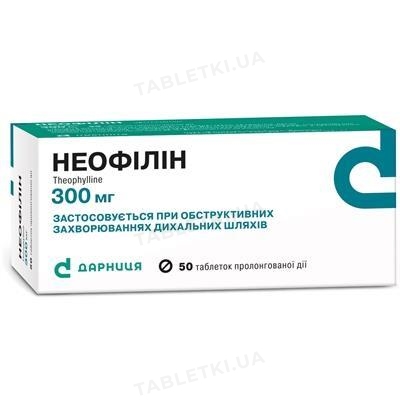
Neofilin Extended-Release Tablets, 300 mg, No. 50 (10 x 5)
Composition
Active ingredient: theophylline;
1 tablet contains 100 mg or 300 mg of theophylline monohydrate, calculated as theophylline;
Excipients: lactose monohydrate, ammonium methacrylate copolymer dispersion, methacrylate copolymer dispersion, magnesium stearate, talc.
Dosage Form
Extended-release tablets.
Main physical and chemical properties:
100 mg tablets—white, flat-cylindrical in shape, with a bevel;
300 mg tablets—white, flat-cylindrical in shape, with a bevel and a score line.
Pharmacological group
Agents for systemic use in obstructive airway diseases. Xanthines. Theophylline. ATC code R03D A04.
Pharmacological Properties
Pharmacodynamics.
Theophylline is a bronchodilator belonging to the methylxanthine group. Its mechanism of action is primarily due to the blockade of adenosine receptors, inhibition of phosphodiesterases, an increase in intracellular cAMP levels, and a decrease in intracellular calcium ion concentrations, thereby causing relaxation of the smooth muscles of the bronchi, gastrointestinal tract, biliary tract, uterus, and coronary, cerebral, and pulmonary vessels, and a decrease in peripheral vascular resistance; the tone of the respiratory muscles (intercostal muscles and diaphragm) increases, pulmonary vascular resistance decreases, and blood oxygenation improves; the respiratory center in the medulla oblongata is activated, its sensitivity to carbon dioxide increases, alveolar ventilation improves, leading to a reduction in the severity and frequency of apnea episodes; eliminates vasospasm, increases collateral blood flow and blood oxygen saturation, reduces perifocal and general cerebral edema, and lowers cerebrospinal fluid pressure and, consequently, intracranial pressure; improves blood rheology, reduces thrombus formation, inhibits platelet aggregation (by suppressing platelet-activating factor and prostaglandin F2α), and normalizes microcirculation; has an antiallergic effect by inhibiting mast cell degranulation and reducing the levels of allergy mediators (serotonin, histamine, leukotrienes); increases renal blood flow, exerts a diuretic effect due to reduced tubular reabsorption, and increases the excretion of water, chloride ions, and sodium.
Pharmacokinetics.
When taken orally, theophylline is completely absorbed in the gastrointestinal tract; bioavailability is approximately 90%. When taken as extended-release tablets, peak plasma concentration is reached after 6 hours. Plasma protein binding is approximately 60% in healthy adults and 35% in patients with liver cirrhosis. It crosses histohematological barriers and is distributed throughout the tissues. About 90% of theophylline is metabolized in the liver by several cytochrome P450 isoenzymes into inactive metabolites—1,3-dimethyluric acid, 1-methyluric acid, and 3-methylxanthine. It is excreted primarily by the kidneys as metabolites; up to 13% of the drug is excreted unchanged in adults, and up to 50% in children. It partially passes into breast milk. The half-life of theophylline depends on age and the presence of concomitant diseases and is as follows: in adult patients with bronchial asthma, 6–12 hours; in children 6 months and older, 3–4 hours; in smokers, 4–5 hours; in the elderly and in patients with heart failure, impaired liver function, pulmonary edema, chronic obstructive pulmonary disease, and bronchitis—more than 24 hours, which requires an appropriate adjustment of the dosing interval.
Therapeutic concentrations of theophylline in the blood are: 10–20 μg/mL to achieve a bronchodilator effect, and 5–10 μg/mL for a stimulating effect on the respiratory center. Toxic concentrations are above 20 μg/mL.
Indications
- Bronchial asthma.
- Chronic obstructive pulmonary diseases (chronic obstructive bronchitis, pulmonary emphysema).
- Pulmonary hypertension.
- Central sleep apnea syndrome.
Contraindications
Hypersensitivity to any component of the medication, as well as to other xanthine derivatives (caffeine, pentoxifylline, theobromine), acute heart failure, angina pectoris, acute myocardial infarction, acute cardiac arrhythmias, paroxysmal tachycardia, extrasystoles, severe hypertension and hypotension, widespread atherosclerosis, pulmonary edema, hemorrhagic stroke, glaucoma, retinal hemorrhage, history of bleeding, gastric and duodenal ulcers (in the acute phase), gastroesophageal reflux, epilepsy, increased seizure susceptibility, uncontrolled hypothyroidism, hyperthyroidism, thyrotoxicosis, impaired liver and/or kidney function, porphyria, sepsis, and concurrent use with ephedrine in children.
Interactions with Other Medications and Other Types of Interactions
Drugs that increase the clearance of theophylline: aminoglutethimide, antiepileptic drugs (e.g., phenytoin, carbamazepine, primidone), magnesium hydroxide, isoproterenol, lithium, moracizin, rifampicin, ritonavir, sulfinpyrazone, barbiturates (especially phenobarbital and pentobarbital). The effect of theophylline may also be reduced in smokers. In patients who are taking one or more of the above-mentioned drugs concurrently with theophylline, serum theophylline concentrations should be monitored and the dose adjusted as necessary.
Drugs that reduce the clearance of theophylline: allopurinol, acyclovir, carbimazole, phenylbutazone, fluvoxamine, imipenem, isoprenaline, cimetidine, fluconazole, furosemide, pentoxifylline, disulfiram, interferon, nizatidine, calcium channel blockers (verapamil, diltiazem), amiodarone, acetaminophen, probenecid, ranitidine, tacrine, propafenone, propranolol, oxpentifylline, isoniazid, lincomycin, methotrexate, zafirlukast, mexiletine, fluoroquinolones (ofloxacin, norfloxacin; when using ciprofloxacin, the dose must be reduced by at least 60%; for enoxacin, by 30%), macrolides (clarithromycin, erythromycin), ticlopidine, tiabendazole, viloxazine hydrochloride, oral contraceptives, and the influenza vaccine. In patients who are taking one or more of the above-mentioned medications concurrently with theophylline, serum theophylline concentrations should be monitored and the dose reduced if necessary.
Plasma concentrations of theophylline may be reduced when theophylline is used concomitantly with herbal medicines containing St. John’s wort (Hypericum perforatum).
Concomitant use of theophylline and phenytoin may lead to a decrease in phenytoin levels.
Ephedrine potentiates the effects of theophylline.
The combination of theophylline and fluvoxamine should be avoided. If this combination cannot be avoided, patients should take half the dose of theophylline and have their plasma concentrations of theophylline closely monitored.
Combinations of theophylline with adenosine, benzodiazepines, halothane, and lomustine should be used with extreme caution. Anesthesia with halothane may cause serious cardiac arrhythmias in patients taking theophylline.
The simultaneous use of theophylline with large amounts of food and beverages containing methylxanthines (coffee, tea, cocoa, chocolate, Coca-Cola, and similar stimulant beverages), medications containing xanthine derivatives (caffeine, theobromine, pentoxifylline), α- and β-adrenergic agonists (selective and nonselective), and glucagon, given the potentiation of theophylline’s effects.
Concomitant use of theophylline with β-adrenergic blockers may antagonize its bronchodilator effect; with ketamine and quinolones—it lowers the seizure threshold; when used with adenosine, lithium carbonate, and β-receptor antagonists, the efficacy of the latter is reduced; when used with doxapram, it may cause central nervous system stimulation.
Theophylline may enhance the effects of diuretics and reserpine.
Concomitant use of theophylline and β-receptor antagonists should be avoided, as theophylline may lose its effectiveness.
There is conflicting evidence regarding the potentiation of theophylline’s effects in influenza-like illnesses.
Xanthines may exacerbate hypokalemia caused by therapy with β-adrenergic agonists, steroids, diuretics, and hypoxia. This applies to hospitalized patients with severe asthma, and it is necessary to monitor serum potassium levels.
Special Considerations for Use
Theophylline should be prescribed only when absolutely necessary and with caution in cases of unstable angina, heart diseases in which tachyarrhythmia may occur; in hypertrophic obstructive cardiomyopathy, renal and hepatic dysfunction, hyperthyroidism, in acute porphyria, chronic alcoholism, and lung diseases; in patients with a history of peptic ulcer disease; and in patients over 60 years of age.
The use of theophylline in cases of severe atherosclerosis or sepsis is possible with caution and under medical supervision, provided there are indications for its use. Restrictions on the use of theophylline in gastroesophageal reflux are related to its effect on the smooth muscles of the cardioesophageal sphincter, which may worsen the patient’s condition in cases of gastroesophageal reflux, thereby increasing reflux.
Smoking and alcohol consumption can lead to increased clearance of theophylline and, consequently, to a reduction in its therapeutic effect and the need for higher doses.
During treatment with theophylline, close monitoring is necessary, and the dose should be reduced when treating patients with heart failure, chronic alcoholism, liver dysfunction (especially cirrhosis), low blood oxygen levels (hypoxemia), fever, or patients with pneumonia or viral infections (especially influenza) due to a possible decrease in theophylline clearance. At the same time, it is necessary to monitor for elevated plasma theophylline levels.
Close monitoring is required when treating patients with peptic ulcers, cardiac arrhythmias, hypertension, other cardiovascular diseases, hyperthyroidism, or acute febrile conditions with theophylline.
Patients with a history of seizures should avoid theophylline and use alternative treatments.
Special caution is required when administering this medication to patients suffering from insomnia, as well as to elderly men with a history of benign prostatic hyperplasia, due to the risk of urinary retention.
If aminophylline (theophylline-ethylenediamine) must be administered to patients who have previously taken theophylline, plasma theophylline levels must be monitored again.
Given that bioequivalence cannot be guaranteed for certain extended-release theophylline-containing medications, switching from treatment with Neofillin, in the form of extended-release tablets, to another extended-release xanthine medication must be carried out through repeated dose titration and following clinical evaluation.
During treatment with theophylline, special caution is required in patients with severe asthma. In such situations, it is recommended to monitor serum potassium levels.
Worsening of asthma symptoms requires urgent medical attention. In the event of an acute asthma attack in a patient receiving extended-release theophylline, intravenous aminophylline should be administered with great caution.
Half of the recommended loading dose of aminophylline (usually 6 mg/kg) should be administered cautiously, i.e., 3 mg/kg.
If theophylline must be administered to children with fever or to children with a history of epilepsy and seizures, their clinical condition must be closely monitored, and plasma theophylline levels must be monitored. Theophylline is not the drug of choice for children with bronchial asthma.
Theophylline may alter certain laboratory parameters: it may increase the amount of fatty acids and the level of catecholamines in the urine.
If adverse reactions occur, the level of theophylline in the blood must be monitored.
Important information about excipients.
This medication contains lactose and should therefore not be used by patients with rare hereditary forms of galactose intolerance, lactase deficiency, or glucose-galactose malabsorption.
Use during pregnancy or breastfeeding.
Pregnancy.
Theophylline crosses the placenta.
Use of the medication during pregnancy is permissible in the absence of a safe alternative, provided that the expected benefit to the mother outweighs the potential risk to the fetus. In pregnant women, serum theophylline concentrations should be monitored more frequently, and the dose adjusted accordingly. The use of theophylline should be avoided late in pregnancy because it may inhibit uterine contractions and cause fetal tachycardia.
Breastfeeding.
Theophylline passes into breast milk; therefore, therapeutic serum concentrations may be achieved in infants. Its use in breastfeeding mothers is permitted only if the expected benefit to the mother outweighs the risk to the newborn.
Theophylline may cause increased irritability in the newborn; for this reason, the therapeutic dose of theophylline should be as low as possible.
Breastfeeding should be done immediately before taking the medication. Any effects of theophylline in infants must be closely monitored. If higher therapeutic doses are required, breastfeeding must be discontinued.
Fertility.
There are no clinical data on fertility in humans. Preclinical data indicate that theophylline has an adverse effect on male and female fertility.
Ability to affect reaction time when operating motor vehicles or other machinery.
Since sensitive patients may experience side effects (dizziness) when taking this medication, they should refrain from driving or performing other tasks requiring concentration while taking it.
Dosage and Administration
Take the medication orally 30–60 minutes before a meal or 2 hours after a meal, with a sufficient amount of liquid. The 300 mg tablet may be split in half (do not split the 100 mg tablets), but it must not be crushed, chewed, or dissolved in water. In some cases, to reduce irritation of the stomach lining, the medication should be taken during or immediately after a meal.
The dosing regimen is determined on an individual basis, depending on the patient’s age, body weight, and metabolic characteristics.
The initial daily dose for adults and children 12 years of age and older weighing more than 45 kg is 300 mg (1 tablet of 300 mg once daily or 3 tablets of 100 mg once daily). After 3 days of treatment, increase the daily dose to 450 mg (1½ tablets of 300 mg); and after another 3 days of treatment, if necessary, the daily dose may be increased to 600 mg (1 tablet of 300 mg twice daily or 3 tablets of 100 mg twice daily).
Dose increases are permitted only if the medication is well tolerated.
For children aged 6 to 12 years weighing 20–45 kg, the daily dose is 150 mg (½ 300-mg tablet once daily). After 3 days of treatment, increase the daily dose to 300 mg (½ 300-mg tablet twice daily); after another 3 days of treatment, the daily dose may be increased to 450–600 mg (1½ 300-mg tablets once daily, or 1 300-mg tablet twice daily, or 3 100-mg tablets twice daily).
For elderly patients with cardiovascular disease, the recommended daily dose is 8 mg/kg of body weight. The maximum therapeutic effect begins to appear 3–4 days after the start of treatment.
For patients who smoke, the daily dose may be gradually increased to 900–1,050 mg (3–3½ 300-mg tablets).
Patients with central sleep apnea syndrome may take a single dose of the medication at night.
Further dose increases should be based on serum theophylline concentration measurements.
The dosage should be individualized, but tablets are usually taken twice daily. For patients with the most severe clinical symptoms, higher morning or evening doses are appropriate.
For patients whose symptoms persist at night or during the day, regardless of other ongoing therapy or whether they have previously received theophylline, treatment may be supplemented with the recommended single morning or evening daily dose of theophylline.
When prescribing high doses, plasma theophylline concentrations should be monitored during treatment (the therapeutic concentration ranges from 10 to 15 μg/mL).
The total daily dose should not exceed 24 mg/kg of body weight for children and 13 mg/kg for adults. Nevertheless, measuring the plasma theophylline level 4–8 hours after administration and at least 3 days after each dose adjustment allows for a more accurate assessment of the need for a specific dose, given the significant individual variations in the rate of elimination among patients.
The table provided can be used as a guide for proper dosing.
| Theophylline concentration
in plasma (μg/mL) |
Result | Recommendation (if clinically indicated) |
| Below 10 | Too low | Increase the dose by 25% |
| 10–20 | Normal | Maintenance dose |
| 20–25 | Very high | Reduce the dose by 10% |
| 25–30 | Very high | Skip the next dose and further reduce the dose by 25% |
| More than 30 | Very high | Skip the next two doses and further reduce the dose by 50% |
Children.
Do not administer this medication to children under 6 years of age weighing less than 20 kg.
Overdose
An overdose is defined as a serum theophylline concentration exceeding 20 mg/mL (110 μmol/L).
Symptoms. Severe symptoms may develop 12 hours after an overdose with the extended-release formulation.
Gastrointestinal tract: nausea, vomiting (often severe), epigastric pain, diarrhea, hematemesis, pancreatitis.
Central nervous system: delirium, agitation, restlessness, dementia, toxic psychosis, tremor, hyperreflexia of the extremities and convulsions, muscle rigidity. In very severe cases, coma may develop.
Cardiovascular system: sinus tachycardia, ectopic rhythm, supraventricular and ventricular tachycardia, hypertension/hypotension, and a sudden drop in blood pressure.
Metabolic disorders: metabolic acidosis, hypokalemia (which can develop rapidly and severely due to the shift of potassium from plasma into cells), hypophosphatemia, hypercalcemia, hypomagnesemia, hyperglycemia, rhabdomyolysis.
Other: respiratory alkalosis, hyperventilation, acute renal failure, dehydration, or exacerbation of other adverse reactions.
Treatment. Discontinue the drug; perform gastric lavage; administer activated charcoal and osmotic laxatives orally (within 1–2 hours after overdose); perform hemodialysis. Monitor serum theophylline levels until they return to normal, and monitor ECG and renal function.
Diazepam is indicated for convulsive syndrome.
For patients without bronchial asthma, non-selective β-blockers may be used if marked tachycardia occurs. In severe cases, the elimination of theophylline can be accelerated by hemosorption or hemodialysis.
Hypokalemia must be avoided or prevented. In the event of hypokalemia, urgent intravenous infusion of potassium chloride solution is required, along with monitoring of plasma potassium and magnesium levels.
Hyperkalemia may develop during correction if large amounts of potassium are administered. If plasma potassium levels are low, plasma magnesium concentrations should be measured as soon as possible.
In cases of ventricular arrhythmias, the use of antiarrhythmic drugs with anticonvulsant effects, such as lidocaine, should be avoided due to the risk of exacerbating seizures. To control vomiting, antiemetics such as metoclopramide or ondansetron should be used.
In cases of tachycardia with adequate cardiac output, it is best not to administer treatment.
In cases of life-threatening overdose with cardiac arrhythmias, administer propranolol to non-asthmatic patients (1 mg for adults and 0.02 mg/kg of body weight for children). This dose may be administered every 5–10 minutes until the heart rhythm normalizes, but the maximum dose of 0.1 mg/kg of body weight should not be exceeded. Propranolol can cause severe bronchospasm in patients with asthma; therefore, verapamil should be used in such cases.
Further treatment depends on the severity of the overdose and the course of intoxication, as well as on the symptoms present.
Side Effects
Adverse reactions are usually observed at plasma theophylline concentrations > 20 μg/mL.
Respiratory system, thoracic organs, and mediastinum: increased respiratory rate.
Gastrointestinal system: heartburn, decreased appetite/anorexia with long-term use, nausea, vomiting, abdominal pain, diarrhea, gastroesophageal reflux, exacerbation of peptic ulcer disease, stimulation of gastric acid secretion, intestinal atony, and gastrointestinal hemorrhage.
Liver and biliary tract: liver dysfunction, jaundice.
Renal and urinary system: increased diuresis, especially in children; urinary retention in elderly men.
Metabolism: hypokalemia, hypercalcemia, hyperuricemia, hyperglycemia, rhabdomyolysis, metabolic acidosis.
Nervous system: dizziness, headache, irritability, anxiety, restlessness, agitation, sleep disturbances, insomnia, tremor, confusion/loss of consciousness, delirium, seizures, hallucinations, presyncope, acute encephalopathy.
Cardiovascular system: palpitations, tachycardia, decreased blood pressure, arrhythmias, cardialgia, increased frequency of angina attacks, extrasystoles (ventricular, supraventricular), heart failure.
Blood and lymphatic system: erythrocyte aplasia.
Immune system disorders: hypersensitivity reactions, including angioedema, anaphylactic and anaphylactoid reactions, bronchospasm.
Skin and subcutaneous tissue disorders: skin rash, exfoliative dermatitis, pruritus, urticaria.
General disorders: fever, weakness, sensation of heat and facial flushing, increased sweating, shortness of breath.
Laboratory parameters: electrolyte imbalance, acid-base imbalance, and increased blood creatinine levels.
In most cases, side effects subside when the drug dose is reduced.
Reporting of Suspected Adverse Reactions.
Reporting suspected adverse reactions after a drug’s approval is an important procedure. It allows for continued monitoring of the benefit-risk profile of the drug in question. Healthcare professionals should report any suspected adverse reactions through the national reporting system.
Shelf Life
2 years.
Storage conditions
Store in the original packaging at a temperature not exceeding 25 °C.
Keep out of reach of children.
Packaging
10 tablets per blister pack; 5 blister packs per package.
Manufacturer
Darnitsa Pharmaceutical Company, PJSC.
Manufacturer’s location and address of its place of business.
Ukraine, 02093, Kyiv, 13 Boryspilskaya St.