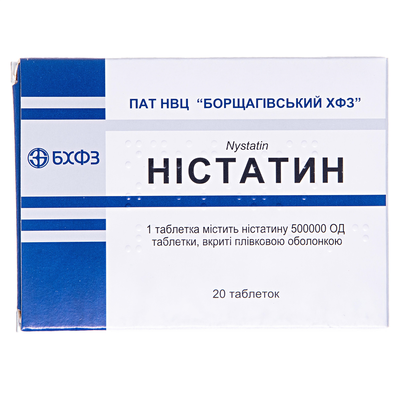
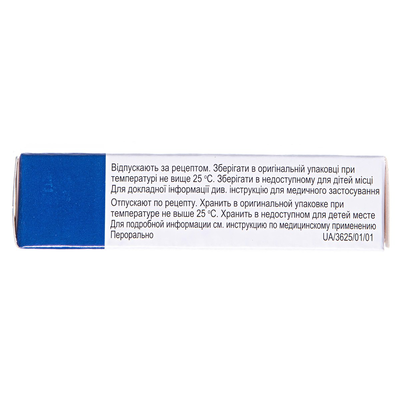
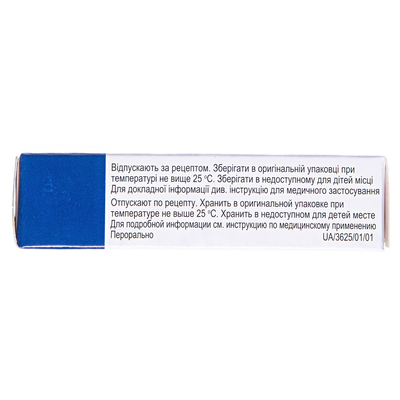
Nystatin tablets, film-coated, 500,000 IU each, No. 20 (20 x 1)
Ingredients
Active ingredient: nystatin;
1 tablet contains 500,000 IU of nystatin;
excipients: microcrystalline cellulose, povidone, croscarmellose sodium, magnesium stearate; film-forming coating: hydroxypropyl methylcellulose, copovidone, polyethylene glycol, medium-chain triglycerides, polydextrose, titanium dioxide (E 171), red iron oxide (E 172), yellow iron oxide (E 172).
Dosage Form
Film-coated tablets.
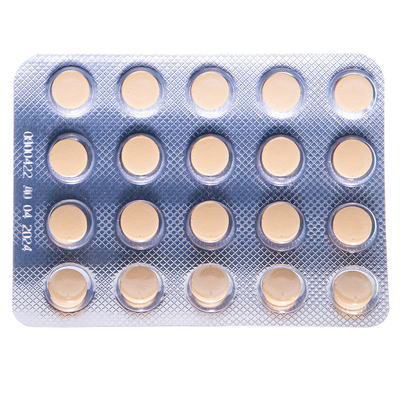
Main physical and chemical properties: round tablets with a biconvex surface, film-coated, ranging in color from yellow to brownish-yellow.
Pharmacotherapeutic group
Antimicrobials used in the treatment of intestinal infections. ATC code A07A A02.
Pharmacological Properties
Pharmacodynamics.
Nystatin is a polyene antibiotic produced by the actinomycete Streptomyces noursei. It exhibits antifungal activity. Nystatin binds to the sterols in the fungal cell membrane, causing the membrane to lose its ability to function as a selective barrier, which leads to the loss of essential cellular components.
Nystatin selectively acts on pathogenic yeast-like fungi of the genera Candida and Aspergillus. Resistance to nystatin in fungi of the genus Candida and other susceptible species develops slowly. It exerts a fungistatic effect and, at high doses, a fungicidal effect.
The drug is inactive against bacteria, actinomycetes, and viruses. It is ineffective against Trichomonas vaginalis and Gardnerella vaginalis (Haemophilus vaginalis).
Pharmacokinetics.
When taken orally, it is poorly absorbed in the gastrointestinal tract (its bioavailability does not exceed 3–5%). Fungistatic concentrations of the antibiotic in the blood and concentrations close to therapeutic levels in the tissues of internal organs are achieved only when it is administered in high doses. The drug does not cross the blood-brain barrier and does not enter the cerebrospinal fluid.
The majority of the antibiotic taken orally is excreted in the feces in an unchanged form, resulting in high concentrations in the stool that are sufficient to produce a therapeutic effect in cases of candidiasis of the gastrointestinal mucosa.
The absorbed drug is excreted from the body in the urine.
Indications
Treatment of gastrointestinal tract infections caused by fungi of the genus Candida (Candida albicans).
Contraindications
- Hypersensitivity to any component of the drug;
- liver dysfunction;
- pancreatitis;
- gastric and duodenal ulcers.
Interactions with Other Medications and Other Types of Interactions
When used concomitantly with clotrimazole, the antifungal activity of clotrimazole is reduced; when used with chloramphenicol, there is a mutual reduction in antimicrobial activity; concomitant use should be avoided.
Cross-resistance has been observed with a number of polyene antibiotics, such as amphotericin B.
Special Considerations for Use
Do not use this medication to treat systemic mycoses.
A full course of therapy is required. Strictly adhere to the treatment regimen and schedule throughout the entire course; take the medication at regular intervals and do not miss doses. If a dose is missed, take it as soon as possible; do not take it if it is almost time for the next dose; do not double the dose.
Nystatin may increase the skin’s sensitivity to sunlight; therefore, direct sunlight and artificial ultraviolet radiation should be avoided during treatment.
If side effects occur, discontinue the medication.
Use during pregnancy or breastfeeding.
The safety of this medication in pregnant women has not been established; therefore, it is contraindicated during pregnancy.
Breastfeeding should be discontinued for the duration of treatment.
Effect on reaction time when operating motor vehicles or other machinery.
No effect.
Dosage and Administration
Take Nystatin tablets orally, without chewing, 40–60 minutes before a meal.
Adults should be prescribed a dose of 500,000 IU (1 tablet) 3–4 times daily. The daily dose is 1,500,000–3,000,000 IU (3–6 tablets); in severe cases, up to 4,000,000–6,000,000 IU (8–12 tablets).
For children 6 years of age and older, administer a dose of 500,000 IU (1 tablet) 3–4 times daily.
For children aged 13 years and older, the dosage is the same as for adults.
The maximum daily dose for children aged 6 years and older is 2,000,000 IU (4 tablets); for those aged 13 years and older, 4,000,000 IU (8 tablets); in severe cases—6,000,000 IU (12 tablets).
The average duration of treatment is 10–14 days (depending on the severity of the disease and sensitivity to the drug).
For chronic recurrent candidiasis, repeat treatment courses should be administered with 2–3-week intervals between them.
No dose adjustment is required for patients with renal or hepatic insufficiency.
Children.
Do not administer this dosage form to children under 6 years of age.
Overdose
Symptoms: Side effects may be exacerbated. Oral doses of nystatin exceeding 5,000,000 IU per day have caused nausea and gastrointestinal disturbances.
Since absorption of nystatin from the gastrointestinal tract is minimal, overdose does not cause systemic toxicity.
Treatment: discontinuation of the drug, symptomatic therapy.
Side Effects
Digestive system: bitter taste in the mouth, dyspeptic symptoms, nausea, vomiting, diarrhea, abdominal pain, loss of appetite.
Immune system: fever, chills, hypersensitivity reactions, including itching, skin rash, hives, anaphylactic reactions, such as angioedema, including facial swelling, bronchospasm, and, rarely, Stevens-Johnson syndrome.
Other: photosensitivity, tachycardia, nonspecific myalgia; possible spread of resistant fungal strains, requiring discontinuation of the drug.
Shelf life
2 years.
Do not use after the expiration date printed on the package.
Storage conditions
Store in the original packaging at a temperature not exceeding 25 °C.
Keep out of reach of children.
Packaging
20 tablets per blister pack, 1 blister pack per package.
Dispensing Category
By prescription.