
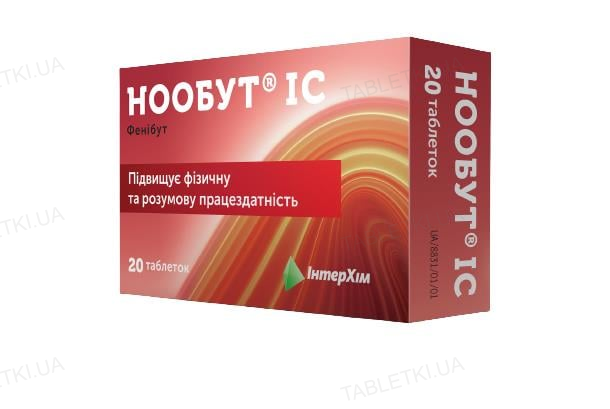
Noobut IC tablets, 0.25 g each, No. 20 (10 x 2)
Ingredients
Active ingredient: phenibut;
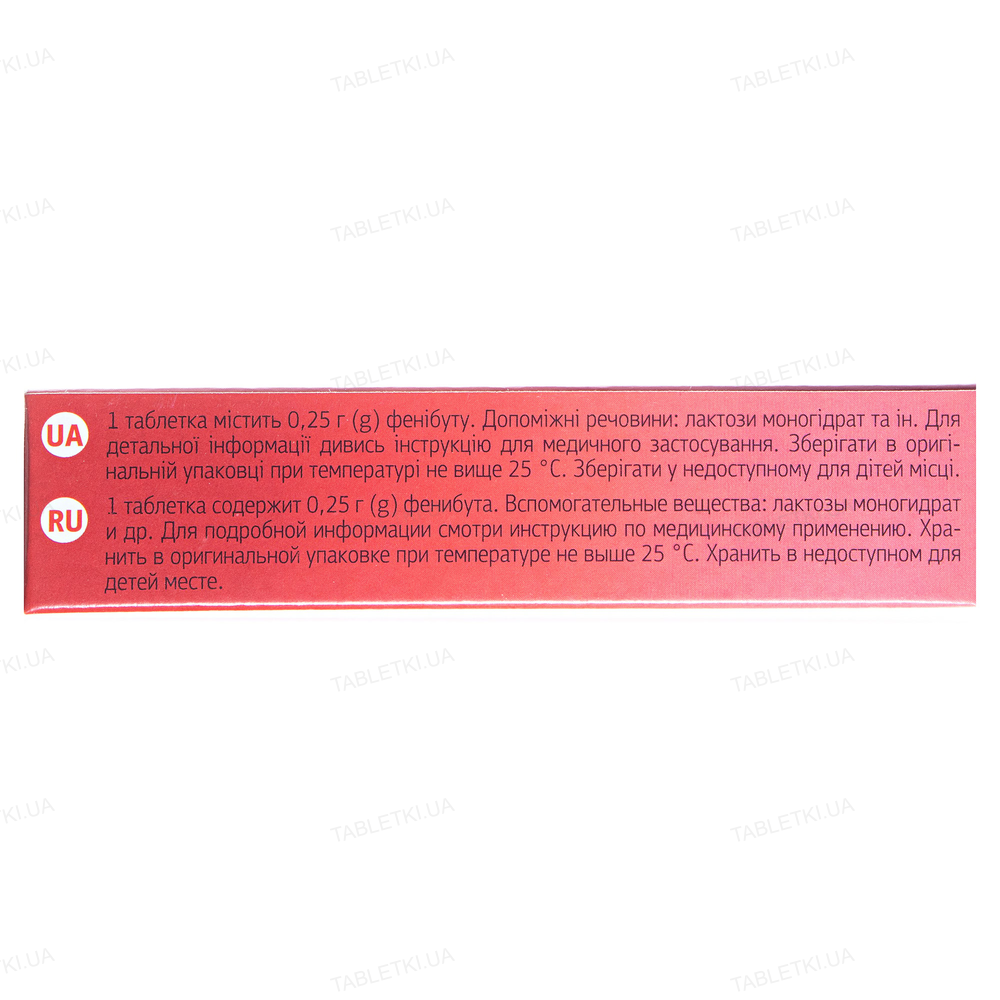
1 tablet contains 100 mg (0.1 g) or 250 mg (0.25 g) of phenibut;
Excipients: lactose monohydrate, potato starch, povidone, calcium stearate.
Dosage Form
Tablets.
Main physical and chemical properties: white or white tablets with a yellowish tint, flat-cylindrical in shape, with a beveled edge; the company’s trademark is imprinted on one side of the tablet, and a score line is present on the other side.
Pharmacotherapeutic group
Psychostimulants, agents used for attention-deficit/hyperactivity disorder (ADHD), and nootropics. Other psychostimulants and nootropics. Phenibut.
ATC code N06B X22.
Pharmacological Properties
Pharmacodynamics.
Phenibut is a derivative of γ-aminobutyric acid (GABA) and phenylethylamine. Its primary effects are antihypoxic and anti-amnesic. The drug Noobut® IS improves memory and attention, facilitates learning processes, and enhances physical and mental performance. Psychological indicators (speed and accuracy of sensorimotor reactions) improve under the influence of the drug. It has been established that Phenibut improves brain bioenergetics by increasing the energy potential of neurons through improved mitochondrial function.
Noobut® IS also has tranquilizing properties: it relieves psycho-emotional tension, feelings of anxiety and fear, emotional lability, and irritability, and improves sleep. Phenibut binds exclusively to GABA_B receptors in the brain; therefore, it exerts a moderate calming effect but does not cause undesirable sedative effects such as drowsiness, dizziness, or reduced attention and performance. The drug prolongs the latent period and reduces the duration and severity of nystagmus, and has an antiepileptic effect. It does not affect cholinergic or adrenergic receptors.
Noobut IS significantly reduces the manifestations of asthenia and vasovegetative symptoms, including headache and a sensation of heaviness in the head. In patients with asthenia and in emotionally labile individuals, the use of Phenibut® improves well-being without causing agitation from the very first days of therapy.
Pharmacokinetics.
Phenibut is well absorbed after oral administration and penetrates all body tissues effectively; it crosses the blood-brain barrier well (approximately 0.1% of the administered dose of Phenibut penetrates into brain tissue, with a significantly higher degree of penetration in young and elderly individuals). The highest binding of phenibut occurs in the liver (80%) and is nonspecific. Distribution in the liver and kidneys is nearly uniform, while in the brain and blood it is less than uniform.
80–95% of phenibut is metabolized in the liver; the metabolites are pharmacologically inactive.
After 3 hours, a noticeable amount of the administered phenibut is detected in the urine; however, the concentration of phenibut in brain tissue does not decrease, and it is still detectable in the brain 6 hours later. The next day, phenibut can be detected only in the urine; it is detected in the urine 2 days after administration, but the amount detected is only 5% of the administered dose. No accumulation is observed with repeated administration.
Indications
Asthenic and anxiety-neurotic conditions (emotional lability, memory impairment, decreased concentration), feelings of restlessness, fear, anxiety, and obsessive-compulsive neurosis.
Insomnia and nighttime restlessness in elderly patients.
Prevention of stress-related conditions prior to surgery or painful diagnostic procedures.
Ménière’s disease, vertigo associated with vestibular dysfunction of various origins.
Prevention of motion sickness (a specific condition characterized by nausea, vomiting, prostration, and vestibular dysfunction caused by being in a moving vehicle, such as a ship or airplane).
Stuttering, enuresis, and tics in children aged 3 to 14 years.
As an adjunct in the treatment of alcohol withdrawal syndrome.
Contraindications
Hypersensitivity to any component of the drug. Acute renal failure. Pregnancy or lactation.
Interactions with Other Medications and Other Forms of Interactions
Noobut IS may be combined with other psychotropic drugs, reducing the doses of Noobut® IS and the concomitantly administered drugs.
Noobut® IS enhances and prolongs the effects of hypnotics, narcotics, neuroleptics, and antiparkinsonian drugs.
Special Considerations
Patients with gastrointestinal disorders should exercise caution when using Noobut IS due to the irritating effect of phenibut®. Such patients should use lower doses of the drug or take it after meals.
During long-term use, blood cell counts and liver function tests should be monitored.
The drug contains lactose and should therefore not be used by patients with rare hereditary forms of galactose intolerance, lactase deficiency, or glucose-galactose malabsorption syndrome.
Pregnancy and lactation.
Animal studies have not revealed any mutagenic, teratogenic, or embryotoxic effects of phenibut. No adequate and well-controlled safety studies of phenibut have been conducted in women during pregnancy or breastfeeding. Therefore, the use of Noobut® IS during pregnancy or lactation is contraindicated.
Effects on the ability to drive and operate machinery.
Patients who experience drowsiness, dizziness, or other central nervous system disturbances during treatment with phenibut should refrain from driving or operating machinery.
Dosage and Administration
The drug should be taken orally. Swallow the tablet whole with a sufficient amount of water. To reduce the irritating effect of phenibut on the gastrointestinal tract (see the “Special Warnings and Precautions for Use” section), the medication may be taken after meals.
Adults
Asthenic and anxiety-neurotic conditions
The drug should be taken at a dose of 250–500 mg three times daily.
Maximum single dose: 750 mg for adults, 500 mg for elderly patients.
The course of treatment is 2–3 weeks. If necessary, the course of treatment may be extended to 4–6 weeks.
Ménière’s disease and vertigo associated with vestibular dysfunction of various origins
For the treatment of vertigo associated with vestibular dysfunction of infectious origin, and for Meniere’s disease during an acute episode, the drug should be administered at a dose of 750 mg three times daily for 5–7 days; and as the severity of vestibular disturbances decreases, 250–500 mg three times daily for 5–7 days, followed by 250 mg once daily for 5 days. In cases of relatively mild disease, the drug should be administered at a dose of 250 mg twice daily for 5–7 days, followed by 250 mg once daily for 7–10 days.
For the treatment of vertigo associated with vestibular dysfunction of vascular or traumatic origin, the drug should be administered at a dose of 250 mg three times daily for 12 days.
Prevention of motion sickness
The drug should be taken at a dose of 250–500 mg as a single dose 1 hour before the expected onset of motion sickness or upon the appearance of the first symptoms of motion sickness.
As part of complex therapy for alcohol withdrawal syndrome
During the first few days of therapy, the drug should be administered at a dose of 250–500 mg three times during the day and 750 mg at night, with a gradual reduction of the daily dose to the usual adult dose.
Patients with hepatic insufficiency
High doses of the drug may be hepatotoxic in patients with hepatic insufficiency. Lower doses should be prescribed for patients in this group.
Patients with renal insufficiency
There are no reports of adverse effects of the drug in patients with renal insufficiency at therapeutic doses.
Children
| Child’s age | Dosage regimen | Maximum single dose |
| 3–4 years | 100 mg twice daily | 100 mg |
| 5–6 years | 100 mg 3 times a day | 100 mg |
| 7–10 years | 200 mg twice a day | 200 mg |
| Ages 11–14 | 200 mg 3 times a day | 300 mg |
The treatment course lasts 2–6 weeks.
To prevent motion sickness, take a single dose of Noobut® IC 1 hour before traveling by sea, land, or air.
Noobut® IC can be combined with psychotropic medications, which enhances its effectiveness (see the section “Interactions with Other Medications and Other Forms of Interactions”).
No cases of drug dependence or withdrawal syndrome have been observed with the use of phenibut.
Isolated cases of tolerance to phenibut have been reported in the literature.
If one or more doses are missed, continue taking the medication at the previously prescribed doses. If you feel unwell, consult a doctor.
Children.
The drug may be used in children aged 3 to 14 years.
Overdose
There are no data on overdose. Noobut® IC is a low-toxicity medication; however, at a daily dose of 7–14 g with prolonged use, it may be hepatotoxic. These doses significantly exceed the recommended average therapeutic doses, depending on the patient’s age.
Symptoms: drowsiness, nausea, vomiting, dizziness.
With long-term use of high doses of phenibut, arterial hypotension, acute renal failure, eosinophilia, and fatty liver disease may develop.
Treatment: gastric lavage. Symptomatic therapy.
There is no specific antidote.
Side Effects
Noobut® IC, like other medications, may cause side effects, although they do not occur in all patients.
Adverse reactions associated with medication use are classified by organ system and frequency. Frequency is defined as follows: very common (≥1/10), common (≥1/100 – <1/10), uncommon (≥1/1,000 – <1/100), rarely (≥1/10,000 – <1/1,000), very rarely (<1/10,000), frequency unknown (frequency cannot be estimated from the available data).
Nervous system disorders: frequency unknown—drowsiness (at the start of treatment), headache, dizziness (when doses exceed 2,000 mg per day; the severity of side effects decreases when the dose is reduced).
Psychiatric disorders: frequency unknown—emotional lability, sleep disturbances (these adverse reactions may occur in children if the drug is used without following the recommendations in the prescribing information).
Gastrointestinal disorders: frequency unknown—nausea (at the start of treatment), vomiting, diarrhea, epigastric pain.
Hepatic and biliary disorders: frequency unknown—hepatotoxicity (with long-term use of high doses).
Immune system disorders: frequency unknown—hypersensitivity reactions, including urticaria, erythema, angioedema, facial swelling, and tongue swelling.
Skin and subcutaneous tissue disorders: rare—allergic reactions (rash, itching).
If any adverse reactions occur, consult a doctor.
Shelf life
3 years.
Storage conditions
Store in the original packaging at a temperature not exceeding 25 °C.
Keep out of reach of children.
Packaging
10 tablets per blister; 2 blisters per package.
Manufacturer
INTERCHIM Limited Liability Company.
Address
Ukraine, 65025, Odessa, 21st km of the Old Kyiv Highway, 40-A.







