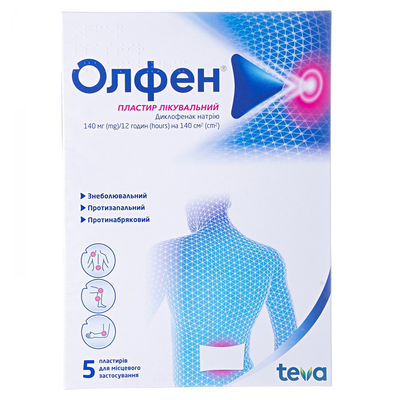
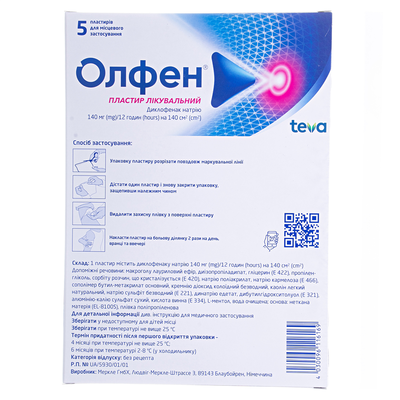
Olfen medicated patch, 140 mg/12 hours (140 cm²), No. 5 (5 x 1) per package.
Ingredients
Active ingredient: diclofenac sodium;
1 patch contains 140 mg of diclofenac sodium per 12 hours per 140 cm²;
excipients: macrogol lauryl ether, diisopropyl adipate, glycerin (E 422), propylene glycol, crystallizing sorbitol solution (E 420), sodium polyacrylate, sodium carmellose (E 466), butyl methacrylate copolymer base, colloidal anhydrous silicon dioxide, natural light kaolin, anhydrous sodium sulfite (E 221), disodium edetate, dibutylhydroxytoluene (E 321), dry aluminum-potassium sulfate, tartaric acid (E 334), L-menthol, purified water;
base: nonwoven fabric (EL-8100S), polypropylene film.
Dosage Form
Medicated patch.
Main physical and chemical properties: a white to light brown paste applied to a nonwoven fabric. The surface of the paste is covered with a transparent polymer film.
Pharmacotherapeutic group
Nonsteroidal anti-inflammatory drugs for topical use. ATC code M02A A15.
Pharmacological properties
Pharmacodynamics.
Olfen® Medicated Patch is a nonsteroidal anti-inflammatory drug (NSAID) with analgesic properties, intended for topical use. Its therapeutic effect is due to the inhibitory effect of diclofenac sodium on prostaglandin synthesis.
When Olfen® Medicated Patch is applied topically, the active ingredient penetrates the skin, reaching the subcutaneous tissues, where it exerts analgesic and anti-inflammatory effects and reduces tissue swelling. When the Olfen® therapeutic patch was used by patients with significant sports injuries, the product demonstrated effective analgesic action compared to a placebo.
Pharmacokinetics.
The concentration of diclofenac in tissues is maintained by continuous release from the patch and does not depend on the time of day. The average concentration of the substance in blood plasma is approximately 3 ng/mL.
The mechanism of metabolism and excretion of diclofenac following topical application corresponds to that observed with oral administration of diclofenac sodium preparations. The half-life is 1–2 hours.
Indications
Short-term topical treatment:
- inflammation of tendons, ligaments, muscles, and joints of traumatic origin, such as sprains, strains, dislocations, and contusions;
- localized forms of rheumatism affecting soft tissues and joints.
Contraindications
Hypersensitivity to diclofenac, acetylsalicylic acid, other nonsteroidal anti-inflammatory drugs, analgesics, or any component of the drug. A history of bronchial asthma attacks, hives, or acute rhinitis caused by acetylsalicylic acid or other nonsteroidal anti-inflammatory drugs. Exacerbation of gastric or duodenal ulcers, open skin lesions, burns, skin infections, or eczema.
Interactions with Other Medications and Other Types of Interactions
Systemic absorption of diclofenac when Olfen® Medicated Patch is used correctly is very low compared to oral administration; therefore, interactions with other medications are unlikely.
Special Instructions for Use
Olfen® Medicated Patch should not be applied to open wounds (such as scrapes or cuts) or to areas of the skin affected by eczema. Avoid contact with the eyes and mucous membranes.
If the patient’s condition has not improved or has worsened after 3 days of treatment, consult a doctor.
To reduce the risk of side effects, treatment should be conducted using the lowest effective dose of diclofenac sodium for the shortest possible duration.
In patients with a history of allergies or bronchial asthma, the use of NSAIDs may cause bronchospasm.
If any skin rash appears after using Olfen® Medicated Patch, treatment with the product should be discontinued.
Avoid direct sunlight or tanning bed exposure at the application site for approximately 1 day to reduce the risk of photosensitivity.
Although the risk of systemic adverse reactions is minimal, Olfen® Medicated Patch should be used with caution in patients with impaired kidney, heart, or liver function, a history of gastric or duodenal ulcers, intestinal phlegmon, or hemorrhagic diathesis.
Elderly patients should use NSAIDs with caution due to their increased susceptibility to side effects.
Olfen® medicated patch contains propylene glycol and dibutylhydroxytoluene. Propylene glycol may cause skin irritation. Dibutylhydroxytoluene may cause local skin reactions (e.g., contact dermatitis) or irritation of the eyes and mucous membranes.
It is not recommended to use any other NSAIDs or medications containing diclofenac while using Olfen® Medicated Patch.
Use During Pregnancy or Breastfeeding
First and second trimesters
There are insufficient clinical data regarding the topical use of diclofenac during pregnancy. Animal studies have shown reproductive toxicity following systemic administration of the drug.
Inhibition of prostaglandin synthesis may adversely affect pregnancy and/or embryofetal development. Data from epidemiological studies indicate an increased risk of miscarriage, heart defects, and gastroschisis following the use of prostaglandin synthesis inhibitors in early pregnancy. It is believed that this risk increases with higher doses and longer duration of therapy.
During the first and second trimesters of pregnancy, the dose should be kept to a minimum, and the duration of treatment should be as short as possible.
Third Trimester
Diclofenac sodium is contraindicated during the third trimester of pregnancy because all prostaglandin synthesis inhibitors may:
- cause the following in the fetus:
- cardiopulmonary toxicity (with premature closure of the ductus arteriosus and the development of pulmonary hypertension);
- impaired renal function progressing to renal failure with oligohydramnios;
- cause the following in the mother and child:
- prolonged bleeding—an effect associated with the inhibition of platelet aggregation, which may occur even when very low doses of the drug are administered;
- inhibition of uterine contractions, leading to delayed or prolonged labor.
Breastfeeding
A small amount of diclofenac and its metabolites passes into breast milk. The decision to use this medication during breastfeeding is made by a doctor when there are compelling reasons for its use, and when the expected benefit of treatment outweighs the potential risk. Olfen® medicated patch should not be applied to the breasts or large areas of skin and should not be used for prolonged periods.
Effect on reaction time when operating motor vehicles or other machinery.
Adverse effects are unlikely.
Directions for Use and Dosage
Apply the patch to the affected area of the body. Apply 1 patch twice daily, in the morning and in the evening. Before use, remove the transparent film that protects the patch’s surface. The patch cannot be divided. Do not use the patch with an occlusive dressing.
If necessary, secure the patch with an elastic bandage. One transdermal patch is intended for continuous use for 12 hours.
Only one patch may be applied to a single affected area at a time. The maximum daily dose is 2 patches, even if it is necessary to apply a patch to more than one area.
The patch should be used for as short a period as possible.
The duration of treatment should not exceed 7 days.
Children
The efficacy and safety of Olfen® Medicated Patch in children under 18 years of age have not been studied.
Overdose
No cases of overdose have been reported.
If systemic side effects occur due to incorrect use or accidental overdose of Olfen® Medicated Patch, appropriate measures should be taken, as in cases of poisoning with oral nonsteroidal anti-inflammatory drugs.
Side Effects
Skin and Subcutaneous Tissue
Common: redness, itching, burning sensation, erythema, skin rashes, sometimes with pustules or blisters.
Uncommon: hypersensitivity reactions, local allergic reactions, including contact dermatitis.
Frequency unknown: In patients who applied NSAIDs topically, generalized skin rashes, hypersensitivity reactions (including angioedema), anaphylactic reactions, and photosensitivity reactions have been observed.
When using Olfen® medicated patch on large areas for a prolonged period, the occurrence of systemic side effects (such as kidney or gastrointestinal disorders, bronchospasm) cannot be ruled out, but the risk of their occurrence is very low compared to that associated with oral diclofenac sodium preparations.
Shelf life
30 months.
Shelf life after first opening the package: 4 months at a temperature not exceeding 25 °C; 6 months at 2–8 °C (in the refrigerator).
Storage conditions
Store at a temperature not exceeding 25 °C. Keep out of the reach of children.
Packaging
No. 2: 2 patches per packet, 1 packet per box.
No. 5: 5 patches per packet, 1 packet per box.
No. 10: 5 patches per packet, 2 packets per box.
Dispensing Category
Over-the-counter.
Manufacturer
Merkle GmbH.