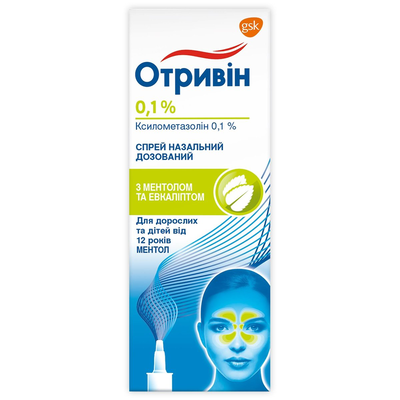
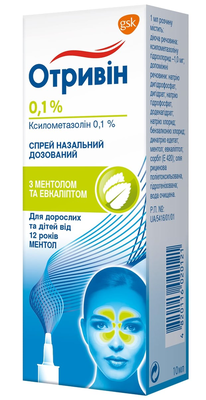
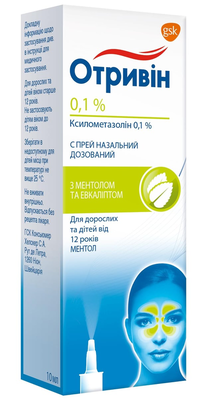
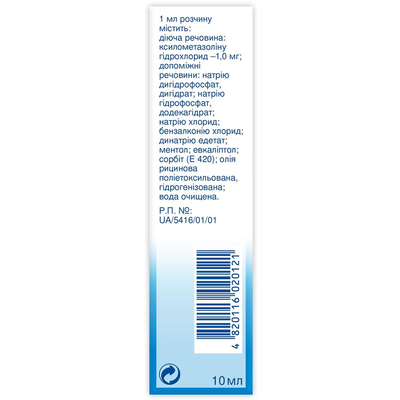
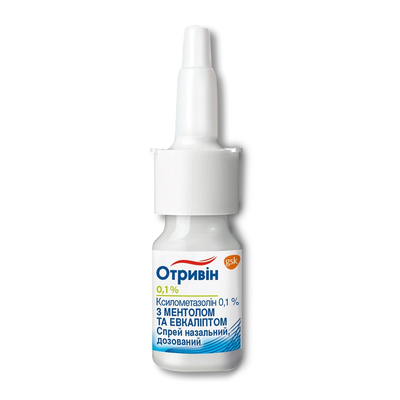
Otrivin with menthol and eucalyptus nasal spray, 0.1% strength, 10 mL per bottle with a spray nozzle.
Ingredients
Active ingredient: xylometazoline hydrochloride;
1 mL of solution contains 1 mg of xylometazoline hydrochloride;
Excipients: sodium dihydrogen phosphate, dihydrate; sodium hydrogen phosphate, dodecahydrate; sodium chloride; benzalkonium chloride; disodium edetate; menthol; eucalyptol; sorbitol (E 420); polyethoxylated, hydrogenated castor oil; purified water.
Dosage Form
Metered-dose nasal spray.
Main physical and chemical properties: a clear or opalescent solution ranging in color from colorless to white.
Pharmacotherapeutic group
Agents used in diseases of the nasal cavity. Decongestants and other preparations for topical use in diseases of the nasal cavity. Sympathomimetics, simple preparations. ATC code R01A A07.
Pharmacological properties
Pharmacodynamics.
Xylometazoline is a sympathomimetic agent that acts on α-adrenergic receptors.
When administered nasally, xylometazoline causes constriction of the blood vessels in the nasal mucosa and adjacent areas of the nasopharynx, thereby eliminating edema and hyperemia of the nasal mucosa and nasopharynx, as well as reducing the associated increased mucus secretion and facilitating the removal of blocked nasal secretions, which leads to the clearing of the nasal passages and easier nasal breathing.
The drug takes effect within 2 minutes after application and lasts up to 12 hours.
The medication is well tolerated, including by patients with sensitive mucous membranes, and does not impair mucociliary function. Laboratory test results have shown that xylometazoline reduces the infectious activity of the human rhinovirus, which is associated with the common cold.
The drug contains cooling, volatile aromatic substances—menthol and eucalyptol.
Pharmacokinetics.
When applied topically, the drug is practically not absorbed; plasma concentrations of xylometazoline are so low that they are practically undetectable (plasma concentrations are close to the limit of quantification).
Xylometazoline has no mutagenic properties. Furthermore, animal studies have not revealed any teratogenic effects of xylometazoline.
Indications
- Symptomatic treatment of nasal congestion associated with the common cold, hay fever, other allergic rhinitis, and sinusitis.
- To facilitate the drainage of secretions in diseases of the paranasal sinuses.
- Adjuvant therapy in cases of otitis media (to reduce mucosal edema).
- To facilitate rhinoscopy.
Contraindications
Hypersensitivity to xylometazoline or any other component of the medication, angle-closure glaucoma, transsphenoidal hypophysectomy and transnasal or transoral surgical procedures involving exposure of the meninges or a history thereof, rhinitis sicca, or atrophic rhinitis.
Drug Interactions and Other Interactions
Monoamine oxidase inhibitors (MAOIs): Xylometazoline may potentiate the effects of monoamine oxidase inhibitors and induce a hypertensive crisis. Do not administer xylometazoline to patients who are taking or have taken MAO inhibitors within the past two weeks.
Tricyclic and tetracyclic antidepressants: When tricyclic or tetracyclic antidepressants are used concomitantly with sympathomimetic agents, the sympathomimetic effect of xylometazoline may be potentiated; therefore, the concurrent use of such agents is not recommended.
Use in combination with β-blockers may cause bronchospasm or a decrease in blood pressure.
Special Considerations for Use
The drug should not be used for more than 7 consecutive days, as prolonged or excessive use may lead to the development of medication-induced rhinitis, characterized by a recurrence of nasal congestion—that is, symptoms similar to a cold—and/or atrophy of the nasal mucosa.
Like other sympathomimetics, this medication should be prescribed with caution to patients who have severe reactions to adrenergic agents, manifested as insomnia, dizziness, tremors, cardiac arrhythmia, or increased blood pressure.
The recommended dose should not be exceeded, especially when treating children and the elderly.
The drug should be prescribed with caution to patients with cardiovascular disease, hypertension, diabetes mellitus, hyperthyroidism, pheochromocytoma, benign prostatic hyperplasia; it should also not be used in patients who have received concomitant treatment with MAO inhibitors or within 2 weeks after discontinuation of such treatment.
Patients with long QT syndrome who are receiving xylometazoline may be at increased risk of serious ventricular arrhythmias.
The product contains benzalkonium chloride, which may cause irritation of the nasal mucosa.
Use During Pregnancy or Breastfeeding
This medication should not be used during pregnancy due to its potential vasoconstrictive effect.
There is no evidence of any adverse effects on the infant. It is unknown whether xylometazoline is excreted in breast milk; therefore, caution is advised, and the drug should be used during breastfeeding only as directed by a doctor.
Fertility.
There are no adequate data on the effect of Otrivin with menthol and eucalyptus on fertility. Since systemic exposure to xylometazoline hydrochloride is very low, the likelihood of an effect on fertility is extremely low.
Effect on reaction time when driving or operating machinery
The drug usually has no or only a minor effect on the ability to drive or operate machinery. If the drug is used for too long or in high doses, its effect on the cardiovascular system cannot be ruled out.
Dosage and Administration
Administer 1 spray into each nostril up to 3 times daily to adults and children 12 years of age and older. Do not administer more than 3 sprays into each nostril per day. The duration of treatment depends on the course of the disease and should not exceed 7 consecutive days.
Do not cut off the spray nozzle. The metered-dose nasal spray is ready for use immediately.
The metered-dose spray ensures accurate dosing and proper distribution of the solution over the surface of the nasal mucosa. Each spray delivers 0.14 mL of solution, corresponding to 0.14 mg of xylometazoline.
Before first use, prime the spray by pressing the nozzle 4 times. After that, the spray will be ready for use throughout the entire treatment period. If the spray does not dispense when the nozzle is pressed, or if the medication has not been used for more than 7 days, the spray must be primed again by spraying 4 times into the air.
Use the spray as follows:
- Thoroughly clean your nose before using the medication;
- Hold the bottle upright, supporting the bottom with your thumb and holding the tip between two fingers;
- Tilt the bottle slightly and insert the tip into your nostril;
- spray and, at the same time, take a light breath through your nose;
- After use, clean and dry the tip before replacing the cap;
- To prevent infection, each bottle of the medication should be used by only one person.
It is recommended to administer the final dose immediately before bedtime.
Children
Do not use this medication in children under 12 years of age.
Overdose
Excessive topical application of xylometazoline hydrochloride or accidental ingestion may lead to severe dizziness, sweating, a significant drop in body temperature, headache, bradycardia, hypertension, respiratory depression, coma, and seizures. Elevated blood pressure may turn into hypotension. Younger children are more sensitive to toxic effects than adults.
All patients with suspected overdose should receive appropriate supportive care and, if necessary, emergency symptomatic treatment under medical supervision. Medical care should include monitoring the patient’s condition for several hours. In cases of severe overdose accompanied by cardiac arrest, resuscitation efforts should continue for at least 1 hour.
Side Effects
Immune system:
rare (<1/10,000): hypersensitivity reactions, including angioedema, rash, and itching.
Nervous system:
common (≥1/100, <1/10): headache.
Eye disorders:
rare (<1/10,000): temporary visual disturbances.
Cardiovascular system:
rare (<1/10,000): irregular or rapid heartbeat, hypertension, arrhythmia.
Respiratory, thoracic, and mediastinal disorders:
common (≥1/100, <1/10): dryness or discomfort of the nasal mucosa, burning sensation; drug-induced rhinitis.
Gastrointestinal system:
common (≥1/100, <1/10): nausea.
General disorders and administration site conditions:
Common (≥1/100, <1/10): burning sensation at the application site.
Shelf life
2.5 years.
Storage conditions
Store out of the reach of children at a temperature not exceeding 25 °C.
Packaging
10 mL in a bottle with a spray nozzle. One bottle per cardboard box.
Dispensing Category
Available without a prescription.
Manufacturer
GSK Consumer Healthcare S.A.R.L.